

Recreation was a Belgian organ-psych trio from that released the album Don’t Open on Triangle in 1970, followed by the 1972 Barclay album Music or Not Music.
Members: Jean-Jacques Falaise (keyboards, guitar), Francis Lonneux (drums), Jean-Paul Vandenbossche (bass)
Formation
Recreation formed in Liège, Belgium. Drummer Francis Lonneux and bassist Jean-Paul Vandenbossche hailed from the beat combo Les Mistigris, which cut four singles on Arsa and Supraphon in 1964/65, plus an additional three in 1966/67 as the backing act for Turkish star Barış Manço.
Lonneux and Vandenbossche teamed with organist Jean-Jacques Falaise, who dominated the Recreation sound with a post-psychedelic Hammond spread akin to Eden Rose.
Don’t Open [aka Recreation]
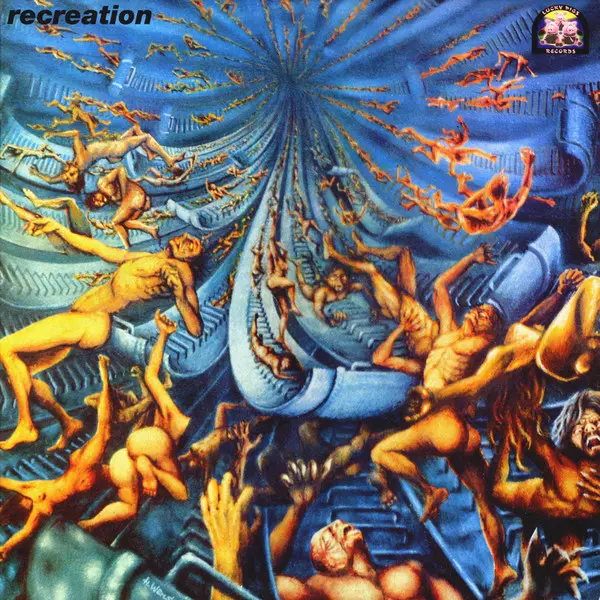 Recreation released their first album, Don’t Open, in 1970 on Triangle (Belgium). In Germany, the album appeared as a self-titled release on Bellaphon with Italian fresco cover art.
Don’t Open lurches through fuzz-toned bass patterns, go-go-bright organ-lines, and nimble backbeats.
“Burning Chapel” lurches with Hammond gasps and guttural bass distortion. “Running for Life” kicks from a cymbal-marked beat into a firmer organ-and-bass charge. “Sexual Lover” drops from its opening runs into floating organ, then erupts with vocal cries and a late reprise.
“Summer in the City” disguises the Lovin’ Spoonful contour through a slowed-down cover arrangement, floating organ, and irregular rhythmic breaks. “California Dreaming” swells from a forceful intro before it settles around the familiar vocal contour. “Reach Out, I’ll Be There” reinvents the Four Tops classic with heavy ensemble force.
A1. “Burning Chapel” (4:04)
A2. “Running for Life” (4:52)
A3. “Sexual Lover” (7:46)
B1. “Summer In the City” (6:40)
B2. “California Dreamin” (5:43)
B3. “Reach Out, I’ll Be There” (4:56)
Barclay staffer Eric Vion produced Don’t Open and wrote the stylized liner notes. Bellaphon designer Helmut Wenske procured the fresco cover, which contrasts his contemporary visual work for Jeronimo and Orange Peel.
Music or Not Music
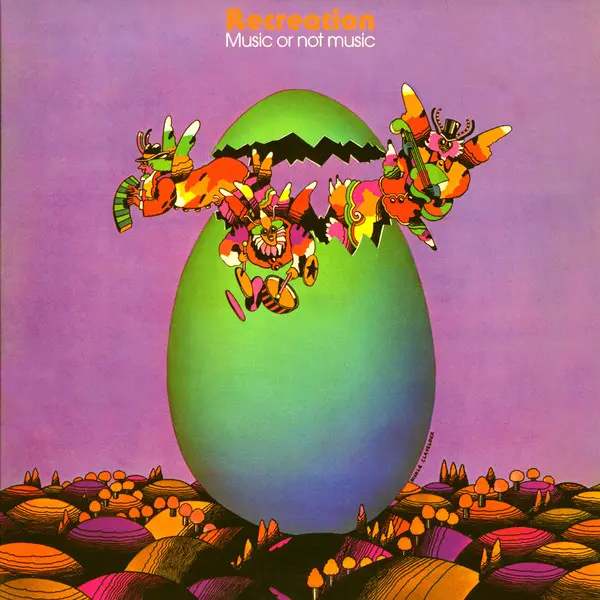 Recreation released their first album, Music or Not Music, in 1972 on Barclay.
Not Music works in short-form fragments, prankish title logic, and abrupt sectional collapse, with side-length continuity replaced by miniature episodes and sharp accent changes. Recreation group-wrote each piece with producer Eric Vion.
“Music Against Music” alternates between piano-lounge quotation and a fuzz-guitar cadenza. “Music for Your Dog” clips through a dry beat, then adds a faster bass figure and late space effects. “Where Is the Bar, Clay?” pivots from organ churn to ivory filigree.
“My Grandmother Likes Andy Williams Too” rattles through a compact ensemble riff, slips in a piano answer, and breaks for a doorbell cue. “We Don’t Like it Either” mutters processed voices over a clipped beat. “Last Train to Rhythmania” swerves from a locked opening run into piano-led acceleration, then admits samples and a late percussion break. “…And the Producer Got Mad” sets passing-car noise under a suspended organ line, then closes on a late lead. “Concerto for Elevator” drifts through samples before a tighter keyboard passage takes over.
A1. “Music Against Music” (1:59) – quotes the theme of “Strangers In the Night,” the 1966 Frank Sinatra ballad.
A2. “Music for Your Dog” (2:25)
A3. “The Night Was Clear, the Moon Was Yellow” (0:12)
A4. “Where Is the Bar, Clay?” (2:11)
A5. “Caligula’s Suite in Horror Minor” (1:37)
A6. “My Grandmother Likes Andy Williams Too” (2:20)
A7. “We Don’t Like it Either” (0:46)
A8. “Last Train to Rhythmania” (5:06)
A9. “…And the Producer Got Mad” (2:44)
B1. “Glove Story” (2:33)
B2. “Laughin’ People – Meanwhile: Starvin’ Children” (1:30)
B3. “Nothing’s Holy” (5:26)
B4. “Concerto for Elevator” (2:20)
B5. “War Business Is a Good Job” (5:12)
B6. “To End or Not to End” (1:18)
Sessions took place with Vion, credited here as Eric Van Hulse. French painter Nicole Claveloux (Zoo, Ophiucus) created Music or Not Music cover, which depicts Recreation as human/butterfly hybrids that sprout from a cracked egg with instruments in hand.
Final Single
In September 1972, Barclay issued a final Recreation single, recorded at Condorcet Studio in Toulouse.
A. “Love Forever” (3:45) – Pierre Groscolas, Roger Loubet
B. “Fallen Astronauts” (3:02) – Antonín Dvořák
Postlude
Jean-Paul Vandenbossche resurfaced in 1979 with Au Hasard des Choses, a jazz-funk album on the Belgian MD label.
Discography:
- Don’t Open [aka Recreation] (1970)
- Music or Not Music (1972)
- “Love Forever” / “Fallen Astronauts” (1972)
Sources:
Artist/Album Pages:
Coloured Balls were an Australian hard-rock band from Melbourne led by guitarist Lobby Loyde. They...
Merry Clayton (born Dec. 25, 1948) is an American soul singer from New Orleans who emerged throug...
Foghat is an English hard-rock/blues band that formed in London in 1971 and built its main recordi...
Warm Dust was an English post-psych, jazz-rock band that released the 1970 double-album And It Cam...
Martha and the Vandellas were an American soul-pop trio from Detroit, signed to the Gordy division o...
Dando Shaft was an English folk-psych band from Coventry that debuted with an album on Young Bloo...
Gloria Barnes is an American soul singer from NYC who released the 1971 album Uptown. https://ope...
The Pink Fairies were an English psychedelic hard-rock band from London that released three albums...
Peter Green (Oct. 29, 1946 – July 25, 2020) was an English blues-rock guitarist from Bethnal Green...
Gillian McPherson is an Irish singer/songwriter from Belfast who released the 1971 album Poets and...
Os Mutantes are a Brazilian samba-psych band that released five albums between 1968 and 1972 on Po...
Whistler was an English folk-rock band that released the 1971 Deram album HoHum. Members: George ...