

Spinetta Jade was an Argentine super-band that released four albums between 1980 and 1984. Anchored by namesake vocalist/guitarist Luis Alberto Spinetta, the band featured a revolving door of established and up-and-coming talent on the Buenos Aires scene. This was the frontman’s fourth major band in a decade, having earlier headed Almendra, Pescado Rabioso, and Invisible. The other constant member was drummer Héctor Pomo Lorenzo, who also played in Invisible as well as Pappo’s Blues and Los Abuelos de la Nada.
Members: Luis Alberto Spinetta (vocals, guitar), Héctor Pomo Lorenzo (drums), Beto Satragni (bass, 1980), Diego Rapoport (keyboards, 1980-82), Juan del Barrio (keyboards, 1980), Frank Ojstersek (bass, 1980-82), César Franov (bass, 1982-84), Paul Dourge (bass, 1984-85), Leonardo Sujatovich (keyboards, 1980-83), Mono Fontana (keyboards, 1984-85), Lito Epumer (guitar, 1984-85)
Background
Alma de Diamante
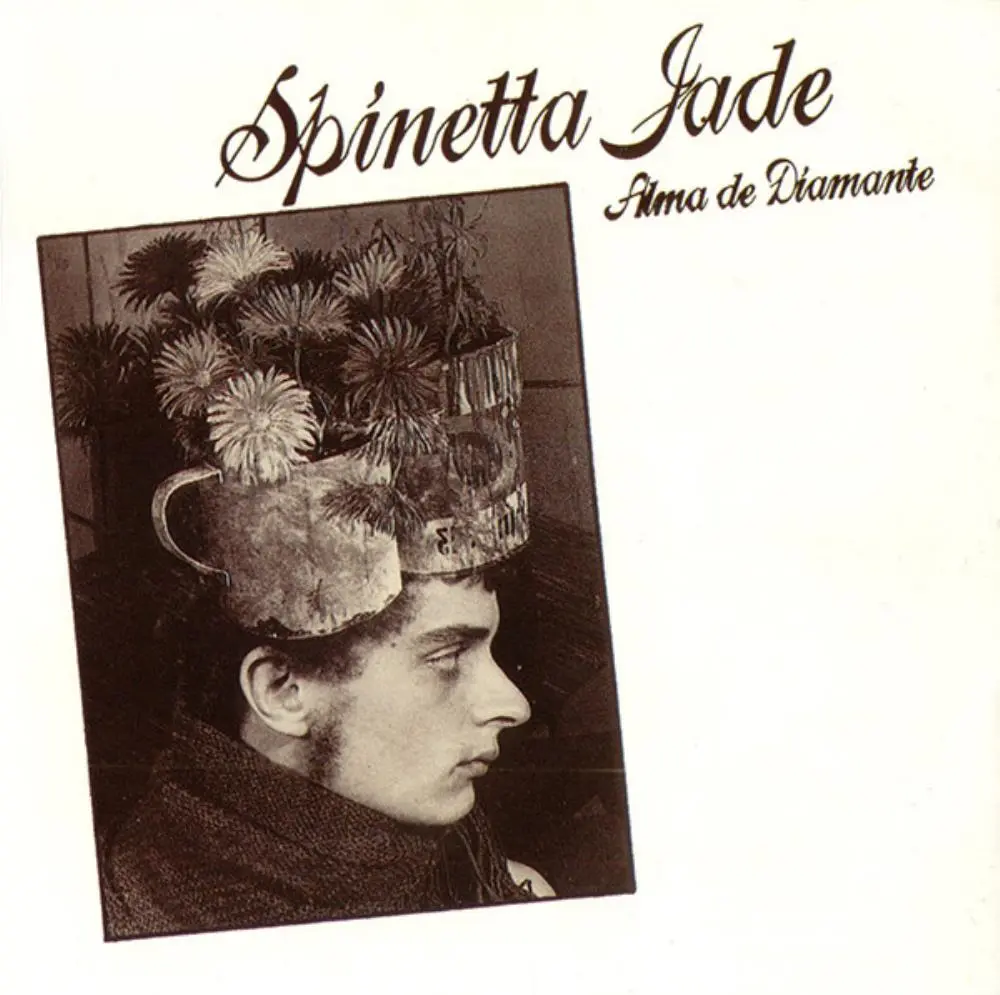 Spinetta Jade released their debut album, Alma de Diamante, in November 1980 on Ratón Finta.
The album frames a two-keyboard front line inside a jazz-rock ensemble setup, moving between vocal-led sections and extended instrumental passages with rapid handoffs between chord blocks, counterlines, and unison figures. Juan del Barrio and Diego Rapoport layer OBX-8, Minimoog, and ARP Odyssey colors against Rhodes and acoustic piano, setting up stacked voicings that open space for sudden accents and short runs. Luis Alberto Spinetta keeps the guitar integrated with the keyboard field, switching from clipped rhythmic placement to lead phrases that track the same harmonic turns, while Héctor “Pomo” Lorenzo drives the shifts with tight attack, rolling fills, and percussion detail over Beto Satragni’s steady low-end spine.
Spinetta wrote all seven tracks, shaping the set around an opening instrumental (“Amenábar”), a mid-album run of vocal pieces, and two longer instrumental centers (“Digital Ayatollah” and “Sombras en los álamos”).
Alma de diamante opens on “Amenábar” with a slow, measured pulse that lets piano, bass, and cymbal-heavy drums set a spacious grid before Mini-Moog and other synth layers start trading short figures; Spinetta’s guitar enters later with a lead that rides the same time pocket and stretches over the keyboard bed. The title track shifts to a ballad-leaning frame, starting on piano, then building toward a brighter mid-song lift where the keyboard solo caps the form.
“Dale gracias” runs a repeating keyboard motive through the length of the track, keeping the vocal line slightly behind a thickened keyboard-and-drum mass that swells and thins in waves. “Con la sombra de tu aliado (el aliado)” tightens the interlock between keyboard, bass, and guitar into a polyrhythmic weave, breaks for a prominent bass solo, then pivots into a piano/bass/drum passage before a late riff snaps the ending into focus.
“La diosa salvaje” drops into a calmer tempo with synth and drums up front, vocals entering after an extended lead-in, and later sections opening room for piano melody and improvised pockets. “Digital Ayatollah” builds in layers from a dramatic keyboard-and-guitar theme, with sharply articulated parts cycling in and out as the arrangement grows denser. “Sombras en los álamos” starts laid-back with continuous keyboard motion and a guitar lead over it, uses hard cuts between sung passages and solo sections to keep the long form moving, then turns more intense around the midpoint before settling back for the close.
A1. “Amenábar” (5:27)
A2. “Alma de diamante” [Diamond Soul] (4:35)
A3. “Dale gracias” [Give Thanks] (5:16)
A4. “Con la sombra de tu aliado (el aliado)” [With the Shadow of Your Ally (The Ally)] (4:23)
B1. “La diosa salvaje” [The Wild Goddess] (6:18)
B2. “Digital Ayatollah” (5:04)
B3. “Sombras en los álamos” [Shadows in the Poplars] (8:06)
Spinetta Jade recorded the album at Estudios ION in Buenos Aires in September–October 1980, after previewing the material live at Estadio Obras Sanitarias in August. Luis Alberto Spinetta produced the sessions with engineering by Carlos Piriz and assistant engineering by Laura Fonzo, supported by technical assistants Dery and Miguel Scalise and an equipment crew credited to Juan Carlos Blardone, Juan Ignacio Lebek, and Juan Carlos Camacho.
Horacio Fontora handled graphic design and Hidalgo Constante Boragno supplied photography, with executive production credited to Alberto Ohanian.
Los Niños que Escriben en el Cielo
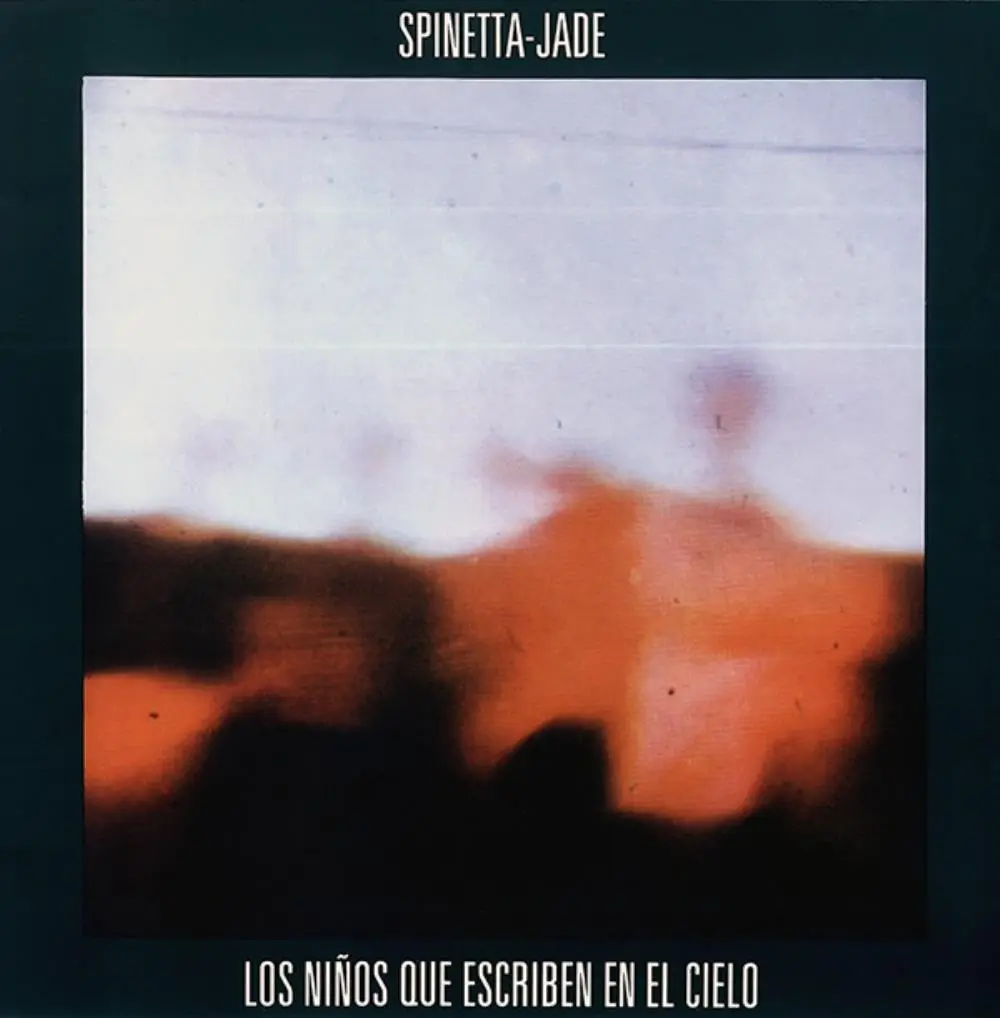 Spinetta Jade released their second album, Los Niños que Escriben en el Cielo, November 1981 on Ratón Finta.
The album sustains the band’s two-keyboard front line while shifting the center of gravity toward interlocked synthesizer voicings, Rhodes/piano figures, and quick arrangement turns that keep the guitar in tighter, more selective windows. Diego Rapoport and Leo Sujatovich stack OBX-8 and analog synth colors against Rhodes and acoustic piano, alternating lead runs with dense chord frames that steer many of the transitions. Luis Alberto Spinetta threads electric-guitar phrases through the keyboard field, then clears the texture when a song calls for a stripped acoustic focus, while Héctor “Pomo” Lorenzo drives the changes with firm attack, cymbal detail, and rolling fills over Frank Ojstersek’s steady bass line.
Spinetta wrote the full set, with arrangements credited across the working lineup (Spinetta, Pomo, Rapoport, Sujatovich, and Ojstersek), and the sequence balances two instrumentals (“Siguiendo los pasos del maestro” and “Influjo estelar”) against vocal pieces that pivot between compact forms and longer, improvisation-open frames.
Los Niños que Escriben en el Cielo (The Children Who Write in the Sky) opens with “Moviola” in a sectioned design that flips tempo and rhythm to mark each new block, letting the bass work up front while a recurring Spinetta guitar riff gains weight each time it returns. “La herida de París” slows the pace and builds its force through guitar-led figures set against thick keyboard framing, with the bass pressing hard underneath the vocal line. “El hombre dirigente” pushes the tempo back up, keeping the keyboard pair active in short bursts and layered chords while the bass stays prominent in the mix.
“Sexo” drops into a laid-back pulse where Spinetta’s guitar leans into a reggae-tilted rhythmic swing inside a denser jazz-leaning arrangement, and Rapoport’s piano break becomes the track’s clearest focal point. The instrumental “Siguiendo los pasos del maestro” turns more severe through aggressive arpeggios and growling low-end movement, then “Contra todos los males de este mundo” snaps into an uptempo, riff-centered surge with a harder rock edge and more direct vocal presence.
“Un viento celeste” starts as a spiraling keyboard introduction and opens into a long, mellow frame with extended Rapoport improvisation. “No te busques ya en el umbral (umbral)” strips back to relaxed vocals over acoustic guitar with light keyboard support, “Influjo estelar” runs as a drum-and-synth instrumental with a pronounced cadence and irregular meter, and “Nunca me oíste en tiempo” closes on a firmer beat with an elevated, solemn charge in the vocal delivery.
A1. “Moviola” (3:25)
A2. “La herida de París” [The Wound of Paris] (4:05)
A3. “El hombre dirigente” [The Leading Man] (4:24)
A4. “Sexo” [Sex] (5:44)
A5. “Siguiendo los pasos del maestro” [Following the Master’s Footsteps] (2:40)
B1. “Contra todos los males de este mundo (el antídoto)” [Against All the Evils of This World (The Antidote)] (2:59)
B2. “Un viento celeste” [A Celestial Wind] (6:45)
B3. “No te busques ya en el umbral (umbral)” [Don’t Look for Yourself at the Threshold (Threshold)] (2:22)
B4. “Influjo estelar” [Stellar Influx] (3:16)
B5. “Nunca me oíste en tiempo” [You Never Heard Me in Time] (4:35)
Spinetta Jade recorded the album in October–November 1981 at Estudios Del Cielito. Spinetta produced for Ohanian Producciones with engineering by Amilcar Gilavert and assistant engineering by Gustavo Gauvry, supported by equipment credited to Juan Carlos Camacho and technical assistance credited to Mariano López.
Sergio Pérez Fernández handled artwork and design with photography by Eduardo Martí, and Alberto Ohanian received executive-producer credit. The sessions credited a detailed equipment list across guitars, bass, drums, and keyboard rigs, including Fender and Gibson guitars with MXR Digital Delay, Ibanez bass with Audioarts Parametric EQ, Gretsch drums with Zildjian cymbals, and a keyboard/synth stack built around Rhodes, Yamaha, OBX-8, and analog synths.
Bajo Belgrano
 Spinetta Jade released their third album, Bajo Belgrano, October 1983 on Ratón Finta.
The album pares the band down to a four-piece core and shifts the center from the earlier dual-keyboard lattice toward song-shaped forms that still leave room for instrumental turns and tightly worked transitions. Keyboardist Leo Sujatovich carries the harmonic frame on acoustic and electric piano, Rhodes, and synthesizers (including Prophet V and Synergy), moving between chord blocks, short lead runs, and coloristic overlays that steer the arrangements.
Luis Alberto Spinetta threads electric-guitar phrases through that keyboard bed, then opens the texture when a track calls for direct vocal address, while bassist César Franov locks the low end with both fretted and fretless lines against Héctor “Pomo” Lorenzo’s firm pulse and quick fills. Osvaldo Fattoruso adds percussion on three tracks, placing extra rhythmic detail into the ensemble when the parts widen.
Spinetta wrote the bulk of the set and split five credits with Sujatovich, who also contributed the album’s standalone instrumental (“Ping pong”), making the record a songwriting pivot as the lineup change removed Diego Rapoport and ended the two-keyboard format.
Bajo Belgrano moves in compact song forms with keyboards foregrounded and the rhythm section kept precise, so even the lighter pieces carry dense harmony and quick internal turns. “Canción del Bajo Belgrano” sets the tone with intense chord movement and a bright keyboard surface, while “Vas a iluminar la casa” snaps in fast on a bass riff that drives the whole frame. “Maribel se durmió” lands as a stripped, lullaby-like piece with a direct emotional line, then “Vida siempre” stretches into a waltz-leaning ballad where Sujatovich’s piano holds the center and Spinetta’s guitar breaks out for a more intricate solo.
“Ping pong” runs as the album’s instrumental showcase, built on a repetitive rhythmic cycle with active synth work and a featured bass solo. “Mapa de tu amor” keeps an FM-clean synth palette over strong bass motion, “Resumen porteño” slows into a heavier vocal focus with tight keyboard voicings underneath, and “Era de uranio” opens on a striking piano introduction before shifting into a complex, charged song with difficult vocal contours and dense harmony. “Viaje y epílogo” closes by starting as a piano-led miniature and then expanding into a more forceful second half where the bass rises in prominence and the vocal delivery stretches wider across the arrangement.
A1. “Canción de Bajo Belgrano” [Song of Bajo Belgrano] (3:32) – Spinetta
A2. “Vas a iluminar la casa” [You’re Going to Light Up the House] (3:12) – Spinetta
A3. “Maribel se durmió” [Maribel Fell Asleep] (2:34) – Spinetta
A4. “Vida siempre” [Life, Always] (5:53) – Spinetta, Sujatovich
A5. “Ping pong” (4:47) – Sujatovich
B1. “Mapa de tu amor” [Map of Your Love] (4:41) – Spinetta, Sujatovich
B2. “Resumen porteño” [Buenos Aires Summary] (3:57) – Spinetta
B3. “Era de uranio” [Uranium Age] (4:21) – Spinetta, Sujatovich
B4. “Cola de mono” [Monkey Tail] (3:19) – Spinetta
B5. “Viaje y epílogo” [Journey and Epilogue] (3:58) – Spinetta, Sujatovich
Spinetta Jade recorded the album between July and September 1983 at Estudios Moebio in Buenos Aires, with Luis Alberto Spinetta producing the sessions.
On the Bajo Belgrano cover, a hazy shoreline scene stretches from a leafy park to a rocky beach, with a lone figure fishing beside the water and another sitting near the edge. The distant city skyline fades into mist under a warm orange sky. Across the foreground, ornate “Spinetta Jade Bajo Belgrano” lettering curls through dense flowers and foliage.
Madre en años Luz
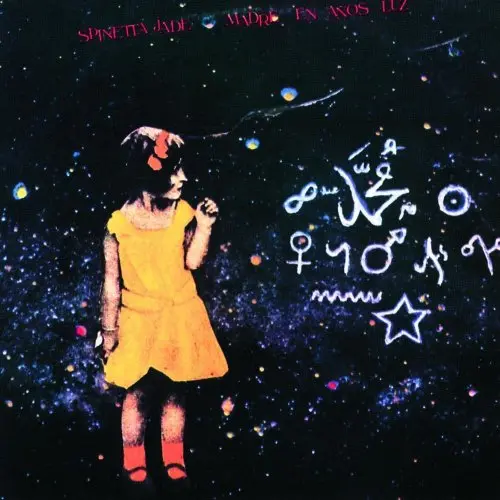 Spinetta Jade released their fourth album, Madre en años Luz, November 1984 on Interdisc.
The album shifted the band’s sound toward programmed rhythm architecture, placing an Oberheim DMX drum machine at the center of the arrangements and reducing acoustic drums to cymbal work on a single track. Juan Carlos “Mono” Fontana built the harmonic and timbral field on Yamaha grand, Yamaha DX7, OBX-8, and Moog The Source, shaping layered synth voicings and keyboard frames that carried much of the motion. Luis Alberto Spinetta threaded guitar lines through that electronic grid and handled the drum programming while César Franov held the low end, and the lineup expanded back to a quintet with Lito Epumer adding a second guitar voice and a featured closing solo. Osvaldo Fattoruso entered as a guest percussionist on two tracks and Pedro Aznar contributed programming on two tracks, reinforcing the album’s studio-built rhythmic focus.
Spinetta wrote the set, with the lone exception of the instrumental “Mula alma,” which Fontana composed, and the original LP sequencing split five tracks on side A and four on side B.
Madre en años luz (Mother in Light Years) centers the album on programmed drum patterns and keyboard color, then uses guitar as puncture and extension point when the arrangements open up. “Camafeo” sits in a clean, forward-moving song frame, while “Entonces es como dar amor” slows into a patient station-platform scene, paced by spare pulse and a restrained vocal line that keeps its weight in the last phrases.
“Amarilla flor” turns stranger on the chord choices and leans on a back-and-forth between the electronic beat and Fontana’s keys, and “Este es el hombre de hielo” jumps in with a frenetic machine entry that pushes a colder, futurist surface under a narrative lyric. “¿No ves que ya no somos chiquitos?” holds a wide, floating atmosphere with Fontana alone under the vocal, then “Ludmila” snaps the record into an irregular but continuous 5/4 cycle—arpeggiated guitar over a near-pedal bass, the title-name shouted as a distant call, and a mid-song keyboard figure that resets the center of gravity.
Side B keeps the motion but shifts the storytelling: “Enero del último día” runs as a zamba-paced vignette with timbaletas and a closing Epumer lead line, “Mula alma” carries Fontana’s chacarera-based instrumental with an attractive, steady contour, and “Diganlé” expands to the longest form, stacking surreal text over the programmed frame before it releases into an extended Epumer solo, with Lorenzo only entering on cymbals.
A1. “Camafeo” [Cameo] (3:52) – Spinetta
A2. “Entonces es como dar amor” [Then It’s Like Giving Love] (5:15) – Spinetta
A3. “Amarilla flor” [Yellow Flower] (3:12) – Spinetta
A4. “Este es el hombre de hielo” [This Is the Ice Man] (3:41) – Spinetta
A5. “¿No ves que ya no somos chiquitos?” [Don’t You See We’re Not Little Kids Anymore?] (2:15) – Spinetta
B1. “Ludmila” (3:48) – Spinetta, Sujatovich
B2. “Enero del último día” [January of the Last Day] (3:41) – Spinetta
B3. “Mula alma” (3:42) – Fontana
B4. “Diganlé” [Tell Them] (6:36) – Spinetta
Spinetta Jade recorded the album in October 1984 at Estudios Moebio in Buenos Aires, with Luis Alberto Spinetta producing the sessions, and the release was noted as the first Argentine album cut from a digital master.
Carlos Mayo handled graphic design, while the cover and back-cover images drew from serigraphs by Sixto Caldano, and the yellow inner sleeve carried song lyrics and technical notes written by philosopher Alejandro Rozitchner. Interdisc issued “Ludmila” backed with “Entonces es como dar amor” as the album’s single.
Discography:
- Alma de Diamante (1980)
- Los Niños que Escriben en el Cielo (1981)
- Bajo Belgrano (1983)
- Madre en años Luz (1984)
Sources:
Artist/Album Pages:
Mezzoforte are an Icelandic jazz-funk band that released thirteen studio albums between 1979 and 2...
Cozy Powell (Dec. 29, 1947 — April 5, 1998) was an English rock drummer who emerged in the early 1...
Sharon Redd (1945–1992) was an American soul-funk singer who served in Bette Midler's backing trio...
Renaissance are an English rock band that released eleven studio albums between 1969 and 1983. The o...
Rare Silk was an American vocal-jazz group behind the 1983 Polydor release New Weave, followed by...
Doe Maar was a Dutch ska and reggae-pop band formed in 1978 by keyboardist–singer Ernst Jansz, bas...
Atmosfear was an English funk band from London that released the 1981 MCA album En Trance and scor...
Mai Yamane — 山根麻以 (Oct. 9, 1958) — is a Japanese singer, pianist, and songwriter who emerged in 19...
Mondo Rock was an Australian pop/rock supergroup that debuted with the 1979 Oz Records release Prima...
Krzak was a Polish blues-rock band from Katowice. Between 1979 and 1981, they released three short...
Paul McCartney (born June 18, 1942) is an English pop-rock singer, bassist, and songwriter from Li...
Cos was a Belgian avant-jazz-rock band that released four albums on IBC between 1974 and 1979, fol...