

Anglo-Saxon Brown was an American soul-funk band that released the 1976 Atlantic album Songs for Evolution. The members cut four earlier singles as Ujima and later made another album as Silk.
Members: Debra Henry (vocals), Dwight Smith (keyboards, vocals), Clemente Burnette (vocals, guitar), Tyrone Durham (drums), Alvin Brown (trumpet, flugelhorn, trombone), Charles Manns (saxophone), Carlton Robinson (bass), Joe Jefferson (keyboards), Larry Washington (percussion)
Background
Anglo-Saxon Brown evolved from Ujima, the outgrowth of Brother Love, a Virginia group active by 1971 on the Richmond R&B circuit. Ujima included bassist-vocalist Carlton Robinson, keyboardist Dwight Smith, saxophonist Charles Manns, trumpeter Alvin Brown, and guitarists Clemente Burnette and David Eugene Brown.
Ujima Singles
Epic signed Ujima in mid-1973 after Alpha Audio owner-producers Nick Colleran and Eric Johnson took on the group under Johnson’s management. In October, Epic issued the debut Ujima single: “I’m Gettin’ Hip (To Your Ways & Actions),” a Dwight Smith original backed with an instrumental version.
A. “I’m Gettin’ Hip (To Your Ways & Actions)” (2:13) — Vocal version with Smith’s keyboard flourishes driving Henry’s lead.
B. “I’m Gettin’ Hip (To Your Ways & Actions)” (2:13) — Instrumental take emphasizing Manns’ sax runs.
In March 1974, Ujima released “She’s Gone,” a Daryl Hall/John Oates cover backed with “Somebody Tell That Girl I’m Gone,” another Smith original.
A. “She’s Gone” (2:53) — Henry’s vocals glide over Smith’s piano against Manns’ sax accents.
B. “Somebody Tell That Girl I’m Gone” (2:38) — Smith’s number with urgent horn stabs and Burnette’s guitar riffs.
 In late 1974, Ujima added vocalist Debra Henry, who leads their February 1975 third a-side “A Shoulder to Lean On,” written and co-produced by Philadelphia songwriters Phil Hurtt and Anthony “Tony” Bell. Carlton Robinson leads the flipside, “I’m Not Ready,” a David Brown original.
A. “A Shoulder to Lean On” (3:28/5:22) — string-laden intro/chorus theme (in C) with moderate funky verses (in Am) that showcase Debra’s soaring, emotive delivery.
B. “I’m Not Ready” (3:03) — energized string/brass arrangement and rhythmic churn usher trade-offs between Robinson belted leads and Smith’s Kendricks-like high-register counter-lines.
Ujima parted from Epic as sessions proceeded at at Alpha Audio, where Smith produced a tentative album, including the originals “Maybe,” “All I Want Is You,” “Sad Sad Love,” “Happy Daze,” and “Blind Leading the Blind,” plus covers of Eddie Kendricks (“Tell Her Love Has Felt the Need”), Sly Stone (“Loose Booty”), and Wings (“My Love”). In 2025, Numero Group recovered the tapes and issued the eight songs as Collective Works.
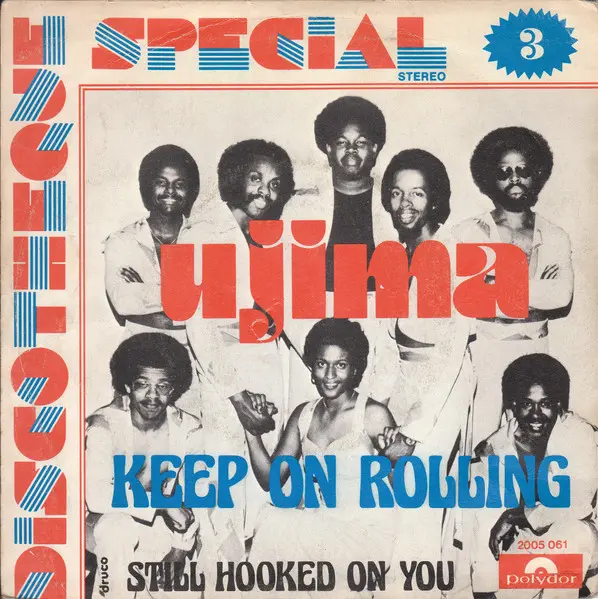
Meanwhile, the LA-based small-press Roxbury issued the final Ujima single: “Keep On Rolling,” a Smith–Burnette number backed with the Brown contribution “Still Hooked On You,” both co-produced by Smith, Johnson, and Colleran. In Europe, the single appeared in March 1976 on Chelsea Records.
A. “Keep On Rolling” (3:40) — Burnette and Smith’s track drives with funky guitar and keyboard interplay.
B. “Still Hooked On You” (3:40) — Brown’s soulful cut with Henry’s vocals over Manns’ sax layers.
Meanwhile, Philadelphia songwriter-producer Joe Jefferson had approached Ujima in 1975 and brought the group into a partnership with songwriter-producer Charles Simmons. Jefferson subsequently secured an Atlantic deal, where the musicians adopted the name Anglo-Saxon Brown.
Songs for Evolution
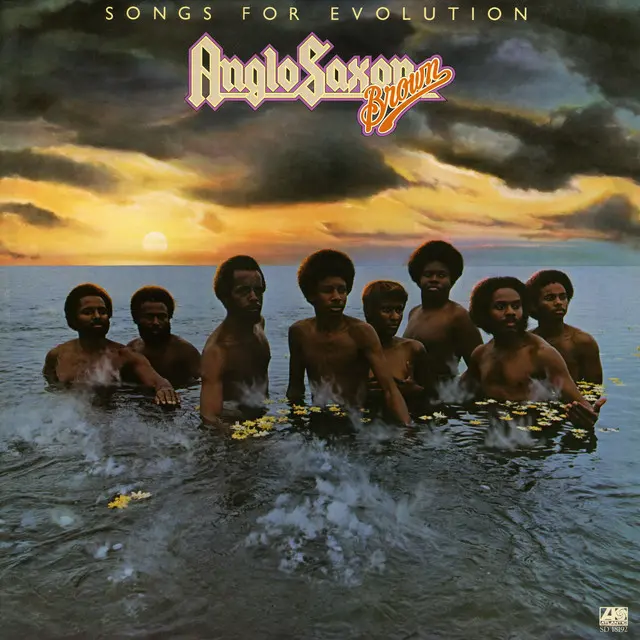 Anglo-Saxon Brown released their singular album, Songs for Evolution, in September 1976 on Atlantic Records.
The album delivers lush Philly soul with funk undercurrents through Debra Henry’s vocal leads and Dwight Smith’s Yamaha grand piano and ARP Odyssey textures. Clemente Burnette strums guitar riffs, Anthony Ingram adds lead guitar bites, Carlton Robinson thumps bass walks, Tyrone Durham snaps drum paces, Charles Manns layers alto, soprano, and tenor sax runs, Alvin Brown weaves trumpet, trombone, and flugelhorn lines, and Larry Washington scatters conga and bongo rolls. Joe Jefferson’s clavinet and Rhodes electric piano frame the sound.
Tracks split between uptempo disco-funk and tender soul ballads. “Gonna Make You Mine” opens with six minutes of dancefloor drive, Henry’s vocals soaring over Jefferson’s clavinet and Manns’ sax bursts. “Straighten It Out” tightens into a funky plea, Burnette’s guitar locking with Durham’s drum kicks. “A S B Theme” struts as a band showcase, Robinson’s bass pulsing beneath Brown’s horn stabs. “The Man I Love” sways in ballad mode, Henry’s phrasing gliding over Smith’s piano chords. “Call On Me” blends two-step rhythms with soul lifts, its vocal harmonies circling Manns’ sax lines.
A1. “Gonna Make You Mine” (6:26) — Jefferson, Simmons
A2. “Straighten It Out” (4:58) — Jefferson, Simmons
A3. “A S B Theme” (5:38) — Robinson
A4. “The Grizzly” (5:10) — Robinson
B1. “Disco Music” (6:27) — Roebuck
B2. “The Man I Love” (4:45) — Jefferson, Simmons
B3. “Call On Me” (5:38) — Jefferson, Simmons
B4. “I’ll Keep Lovin’ You” (5:41) — Jefferson, Simmons
Sessions occurred at Sigma Sound Studios in Philadelphia with producers Joe Jefferson and Charles Simmons, chief engineers Jay Mark and Jim Gallagher, and assistant engineers Art Stoppe, Carla Bandini, Jeff Stewart, and Michael Hutchinson.
Atlantic Records issued “Straighten It Out” (b/w mono version, catalog unlisted) as a 1976 single. “Call On Me” gained traction in London’s modern soul and reggae scenes in the late 1980s via South London’s Rock To Rock Radio.
Postlude
Anglo-Saxon Brown morphed into Silk in 1978, swapping Carlton Robinson for bassist Melvin Watson while retaining Debra Henry, Dwight Smith, Clemente Burnette, Tyrone Durham, Alvin Brown, and Charles Manns. Silk released Midnight Dancer on Philadelphia International Records in 1979, yielding the minor hit “I Can’t Stop Turning You On.”
Discography:
- Songs for Evolution (1976)
Sources:
Artist/Album Pages:
The Isley Brothers were an American soul-funk band from Cincinnati that first performed doo-wop in...
The Kay-Gee's were an American soul-funk band behind the 1974–76 Gang Records albums Keep on Bumpi...
Todd Rundgren (born June 22, 1948) is an American vocalist, songwriter, multi-instrumentalist, ban...
Faze-O was an American soul-funk band that released three albums between 1977 and 1979 and scored ...
Afrique was a studio-funk band assembled in Los Angeles by mostly American musicians for the 1973...
Universal Jones was an American soul-funk band that released the 1972 album Vol. 1 on MGM, produc...
Ollie Baba was an American soul-funk band that released a 1978 self-titled album on Polydor. Mem...
Wax was an American soul-funk septet that released the 1980/81 RCA albums Wax Attack and Do You Be...
The Blackbyrds were an American soul-funk band from Washington, D.C., named after the 1973 album b...
The Best of Both Worlds were an American soul-funk band from Washington, D.C., that released the a...
Newban was an American soul-funk band that released two albums on the tax-scam Guinness label in 1...
The Meters were an American funk band from New Orleans that released three albums on Josie Records...