

Octopus was a German symphonic-rock band fronted by Jennifer Hensel. On Sky Records, they made the 1977–79 albums The Boat of Thoughts, An Ocean of Rocks, and Rubber Angel. Post-Hansel, they cut the 1981 Rockport release Hart am Rand.
Members: Claus D. Kniemeyer (bass), Pit Hensel (guitar, 1973-78), Werner Littau (keyboards, 1973-81), Jennifer Hensel (vocals, 1973-80), Dieter Becke (drums), Frank Eule (drums), Sepp Niemeyer (drums, 1977-81), Winfried Kowallik (guitar, 1978-80), Doris Tangel (vocals, 1980), Alex Rodman (guitar, 1980), Georg Klivinyi (guitar, 1980-83), Michael Stein (vocals, 1980-83)
Inception
Octopus formed in 1972 at the University of Frankfurt where bassist–lyricist Claus D. Kniemeyer and drummer Dieter-Paul Becke teamed with the husband-wife pair of guitarist Pit Hensel and vocalist Jennifer (née Capell). Their notice on the campus bulletin board keyboardist–composer Werner Littau. The band developed an originals repertoire and made their live debut on November 20, 1973, in Ranstadt.
In spring 1974, they on-boarded second keyboardist Hans-Paul Seiler, whose arsenal of Mellotron and Fender Rhodes enhanced the early Octopus setlist staples “Time In My Hands,” “The Shadow of Your Smile,” “Son of Sorrow,” and the Moody Blues cover “Nights In White Satin” — each showcasing Jennifer’s deep, androgynous vocal command. On October 24, they floored an audience of 7,500 at the Philipshalle in Düsseldorf as part of an Oktoberfest ’74 concert event. Further songs from this period include “Judgement Day,” “Zipoli,” and “World of Cruelty.”
Becke asserted himself with the instrumental piece “Slight Delay,” but quit before the new year. Drummer Ulrich Faust stepped in before Frank Eule took the reigns just before the band’s mid-1975 collapse. By early 1976, Octopus reconvened as a quintet comprised of Kniemeyer, Littau, Eule, and the Hensel’s.
The Boat of Thoughts
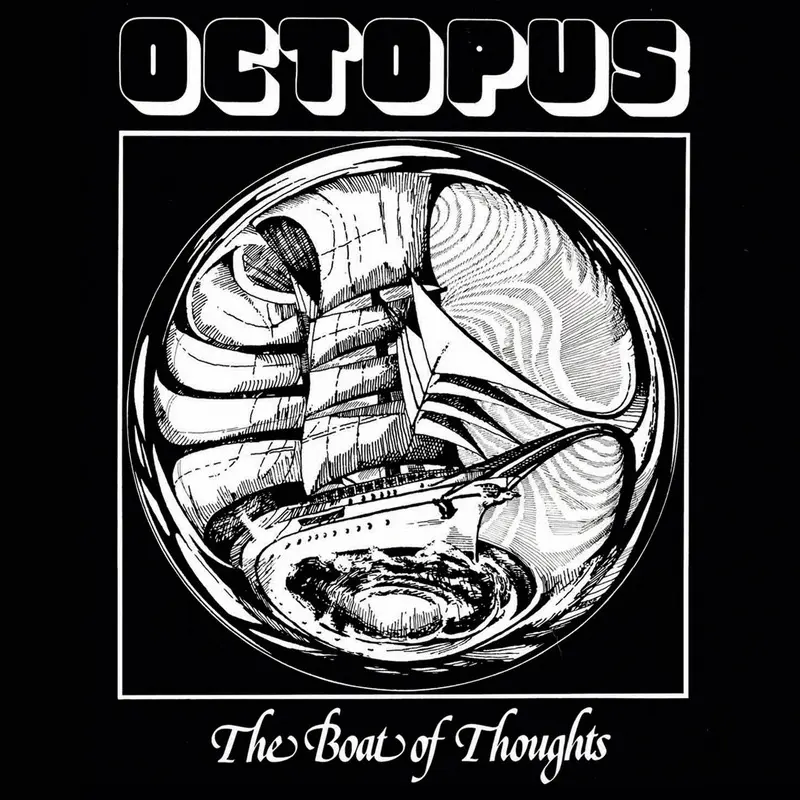 Octopus released their debut album, The Boat of Thoughts, in March 1977 on Sky.
The album alternates between atmospheric passages and riff-based sequences shaped by the interaction between guitarist Pit Hensel and keyboardist Werner Littau, who splits duties across organ, Moog, piano, Mellotron, and string ensemble textures. Jennifer Hensel dominates throughout with bold phrasing across the shifting instrumental terrain.
The Boat of Thoughts opens with “The First Flight of the Owl,” which frames sharp guitar themes within a shifting instrumental arc: an initial 2½-minute buildup recurs to bookend the piece, with intervening sections that trade vocal declarations against surging bass and cycling synth lines. “Kill Your Murderer” runs on sustained organ and mellotron pressure, broken by alternating passages of guitar lead and vocal delivery; its middle stretch settles briefly into calm before a drawn-out guitar solo pulls the track toward closure. “If You Ask Me” builds more gradually, with isolated guitar phrasing above mid-tempo drum patterns, later joined by organ fills that accent the vocal lines.
“The Delayable Rise of Glib” opens on keyboard focus, cycling between organ and Moog until the vocal entry redirects its structure toward chordal emphasis. “We’re Losing Touch” shifts between rhythmic drive and textural overlays, incorporating low-register synth patterns and suspended guitar lines before ending on a coiled, percussion-led fadeout. The closing title piece begins on acoustic guitar over deep drum resonance, pivots into electric piano and solo guitar phrasing, then collapses into a broad mellotron surge before darkening into a slow-tempo, organ-heavy resolution. Across the album, keyboardist Werner Littau layers organ, Moog, and Mellotron in dynamic opposition and alignment with guitarist Pit Hensel, whose phrasing alternates between clipped attack and sustained solo figures.
A1. “The First Flight of the Owl” (5:09) – P. Hensel
A2. “Kill Your Murderer” (6:09) – P. Hensel
A3. “If You Ask Me” (6:06) – Littau
B1. “The Deleyable Rise of Glib” (3:18) – P. Hensel, Littau
B2. “We Are Loosing Touch” (5:49) – Littau
B3. “The Boat of Thoughts” (8:58) – P. Hensel, Littau
Octopus recorded the album in 1976 at Tonstudio Hiltpoltstein with engineer Manfred Neuner. The band self-produced the sessions and handled arrangements internally. Neuner worked in sequence on albums by Aera, Bullfrog, Cry Freedom, Pancake, and Second Movement.
Visual design credits go to Hase Design and Marlis Scharff-Kniemeyer, whose swirling black-and-white illustration frames a sailing ship caught in a whirlpool-like spiral. The warped horizon and contoured waves evoke movement through a dream or mindspace, aligning with the album’s introspective title.
After this album, Frank Eule cleared for drummer Sepp Niemeyer of folksters Emma Myldenberger.
An Ocean of Rocks
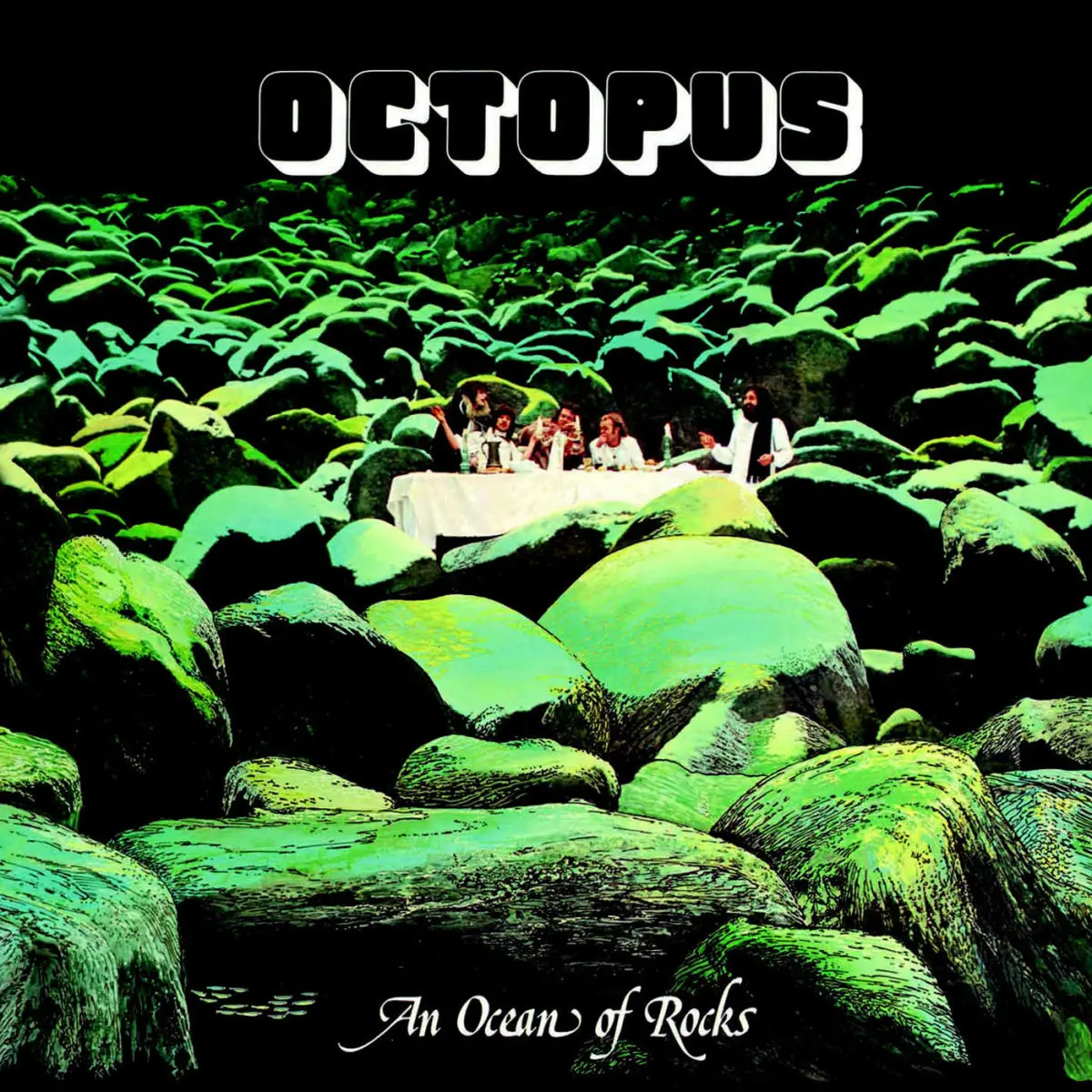 Octopus released their second album, An Ocean of Rocks, in April 1978 on Sky.
Guitarist Pit Hensel and keyboardist Werner Littau extend their instrumental presence across longer forms, shaping side-length contrast with layered textures and thematic interplay. Littau alternates between sustained pads and tonal runs while Hensel counters with clipped phrasing and gradual scalar development.
An Ocean of Rocks balances multi-layered organ and synth arrangements with bursts of guitar-led intensity, shifting between restrained pacing and sudden tonal surges. “Start the Music” builds from tight vocal–guitar exchanges into a layered instrumental section driven by organ phrasing. “Son of Sorrow” alternates vocal refrains and pulsing keyboard passages with extended guitar solos spaced across its structure. “The Shifting of Space and Time” drifts into spacious intervals before locking into a steady mid-tempo pulse under organ sustain. “An Ocean of Rocks” closes on a tightly wound, upbeat sequence where guitar and organ push forward in tandem across a narrowed dynamic arc.
A1. “Start the Music” (3:52) – P. Hensel
A2. “On My Mind” (5:43) – Littau
A3. “Son of Sorrow” (6:32) – Littau
A4. “The Delayable Rise of Glib, Part 2” (3:43) – P. Hensel
B1. “The Entrance” (2:26) – P. Hensel
B2. “The Shifting of Space and Time” (5:37) – Littau
B3. “Octopus – The Survivor of Atlantis” (7:16) – Littau
B4. “An Ocean of Rocks” (6:02) – P. Hensel
Octopus self-produced the album between January 12 and 17, 1978, at Tonstudio Hiltpoltstein with engineer Manfred Neuner and assistant Ralf Haupt.
Like its predecessor, An Ocean of Rocks features design and photography by M. Scharff, who placed the band mid-meal at a long white table nestled among a surreal landscape of oversized, sea-slick boulders rendered in saturated greens. The image merges natural density with absurd placement, evoking isolation and theatrical contrast.
In late 1978, Pit Hensel left Octopus and later relinked with Eule in the band Memphis, which made a 1982 self-titled album on X Records. The Hensel’s soon divorced though Jennifer retained Pit’s surname for the time being. Octopus continued with guitarist Winfried Kowallik, who eventually became Jennifer’s new personal partner.
Rubber Angel
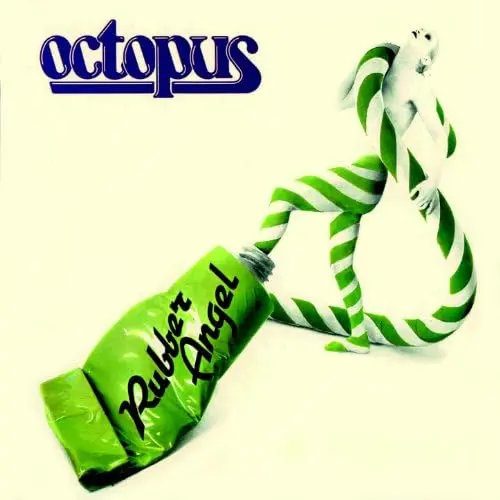 Octopus released their third album, Rubber Angel, in 1979 on Sky.
Guitarist Winfried Kowallik and keyboardist Werner Littau exchange tight lead figures across the album’s compact song structures, layering bright runs and accent stabs in close sequence. Littau alternates between keyboard textures while Kowallik applies clipped phrasing and short-tone passages, both working within dense, upbeat frameworks.
Littau adds continued bursts of Hammond but leans more heavily on polyphonic synth layers, which shape the album’s tonal character. On “The Roly-Poly Bumble-Bee,” Kowallik shifts to 12-string, threading clean arpeggios between Littau’s more exploratory synth voicings. The piece stretches their usual format into a freer, more spacious frame, allowing both players to expand and contrast their roles.
A1. “Too Hard to Love You” (3:56)
A2. “Stampede” (3:25)
A3. “Plastic Dreams” (4:34)
A4. “Outside, so Far Away” (4:20)
B1. “Cross-Eyed Cat” (3:26)
B2. “Black Points” (3:37)
B3. “City Life” (3:58)
B4. “The Roly-Poly Bumble-Bee” (5:57)
Octopus recorded and mixed the album in 1979 at Soundhouse Frankfurt with Jochen Wenke, who handled production, engineering, and final mixdown.
The cover depicts a faceless figure wrapped in green-striped coil, squeezed from a tube labeled Rubber Angel, set against a stark white backdrop.
Discography:
- The Boat of Thoughts (1977)
- An Ocean of Rocks (1978)
- Rubber Angel (1979)
- Hart am Rand (1981)
Sources:
Artist/Album Pages:
The Sylvers were an American soul-funk family act from Memphis, best known for the 1975/76 hits "B...
Limey was an English rustic-rock band that cut an eponymous 1975 album on RCA. Guitarist–singer Bria...
Strife was an English hard-rock band that released the 1975 Chrysalis album Rush, followed by the ...
Dr. Music was a Canadian jazz-rock/soul collective from Toronto that released three albums from 19...
Sunbear was an American jazz-funk/soul duo that released a self-titled album on Soul Train Records...
Minotaurus was a German symphonic-rock band that self-released the 1978 album Fly Away. Members:...
Gina X Performance was a German electronic project led by Gina Kikoine and producer Zeus B. Held, ...
Kill Devil was an American rustic-rock band from Merrifield, Virginia, that issued the 1977 priva...
Chick Corea (June 12, 1941 – Feb. 9, 2021) was an American jazz pianist, composer, and bandleader ...
Zafer Dilek (August 30, 1944 — December 11, 2025) was a Turkish musician, composer, and arranger w...
Brân was a Welsh-language rock group active from 1974 through 1979. The group issued a four-song E...
Billy Joel is an American pianist, singer, and songwriter from the Bronx who released the album Co...