

Steve Marcus (September 18, 1939 — September 25, 2005) was an American tenor saxophonist from New York City.
He helped pioneer electric jazz with his albums Tomorrow Never Knows (1968), Count’s Rock Band (1968), and The Lord’s Prayer (1969), which recast pop and rock songs with improvisational saxophone over guitar-driven rhythm sections.
His electric tone and modal phrasing on “Eight Miles High,” “Rain,” and “Hey Jude” prefigured jazz-rock fusion. Later collaborations with Sonny Sharrock, Miroslav Vitous, and Jiro Inagaki further expanded his reach into avant-garde and international jazz hybrids.
Background
Steve Marcus was raised in a musical household and first aspired to play guitar. Finding no instructor, he took up clarinet and switched to saxophone at 15. In 1962, while studying at Berklee School of Music, he was tapped by bandleader Stan Kenton to fill in for absent saxophonist Charlie Mariano. Impressed by Marcus’ sight-reading and tone, Kenton hired him full-time within weeks. Marcus remained until Kenton disbanded the orchestra in late 1963, after which he toured with Woody Herman and Gary Burton. By 1966, Marcus was working with flautist Herbie Mann during the latter’s initial forays into global and rock-influenced jazz.
Marcus formed his own electric combo in 1967 under the Herbie Mann umbrella, collaborating with guitarist Larry Coryell (b. April 2, 1943; Galveston, Texas), drummer Bob Moses (b. January 28, 1948; New York City), pianist Mike Nock (b. September 27, 1940; Christchurch, New Zealand), and bassist Chris Hills (b. c. 1946; New York). Coryell, a graduate of the University of Washington and a founding member of The Free Spirits, had drawn attention for his work in the Gary Burton Quartet. Moses, a teenage prodigy and former student of Jim Chapin, brought a fluid, open-ended time feel. Nock had studied at Berklee and played with Yusef Lateef. Hills, a multi-instrumentalist, had roots in R&B and studio work.
This lineup debuted informally on the New York club circuit and was signed by Atlantic subsidiary Vortex Records, which positioned Marcus as bandleader under the name Steve Marcus and the Count’s Rock Band. Their earliest studio output included extended renditions of rock and pop material.
Tomorrow Never Knows
 Steve Marcus released his debut album, Tomorrow Never Knows, in February 1968 on Vortex Records.
The album fuses contemporary rock themes with modal improvisation, showcasing Marcus’ early integration of electric jazz textures. Working with a young Larry Coryell, Marcus reimagines late-’60s pop material as extended frameworks for exploratory interplay. The set bypasses original compositions (except one) in favor of reconstructions of recent rock staples, performed in unbroken sequence on each LP side.
Marcus plays both soprano and tenor saxophone in leading voice roles across all six tracks. Guitarist Larry Coryell serves as the primary counterforce, using distortion and sustain to destabilize and color the harmonic field. Mike Nock, on acoustic piano, offers scalar movement and chordal punctuation. The rhythm section comprises bassist Chris Hills and drummer Bob Moses, whose work favors open time and buoyant elasticity.
Marcus arranged five covers, drawing from The Byrds (“Eight Miles High”), Donovan (“Mellow Yellow”), Herman’s Hermits (“Listen People”), and two Lennon–McCartney numbers: “Rain” and “Tomorrow Never Knows.” The only original, “Half a Heart,” comes from vibraphonist Gary Burton, Marcus’ former bandleader.
Side A opens with terse soprano bursts and a flanged rhythmic churn on “Eight Miles High,” which contracts into the slurred, descending phrases of “Mellow Yellow.” “Listen People” presents a brief reflective pause before “Rain” stretches its central theme into a dynamic arc, moving from limpid exposition to a spiraling conclusion. The title track fills all of side B with intensifying tenor phrases over a circular vamp, culminating in a polyrhythmic acceleration. The album closes on “Half a Heart,” where phrased themes and clipped cymbal patterns settle into a measured resolution.
A1. “Eight Miles High” (4:44)
A2. “Mellow Yellow” (4:50)
A3. “Listen People” (2:25)
A4. “Rain” (7:02) — originated as a 1966 b-side by The Beatles, written by Lennon–McCartney; noted for reverse tape effects and layered harmonies
B1. “Tomorrow Never Knows” (11:07) — originated as a 1966 Beatles track, written by Lennon–McCartney; based on a one-chord drone and tape loops
B2. “Half a Heart” (5:21) — composed by Gary Burton
Sessions occurred on October 31, 1967, at Atlantic Studios in New York City with producer Herbie Mann and engineer Adrian Barber.
Tomorrow Never Knows features cover art by Haig Adishian with photography by Tom Zimmermann. The original pressing appeared on purple-label Vortex, catalog no. SD 2001.
Gerry Rafferty appropriated the “Half a Heart” saxophone riff in his 1978 hit “Baker Street.”
Count’s Rock Band
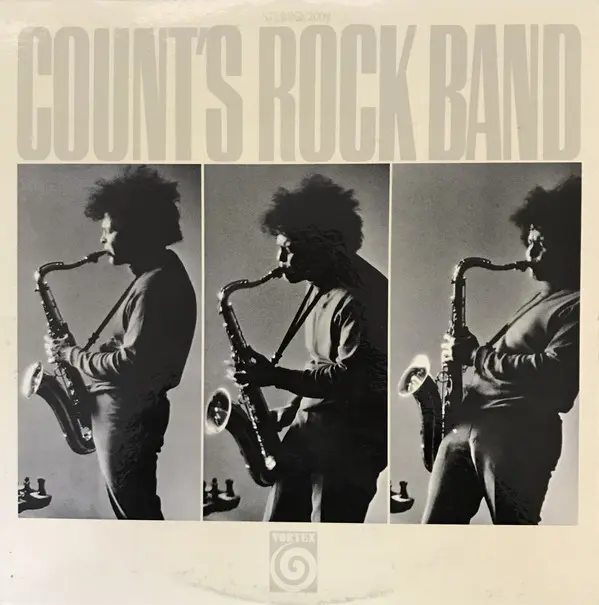 Steve Marcus released his second album, Count’s Rock Band, in October 1968 on Vortex Records.
The album builds on the fusion approach of Tomorrow Never Knows with longer forms and more open-ended improvisation. Marcus expands his tonal palette with electric saxophone, while Larry Coryell increases the distortion quotient. The record foregrounds rhythmic abandon and group interaction over song structure, marking a further step into avant-garde territory.
Marcus plays soprano, tenor, and electric saxophone in the lead voice role. Coryell’s guitar assumes a more central presence with frequent use of overdrive and feedback. Mike Nock alternates between piano and harpsichord, while Chris Hills handles both electric bass and rhythm guitar, anchoring or doubling textures. Bob Moses maintains a loose rhythmic pulse, and Chris Swansen contributes percussion and arrangement support. Accordionist Dominic Cortese appears briefly.
Chris Hills composed two extended jams: “Theresa’s Blues” and “Ooh Baby.” Additional material comes from Chris Swansen (“C’est Ça”) and covers of Simon & Garfunkel’s “Scarborough Fair” and the Rolling Stones’ “Back Street Girl.”
“Theresa’s Blues” opens the set with unmetered guitar tremors and upper-register sax phrases before stabilizing into an elastic blues form with eruptive breaks and stretches of free interaction. “Scarborough Fair” reworks the Simon & Garfunkel ballad as a fleeting modal interlude. The second side opens with “Ooh Baby,” which alternates between clustered ensemble figures and limber solo episodes. “Back Street Girl” closes the album with sustained organ-like tones from electric saxophone over a rubato piano base, contrasting the preceding material. The interspersed “Drum Solo,” “C’est Ça,” and “Piano Solo” serve as transitional fragments between the longer pieces.
A1. “Theresa’s Blues” (12:19)
A2. “Scarborough Fair” (2:39) — originated as a 1966 track by Simon & Garfunkel, adapted from a traditional English ballad
A3. “Drum Solo” (0:35)
B1. “Ooh Baby” (12:14)
B2. “C’est Ça” (0:19)
B3. “Back Street Girl” (5:46) — originated as a 1967 track by The Rolling Stones, written by Jagger–Richards; a chanson-style ballad from Between the Buttons
B4. “Piano Solo” (0:51)
Sessions occurred from May 9–15, 1968, at Atlantic Studios in New York with producer Herbie Mann and engineer Adrian Barber.
Count’s Rock Band features photography and cover design by Tom Zimmermann. It appeared on Vortex Records (distributed by ATCO) with initial pressings manufactured by Presswell.
The Lord’s Prayer
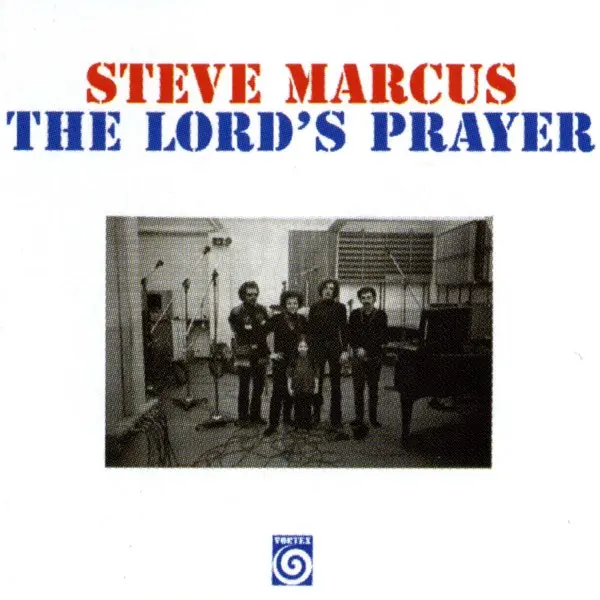 Steve Marcus released his third album, The Lord’s Prayer, in 1969 on Vortex Records.
The album blends electric jazz textures with third-stream and sacred elements, introducing choral arrangements and orchestration alongside amplified solos. Marcus relinquishes some improvisational space in favor of layered ensemble settings and vocal features, further expanding his stylistic reach beyond the freer contours of his earlier albums.
Marcus plays both tenor and soprano saxophone, and also contributes guitar on select cuts. Herbie Hancock anchors the harmonic foundation on acoustic and electric piano, alternating between modal comping and pointillistic runs. Miroslav Vitous handles most bass duties, joined by Ed Xiques on additional low-end parts. Bob Moses resumes his role as primary drummer, with Larry Clark adding secondary percussion and taking lead vocals on three tracks. Chris Swansen arranges and conducts the horn and string ensemble, with contributions from Jack and Dave Gale on trumpet and trombone.
The program includes four covers: “Hey Jude” (Lennon–McCartney), “Just Like Tom Thumb’s Blues” (Bob Dylan), “Wild Thing” (Chip Taylor), and “America” (a brief vocal fragment). The remaining titles—“Amy” (Moses), “Hope” (Vitous), “T. With Strings” (Swansen), and “The Lord’s Prayer” (arr. Marcus)—form a suite of contemplative instrumentals, most in rubato or slow time.
“Hey Jude” unfolds in two parts, beginning with a symphonic statement of the main theme led by sax and vocal, then dissolving into a loosely timed improvisation over electric piano figures. “Amy” alternates between sparse soprano lines and chordal density before expanding into free motion. “T. With Strings” places saxophone in dialogue with sustained string clusters. “Hope” develops slowly over nearly eleven minutes, building from bowed bass to full-group catharsis. “The Lord’s Prayer” closes the album in hymn-like cadence, with layered harmonies and final saxophone declamation.
A1. “Hey Jude (Part 1 & 2)” (8:23) — originated as a 1968 single by The Beatles, written by Lennon–McCartney; extended coda adapted for ensemble and vocal
A2. “Amy” (7:57)
A3. “Just Like Tom Thumb’s Blues” (1:02) — originated as a 1965 track by Bob Dylan; features abbreviated vocal setting
A4. “T. With Strings” (2:06)
B1. “Wild Thing” (2:23) — originated as a 1966 hit by The Troggs, written by Chip Taylor
B2. “Hope” (10:45)
B3. “America” (0:35)
B4. “The Lord’s Prayer” (4:42)
Sessions for “Hey Jude,” “Amy,” “T. With Strings,” and “Hope” occurred at Apostolic Recording Studios, New York. All other selections were recorded at Atlantic Studios, New York, with producers Herbie Mann and engineers Adrian Barber and Dave Baker.
The Lord’s Prayer features cover design and tenor saxophone photography by Tom Zimmermann, with additional images by Phil Perkins. Monarch Records manufactured initial pressings for Atlantic’s Vortex label.
Green Line
 Steve Marcus recorded his fourth album, Green Line, in collaboration with Sonny Sharrock, Miroslav Vitous, and Daniel Humair. The album appeared in December 1970 on Victor World Group (Japan only).
The set consists of four extended pieces that shift from structured interplay to unbound free improvisation. Marcus works in tandem with Sharrock’s jagged electric guitar textures, while Vitous and Humair establish and then erode rhythmic frameworks. The album proceeds in descending order of formality, with each track embracing greater abstraction and density than the last.
Marcus plays both tenor and soprano saxophone, alternating long-toned themes with short scalar bursts and multiphonics. Sharrock’s guitar interjects percussive scrapes and tremolo pulses, expanding the group’s harmonic perimeter. Vitous moves between sparse low-note articulation and continuous upper-register bowing. Humair favors broken pulses and accent clusters that shift the group’s center of gravity across each track.
The quartet tackles one piece by each member: “Melvin” (Humair), “Green Line” (Vitous), “The Echos” (Sharrock), and “Mr. Sheets at Night,” credited to Eleanor Marcus. Each composition becomes a springboard for full-group deconstruction. “Melvin” opens with a choppy thematic figure that yields to open trio space beneath Marcus’ tenor explorations. “Mr. Sheets at Night” builds from lyrical soprano fragments over brushed cymbals and sparse accompaniment. “Green Line” uses a cyclical bass motif as grounding for abrupt saxophone and guitar exchanges. “The Echos” dispenses with structure altogether, favoring sustained sonic pressure, dense overtones, and asymmetric momentum.
A1. “Melvin” (8:48)
A2. “Mr. Sheets at Night” (7:05)
B1. “Green Line” (6:11)
B2. “The Echos” (10:49)
Sessions occurred on September 11, 1970, at Victor Studio in Aoyama, Tokyo, with producers Fujiya Jimbo and Tetsuya Shimoda and engineer Norio Yoshizawa.
Green Line features gatefold packaging with artwork, photography, and design by Tadayuki Naito. The Japanese-only release appeared on the Victor World Group label with liner notes in Japanese and English, and some pressings marked as promotional (見本盤).
Something
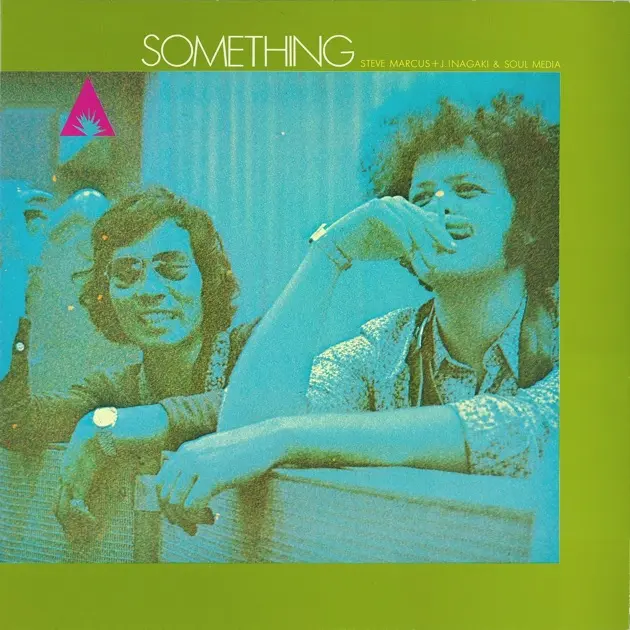 Steve Marcus recorded his fifth album, Something, in collaboration with Jiro Inagaki & His Soul Media. The album appeared in January 1971 on Japanese Columbia.
The album consists of three extended pieces that combine modal jazz with electric textures and chamber-like dynamics. Marcus shares the tenor spotlight with Inagaki in a dual-frontline format that alternates between theme statements and parallel improvisations. The material ranges from lyrical adaptation to open-form development, shaped by a restrained yet deeply interactive rhythm section.
Marcus plays both tenor and soprano saxophone in melodic and atmospheric roles, while Inagaki reinforces the harmonic lead on tenor. Masahiko Satoh plays acoustic and electric piano, establishing tone clusters and pulse fragments that underpin the horns. Guitarist Ryo Kawasaki adds feedback washes and sustained comping, while Yasuo Arakawa’s bass outlines modal centers. Drummers Hajime Ishimatsu and Seiji Tanaka alternate or combine across tracks, maintaining a quiet but firm undercurrent.
The album opens with a cover of “Something,” arranged in slow tempo with overlapping sax phrases over dense electric piano chords. Satoh composed the remaining two tracks: “Fairy Rings,” a suite-like piece with floating textures, and “Serenity,” a long-form exploration built on spacious modal figures that dissolve into free-time interplay.
A1. “Something” (6:50) — originated as a 1969 single by The Beatles, written by George Harrison; interpreted here as a slow, modal ballad with layered horn voicing
A2. “Fairy Rings” (9:49)
B. “Serenity” (11:44)
Sessions occurred in September 1970 in Tokyo, recorded using a prototype Denon system, with production by Nippon Columbia.
Something appeared exclusively in Japan with full credits to Jiro Inagaki & His Soul Media. The release marked Marcus’ final 1970s project issued through a Japanese label.
Sometime Other Than Now
 Steve Marcus released his six album, Sometime Other Than Now, in 1976 on Flying Dutchman.
The album marks Marcus’ return to the U.S. jazz scene after several years abroad, pairing him with a younger fusion rhythm section. In place of extended solo flights, Marcus works within tighter structures and funk-inflected motifs, blending multiphonic saxophone textures with electric keyboards and syncopated pulses across six compact pieces.
Marcus plays soprano and tenor saxophone in tightly phrased thematic roles, occasionally veering into spiraled upper-register shapes. Guitarist Steve Khan wrote all six tracks and functions as harmonic director, using choppy rhythms and modal voicings. Don Grolnick supplies electric piano, Clavinet, and synthesizer layers that range from dense comping to subtle background shimmer. Will Lee’s electric bass locks into syncopated foundations with drummer Steve Gadd, whose sharp, polyrhythmic accents steer dynamic motion across each track.
Steve Khan composed all selections, with Marcus interpreting the heads and weaving into the ensemble structure rather than acting as sole melodic driver.
“Sometime Other Than Now” opens the album with saxophone led in slow unison before unfolding into contrapuntal fragments. “The New Sado-Masochism Tango” hinges on irregular phrasing and angular changes, while “The Rites of Darkness” employs layered electric keys over a gradual rhythmic thickening. Side B begins with “The Brown Rice Ooze,” a slow-rolling vamp stretched over nine minutes, followed by “Nazca,” which shifts between steady momentum and suspended passages. The album closes on “Candles,” where Marcus plays drawn, lyrical lines over a loosely syncopated base.
A1. “Sometime Other Than Now” (6:02)
A2. “The New Sado-Masochism Tango (As Opposed to the Old…Which We All Knew and Loved So Well)” (4:18)
A3. “The Rites of Darkness” (7:47)
B1. “The Brown Rice Ooze” (9:13)
B2. “Nazca” (6:41)
B3. “Candles” (5:11)
Sessions occurred in 1976 with producer Bob Thiele and engineer Harvey Goldberg at an unspecified studio. Matt Murray assisted with engineering; Mike Posner handled mastering.
Sometime Other Than Now appeared on Flying Dutchman, manufactured and distributed by RCA with pressings from RCA’s Hollywood plant.
Discography:
- Tomorrow Never Knows (1968)
- Count’s Rock Band (1969)
- The Lord’s Prayer (1969)
- Green Line (1971 • Steve Marcus, Sonny Sharrock, Miroslav Vitous & Daniel Humair)
- Something (1972 • Steve Marcus & Jiro Inagaki & His Soul Media)
- Sometime Other Than Now (1976)
Sources:
Artist/Album Pages:
Wolfgang Schlüter (November 12, 1933 — November 12, 2018) was a German jazz vibraphonist and percu...
Van der Graaf Generator are an English rock band, formed at Manchester University in 1967 by singer–...
Pumpkin was a Dutch jazz-rock band that released a 1975 self-titled album on Bubble. Members: Fr...
Selda Bağcan is a Turkish folk-pop singer/songwriter who cut twelve singles between 1971 and 1974,...
Frank Robson (April 27, 1946 – November 16, 2024) was an English–Finnish keyboardist and singer wh...
Mads Vinding Group was a Danish jazz-rock combo behind the 1974 Sonet album Danish Design. Membe...
Tomorrow's Gift was a German musical collective that released a self-titled, psych-rock double-alb...
Ruby Andrews is an American soul singer who released fifteen singles on Zodiac Records, including...
Beckett was an English rock band from Newcastle that released a self-titled album on Raft Records in...
David Bowie (January 8, 1947 – January 10, 2016) was an English singer, songwriter, multi-instrument...
Petr Novák (September 6, 1945 – August 19, 1997) was a Czech rock singer and songwriter who formed...
Tarántula was a Spanish symphonic/hard-rock band that debuted in 1976 on Novola, followed by a 197...