

Yvonne Fair (Oct. 21, 1942 — March 6, 1994) was an American soul singer who emerged in the James Brown Revue. She released thirteen singles between 1962 and 1976 and scored R&B hits with “Funky Music Sho’ ‘Nuff Turns Me On,” “Walk Out the Door If You Wanna,” and “Love Ain’t No Toy,” all included on her 1975 album The Bitch Is Black, which also spawned the international hit “It Should Have Been Me.”
Background
Flora Yvonne Coleman was born on October 21, 1942, in Richmond, Virginia, and grew up in the Bronx. Coleman used Yvonne in place of Flora and first worked under the name Yvonne Harris. She married Leroy Fair early in adulthood and retained the Fair surname for stage work. In 1961, Fair joined the Chantels during the group’s Carlton Records period, when the Bronx vocal group scored their second big hit, “Look In My Eyes.” She left the Chantels for the James Brown Revue before her first solo session for King.
1962–1966 Singles
Yvonne Fair cut six stock singles between the February 1962 King issue “I Found You” and the March 1966 Smash release “Baby, Baby, Baby.”
The run contains twelve side placements, including four James Brown-written or co-written songs. The releases print Brown, D. Rozier, Julius Dixon, Rudolph Toombs, Ted Jarrett, Jim Jam, B. Jones, N. Jones, and A. King as writers. Fair cut songs first recorded by Annie Laurie (“It Hurts To Be In Love”) and Gene Allison (“You Can Make It if You Try”).
In February 1962, King issued “I Found You” (b/w “If I Knew”), billed to Yvonne Fair and James Brown Band. Brown wrote both sides. “I Found You” later supplied the song base for Brown’s “I Got You (I Feel Good).”
King followed in June 1962 with “Tell Me Why” (b/w “Say So Long”). D. Rozier and Brown wrote “Tell Me Why,” and Brown wrote “Say So Long.”
Fair continued the King run in August 1962 with “It Hurts To Be In Love” (b/w “You Can Make It If You Try”). Dixon and Toombs wrote “It Hurts to Be In Love,” a title first cut by Annie Laurie for De Luxe. Jarrett wrote “You Can Make It if You Try,” which Gene Allison had carried onto the R&B chart for Vee-Jay.
Dade issued “Straighten Up” in November 1963 (b/w “Say Yeah Yeah”), both Rozier compositions. Brown produced the single, which placed Fair’s lead line against Famous Flames replies and Brown-band punctuation.
King returned to the earlier band material in September 1965 with “You Can Make It if You Try” (b/w “Tell Me Why”). Brown produced the reissue, which reversed two 1962 sides.
Smash issued “Baby, Baby, Baby” (b/w “Just as Sure (As You Play, You Must Pay)”) in March 1966, both handled by James Brown Productions. The label credits “Baby, Baby, Baby” to Jim Jam and “Just as Sure” to B. Jones, N. Jones, and A. King.
Mid-sixties to 1973
Fair returned to show business in the mid-Sixties with singer Chuck Jackson, whom she had met during her time with James Brown. Jackson gave Fair a solo feature in his revue and paired with her for duet numbers. When Jackson signed with Motown in 1967, he asked the label to sign Fair; Motown personnel already knew her from Jackson engagements at Detroit’s 20 Grand Club.
Fair worked at Hitsville with producers Harvey Fuqua and Johnny Bristol, who cut unreleased late-Sixties material with Fair and Jackson. Motown used Fair as an opening act for label tours during her first years on the roster. In 1971 and 1972, Fair opened Jackson 5 summer tours with Tuskegee University group the Commodores as her backing band; a liaison that brought the up-and-coming group into Motown’s orbit. She encouraged saxophonist Lionel Richie to sing duets with her during the tour.
Fair appeared in the 1972 Motown film Lady Sings the Blues as a nightclub singer named Yvonne. She sang “Shuffle Blues” in the film, though the performance did not appear on the soundtrack album. By 1973, Fair had a Motown profile built from revue work, unreleased Hitsville sessions, label-tour support slots, and a small screen role tied to the company’s film division.
1970–1973 Singles
Yvonne Fair released one stock single during 1970–1973, the July 1970 Soul issue “Stay a Little Longer,” co-written by Fuqua with Arthur Scott and Vernon Williams. Fuqua wrote the b-side, “We Should Never Be Lonely My Love,” with Bristol and Mary Balnius.
Fuqua produced “Stay a Little Longer,” which Willie Shorter arranged after a May 1969 Golden World completion date. Bristol produced “We Should Never Be Lonely My Love,” which Paul Riser arranged after a September 1969 Golden World completion date. Motown also serviced a promo pressing with “Stay a Little Longer” on both sides.
The Bitch Is Black
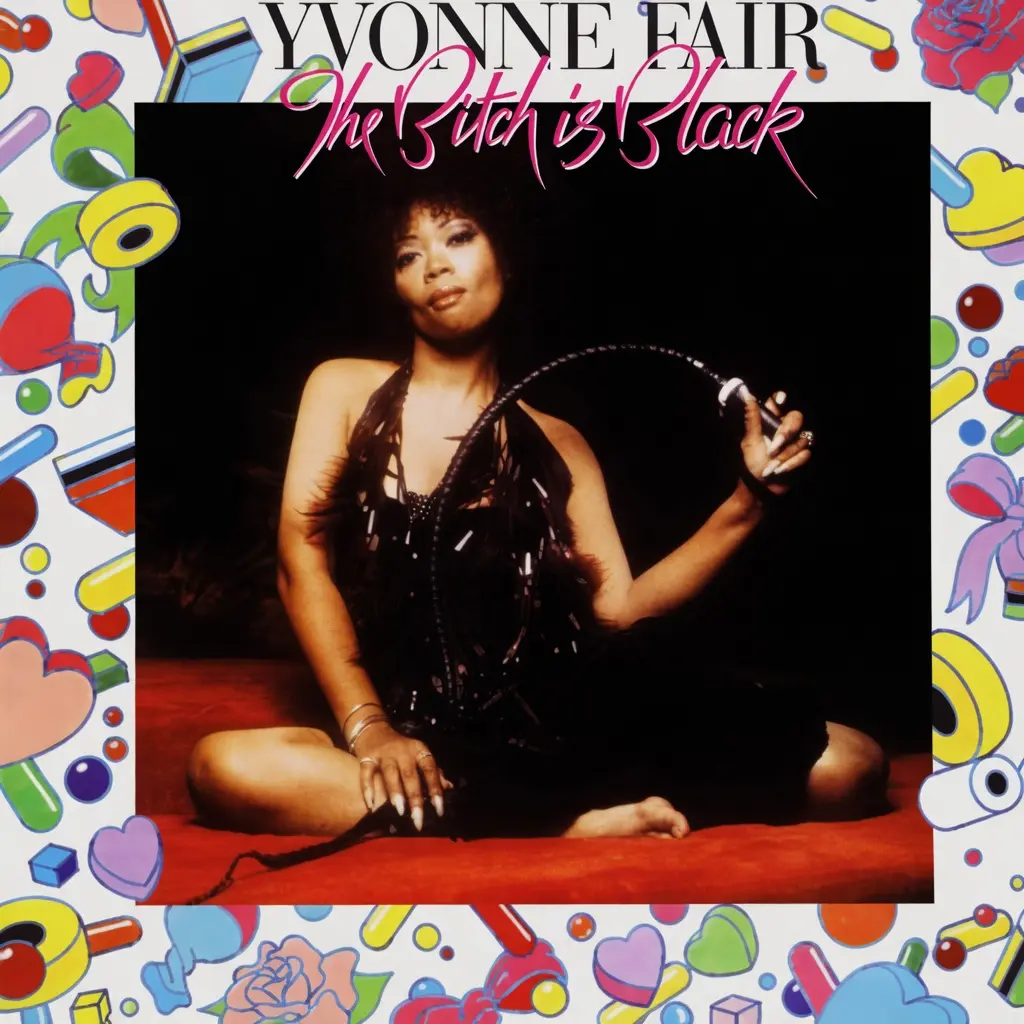 Yvonne Fair released her debut album, The Bitch Is Black, in 1975 on Motown.
The album presents a mix of hard-edged funk and string-lined soul, performed by Fair with a large studio band. Fair sings the faster titles with rasp-edged projection, clipped asides, and shouted replies.
Fair sings with bassists Henry Davis and James Jamerson and drummers Ed Greene and James Gadson. The studio band also includes keyboardists Earl Van Dyke and Mark Davis, and guitarists Dennis Coffey, Eddie Willis, Johnny McGhee, and Melvin “Wah Wah” Ragin. Percussionist Eddie “Bongo” Brown appears on bongos and congas with backing singers Carolyn Willis and the Waters siblings.
“Funky Music Sho Nuff Turns Me On” lunges through a clipped backbeat, with Fair’s grainy voice biting into the title phrase over interlocked guitar and congas. “It Should Have Been Me” pleads across a rhythm-box first half, then crests into a larger chorus. “Stay a Little Longer” saunters through string-laden romance and sweet-backed replies. “It’s Bad for Me to See You” lingers on softer lead placement and a gentler arrangement. “Tell Me Something Good” struts through sticky syncopation while Fair belts short reply phrases. “Let Your Hair Down” snarls across a hard-edged dancefloor track, with sharp refrain accents and raw upper-register lead lines.
A1. “Funky Music Sho Nuff Turns Me On” (3:04) – Norman Whitfield / Barrett Strong
A2. “It Should Have Been Me” (3:34) – Whitfield / William “Mickey” Stevenson
A3. “Stay a Little Longer” (3:27) – Arthur Scott / Harvey Fuqua / Vernon Williams
A4. “It’s Bad For Me to See You” (3:32) – Gloria Jones / Pam Sawyer
A5. “Tell Me Something Good” (3:29) – Stevie Wonder
B1. “Let Your Hair Down” (4:08) – Whitfield
B2. “Love Ain’t No Toy” (3:24) – Whitfield
B3. “I Know (You Don’t Love Me No More)” (3:17) – Barbara George
B4. “Walk Out the Door If You Wanna” (2:16) – Whitfield
B5. “You Can’t Judge a Book By It’s Cover” (2:43) – Henry Cosby / Wonder / Sylvia Moy
Norman Whitfield produced the album at Motown Recording Studios in Hollywood, where Angel Balestier, Art Stewart, Bob Robitaille, and Glenn Jordan engineered the sessions. Whitfield co-arranged The Bitch Is Black with Paul Riser. Harvey Fuqua produced “Stay a Little Longer” while Gloria Jones and Pam Sawyer did likewise for “It’s Bad for Me To See You.”
Katarina Pettersson oversaw the cover package, with design by Art Attack and photography by Jim Britt. The front cover shows Fair seated in a black outfit with a whip and an illustrated border.
Motown lifted “Funky Music Sho Nuff Turns Me On” as a 1974 single (b/w “Let Your Hair Down”), which reached No. 32 on Billboard Hot Soul Singles.
“Walk Out the Door If You Wanna” followed in September 1974 (b/w “It Should Have Been Me”) and reached No. 60 on the Hot Soul Singles chart. “Love Ain’t No Toy” became a May 1975 single (b/w “You Can’t Judge a Book By Its Cover”) and reached No. 96 on the Hot Soul.
In 1976, Motown reactivated “It Should Have Been Me” as a US single (b/w “Tell Me Something Good”); the single reached No. 85 on the Billboard Hot 100. Tamla Motown issued the song in Britain, where it reached No. 5 on the Official Singles Chart.
The Bitch Is Black reached No. 57 on Billboard R&B Albums.
Postlude
Yvonne Fair backed Patti LaBelle on the ex-Labelle singer’s 1977 debut solo album. In 1980, Fair sang “Jesus Is Love” on the eighth Commodores album, Heroes. Through most of the Eighties, Fair resigned to occasional Los Angeles club dates. She also worked as a personal assistant and wardrobe coordinator for Dionne Warwick.
In 1991, “It Should Have Been Me” gained newfound popularity through the Jools Holland road move Mr. Roadrunner.
Fair died of pancreatic cancer on March 6, 1994, in Las Vegas.
Discography:
- The Bitch Is Black (1975)
Sources:
Artist/Album Pages:
Haikara was a Finnish symphonic/jazz-rock band that made the 1972–74 albums Haikara and Geafar, fo...
Ruth Copeland (born 1946) is an English soul-rock singer who moved stateside in the late 1960s and...
Hands are an American symphonic/art-rock band from Dallas that recorded a clutch of demos between ...
Bemibem was a Polish soul-pop band behind the 1974 album Bemowe Frazy on Polskie Nagrania Muza. ...
Alan Hull (1945—1995) was an English singer-songwriter from Newcastle, best known as the mastermind ...
Petrus Castrus was a Portuguese symphonic-rock band that included musician/composer Júlio Pereira....
Ramses was a German symphonic-rock band that released three albums between 1976 and 1981 on Sky Re...
Keith Jarrett is an American jazz pianist who debuted with Art Blakey & the Jazz Messengers (1...
Roy Haynes (March 13, 1925 — November 12, 2024) was an American jazz drummer and bandleader from ...
Millie Jackson is an American soul singer who made nineteen albums between 1972 and 1983 on Spring...
Jordi Sabatés (born Oct. 23, 1948) is a Spanish jazz pianist who emerged in mid-Sixties Barcelona ...
Games were an American art-rock band from California that released the 1977 album Stargazer on sel...