

Panthéon was a Dutch jazz-rock band that released a standalone single on Philips and the album Orion on Vertigo, both in 1972.
Members: Ruud Wouterson (vocals, keyboards), Hans Boer (saxophone, harmonica, vocals), Rob Verhoeven (drums), Albert Veldkamp (bass), John Schut (guitar), Jan Slijkhuis (drums), Guus Swerissen (bass)
Background
Panthéon formed in Arnhem in 1971 as a five-member high-school band. The group cut its first single as a quartet with keyboardist/vocalist Ruud Wouterson, wind player/vocalist Hans Boer (flute, alto saxophone, tenor saxophone), bassist/guitarist Albert Veldkamp, and drummer Rob Verhoeven. None of the four had turned twenty-one at the time of the first single.
Panthéon won first prize at the Rekreade Festival, a national talent contest in The Hague. The group used the Phonogram prize session for the 1972 Philips single “I Want to Know” (b/w “Master Basion”). Phonogram retitled the B-side from “Masturbation” for the single. Panthéon reached radio and television with the 1972 Vertigo single “Daybreak” (b/w “Anaïs”). The group played Paradiso and Soos ’59 and opened for Focus and Solution.
Orion
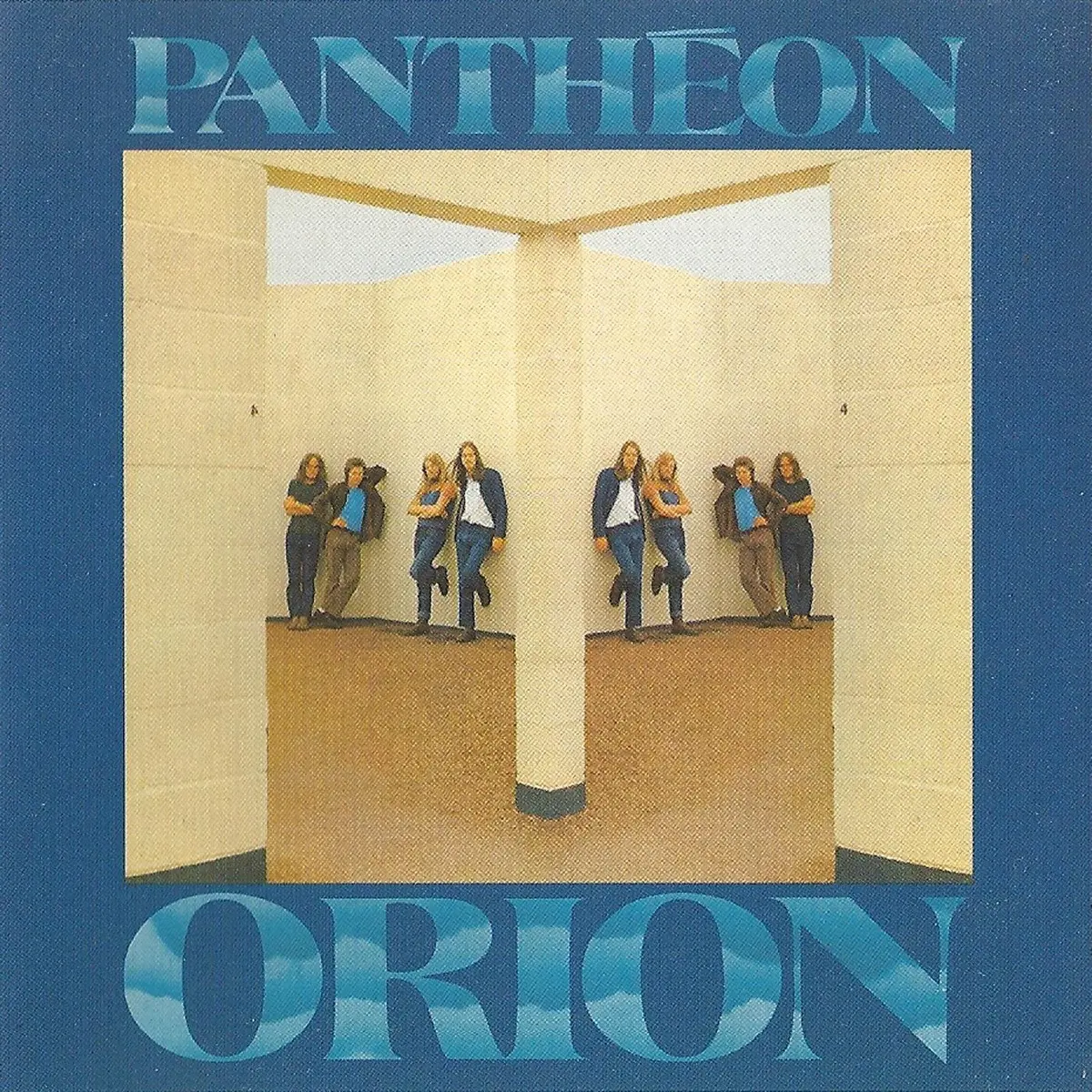 Panthéon released their debut album, Orion, in 1972 on Vertigo.
Orion features five Ruud Wouterson compositions in a keyboard-led quartet format, with keyboardist Ruud Wouterson (organ, spinet, celesta, piano, ARP synthesizer, vocals), multi-instrumentalist Albert Veldkamp (bass guitar, electric guitar, acoustic guitar), drummer Rob Verhoeven, and reedist-vocalist Hans Boer (flute, alto saxophone, tenor saxophone). The group placed four titles on the first side and the side-long “Orion” on the second side.
“Daybreak” skips through brisk vocalise, flute lead, and a compact guitar break. “Anaïs” glides on a minor-tinted lead, returns to a repeated figure, and brightens for a brief central passage before light electronic color. “Apocalyps” surges from a clustered opening into floating organ, recoils into a quiet passage, then advances through a steadier reed-led refrain, wordless vocalise, clipped accent shifts, and a late piano run. “The Madman” darts through a comic warm-up figure.
“Orion” fans out from pastoral leads into sunlit ensemble passages, reed-marked turns, recurring vocal phrases, and broad changes in pressure. The piece sharpens after the opening statements, threads earlier figures through several returns, and holds the second side through controlled shifts in density, pulse, and tonal color.
A1. “Daybreak” (2:30)
A2. “Anaïs” (5:00)
A3. “Apocalyps” (10:52)
A4. “The Madman” (1:20)
B. “Orion” (19:27)
Tony Vos produced Orion with engineer Albert Kos. Jan H. van Uden designed the cover package, which frames a mirrored quartet photograph between blue block lettering.
Philips issued the pre-album single “I Want To Know” in March 1972 (b/w “Master Basion”). Vertigo lifted “Daybreak” as a November 1972 single (b/w “Anais”).
Discography:
- Orion (1972)
- “I Want to Know” / “Master Basion” (1972)
Sources:
Artist/Album Pages:
Spirit was an American psych-rock band from Los Angeles that released three 1968/69 albums on Ode...
Greenslade was an English symphonic-rock supergroup comprised of ex-members of Colosseum, Fields, ...
Buddy Miles (Sept. 5, 1947 — Feb. 26, 2008) was an American drummer, singer, producer, and songwri...
Jimmy Castor (Jan. 23, 1940 — Jan. 16, 2012) was an American R&B saxophonist and vocalist who ...
Pazop was a Belgian avant jazz-rock band that made the 1972 single "Captain Black" / "Morning" on ...
Donald Byrd (1932–2013) was an American post-bop trumpeter who apprenticed with the Jazz Messenger...
Goldenrod was an American jam-rock/psych band from Los Angeles that released a 1969 self-titled a...
The Quick was the English synth-funk duo of vocalist Colin Campsie and bassist/keyboardist George ...
Nolan Porter (1949–2021) was an American soul singer from Los Angeles who released the 1971/72 al...
Scope was a Dutch instrumental jazz-rock band that released two albums in 1974/75 on Atlantic. M...
M was the recording moniker of English musician, singer, and songwriter Robin Scott, who released ...
Franz K. was a German political hard-rock/blues band that released ten albums and assorted singles...