

Nina Hagen is a German singer and media personality who made two late-Seventies bandleader albums and scored a European hit with “African Reggae.” She gained international cult renown with her 1982–85 CBS albums Nunsexmonkrock, Angstlos, In Ekstase, and the hits “New York / N.Y.” and “Universelles Radio.”
Background
She was born Catherine Hagen on March 11, 1955, in East Berlin to Hans Oliva-Hagen, a scriptwriter of Jewish descent, and Eva-Maria Hagen, a prominent actress and chanson singer. Raised in a politically charged artistic household, Nina studied ballet from the age of four and was recognized as an operatic prodigy by age nine. Following her parents’ divorce, her mother entered a long-term relationship with dissident songwriter Wolf Biermann, whose anti-establishment stance influenced Hagen’s early worldview.
Hagen began her professional music career in the early 1970s with the East German cover band Fritzens Dampferband, where she added songs by Janis Joplin and Tina Turner to the permitted socialist repertoire. She received formal vocal training from 1972 to 1973 at the Central Studio for Light Music in East Berlin and soon joined the group Automobil. With them, she recorded “Du hast den Farbfilm vergessen,” a sardonic pop song that became a major hit across the GDR in 1974 and remains her best-known East German recording. Her career continued with additional TV appearances and novelty hits until 1976, when East German authorities expelled Biermann and banned him from returning. Nina petitioned for an exit visa to join him in the West, claiming filial connection and threatening to become “the next Biermann” if refused. Within days, the regime allowed her and her mother to emigrate.
After settling in Hamburg, Hagen signed with CBS and briefly traveled to London at the label’s suggestion. Immersed in the emerging punk scene, she connected with members of The Slits and absorbed the confrontational performance style and musical minimalism of British punk firsthand. She returned to West Berlin in mid-1977 and formed the Nina Hagen Band with keyboardist Reinhold Heil (formerly of Bakmak) and three members of the avant-cabaret group Lokomotive Kreuzberg: guitarist Bernhard “Potsch” Potschka, bassist Manfred Praeker, and drummer Herwig Mitteregger. The group signed to CBS that November and entered Hansa Tonstudio in Berlin to record their self-titled debut.
Nina Hagen Band
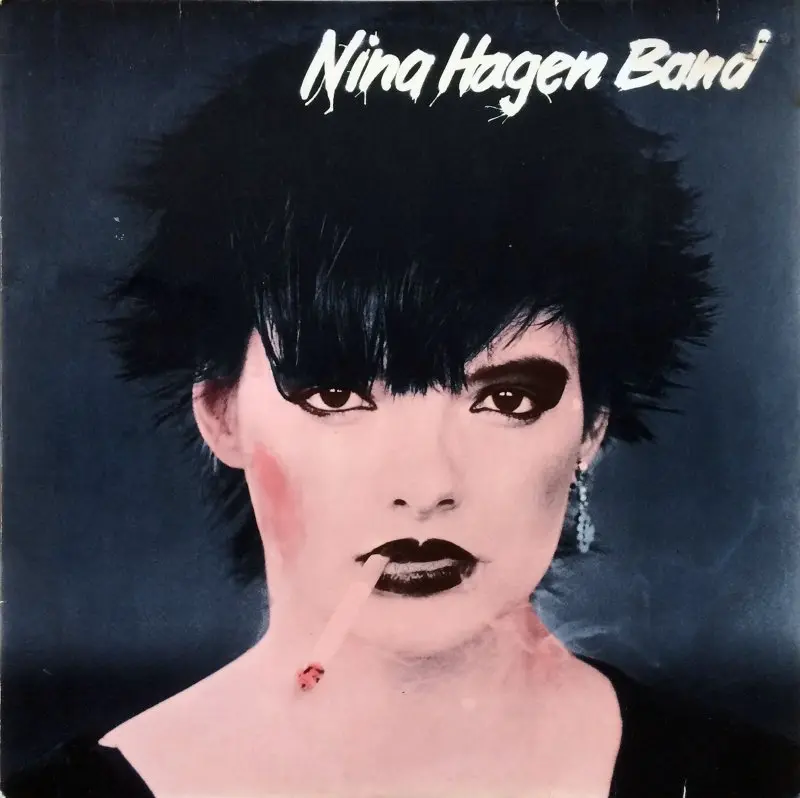 The Nina Hagen Band released their self-titled debut album on February 11, 1978, on CBS.
Built from material Nina Hagen first conceived while living in East Germany, the album fuses theatrical post-punk stylings with angular Neue Deutsche Welle and eruptive vocal contortions. Guitarist Bernhard Potschka and keyboardist Reinhold Heil engage in interlocked passages that counter Hagen’s shifting vocal personas with staccato riffing, sharp breaks, and tightly coiled keyboard sequences. Drummer Herwig Mitteregger, who also plays vibraphone, co-authors several tracks with intricate rhythmic pivots, while bassist Manfred Praeker contributes to the tonal contrasts and joins in on group backing vocals.
Much of the material predates the band’s formation, including “TV-Glotzer (White Punks on Dope),” a reworking of The Tubes’ song with German lyrics Hagen wrote prior to her emigration, portraying the isolation of East German life and the pull of televised Western imagery. “Pank,” a brief burst co-written with Ari Up of The Slits, developed from Hagen’s immersion in the London punk scene in early 1977.
A1. “TV-Glotzer (White Punks on Dope)” (5:15)
A2. “Rangehn” (3:27)
A3. “Unbeschreiblich ♀” (3:30)
A4. “Auf’m Bahnhof Zoo” (5:25)
A5. “Naturträne” (4:05)
B1. “Superboy” (4:01)
B2. “Heiss” (4:11)
B3. “Fisch im Wasser” (0:51)
B4. “Auf’m Friedhof” (6:15)
B5. “Der Spinner” (3:15)
B6. “Pank” (1:45)
The album was recorded at Hansa Tonstudio in Berlin and co-produced by the band alongside Tom Müller and Ralf Nowy, with engineering support by Michael Zimmerling. Hagen led the creative direction, drawing on her theatrical background while the band’s ex-Lokomotive Kreuzberg members crafted the musical frameworks.
“TV-Glotzer” appeared as the lead single backed with “Heiss” (Germany) and “Naturträne” (UK). CBS followed with singles of “Naturträne,” “Auf’m Bahnhof Zoo,” and “Unbeschreiblich ♀.” The album reached No. 11 on the German charts and sold over 250,000 copies, earning gold certification from the BVMI. The band promoted the release with a European tour, including a Rockpalast-broadcast performance at Dortmund’s Westfalenhalle in December 1978.
Unbehagen
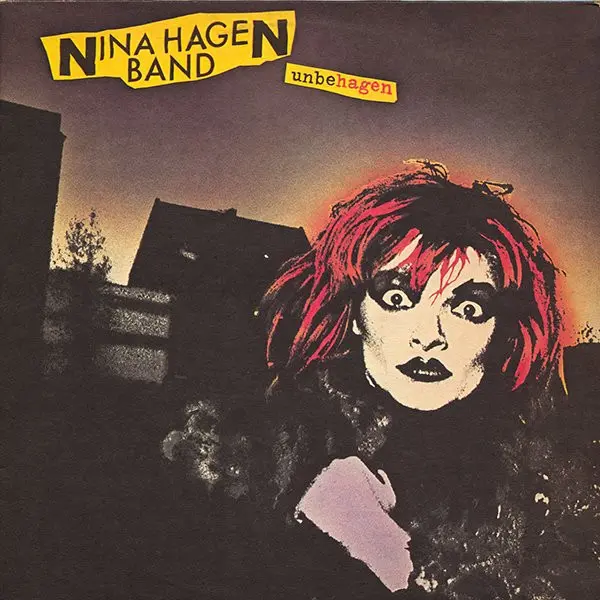 The Nina Hagen Band released their second album, Unbehagen, in 1979 on CBS.
Shaped during a period of growing public attention around Hagen’s stage persona and televised controversies, the album pushes further into theatrical Neue Deutsche Welle while retaining sharp-edged post-punk arrangements and bursts of reggae-informed pacing. Guitarist Bernhard Potschka drives angular, choppy riffs through the set’s longer numbers, often trading momentum with keyboardist Reinhold Heil, who expands the tonal space with extended synth backdrops and clipped keyboard accents.
“African Reggae” opens with six minutes of staggered interplay between Potschka’s brittle guitar figures and Heil’s elastic phrasing. On “No Way,” Heil switches to bass synthesizer while bassist Manfred Praeker adds rhythm guitar, shifting roles with drummer Herwig Mitteregger, who shares co-writing credits on four tracks and underpins the material with taut drum patterns and hand percussion. The track “Herrmann hiess er,” co-written with Praeker, addresses themes of addiction and carries autobiographical associations with Dutch musician Herman Brood, Hagen’s former partner. The band recorded one track, “Wenn ich ein Junge wär,” live in April 1979 at the Saarbrücken Congress Hall. “Wir leben immer… noch” reworks Lene Lovich’s “Lucky Number” into a German-language version arranged by the group.
A1. “African Reggae” (6:17)
A2. “Alptraum” (6:10)
A3. “Wir leben immer…noch (Lucky Number)” (4:53)
A4. “Wenn ich ein Junge wär” (2:14)
B1. “Herrmann hiess er” (6:34)
B2. “Auf’m Rummel” (4:32)
B3. “Wau Wau” (2:07)
B4. “Fall in Love mit mir” (3:47)
B5. “No Way” (1:05)
Sessions took place between October 1978 and November 1979 at Hansa Tonstudio in Berlin, with co-production by the band, Tom Müller, and Ralph Nowy. The album followed a period of escalating media attention for Hagen, including her televised August 1979 appearance on Club 2, which amplified public focus on her image.
CBS issued three singles from Unbehagen: “African Reggae,” “Herrmann hiess er,” and “Auf’m Rummel.” The album entered the German Top 100 in early 1980 and reached No. 2. It charted across multiple European territories and was certified Gold in Germany in 1981 for sales exceeding 250,000 copies. Following the album’s release, Hagen departed for a solo career while the remaining members regrouped as Spliff.
Cha Cha
Cha Cha is a 1979 Dutch film that blends narrative fiction with real-life personas from the European punk and new wave scene. Directed by Herbert Curiel and co-written by Herman Brood, the film stars Brood alongside Nina Hagen, Lene Lovich, and Les Chappell, all of whom appear under their own names. The plot follows Brood as a disillusioned bank robber who tries to escape his criminal past and reinvent himself as a rock star amid the chaotic energy of Amsterdam’s late-1970s subculture.
Hagen appears on the Cha Cha soundtrack in two collaborative tracks with Brood and his backing band, The Wild Romance. On side A, she joins Brood, Lovich, and Chappell on “I Love You Like I Love Myself.” Later, she leads “Herman’s Door,” a jagged new wave track with The Wild Romance. On side B, she performs “Herman Ist High,” a satirical and dissonant cut that references Brood’s drug use. The Cha Cha soundtrack was released jointly by CBS and Ariola Records and features contributions from the film’s cast and other Dutch underground acts of the time, including Alquin spinoff The Meteors.
The film gained cult status for its raw, improvised tone and live musical performances by the cast. Hagen’s participation came during her brief but intense romantic relationship with Brood, which unraveled soon after due to his escalating drug use. Despite the breakup, Hagen later referred to Brood as her “soulmate” and spoke fondly of him after his death in 2001.
Nunsexmonkrock
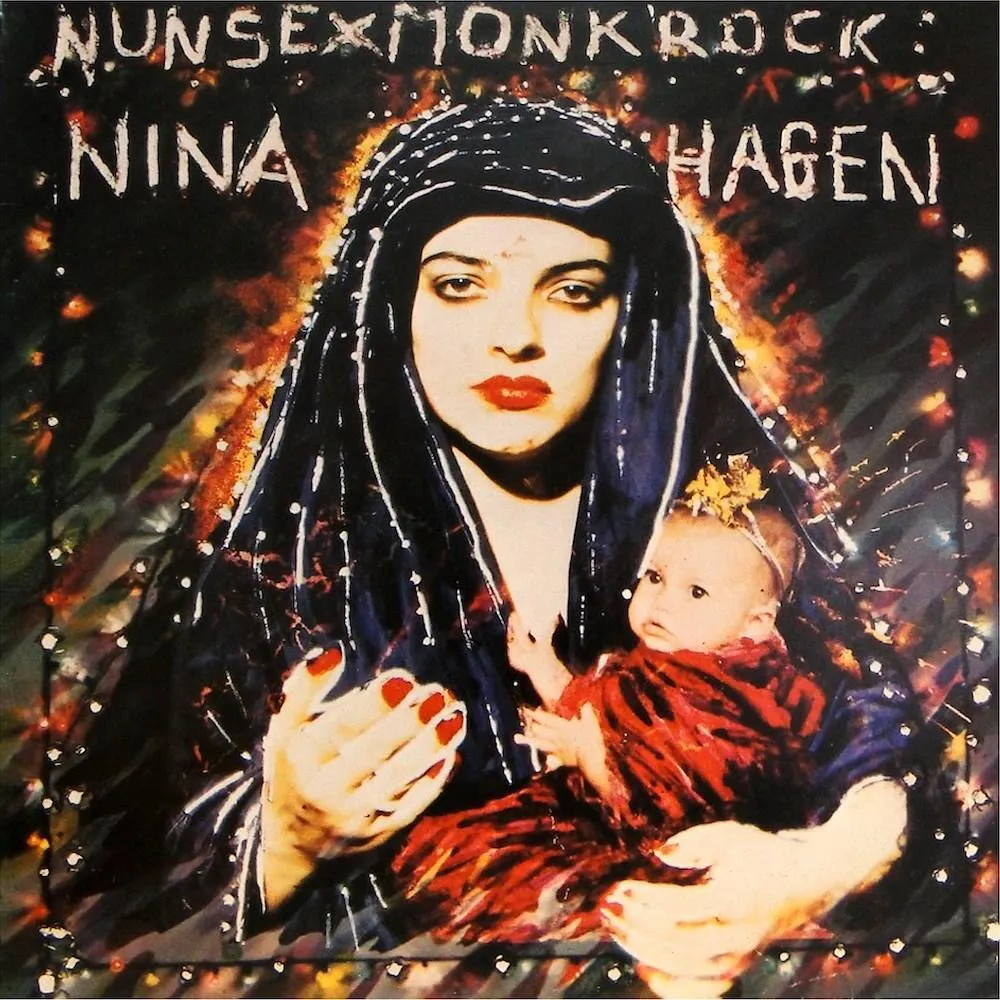 Nina Hagen released her debut solo album, Nunsexmonkrock, in May 1982 on CBS.
Departing from the collective framework of her earlier band, Hagen pushes further into fractured experimental terrain on her solo debut, fusing post-punk structures with unpredictable electronic phrasing, religious motifs, and performance-art vocal shapes.
Keyboardist Paul Roessler—credited on piano and synthesizer—forms the album’s melodic axis, trading layered synth pulses with bassist Karl Rucker, who doubles on synthesizer and shares co-writing duties on two tracks. Guitarist Chris Spedding supplies jagged rhythm clusters and abstract chordal support across Hagen’s register shifts, with auxiliary stabs from baritone saxophonist Axel Gath and additional keys by Paul Shaffer.
On “Dread Love,” Hagen invokes the phrase “let’s do the nun sex monk rock,” which gave the album its title. The track was co-written with Ferdinand Karmelk, the Dutch guitarist and father of Hagen’s daughter, Cosma Shiva, who inspired and appears on the song bearing her name. “Antiworld” draws its lyrics from a 1964 poem by Andrei Voznesensky and includes a segment from Jimi Hendrix’s “Third Stone from the Sun.”
“Smack Jack,” the album’s lone single, was written solely by Karmelk and addresses heroin addiction. “Iki Maska” features interpolations from the B-52’s “Planet Claire,” Bryan Adams and Pavarotti’s take on “’O Sole Mio,” and quotes from Bowie’s “Ziggy Stardust.” The album closes with “UFO,” based on Hagen’s personal sighting on a Malibu beach during her pregnancy.
A1. “Antiworld” (4:41)
A2. “Smack Jack” (5:10)
A3. “Taitschi-Tarot” (3:20)
A4. “Dread Love” (4:20)
A5. “Future Is Now” (2:53)
B1. “Born in Xixax” (3:50)
B2. “Iki Maska” (5:08)
B3. “Dr. Art” (3:45)
B4. “Cosma Shiva” (5:00)
B5. “Ufo” (4:40)
Sessions took place in New York at Blue Rock Studio during 1981 and early 1982, with production by Mike Thorne. Hagen originally planned to collaborate with Karmelk but instead recorded with a newly assembled group that included studio drummer Allan Schwartzberg. She performed “Future Is Now” on Austrian television in 1979 during her controversial Club 2 appearance, prior to the album’s delayed recording sessions.
CBS issued “Smack Jack” as the sole single, backed with “Cosma Shiva.” The single reached No. 7 in Norway. Nunsexmonkrock entered the German chart at No. 27 and appeared in the album rankings in New Zealand and Norway. The cover photo, taken by Juliana Grigorova, depicts Hagen cradling her daughter Cosma in a pose modeled on Madonna and child iconography. CBS reissued the album in 1991 as part of a compilation with material from the Nina Hagen Band era.
Angstlos
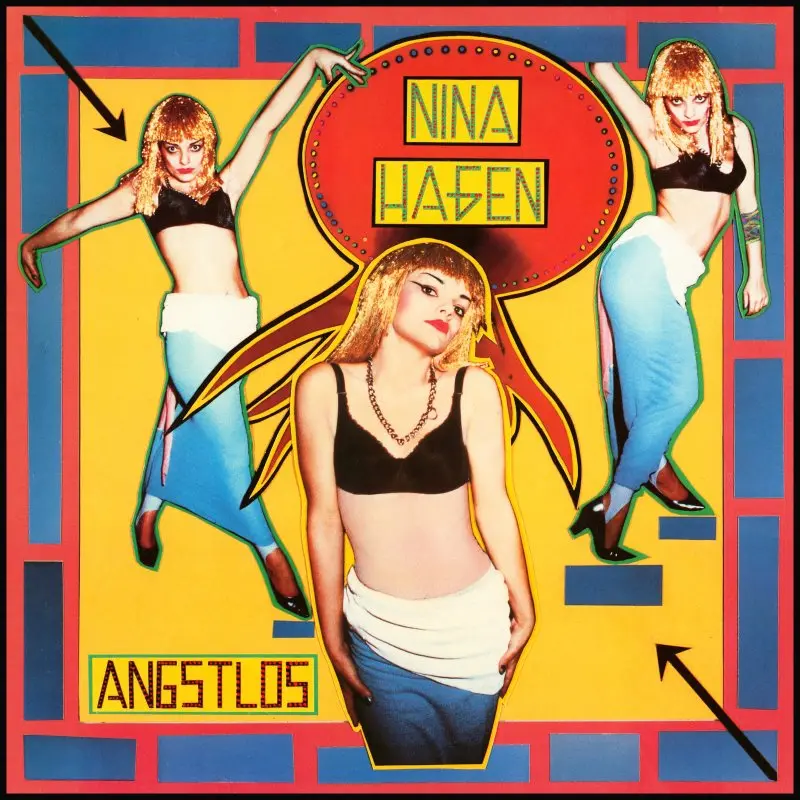 Nina Hagen released her second solo album, Angstlos, in November 1983 on CBS.
Departing from the angular experimentalism of her earlier work, Hagen aligns with electronic dance-pop structures shaped by producer Giorgio Moroder and co-producer Keith Forsey. Guitarist Steve Schiff co-wrote multiple tracks and alternates with Richie Zito on rhythm and lead figures, building momentum through interlocking parts with keyboardists Arthur Barrow and John Philip Shenale. Schiff also handles keyboard sequencing, often trading melodic leads with bassist and co-arranger Karl Rucker, who punctuates tracks with synth flourishes and tightly programmed runs.
Hagen draws on a broader pool of contributors for select material, including “Was es ist,” written by Red Hot Chili Peppers members Michael Balzary (Flea) and Anthony Kiedis. She alternates English and German phrasing across the album, including the lead track “New York / N.Y.,” where she raps in both languages, reserving only the refrain for sung vocal lines. “Zarah” adapts the 1940s Zarah Leander ballad “Ich weiss, es wird einmal ein Wunder geschehen,” adding a steady tempo and layered keys. Photographer Juliana Grigorova co-wrote “Lorelei,” which appears only on the German version of the album.
A1. “New York / N.Y.” (4:59)
A2. “Was es ist” (4:19)
A3. “Lorelei” (2:35)
A4. “Zarah (Ich weiss, es wird einmal ein Wunder geschehn)” (5:02)
B1. “Frühling in Paris” (3:35)
B2. “I Love Paul” (3:50)
B3. “My Sensation” (4:03)
B4. “Newsflash” (3:58)
B5. “The Change” (4:40)
Hagen recorded Angstlos during 1982 with a full studio ensemble assembled under the direction of Moroder, whose production emphasizes layered synthesizer textures and precision sequencing. John Gilston handled Simmons drum programming while Vlado Meller mastered the final mix.
CBS issued “New York / N.Y.” as the lead single, which reached No. 9 on the US dance charts. “Zarah” followed as the second single and charted in the US club listings. The album appeared in the German Top 30 and reached the Top 50 in several international markets, including Austria, the Netherlands, and New Zealand. An English version titled Fearless appeared simultaneously in other territories.
In Ekstase
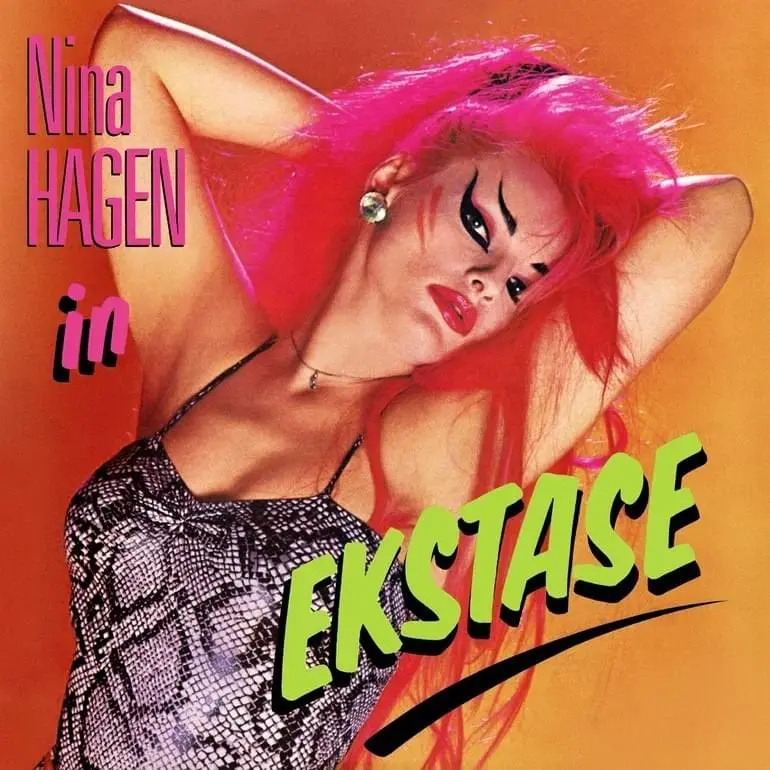 Nina Hagen released her third solo album, In Ekstase, in May 1985 on CBS.
Shifting from the dance-pop production of her prior release, Hagen returns to punk-inflected theatrics laced with studio experimentation and sardonic edge. Guitarist Billy Liesegang trades coarse, chopped patterns with keyboardist Roger Scott Craig, who guides arrangements with metallic textures and sampled overlays. Karl Rucker spans bass, keyboards, and drums, often intertwining synthetic low-end with abrupt tonal shifts from pianist Balis Jiouraitis and saxophonist Alain Guillard. Michael McEvoy contributes horn arrangements that add contrast against Hagen’s spoken-word incantations and octave-spanning deliveries.
“Universal Radio,” co-written with Ron Dumas, originated from a 1983 demo by the Ron Dumas Group. Hagen’s label steered the final vocal direction, though she later voiced reservations about the arrangement. “Gott im Himmel,” a German adaptation of Norman Greenbaum’s “Spirit in the Sky,” draws on her 1981 Malibu UFO sighting, which also inspired “Die Ufos sind da.” “Prima Nina in Ekstase” reflects on her 1977 arrival in London, where she was dubbed the “Mother of Punk” by younger peers in the scene. “My Way,” first issued on her 1980 EP, reappears here with new context as part of a sequence that includes the satirical “1985 Ekstasy Drive.” The closing segment, “Vater Unser,” reconfigures the Lord’s Prayer against distorted bass and interpolates a passage from Khachaturian’s “Sabre Dance.”
A1. “Universelles Radio” (3:34)
A2. “Die Ufos sind da” (3:29)
A3. “Russischer Reggae” (4:29)
A4. “My Way” (4:25) – originated as “Comme d’habitude,” translated to English by Paul Anka and recorded by Frank Sintatre (1969) and Sid Vicious (1978).
A5. “1985 Ekstasy Drive” (3:22)
B1. “Prima Nina in Ekstase” (4:01)
B2. “Gott im Himmel (Spirit in the Sky)” (3:39)
B3. “Atomic Flash de Luxe” (4:02)
B4. “Vater Unser” (3:24)
B5. “Gott im Himmel (Spirit in the Sky) / Reprise” (0:59)
Sessions took place across Mediterranean Studios in Ibiza and Maracadet Studios in Paris with producer Adam Kidron, who continued working despite temporary arm numbness caused by a motorbike accident. Landscape frontman Richard James Burgess produced “My Way,” the only track recorded earlier.
Hagen premiered “Universal Radio” on KROQ with Rodney Bingenheimer before its release as the album’s lead single. It peaked at No. 39 on the Billboard Dance Club Songs chart. She supported the album with performances at Rock in Rio in January 1985 and appeared on multiple U.S. television programs. In Ekstase charted in Austria, Switzerland, Germany, Sweden, and New Zealand. It marked her final album for CBS prior to the expiration of her contract in 1986.
Discography:
- Nina Hagen Band (1978 • Nina Hagen Band)
- Unbehagen (1979 • Nina Hagen Band)
- Nunsexmonkrock (1982)
- Angstlos (1983)
- In Ekstase (1985)
- Nina Hagen (1989)
Sources:
Artist/Album Pages:
Pylon was an American new wave band from Athens, Ga., that debuted with the 1979 single "Cool" / ...
Nexus was a Swedish jazz-rock band that released three albums between 1978 and 1987 on Four Leaf C...
Cobraa was a German rock band that released a 1974 self-titled album on Electrola. Members: Fried...
Palais Schaumburg was a German NDW band that released six singles and the 1981–84 Phonogram albums...
Oniris was the French symphonic-rock band behind the 1979 Barclay album L'Homme-Voilier. Members...
Univers Zéro is a Belgian chamber-rock/Zeuhl ensemble that debuted with a 1977 self-titled Atem rele...
Van Morrison (born Aug. 31, 1945) is an Irish singer–songwriter, best known for the hits "Brown Ey...
Gary Wright (April 26, 1943 – September 4, 2023) was an American singer, musician, and songwriter ...
Manfred Mann's Earth Band was an English symphonic/art-rock band that released a pair of albums on P...
Triumvirat was a German symphonic-rock band that released seven albums between 1972 and 1980 on Ha...
Section 25 was an English post-punk band that cut two 1980 Factory singles and the 1981 album Alw...
Second Direction was a German jazz-rock band that released the 1976 album Four Corners on Trend an...