

Masters of Deceit was an American psychedelic rock band that released the 1969 Vangaurd album Hensley’s Electric Jazz Band and Synthetic Symphonette.
Members: Gary Campbell (bass, vocals), Stan Gage (drums), Steve Blum (guitar, bass), Tom Hensley (organ, clavinet, piano, lead vocals, tenor saxophone)
Inception
Masters of Deceit formed in Indianapolis, Indiana, around pianist–composer Tom Hensley, a multi-instrumentalist and arranger who served as music director at local station WBIW. He teamed with saxophonist–bassist Gary Campbell, guitarist Steve Blum, and drummer Stan Gage.
Hensley’s Electric Jazz Band and Synthetic Symphonette
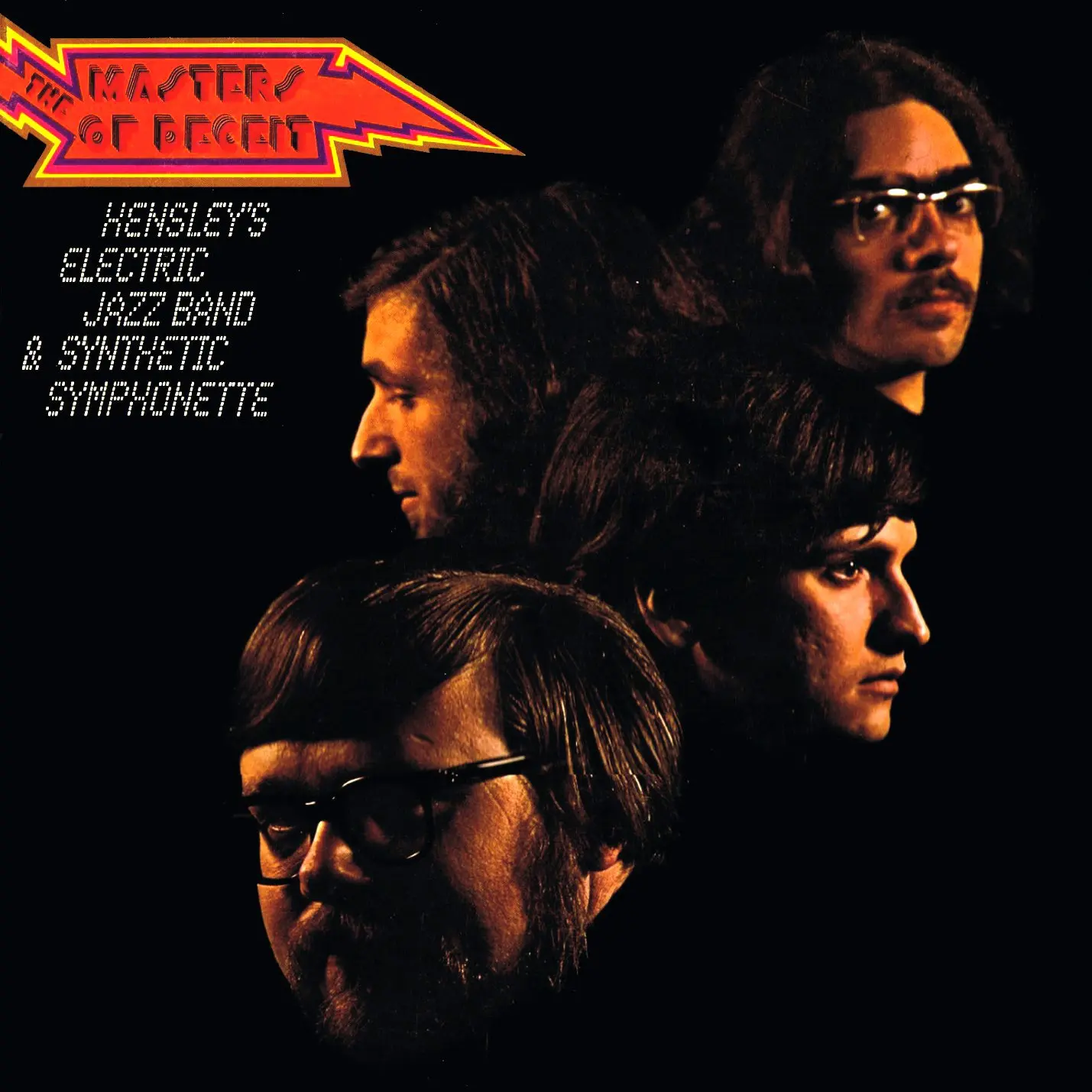 Masters of Deceit released their singular album in September 1969 on Vanguard (VSD-6522). The titles is a tongue-in-cheek moniker that mirrored the band’s mix of serious musical ambition and playful, post-psychedelic experimentation.
The album features six original tracks: four by Hensley, two (“Shining,” “The Grand Illusion”) by songwriter Cradoc Bagshaw. Campbell plays both bass and tenor sax, while Blum doubles on guitar and bass. On “Mirror,” Campbell and Blum swap roles, with Campbell handling sax and Blum on bass.
Side A mixes concise jazz–prog songs with baroque and symphonic textures. “Shining” opens with stately Mellotron-style organ and layered harmonies reminiscent of In the Court of the Crimson King. “Boxes” explores early Canterbury-style jazz-rock with odd cadences, clavinet stabs, and a lightly whimsical tone, while “The Grand Illusion” veers toward theatrical art-rock. The seven-minute “Long Hard Journey” closes the side in Moody Blues mode, combining narrative lyrics with slowly unfurling psych–symphonic motifs.
Side B opens with the fusion-tinged “Mirror,” then gives way to the 15-minute suite “Pieces: Together: Pieces,” a multipart opus that moves from Jefferson Airplane-style psych to avant-garde jazz breakdowns and Caravan-like melodic passages. Its central jam includes standout solos from each player, including a lengthy, distorted keyboard finale from Hensley.
A1. “Shining” (4:31)
A2. “Boxes” (4:52)
A3. “The Grand Illusion” (3:34)
A4. “Long Hard Journey” (7:22)
B1. “Mirror” (4:32)
B2. “Pieces: Together: Pieces” (15:09)
Hensley co-produced the album with Vanguard co-founder Maynard Solomon. Ed Friedner engineered Synthetic Symphonette in sequence with label titles by Listening, The Frost, and The Third Power.
Synthetic Symphonette appeared in a gatefold Unipak cover with artwork designed by Hensley, Fred Holtz, and Davi Det Hompson. Photographer Joel Brodsky took the dark-lit head-to-head group shots (front and back). The inner-gates feature liner-notes and a photo collage with comic word bubbles.
Legacy
Synthetic Symphonette later gained cult status among early progressive rock collectors for its unlikely fusion of jazz psych, Canterbury whimsy, and embryonic symphonic rock. Collectors noted similarities to Wyatt-era Soft Machine, United States of America, Spoils of War, and Brimstone. With its tight playing, clavinet-driven grooves, and sly time shifts, the album stands as an early American take on the soon-to-evolve Canterbury scene.
After the band, Tom Hensley became a longtime arranger and pianist for Neil Diamond and contributed to albums by Essra Mohawk, Martha Reeves, Daryl Hall & John Oates, and Dee Dee Bridgewater. Gary Campbell moved into jazz fusion, playing with Miroslav Vitous, David Friesen, John Stowell, and David Earle Johnson. Stan Gage and Steve Blum did not reappear on other major recordings.
Discography:
- Hensley’s Electric Jazz Band and Synthetic Symphonette (1969)
Sources:
Artist/Album Pages:
Thomas & Richard Frost was the American chamber-pop/psych duo of Californian brothers Tom and ...
Glencoe was an English rustic-rock band behind the 1972/73 Epic albums Glencoe and The Spirit of G...
Wlodek Gulgowski (February 13, 1944) is a Polish keyboardist and composer who first recorded with ...
Space Opera was an American rustic-rock band from Fort Worth, Texas, that released a self-titled a...
Cactus was an American hard-rock|blues band that released four albums between 1970 and 1972 on At...
Bread Love and Dreams were a Scottish folk trio that released a self-titled album on Decca in 1969. ...
Roger Bunn (1942–2005) was an English singer-songwriter who released the 1971 album Piece of Mind on...
The Originals were an American soul group from Detroit that released seven albums on Motown's Sou...
Stray was an English hard-rock band that released five albums between 1970 and 1974 on Transatlant...
Kiyoko Itoh is a Japanese art-pop vocalist who released numerous singles between 1967 and 1971 on ...
Boomerang was an American hard-rock band from NYC that released a 1971 self-titled album on RCA V...
Phoenix is a pioneering Romanian rock band, active from the mid-1960s. They released two beat-styl...