

Logic System is a Japanese electronic music project led by synthesizer programmer and composer Hideki Matsutake (松武秀樹, b. August 12, 1951, Yokohama). The project launched in 1981 and released three studio albums on Toshiba-EMI’s Express sublabel over eighteen months. Each album adopted a distinct concept and approach, with the first built from sequenced machine rhythms, the second shaped around a dialogue between programmed and live performance, and the third organized as a tone-poem journey aboard the historic Orient Express rail route.
Members: Hideki Matsutake (synthesizer, computer programming, 1981–present), Makoto Irie (arrangement, 1991–present)
Background
Hideki Matsutake’s entry into professional music came in June 1971 when, at nineteen, he joined composer Isao Tomita as an apprentice. The position gave him access to one of Japan’s few Moog III-P modular synthesizers at a time when the instrument was virtually unknown in the country — Tomita had endured a protracted customs dispute at Haneda International Airport to import it, eventually resolving the standoff by having Dr. Robert Moog send photographs of Stevie Wonder playing the instrument. Through that apprenticeship Matsutake absorbed Tomita’s foundational principle: that creating synthesizer sounds requires a fully formed sonic blueprint in the mind before a single patch cable is connected.
In 1974 Matsutake established Musical Advertising Corporation, his own production company, and began work with artists in the Japanese new-music sphere, including Yoshitaka Minami and Akiko Yano. He purchased his own Moog IIIc — at the time a roughly 2.5-million-yen instrument before a 200% luxury tax pushed the final cost toward 10 million yen — and later added an Emu Modular System, selected for the contrast between its solid, metallic character and the Moog’s warmer, softer output. He acquired a Roland MC-8 MicroComposer on the day of its commercial release; the device cost 1.2 million yen and stored a practical maximum of around 1,333 notes, but it opened the possibility of executing rhythmic and melodic sequences with a precision no human performer could replicate.
In 1978 Matsutake participated in the production of Ryuichi Sakamoto‘s debut album Thousand Knives, after Sakamoto, seeking a Moog III for the project, was told that only two existed in private hands in Japan — Isao Tomita’s and Matsutake’s. That session connected Matsutake with the trio that would form Yellow Magic Orchestra, and from 1978 to 1982 he served the group as sound programmer, operating his expanding modular rig in the studio and on tour — eventually earning informal designation as the group’s fourth member. His studio contributions to YMO spanned the self-titled debut (1978), Solid State Survivor (1979), ×∞Multiplies (1980), BGM (1981), and Technodelic (1981). In parallel he carried a heavy schedule of session work across a wide range of Japanese artists, bringing the MC-8 and his modular systems to bear on recordings in pop, jazz-fusion, and experimental contexts.
Among Matsutake’s notable outside credits between 1978 and 1980: Haruomi Hosono and Tadanori Yokoo’s Cochin Moon (1978); Akiko Yano‘s Toki Me Ki (1978); Yukihiro Takahashi‘s Murdered by the Music (1980); Ryuichi Sakamoto’s B-2 Unit (1980); Yumi Matsutōya’s Sadness Is a Gallery in My Heart (1979); and the Casiopea album Make Up City (1980). He also released material under his own name, including Space Fantasy (1978) and The Fantasia (1978), both on For Life Records.
In 1981 Matsutake formed Logic System with arranger Ryo Kawakami, releasing the project’s debut album in June of that year. The two had worked together across various projects and their collaboration shaped the character of the first record. Kawakami’s involvement did not extend beyond the debut; the second album drew on a different cast assembled in Los Angeles, and the third on a set of Japanese composers Matsutake briefed on the project’s thematic concept. Makoto Irie joined as a full collaborator when Logic System resumed activity in 1991.
Logic
 Logic System released its debut album, Logic, on June 5, 1981, on Toshiba-EMI’s Express sublabel.
The album holds to a single governing concept: music constructed from a deliberately limited hardware palette. Matsutake worked with a Moog IIIc, an Oberheim 8-Voice, an EMS VCS-3, and a Roland TR-808, with sequencing handled by the Roland MC-8 MicroComposer. The result is locked to machine rhythms throughout, with little concession to variation in feel — an approach Matsutake described as a product of both principle and constraint, the instrumentation determining the parameters of what was possible.
Ryo Kawakami wrote and arranged the majority of the album’s tracks; Matsutake composed and arranged the opening ‘Intro’ and co-arranged ‘Convulsion of Nature’ with Kawakami. Guitarist Kenji Omura and electric violinist Hiroki Tamaki appear on individual tracks, though their contributions are processed into the album’s machine texture rather than foregrounded as acoustic color. Omura’s guitar on ‘Domino Dance,’ for instance, was treated so heavily that it registers as synthesizer tone. The album’s rhythm section is anchored by the TR-808, whose mechanical precision defines the album’s forward motion from track to track. Lyrics on ‘XY?’ and ‘Talk Back’ were written by Matsutake with English-language assistance from Gregg D. Moore.
The opening ‘Intro’ establishes the album’s machine-first identity in under a minute before ‘Unit’ sets a crisp, sustained pace with interlocking sequencer lines — a track one reviewer compared to library-music idiom inflected with European electronic influences, pressed into a lounge-at-Narita-airport atmosphere. ‘Domino Dance,’ the album’s best-known track, rides a bass line Matsutake described as bizarre even by the record’s own standards; the ‘Domino Dance’ title is made literal by the sound of dominoes falling audible at the track’s end, and the opening synth figure takes its starting point from the arcade game Pac-Man. ‘Convulsion of Nature’ (天変地異) sustains a mid-album tension before the back half’s ‘Clash (Chinjyu of Sun)’ and ‘Person to Person’ open into slightly looser, more spacious arrangements. ‘Person to Person’ was selected for use in a 1981 television commercial for the Mazda Luce. The closing title track locks the album into its most concentrated sequencer-driven passage.
A1. “Intro” (0:40) — Matsutake
A2. “Unit” (4:50) — Kawakami
A3. “Domino Dance” (4:15) — Kawakami
A4. 天変地異 “Convulsion of Nature” (3:01) — Matsutake/Kawakami
A5. “XY?” (4:16)
B1. “Talk Back” (4:14)
B2. “Clash (Chinjyu of Sun)” (4:17) — Kawakami
B3. “Person to Person” (4:18) — Kawakami
B4. “Logic” (4:15) — Kawakami
Matsutake produced the album and engineered alongside Suguru Sekimoto. Ryo Kawakami served as co-producer. The album was recorded at Sound City Studio in Tokyo and mastered at the Toshiba EMI Mastering Room. The European pressing on EMI carried the sleeve notation: “If you don’t listen to this album, you can’t enjoy the essence of computer music.” Toshiba also issued a six-track promotional 12″ mini-album, Logic (Impression-DUD), on the Diatone label.
Toshiba-EMI issued “Domino Dance” backed with “Unit” as a single on June 1, 1981, ahead of the album. Both tracks were composed and arranged by Kawakami.
Venus
 Logic System released its second album, Venus, on December 21, 1981, on Toshiba-EMI’s Express sublabel.
Where Logic treated the machine as sole instrument, Venus positioned live performance against computer programming as competing forces — its stated concept a confrontation between human musicianship and the precision and endurance of sequenced sound. Matsutake assembled the album in Los Angeles with a cast drawn partly from his 1978 work on Akiko Yano’s Toki Me Ki sessions in New York, and partly from American session players he had wanted to work with since encountering their names on records. The album was recorded and mixed overseas — the only Logic System album to receive that treatment — with engineers Don Murray and Toshi Endo, and assistant engineers Paul Lani, Keith Seppanen, and Norm Dlugatch. Katsunori Ishida co-produced and co-arranged alongside Matsutake.
Drummer Vinnie Colaiuta, a veteran of Weather Report, and bassist Nathan East anchor the album’s rhythm. Keyboardist and synthesizer player Roger Powell, of Utopia, contributed synth solos Matsutake singled out as among the album’s highlights; Powell’s classical background gave his playing a formal authority the programming-only approach of Logic could not replicate. Synthesizer programmer Michael Boddicker — whose credit appeared on a wide range of American records Matsutake admired — arrived at the studio with a truckload of instruments and used two or three. Trumpeter Jerry Hey played pre-written phrases and solos in single takes. Don Grusin contributed keyboards. Matsutake’s programming on Venus was, by his own account, the most demanding of his career, the intent being to counter the live performances with sequenced parts that could not be physically replicated by any of the musicians present.
The writing credits span Japanese and American composers: Katsunori Ishida wrote the title track and “Metamorphism”; Roger Powell wrote “Morpheus” and “Prophet”; Michael Boddicker wrote “Plan” and “Automatic Collect, Automatic Correct”; Don Grusin wrote “Take a Chance”; Kazumasa Oda wrote “I Love You”; Nathan East wrote “Be Yourself.” Matsutake wrote the closing “Equivalent,” a thirty-one second coda. Poems by Chris Mosdell appear as lyrics. The album was mastered by Shogo Takeuchi. Art direction was by Tohji Murata with cover concept by Staff Inc. and illustration by Pater Sato.
A1. “Venus” (4:57) — Katsunori Ishida
A2. “Morpheus” (3:05) — Roger Powell
A3. “I Love You” (4:42) — Kazumasa Oda
A4. “Plan” (2:59) — Michael Boddicker
A5. “Take a Chance” (4:27) — Don Grusin
B1. “Automatic Collect, Automatic Correct” (5:20) — Michael Boddicker
B2. “Be Yourself” (5:01) — Nathan East
B3. “Prophet” (5:03) — Roger Powell
B4. “Metamorphism” (4:05) — Katsunori Ishida
B5. “Equivalent” (0:31) — Matsutake
Toshiba-EMI issued “Orient Express” backed with “Be Yourself” as a single on May 21, 1982 (ETP-17349) — a pairing that drew the title track from the subsequent album and the B-side from Venus. “Be Yourself” was written by Nathan East and arranged by Katsunori Ishida; “Orient Express” was written by Kyohei Tsutsumi and arranged by Masaaki Ohmura. A further single coupling “Be Yourself” with “Domino Dance” appeared the same year.
Orient Express
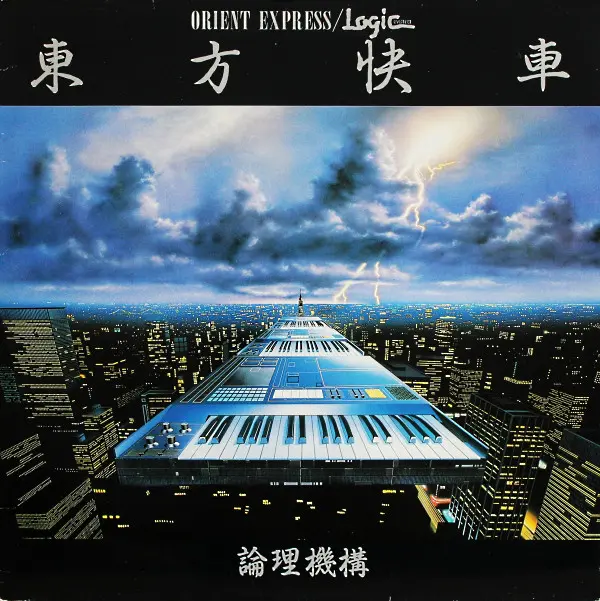 Logic System released its third album, Orient Express, on October 1, 1982, on Toshiba-EMI’s Express sublabel.
The third album abandons both the machine-absolutism of Logic and the human-versus-computer framework of Venus in favor of a programmatic concept drawn from Matsutake’s longstanding interest in the historic Orient Express railway. The album imagines a journey along the pre-war Paris-to-Istanbul route, each track corresponding to a place, passage, or figure associated with the line. Matsutake briefed several composers on the concept and asked each to write material accordingly, then programmed and operated the synthesizer parts himself while bringing in session musicians for additional instrumental color. Guitarists Kenji Ohmura and Nobuyuki Shimizu appear across the album’s arrangements; bassist Toshitsugu Goboh anchors the rhythm. Singer Harumi Ozora performs on “Simoon.”
The album’s source material is a mixture of original composition and outside repertoire. “Simoon” is drawn from YMO’s 1978 self-titled debut, here arranged by Masaaki Ohmura and given a vocal reading by Ozora; Matsutake chose the piece partly for its desert resonance — Istanbul, the Orient Express’s eastern terminus, sits near the edge of the Arabian region — and partly to bring a female voice to the album. “In a Persian Market” is an arrangement of Albert Ketèlbey’s 1920 orchestral piece, handled by Matsutake himself. “Classical Gas” draws on Mason Williams’s 1968 guitar composition, arranged by Tsugutoshi Goto. “Karelia” takes its name and character from the Finnish region associated with the train’s northern European route, composed by C. Kaparow and arranged by Kenji Ohmura. “Sofia,” named for the Bulgarian capital on the line, was written by Kazuhiko Kato and arranged by Nobuyuki Shimizu.
The album closes with “Georges Nagelmackers,” written and arranged by Masaaki Ohmura as a tribute to the Belgian entrepreneur who founded the Compagnie Internationale des Wagons-Lits and created the Orient Express. Matsutake had read Nagelmackers’s biography and was struck by a reported ambition to extend the line as far as Tokyo; the closing track reflects on that unrealized plan and on Nagelmackers’s belief that the railway, had it reached Asia, might have averted the conflicts that eventually destroyed the route. The track remained, for Matsutake, the most emotionally resonant piece across the first three Logic System albums.
A1. “Overture” (0:48) — Nobuyuki Shimizu
A2. “Orient Express” (4:13) — Kyohei Tsutsumi
A3. “Simoon” (4:14) — Haruomi Hosono
A4. “Armistice” (4:32) — Kenji Ohmura
A5. “In a Persian Market” (5:46) — Albert Ketèlbey
B1. “Karelia” (2:47) — C. Kaparow
B2. “Wagons-Lits” (4:03) — Nobuyuki Shimizu
B3. “Sofia” (4:21) — Kazuhiko Kato
B4. “Classical Gas” (3:50) — Mason Williams
B5. “Georges Nagelmackers” (4:29) — Masaaki Ohmura
Matsutake produced the album and engineered alongside Atsuo Fujita and Kenji Murata, with assistant engineers Hiroshi Saito, Takashi Ichimura, and Yukie Nakagawa. Takeshi Sasagima and Haruyoshi Shigemitsu served as co-producers. Executive producers were Ichiro Azuma and Kazunaga Nitta.
Toshiba-EMI issued “Orient Express” backed with “Simoon” as a single in 1982. A further pressing paired “Simoon” with “Be Yourself” as a 1983 release.
Discography:
- Logic (1981)
- Venus (1981)
- Orient Express (1982)
Sources:
Artist/Album Pages:
Dee Dee Bridgewater is an American soul and jazz singer from Memphis. After numerous sessions for ...
Dreamboy was an American soul-funk band that released a 1983 extended-play and the 1984 album Cont...
Angela Bofill (May 2, 1954 – June 13, 2024) was an American soul singer/songwriter who released se...
Richard Clapton is an Australian singer-songwriter who debuted with the 1973 Infinity album Prussi...
The Ashby-Ostermann Alliance was an American jazz-rock band from Chicago that released a 1981 self...
Black Uhuru are a Jamaican reggae trio that debuted as Black Sounds Uhro with the 1977 album Love ...
Kim Wilde (born Nov. 18, 1960) is an English pop and dance singer who shot to fame with "Kids in A...
Blood, Sweat & Tears were an American brass-rock/soul band from N.Y.C., formed in 1967 by Blue...
The 7th Wonder was an American soul-funk band from Tuskegee that released the 1978/79 Parachute al...
Gaskin was an English hard-rock/metal band that released the 1981/82 Rondelet albums End of the Wo...
Frank Marino is a Québécois guitarist, vocalist, and songwriter who fronted the hard-rock trio Mah...
Murasaki was a Japanese hard-rock band from the island of Okinawa. They made the 1975/76 Bourbon a...