

Il Volo was an Italian symphonic-rock supergroup that released the 1974/75 albums Il Volo and Essere o Non Essere? on Numero Uno.
Members: Alberto Radius (guitar, vocals), Mario Lavezzi (guitar, mandolin, vocals), Vince Tempera (keyboards), Gabriele Lorenzi (keyboards), Bob Callero (bass), Gianni Dall’Aglio (drums, percussion, vocals)
Background
Il Volo (The Flight) formed in early 1974 as a studio-based project uniting six veteran musicians from across the Italian pop and rock scene. Guitarist–vocalist Alberto Radius and keyboardist Gabriele Lorenzi had just disbanded Formula 3, a long-running trio affiliated with producer Mogol and singer–songwriter Lucio Battisti. Their departure from Formula 3 marked a deliberate shift toward more expansive and collaborative musical territory.
They teamed with guitarist–vocalist Mario Lavezzi, a former member of I Camaleonti and the experimental project Flora Fauna Cemento. The rhythm section brought in Bob Callero, who had played with both Osage Tribe and the instrumental jazz-rock unit Duello Madre, and drummer Gianni Dall’Aglio, previously with the beat group I Ribelli. Rounding out the sextet was Vince Tempera, a prolific session keyboardist and composer known for his work in Pleasure Machine and studio arranging across the Numero Uno roster.
All six members brought substantial studio and live experience to the project, and their prior affiliations shaped the group’s hybrid approach. Rather than forming for touring purposes, Il Volo assembled expressly to create sophisticated, studio-crafted albums under the production of Mogol, a veteran lyricist and co-founder of Numero Uno, a subsidiary of RCA Italiana.
Il Volo
 Il Volo released their self-titled debut album in 1974 on Numero Uno.
The album marks a studio-based collaboration between veterans of Formula Tre, Camaleonti, Osage Tribe, Flora Fauna e Cemento, Duello Madre, and I Ribelli. While rooted in songform and cinematic textures, the album presents a brief, ornate collection shaped by its dual keyboard and guitar arrangements. In contrast to their predominantly instrumental 1975 follow-up, this release centers on vocal expression, studio effects, and concise structures that flirt with fusion and symphonic elements without indulging in extended instrumental passages.
Alberto Radius plays electric and acoustic guitars, electric sitar, and sings select leads. Mario Lavezzi contributes 12-string, electric, acoustic, and electric mandolin parts while also handling vocal duties. Vincenzo Tempera alternates piano, Fender Rhodes, and clavinet, anchoring transitions and layering harmonic content. Gabriele Lorenzi adds organ, Eminent and Moog synthesizers, and harpsichord embellishments. Roberto Callero underpins each track with bass figures that often define the album’s pulse. Gianni Dall’Aglio multi-tasks on drums, congas, and vocals, providing percussive texture and vocal support.
Il Volo group-composed the album’s eight tracks, which contain verses by veteran lyricist and Numero Uno co-founder Mogol (Giulio Rapetti).
“Come Una Zanzara” opens with ambient phrasing before giving way to syncopated electric piano and sitar accents, underscored by sharp rhythm shifts and a recurring vocal motif that reappears throughout the album. “La Mia Rivoluzione” begins with acoustic guitar and falsetto vocals, then builds into a mid-tempo shuffle marked by a gliding string-synth layer and a delayed electric guitar solo. “Il Calore Umano” opens with staggered keyboard pulses and drum flourishes, followed by a chordal break and radiant lead guitar phrasing. “Il Canto Della Preistoria” starts with spoken narration before settling into a folk-like acoustic section; the vocal phrasing is punctuated by harpsichord and synth textures.
The second side leans into balladic and rhythmic contrasts: “I Primi Respiri” merges 3/4 waltz phrases with layered vocals and electric mandolin; “La Canzone Del Nostro Tempo” opens with bass-driven syncopation and escalates into polyphonic key–guitar interplay; “Sonno” stretches falsetto phrasing over delicate acoustic piano and ensemble swells; and “Sinfonia Delle Scarpe Da Tennis” closes the album with a shuffling organ-led figure, whimsical vocal inflections, and harpsichord punctuation.
A1. “Come Una Zanzara” [Like a Mosquito] (4:21) — reprises its main vocal motif across the album; includes electric sitar and phased electric piano
A2. “La Mia Rivoluzione” [My Revolution] (3:58) — built on acoustic shuffle rhythm; features vocal falsetto and delayed lead guitar
A3. “Il Calore Umano” [Human Warmth] (4:43) — opens with layered synth and string textures; transitions to vocal choral work and solo guitar
A4. “Il Canto Della Preistoria” [The Song of Prehistory] (4:34) — begins with narration; alternates folk guitar with harpsichord and synth interjections
B1. “I Primi Respiri” [First Breaths] (3:52) — phrased in waltz-time with whisper vocals, electric mandolin, and string textures
B2. “La Canzone Del Nostro Tempo” [Our Time’s Song] (4:14) — opens with syncopated bass riff; develops into alternating vocal–keyboard sections
B3. “Sonno” [Sleep] (4:08) — falsetto vocal over acoustic guitar and piano; includes final electric guitar reprise
B4. “Sinfonia Delle Scarpe da Tennis” [Symphony of Sneakers] (2:58) — lighthearted closer with organ, barrelhouse piano, and harpsichord
Sessions occurred in Milan at Ricordi Studios, where Mogol produced the album months after the initial Formula 3 swan song, La Grande Casa.
Essere o Non Essere?
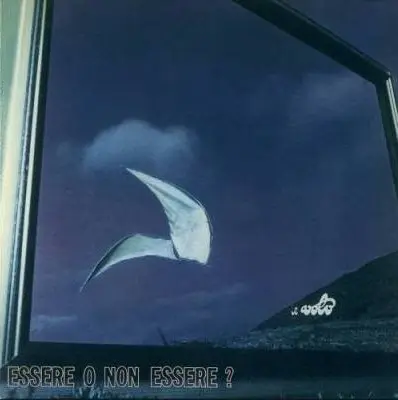 Il Volo released their second album, Essere o Non Essere?, in 1975 on Numero Uno. The title is Italian for “To Be or Not to Be?” – the famous monologue from Shakespeare’s Hamlet.
The album marks a decisive turn from the vocal-led pop structures of their debut toward ensemble-driven instrumental forms. With only one sung track and wordless phrases used sparingly elsewhere, the group pivoted toward expansive textures, jazz phrasing, and unorthodox fusion voicings—anchored by clavinet lines, electric sitar, Fender Rhodes, and tight rhythmic interplay. Compared to the prior album’s melodic restraint, Essere o Non Essere? adopts a looser, modal framework with wider harmonic spacing and sectional unpredictability.
Alberto Radius plays electric guitar with modulated sustain and sitar accents, adding angularity to the ensemble’s phrasing. Mario Lavezzi alternates 12-string and electric textures with clipped rhythm figures and acoustic overlays. Vince Tempera commands Rhodes, clavinet, and string synths with clustered runs and modal beds. Gabriele Lorenzi reinforces the harmonic palette with Moog voicings and organ gestures that track shifting meters. Bob Callero drives the pulse with dense, pulsing bass figures and responsive countermelodies. Gianni Dall’Aglio builds texture with rim accents, Latin snare fills, and dry tom phrasing across shifting rhythmic modes.
Radius co-wrote four songs with Lavezzi, who composed “Essere” with lyrics by Mogol. Lorenzi and Tempera co-wrote “Alcune Scene.” The album concludes Dall’Aglio’s composition “Canti e Suoni.”
The album opens with “Gente in Amore,” a phased instrumental suite that balances acoustic guitar overlays with sitar, string-synth, and throbbing low-end, interrupted by murmured voice layers. “Medio Oriente 249000 Tutto Compreso” and the brief “Canto di Lavoro” form a two-part sequence with sitar leads, percussion cycles, and modal keyboard overlays that evoke Near Eastern tonalities. “Essere,” the only lyrical track, centers on subdued vocals and Rhodes-driven tension with clipped rhythm guitar and rising cadences.
“Alcune Scene” alternates free-time texture and brisk fusion overlays, using slow–fast transitions and Moog–clavinet duels. “Svegliandomi Con Te alle 6 del Mattino” builds from reverberant guitar and ambient synth pads into chromatic jamming with Fender piano crescendos. “Canti e Suoni” closes the album with layered falsetto motifs, echo-slap percussion, and looped synth figures in gradual crescendo.
A1. “Gente in Amore” [People in Love] (5:03) — string-synth opener with electric sitar and acoustic overlays; features recurring voice motifs and modal transitions
A2. “Medio Oriente 249000 Tutto Compreso” [Middle East 249000 All-Inclusive] (5:46) — includes sitar solo, synth sax voicing, and dry conga patterns
A3. “Essere” [To Be] (4:03) — sole vocal track; subdued melody over clavinet, electric piano, and layered rhythm guitar
B1. “Alcune Scene” [Some Scenes] (6:16) — free-time intro with swelling Moog; turns to fast sectional trade-offs and Fender–guitar dialogues
B2. “Svegliandomi Con Te alle 6 del Mattino” [Waking With You at 6 AM] (5:17) — ambient prelude leads to chromatic keyboard-guitar jamming
B3. “Canti e Suoni” [Chants and Sounds] (4:23) — falsetto voice fragments over circular synth and rhythmic accelerando
Mogol produced the album at Studio Il Mulino with engineers Gianni Prudente and Riccardo Pizzamiglio. Essere o Non Essere? appeared in a blue-sky gatefold designed by Marco Locci with photography by Piero Migliorisi and illustrations by Miloto.
Postlude
In 1975, the members of Il Volo collaborated with Fausto Leali on his album Amore dolce, Amore amaro, Amore mio, contributing instrumentation and arrangements. Following the release of Essere o Non Essere?, bassist Bob Callero—credited as “Olov” and pictured only from behind on the debut LP—departed and was briefly replaced by Michele Seffer, formerly of Era di Acquario. No further recordings were made, and Il Volo disbanded later that year.
Discography:
- Il Volo (1974)
- Essere o Non Essere? (1975)
Sources:
Artist/Album Pages:
Sweet was an English hard-rock/pop band from Harefield, Greater London, that released four studio al...
Paice Ashton Lord was an English hard-rock band that released the album Malice in Wonderland on Oy...
Sandra Wright (Oct. 1, 1948 — Jan. 11, 2010) was an American soul singer from Memphis who recorde...
Nada (born Nov. 17, 1953) is an Italian singer, songwriter, and actress who reached national promi...
Steeleye Span was an English folk-rock band that debuted with the 1970 RCA release Hark! The Villa...
Illusion was an English folk-rock band behind the 1977/78 Island albums Out of the Mist and Illusion...
Orchestra Julian was a Venezuelan jazz-funk ensemble led by producer and arranger Julian Romero. The...
Satchitananda was an American symphonic/jazz-rock band behind the 1978 album A Thought Away. Mem...
Gordon Giltrap (born April 6, 1948) is an English classical guitarist and composer who released tw...
Kayak was a Dutch art-pop band that released eight albums between 1973 and 1981 on EMI and Vertigo...
Chaka Khan (born March 23, 1953) is an American soul singer who first emerged as the featured voca...
Bernie Worrell (April 19, 1944 — June 24, 2016) was an American funk keyboardist, composer, and ar...