

Igra Staklenih Perli was a Yugoslav space-rock band that released the 1979/80 RTB albums Igra Staklenih Perli and Vrt Svetlosti. Pre-record material (1976–78) surfaced on the archival discs Inner Flow and Drives.
Members: Svaba the Kraut [aka Zoran Lakić] (keyboards, 1976-1985), Joshua N’Goma [aka Vojkan Rakić] (guitar, 1976-80), Predrag Vuković (percussion), Draško “Dracula” Nikodijević (bass, synthesizer, vocals), Dragan Šoć (drums, 1977-85), Slobodan Trbojević (bass, 1978-85), Ivan Pajević (guitar, 1980-85)
Background
Igra Staklenih Perli formed in 1976 in Belgrade, where keyboardist Zoran Lakić (“Švaba”), guitarist Vojkan Rakić, and percussionist Predrag Vuković came together as school friends inspired by Pink Floyd, Tangerine Dream, Hawkwind, and Jimi Hendrix. They named their group after The Glass Bead Game, the 1962 post-apocalypse novel by German philosophical author Hermann Hess. Vuković, an art-history major, designed their visuals. Bassist Draško “Drakula” Nikodijević completed the initial lineup, which moved from rehearsal work into live activity.
ISP played mid-1977 shows at Dadov Theatre and the Tokovi Amateur Festival (Voždovac). That autumn, they on-boarded drummer Dragan Šoć and gave free Belgrade concerts at Block 45 and the Belgrade Students’ Cultural Center, which drew enough local momentum for a contract with PGP-RTB.
Igra Staklenih Perli
 Igra Staklenih Perli released their self-titled debut album in 1979 on RTB.
The album delivers cyclic, “stream of consciousness” pieces with guitarist Vojkan Rakić and keyboardist Zoran Lakić in a constant exchange of lead lines, sustained layers, and counterpoint, underpinned by bassist Draško Nikodijević and drummer Predrag Vuković, who holds pulse amid shifts in density.
“Gušterov trg” opens on sparse space and then locking into a more insistent march before the vocal enters, while the guitar pushes forward with brighter lead breaks as the track gains speed. “Solarni modus” starts on piano, drums, and guitar in a steadier frame, then brings the guitar up in the mix mid-track for a sharper, more direct center of gravity.
“Putovanje u plavo” rides a steady beat from the outset, adds heavier weight around the early turns, then lets a long guitar surge take over late, after which the rhythm keeps moving as the top layer drops back into effects and haze. “Pečurka” begins in a low, humming shadow, introduces a slow pound and whispered vocal, then climbs into a thicker, louder crest before easing back down. “Majestetski kraj” closes on organ-led momentum that builds from a measured start into a stronger, more driving finish.
Despite the titles, ISP use English lyrics apart from “Putovanje u plavo,” a Serbo-Croatian-sung track. They conceived “Pečurka” as a tribute to German Krautrock pioneers Can.
A1. “Gušterov trg” [Lizard Square] (4:32)
A2. “Solarni modus” [Solar Modus] (4:07)
A3. “Putovanje u plavo” [Voyage into Blue] (6:49)
B1. “Pečurka” [Mushroom] (7:07)
B2. “Majestetski kraj” [Majestic End] (5:19)
ISP recorded the album in August 1978 at Studio V (PGP RTB) with engineer Tahir Durkalić.
Predrag Vuković designed the album cover: a stark black field with high-contrast red-and-white illustration and lettering. At left, a stylized, mask-faced figure in an oversized, circular hat holds a long-necked stringed instrument, with ribbon-like red forms and decorative lines wrapping around the body and neck; white ornamental shapes at the bottom read as smoke, waves, or foliage rising into the figure. At right, the band name appears in ornate, jagged script, outlined in red, floating over a loose red graphic that suggests orbiting trails, starburst rings, and a small horned profile with a single bright “eye,” giving the whole layout a surreal, cosmic-poster feel.
After the album’s release, ISP performed at the Belgrade Faculty of Dental Medicine. DJ Goran Cvetić, a local journalist, ran their lights and slides. His tape of the show later surfaced on the archival disc Soft Explosion Live.
Between albums, Draško Nikodijević cleared for bassist Slobodan Trbojević.
Vrt Svetlosti
 Igra Staklenih Perli released their second album, Vrt Svetlosti, in 1980 on RTB.
Vrt Svetlosti builds their fantasy/sci-fi framework with heightened emphasis on Zoran Lakić, whose synthesizer and phased organ layers submerge Vojkan Rakić across lengthy passages. New bassist Slobodan Trbojević holds the backbone with Dragan Soć; accented further by Predrag Vuković, whose percussion fills extended structures.
“Igrač” runs past ten minutes and leans on extended development around the vocal, while the title track brings a clearer vocal focus with a folk/renaissance-adjacent phrasing in the topline. Elsewhere the record relies more on instrumentals, where steady, upbeat pacing sits under thick keyboard textures, occasional fusion-esque turns, and female vocal passages that punctuate the longer arcs, with an overall mix that retains a rough, low-polish character.
A1. “Igrač” [Dancer] (10:10)
A2. “Čarobnjaci” [Wizards] (7:20)
B1. “Vrt svetlosti” [The Garden of Light] (9:23)
B2. “Lunarni modus” [Lunar Modus] (3:42)
B3. “Sanjaš” [You Are Dreaming] (4:43)
Sessions spanned July 1979 through January 1980 at Studio V (PGP RTB) with producer Aleksandar Pilipenko.
Predrag Vuković co-designed the intended cover with Dejan Popov, but RTB vetoed their visuals. ISP promoted the album with a fashion show event at Beko Hall in Belgrade.
Soft Explosion Live
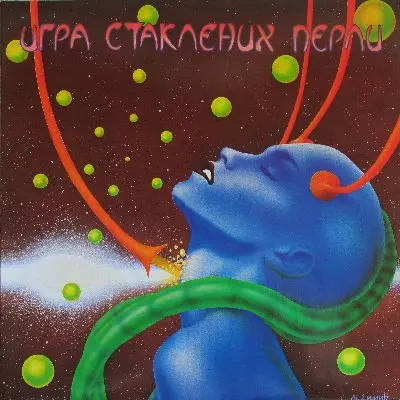 In 1991, Kalemegdan Disk issued Soft Live Explosion, sourced from Goran Cvetić’s tape recording of the 1979 Igra Staklenih Perli concert at the Belgrade University Medical College.
They open the set with “Tiha Eksplozija,” where an on-mic band introduction leads into darker soundscape sections before the tempo tightens into a stronger, more rhythmic drive; a later dip in intensity brings the vocal forward in sustained, crying lines. “Gušterov Trg” adds English vocals over prominent bass-and-guitar weight, with spacey synth accents cutting across the top. “Pečurka” centers organ color and close, murmured singing on a steady pulse. “Putovanje u Plavo” starts in haze, then pivots once an urgent bass line arrives, with drums locking in behind it and synth lines shooting outward above the beat.
A1. “Tiha Eksplozija” [Soft Explosion] (12:37)
A2. “Kvadrant G” [Quadrant G] (8:23)
B1. “Gusterov Trg” [Lyzzard Square] (5:29)
B2. “Pečurka” [Mushroom] (7:51)
B3. “Putovanje u Plavo” [Voyage into Blue] (5:48)
B4. “Povratak na Gusterov Trg” [Return to Lyzzard Square] (4:32)
Inner Flow
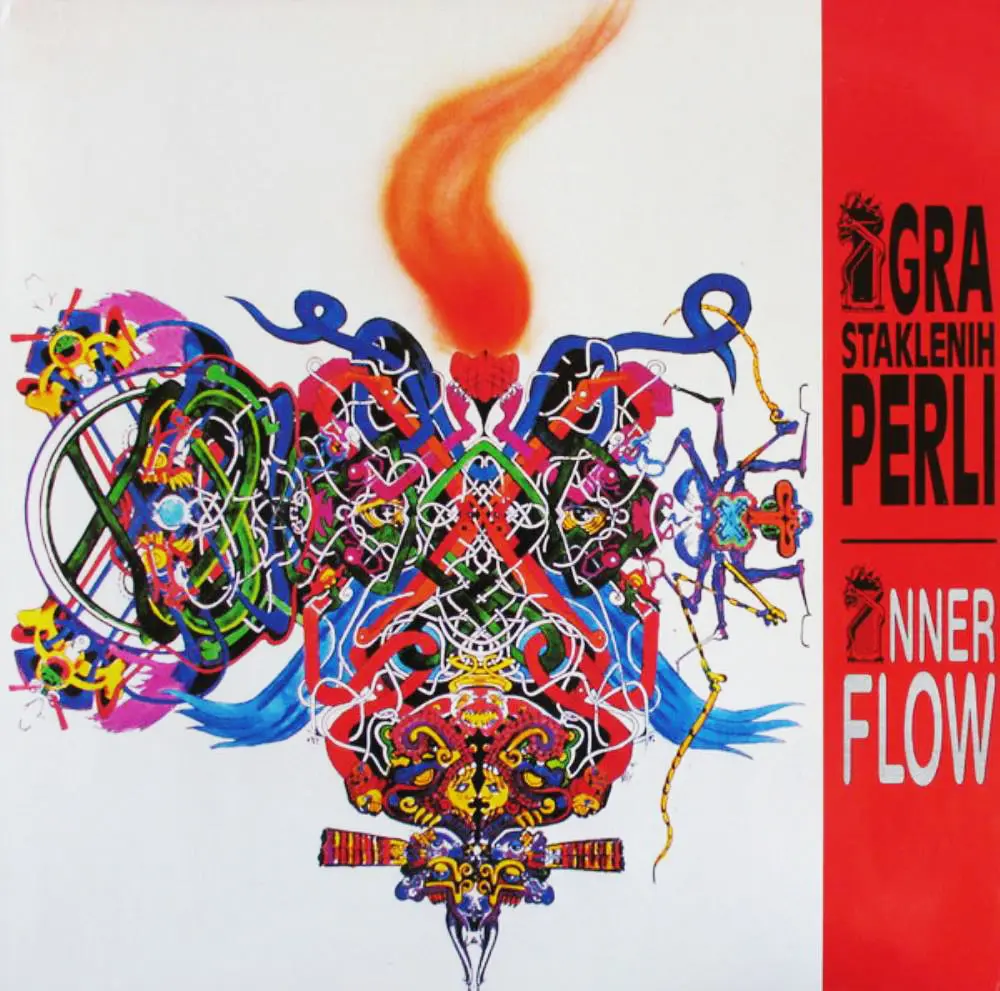 In 1992, Kalemegdan Disk released Inner Flow, a collection of 1976–77 material by Igra Staklenih Perli.
The set documents ISP their earliest studio experiments with intertwined lead figures and layered textures by guitarist Vojkan Rakić and keyboardist Zoran Lakić, anchored by their original rhythm section with Draško Nikodijević and Predrag Vuković.
Inner Flow opens with “Flow Access,” which pairs abrasive bursts with a low, steady pulse, then moves into “Hotel Wave,” where light keys set the bed before bass, drums, and guitar lock in and the tempo tightens after the midpoint, with brief vocal lines near the end. “Magic Machine” starts on organ, bass, and beat, adds guitar, then breaks into a spacey gap before darker voices surface late, while “Lake of Lily” rides a rhythm that accelerates as organ joins, with vocals that appear and then drop out quickly.
Side two leans harder on repetition and pressure: “Drakula’s Dance” drives on heavy rhythm and abrasive guitar with the bass stepping forward late, “Inner Flow” builds from percussion and organ into extended guitar lead work, drops into a spaced-out section, then returns for a louder final push, and “Balkan IV” closes on atmosphere with intermittent guitar and sound fragments, with vocal sounds and samples entering after the midpoint.
A1. “Flow Access” (1:44)
A2. “Hotel Wave” (4:58)
A3. “Magic Machine” (8:00)
A2. “Lake of Lily” (6:41)
B1. “Drakula’s Dance” (6:57)
B2. “Inner Flow” (12:05)
B3. “Balkan IV” (4:08)
Sessions occurred at Joshua’s Attic in the months after ISP’s formation. “Inner Flow” dates from a 1978 live performance at SKC in Belgrade.
The cover uses a stark white field dominated by a symmetrical, inkblot-like illustration that reads as a hybrid of mask, circuitry, and ornamental filigree. A flame-shaped orange plume rises from the top center like a candle flare, while the mirrored body below stacks dense red, blue, green, and black linework—loops, knots, and lattice patterns—into a totemic form with small eye-like details and curling extensions that spill outward at the sides.
Drives
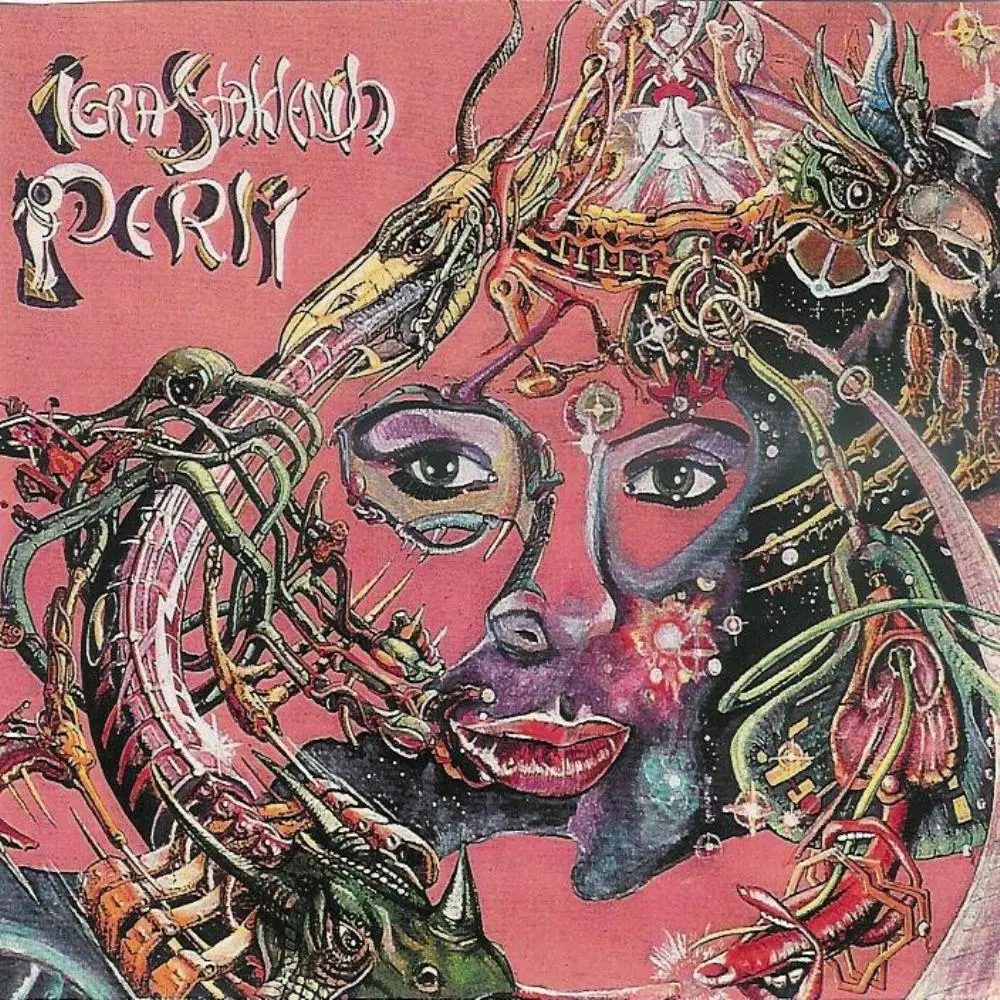 In 1993, Kalemegdan released Drives, a collection of 1978 material by Igra Staklenih Perli.
Drives captures long-form improvisations in rehearsal settings by the Nikodijević lineup, with extended passages of sustained hum and low-level drift that occasionally cohere into a steadier pulse.
“Return…” carries a more clearly defined through-line and forward push than the surrounding material, and it connects to the “Return to Lyzzard Square” performance later issued on Soft Explosion Live. The recording keeps a room-captured, private-tape character throughout, and the set stays centered on open-ended development across long durations.
A1. “Warriors” (13:10)
A2. “Return …” (7:27)
B1. “Crazee – Lazee” (6:22)
B2. “Drives” (16:43)
Vuković illustrated the cover in his signature style. It sets the band name and album title in warped, hand-drawn letters at the upper left over a dusty rose background, then fills the frame with a dense surreal collage centered on a woman’s face. Her features split into contrasting color fields—one side warmer, the other shaded and space-speckled—while insectile and mechanical forms swarm around her head like a crown: horned beetle shapes, articulated tubes, cables, and metallic fragments that arc in from both sides. Small starbursts and jewel-like highlights punctuate the darker half of the face, and the surrounding mass of segmented limbs and conduits creates a bio-mechanical halo that crowds the portrait to the edges.
Discography:
- Igra Staklenih Perli (1979)
- Vrt Svetlosti (1980)
- Inner Flow (1992, recorded 1976–1977)
- Drives (1993, recorded 1978)
Sources:
- Discogs: Igra Staklenih Perli
- MusicBrainz: Igra Staklenih Perli
- RYM: Igra Staklenih Perli
- ProgArchives: Igra Staklenih Perli
Artist/Album Pages:
Henry Badowski (born Oct. 3, 1958) is an English New Wave/synthpop songwriter and multi-instrument...
Albania was a Scottish New Wave band that released multiple singles and the album Are You All Mine i...
Aardvarks were an Austrian hard-rock band that self-released four albums between 1982 and 1990 on ...
Ali Thomson is a Scottish art-pop vocalist and songwriter behind the 1980/81 A&M albums Take a...
Pylon was an American new wave band from Athens, Ga., that debuted with the 1979 single "Cool" / ...
Metro was an English symphonic/art-pop combo that was active through two iterations between 1976 and...
Ozzy Osbourne (December 3, 1948 – July 22, 2025) was an English hard-rock/metal singer who gained ...
Panaché was an American soul-funk duo that released the 1979 album This Is Panaché on self-press R...
Loudness was a Japanese hard-rock/metal band with guitarist Akira Takasaki. They debuted with the ...
Sortilège was a French hard-rock/metal band that emerged with a 1983 EP on Rave-On, followed by th...
The Landress / Hart Group was an American jazz-rock band behind the 1981 album Dancing Moments on...
EPO (エポ) — born Eiko Sato (佐藤榮子) on May 12, 1960 — is a Japanese singer-songwriter from Tokyo who ...