
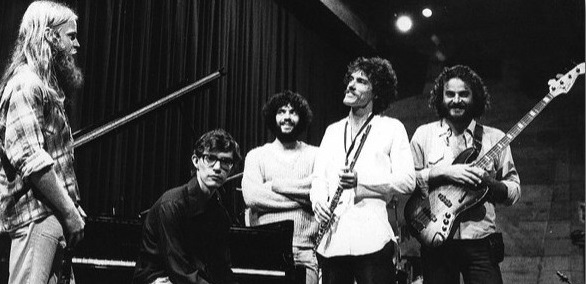
Grupo Um was a Brazilian avant-jazz/rock band that released three albums between 1979 and 1983 on Tapecar, Y, and Lira Paulistana.
Members: Lelo Nazario (electric piano, keyboards), Zé Eduardo Nazario (drums, percussion, khene), Zeca Assumpção (electric bass, piano, 1976-80), Carlinhos Gonçalves (percussion, 1977-80), Rodolfo Stroeter (electric bass, acoustic bass, 1980-84)
Background
Grupo Um originated in 1975 in São Paulo when keyboardist Lelo Nazario and drummer-percussionist Zé Eduardo Nazario teamed with bassist Zeca Assumpção, fellow members of the Hermeto Pascoal ensemble.
The Nazario brothers grew up with classical, jazz, and bossa nova records in the home of journalist Joaquim Pinto Nazário, a director of Diário de São Paulo. Zé Eduardo took childhood piano lessons and began drums at twelve. At thirteen, he turned professional with Xangô Três, a samba-jazz trio, and worked with pianist Mário Albanese on the five-beat jequibau rhythm. He later accompanied pianist Tenório Júnior at Totem and formed the Grupo Experimental de Percussão de São Paulo with Guilherme Franco.
Lelo studied piano from age four and discovered musique concrète through the 1959 compilation Musique Concrète N° 1, a gift from a family friend. The brothers experimented with tape and percussion at home.
In 1973, Zé Eduardo joined Hermeto Pascoal after a substitute engagement in Londrina. Lelo attended the daily rehearsals and joined after drummer-keyboardist Nenê left for Elis Regina. The brothers also teamed with Argentine saxophonist Hector Costita in Malika, which combined South American folk music with jazz.
Assumpção studied at Berklee College of Music in Boston. He also played with Zé Eduardo in Mandala, a quintet that cut a 1976 album for Morisom.
During breaks between engagements with Hermeto, the trio rehearsed originals in a basement on Rua Teodoro Sampaio in Pinheiros. Composer-arranger Rogério Duprat invited Zé Eduardo to use the nearby Vice-Versa studio during construction, then enlisted the trio to test the completed room. In 1975, they cut two days of material with engineer Renato Viola, later issued as Starting Point. Lelo played prepared piano and Fender Rhodes alongside the bass and percussion.
In July 1976, the brothers performed with synthesist Luiz Roberto Oliveira at the Museu de Arte de São Paulo, where they combined piano and percussion with ARP synthesizer and prerecorded tape. Lelo learned synthesizer operation from Oliveira and developed “Mobile/Stabile,” an electroacoustic composition with taped electronic passages for live instrumental improvisation.
When Pascoal relocated to Rio de Janeiro, the trio stayed in São Paulo to pursue their own material. Grupo Um debuted under that name in March 1977 at Parque do Morumbi with an expanded ensemble that included trumpeter Márcio Montarroyos. The trio added saxophonist Roberto Sion and percussionist Carlinhos Gonçalves for the November sessions at Vice-Versa B, later issued as Nineteen Seventy Seven.
Through Montarroyos, Zé Eduardo took the tapes to Som Livre, where producer Guto Graça Mello declined the material. Grupo Um performed with Montarroyos at the 1978 São Paulo International Jazz Festival, where organizers cut the tape playback during “Mobile/Stabile” amid a dispute over the allotted performance time.
After unsuccessful approaches to record companies, Lelo consulted pianist Antonio Adolfo about independent production. Adolfo had self-released the 1977 Artezanal album Feito em Casa.
Zé Eduardo also worked with Egberto Gismonti in Academia de Danças and joined Assumpção and saxophonist-flutist Mauro Senise on the 1978 album Nó Caipira. After the May 1979 return from the Tropical Jazz Rock tour, the drummer left Academia de Danças and resumed work with Grupo Um. The trio retained Gonçalves and recruited Senise in place of Sion.
Grupo Um financed the sessions and a thousand-copy LP pressing. On September 26–27, 1979, the musicians cut Marcha Sobre a Cidade at the four-track Vice-Versa B studio.
Discography:
- Marcha sobre a cidade (1979)
- Reflexões sobre a crise do desejo…/ (1981)
- A flor de plástico incinerada (1983)
References and notes
- Marcha Sobre a Cidade: um marco na história da vanguarda — official anniversary booklet, 2025, printed pages 7 and 72. Dates the origin to 1975 and distinguishes the first issued album from the earlier studio recordings. The production history identifies Antonio Adolfo as a model for independent release. This updated chronology supersedes the 1976 formation date in older biographies. (UTOPIA Studio, official booklet)
- Lelo and Zé Eduardo Nazario interview — June 2, 2026. Direct answers establish the early piano studies, Xangô Três, the Albanese connection, the childhood musique concrète record, and the percussion experiments. Zé Eduardo explains the Londrina engagement, recruitment by Hermeto, the subsequent arrival of Lelo, and the Vice-Versa studio test. (Joshua Minsoo Kim, Tone Glow)
- Zé Eduardo Nazario interview — March 2, 2026. Identifies father Joaquim Pinto Nazário and the editorial position at Diário de São Paulo. Nazario describes the household record collection and carefully distinguishes the contribution to the jequibau drum pattern from authorship of the rhythm. (Guilherme Espir, NOIZE)
- Zeca Assumpção — personal testimony and curriculum. Documents studies in music, arrangement, and composition at Berklee, four years with Hermeto Pascoal, and participation as a Grupo Um founder. Published alongside a first-person remembrance of cousin Nico Assumpção. (Official Nico Assumpção memorial website)
- Mandala — Morisom album documentation, 1976. Catalogues the five musicians and individual instrumental credits, including Assumpção, Nazario, Sion, Ayres, and Oliveira. Confirms the prior recorded association and the album date without treating 1976 as the formation year. (Maria Luiza Kfouri, Discografia Brasileira)
- Starting Point — official release documentation, February 17, 2023. Identifies the 1975 basement experiments, two-day Vice-Versa session, engineer Renato Viola, prepared piano, electric piano, and the bowed and struck saw blade. The release date establishes the archival status of these recordings. (Far Out Recordings, official Bandcamp edition)
- Lelo and Zé Eduardo Nazario interview feature — February 10, 2026. Supplies the March 1977 Parque do Morumbi concert, first use of the Grupo Um name, November session date, and synthesizer instruction from Luiz Roberto Oliveira. Direct recollections explain the electronic tape beneath “Mobile/Stabile.” (Bret Sjerven, Bandcamp Daily)
- Zé Eduardo Nazario retrospective — reproduced October 16, 2017. Reproduces a signed account from the former official website. Documents the July 1976 MASP concert with Oliveira, the partial interruption caused by work with Gismonti, and the May 1979 return from the Tropical Jazz Rock tour. The opening chronology predates the later identification of the 1975 tapes. (Zé Eduardo Nazario, reproduced by Woodstock Sound)
- Nineteen Seventy Seven — official archival release documentation, 2026. Confirms the expansion to a quintet with Sion and Gonçalves and the direct recording method at the small Vice-Versa B studio. Separately identifies the 1978 festival performance and interruption of “Mobile/Stabile.” (Far Out Recordings, official Bandcamp edition)
- “Atitude muda: o Grupo Um, a produção musical independente e o Lira Paulistana (1976–1984)” — 2020. Draws on interviews with both brothers and a 1980 Aramis Millarch interview. Documents the Som Livre approach through Montarroyos, the refusal from Guto Graça Mello, consultation with Adolfo, and payment for recording and pressing. Places the Lira association after the album sessions. (Renan Branco Ruiz, Caminhos da História, volume 25, number 2)
- Nó Caipira — official reissue credits. Confirms the shared album credit for Zé Eduardo Nazario, Zeca Assumpção, and Mauro Senise with Egberto Gismonti. The displayed 1993 release date belongs to the Carmo CD edition. (Carmo / ECM Records)
- Mauro Senise — official biography. Names flute teacher Odette Ernest Dias and saxophone teacher Paulo Moura. Confirms the early ensemble work and guest appearances on two Grupo Um albums. (Mauro Senise, official website)
- Marcha Sobre a Cidade — original credits and 2002 liner notes. Gives the September 26 recording date, September 27 mix date, four-track studio conditions, independent financing, and initial thousand-copy edition. Lelo explicitly identifies Senise as the replacement for Sion before the LP; Sion appears on material added to the CD edition. (Lelo Nazario and Irati Antonio, official album history)
Artist/Album Pages:
Marc & the Mambas were an English cabaret-goth band led by singer–musician Marc Almond, conduc...
Dalis Car was an English art-pop duo comprised of former Japan bassist Mick Karn and ex-Bauhaus vo...
The Korgis were an English pop-rock band that charted with "If I Had You," "Everybody's Got to Lea...
Mother Goose was a New Zealander art-rock band behind the 1977–79 Mushroom albums Stuffed and Don'...
Raven are an English metal band that released three albums and a live disc between 1981 and 1984 on ...
Face Dancer was an American hard-rock band behind the 1979/80 Capitol albums This World and About ...
Delta 5 was an English post-punk band that released three 1979–80 Rough Trade singles and the 1981...
Eduardo Bort (January 2, 1948 – February 27, 2020) was a Spanish musician and composer who release...
Pepe Sánchez y Su Rock Band were a Spanish Latin-jazz/rock band behind the 1976 Marfer album Regre...
Mamba was a Swedish Latin/jazz-rock band behind a 1979 self-titled album on Sonet. Danish bassist...
Casa das Máquinas was a Brazilian symphonic/hard-rock band that released three albums between 1974...
Badfinger was a Welsh pop-rock band first called The Iveys, which released the 1969 album Maybe T...