

Emmanuel Booz (born 1943) is a French symphonic/folk singer and composer who released four albums and six singles on Barclay, Atlantic, and Polydor during the 1970s.
Background
Emmanuel Booz was born in 1943 in Versailles, Île-de-France, France. Little is known about his childhood, but he was reportedly taken in by members of the French Resistance in Vierzon during the war, where he remained until 1948.
Booz launched his career with the 1969 single “Egregie Le mont des oliviers” backed with “Glorification.”
Au restaurant d’Alice
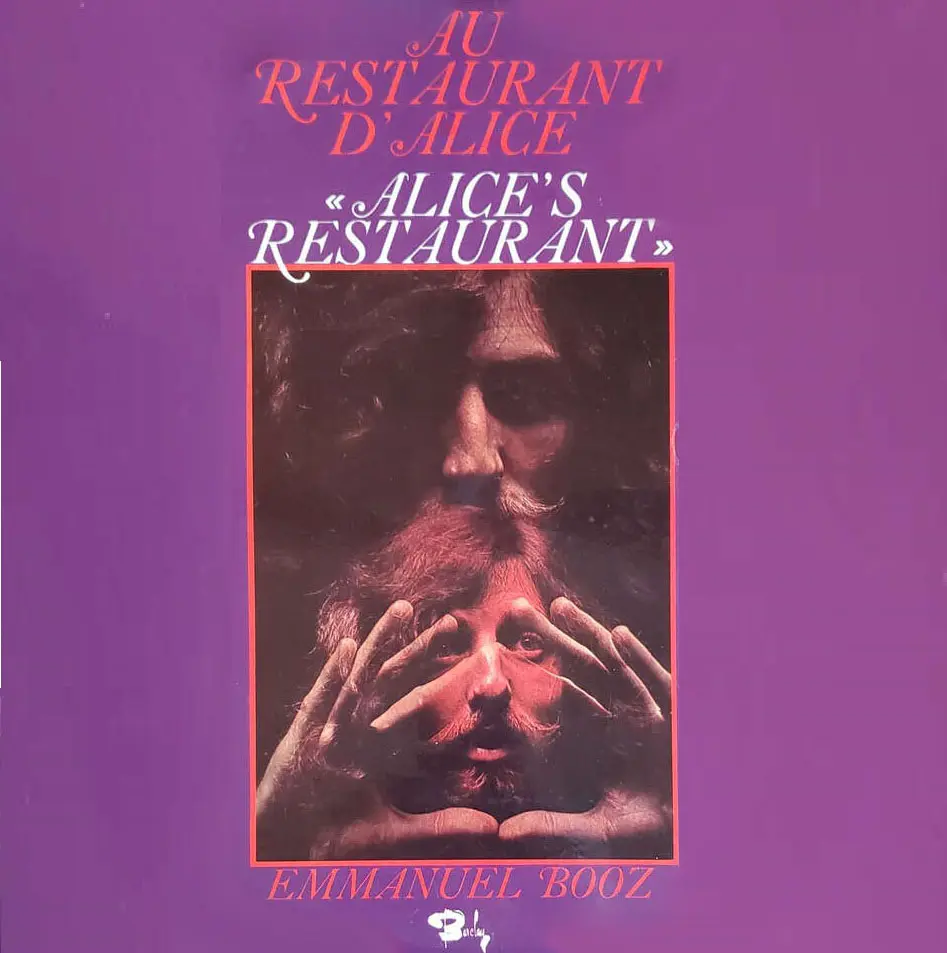 Emmanuel Booz released his debut album, Au restaurant d’Alice, in 1970 on Barclay.
The album opens with a single extended composition on side A and six shorter tracks on side B, highlighting Booz’s early exploration of folk and acoustic styles. Side A interprets Arlo Guthrie’s Alice’s Restaurant, preserving the original ragtime guitar riff while overlaying Booz’s French vocals. Side B shifts to acoustic arrangements reminiscent of 1960s pop-folk, featuring piano, organ, violin, flute, and occasional distorted guitar, emphasizing Booz’s skill in crafting contoured melodies.
Booz performs as vocalist and guitarist. Side B features Maurice Dulac (accordion, flute), with arrangements conducted by Christian Chevallier and Jean Musy.
Booz wrote four of the six tracks on side B. Secondary songwriting contributions include Boris Bergman, Maurice Dulac, Arlo Guthrie, and Woody Guthrie. Side A covers Arlo Guthrie’s Alice’s Restaurant, while B3 (Voitur-Tur-Tur) credits Woody Guthrie in addition to Bergman.
The music divides between the 21-minute side A, a French-language adaptation of Guthrie’s narrative featuring ragtime guitar and organ riffs, and side B’s concise acoustic songs. Tracks on side B alternate between contemplative ballads and upbeat folk-pop numbers, using flute, violin, accordion, and keys to provide tonal variation and highlight Booz’s vocal phrasing.
A1. “Au Restaurant d’Alice” (21:52) — French-language interpretation of Arlo Guthrie’s Alice’s Restaurant, preserving the original ragtime riff and storytelling structure.
B1. “Jean et Jean” (3:40) — co-written by Boris Bergman, Emmanuel Booz, Maurice Dulac, featuring accordion and flute textures.
B2. “Le Vent du Soir” (3:00) — written by Arlo Guthrie and Boris Bergman, soft acoustic instrumentation with piano and organ.
B3. “Voitur-Tur-Tur” (2:10) — Bergman and Woody Guthrie, incorporating folk narrative and rhythmic variation.
B4. “La Robe en Bois” (2:30) — Bergman and Dulac, acoustic arrangement with violin and subtle percussion.
B5. “Rosy Rag” (2:10) — Arlo Guthrie and Bergman, upbeat folk-pop with organ accompaniment.
B6. “Visage” (2:15) — Bergman, Booz, and Dulac, features layered acoustic textures and contoured melodic lines.
Sessions occurred at CTS Studios and Studio Davout with producer Sevac Ekian and engineers John Richards (A) and René Ameline (B1–B6).
Au Restaurant d’Alice features photography by Alain Marouani and Peter Dance.
Barclay promoted the album with the single “Au Restaurant d’Alice” (b/w “Jean et Jean”). In Canada, the follow-up single was “Tout Est Très Bien Comme Ça” (b/w “Ma Terre”) in May 1971.
Le jour où les vaches…
 Emmanuel Booz released his second album, Le jour où les vaches…, in 1974 on Atlantic.
The album presents Booz’s dark, theatrical fusion of symphonic rock and chanson framed by orchestral arrangements and poetic vocal delivery. Backed by three members of the French progressive band Alice — bassist–guitarist Alain Suzan, drummer Doudou Weiss, and guitarist–vocalist Paul Scemama — Booz developed a concept work that alternates between declamatory drama and lush, classical passages. Pianist–arranger William Sheller, known for merging classical and pop idioms, handled much of the orchestration alongside keyboardist Michel Queuriot (organ, synthesizer) and violinist Michel Ripoche (electric violin).
Booz wrote all lyrics and music apart from two pieces by arranger Yvan Jullien. Sheller arranged five tracks and contributed piano parts. Jullien arranged and co-wrote “Espérance” and “Réveillons-nous, Réveillez-vous.”
The album unfolds as a continuous narrative balancing intimate reflection and rising intensity. “Samedi 15 Décembre” opens with Booz’s spoken monologue, setting a tone of isolation and unease. “Espérance” follows with tense, brass-lined motion over pulsing bass. “Réveillons-nous, Réveillez-vous” expands into surging rhythms and Zeuhl-like momentum with declamatory vocals and orchestral crescendos. “Donne” moves from a child’s voice and acoustic calm to operatic tension with strings and layered chanting. “Je Ne Peux Rien Te Dire” opens sparse on piano and fragile vocals, then builds with bass and restrained drums.
“L’Homme aux Mille Clés d’Or” introduces uptempo interplay between organ, bass, and choirs, while “Angoulême” contrasts pastoral verses and violin-led swells. The title track, “Le Jour Où les Vaches…,” combines driving rhythm with organ and vocal counterpoint. “Nous les Enfants” closes the album in an extended, operatic sequence that evolves from pastoral quiet into dense orchestration and dramatic choral interplay.
A1. “Samedi 15 Décembre” [Saturday, December 15] (1:34)
A2. “Espérance” [Hope] (3:08) — music and arrangement by Yvan Jullien.
A3. “Réveillons-nous, Réveillez-vous” [Let’s Wake Up, Wake Yourselves] (6:55) — music and arrangement by Yvan Jullien.
A4. “Donne” [Give] (5:35) — features Sheller on piano and arrangement, with Suzan (bass) and Weiss (drums).
A5. “Je Ne Peux Rien te Dire” [I Can’t Tell You Anything] (4:26) — arranged by Sheller with Queuriot (piano), Suzan (bass), and Weiss (drums).
B1. “L’Homme aux Mille Clés d’Or” [The Man with a Thousand Golden Keys] (4:09) — arranged by Sheller; includes Suzan and Weiss (vocals, rhythm) and Queuriot (organ, synthesizer).
B2. “Angoulême” (4:50) — arranged by Sheller; features Ripoche (electric violin), Suzan and Scemama (guitars), and Weiss (timbales).
B3. “Le Jour Où les Vaches…” [The Day the Cows…] (3:08) — with Booz on lead vocals and organ by Queuriot.
B4. “Nous les Enfants” [We the Children] (8:00) — arranged by Sheller; closes the album with operatic vocals and orchestral layers.
Sessions occurred at Studio Davout in Paris with producers Paul Scemama and Jean-Paul Missey, who also handled recording.
Le jour où les vaches… features cover photography by Claude Mallet and layout by Patrick Serraire.
Atlantic issued the album with the support of WEA Filipacchi Music. Though not promoted with singles, Le jour où les vaches… became regarded as a landmark in theatrical French progressive music for its orchestral scale, emotional range, and lyrical depth.
Between albums, Booz issued a non-album single: “Chanson Liberté” backed with “Et L’On M’Appelle.”
Clochard
 Emmanuel Booz released his third album, Clochard, in October 1976 on Atlantic.
The album presents a darker, more eclectic sound than its predecessor, mixing chanson, spacey jazz–fusion, and folk-based narrative pieces. Booz retained violinist Michel Ripoche and surrounded himself with musicians from the Clearlight circle: bassist–arranger Joël Dugrenot, saxophonist–flutist François Jeanneau, guitarist Yves Chouard, keyboardist Gilles Tinayre, and drummer Serge Haouzi.
Booz wrote six of the album’s eight songs. Dugrenot composed the opener “Un Jour Vous Partirez” and the closing “100 Mille Ans.” The lyrics center on alienation, poverty, and urban decay—recurring motifs in Booz’s work.
The music alternates between somber acoustic chansons and instrumental-rich progressive numbers. “Un Jour Vous Partirez” opens with electronic drones and soprano sax, evoking Terry Riley’s layered minimalism. The title track is spare, voice and strummed guitar framing Booz’s theatrical delivery. “Monsieur le Président” unfolds as a biting political address with active interplay between bass, violin, and reeds. “La Chanson des Pendus” pairs medieval guitar patterns with fatalistic poetry.
On side two, “Assis sur les Trottoirs de ma Ville de Province” builds from subdued vocal passages to soaring sax and violin flights. “À Vous Tous” and “Ma Vie Est Bien Comme Ça” return to introspective chanson form, while “100 Mille Ans” expands into a seven-minute ensemble piece with shifting intensity and symphonic grandeur.
A1. “Un Jour Vous Partirez” [One Day You Will Leave] (6:12)
A2. “Clochard” [Tramp] (3:38)
A3. “Monsieur le Président” (5:24)
A4. “La Chanson des Pendus” [The Song of the Hanged] (5:09)
B1. “Assis sur les Trottoirs de ma Ville de Province” [Sitting on the Sidewalks of My Provincial Town] (6:05)
B2. “À Vous Tous” [To You All] (4:40)
B3. “Ma Vie Est Bien Comme Ça” [My Life Is Fine That Way] (4:01)
B4. “100 Mille Ans” [100 Thousand Years] (7:26)
Sessions occurred at Studio Damiens with Jacqueline Herrenschmidt as producer and Andy Scott as engineer.
Clochard features photography by Charles Éric.
Dans quel état j’erre
 Emmanuel Booz released his fourth album, Dans quel état j’erre, in 1979 on Polydor.
The album expands Booz’s theatrical chanson style into a dense, experimental fusion of hard rock, electronic space textures, and symphonic passages. It features violinist Didier Lockwood, keyboardist–synthesist Gilles Tinayre, guitarist Jean-Claude D’Agostini, bassist Charlie Charrieras, drummers Maurice Mathias and Jean Schultheis, electric pianists Philippe Briche and Roger Doereux, bass clarinetist Gérard Pisani, violist Jean-Louis Mahjun, and violinist Pierre Blanchard.
Booz wrote the lyrics and co-composed the music with Tinayre and D’Agostini, who arranged the material. The album’s three extended tracks divide between large-scale suites and compact ensemble movements.
“Ode aux Rats” [“Ode to Rats”] opens with found-sound effects and builds into a 16-minute suite of guitar distortion, sharp rhythmic changes, and layered synthesizers. Booz alternates shouted and declaimed vocals over surging violin figures and sequenced synth sections that subside into an ambient midsection and re-emerge with climactic intensity. “La Symphonie Catastrophique” [“Catastrophic Symphony”] combines rapid-tempo guitar lines with theatrical vocals, alternating between driving rock sections and slower keyboard-based interludes. “Armoire et Persil” [“Cupboard and Parsley”] closes the album with syncopated rhythms, spacey synthesizers, and surreal lyrics referencing Jacques Brel’s imagery.
A1. “Ode aux Rats” [Ode to Rats] (16:30)
B1. “La Symphonie Catastrophique” [Catastrophic Symphony] (9:45)
B2. “Armoire et Persil” [Cupboard and Parsley] (8:35)
Sessions occurred at Studio Damiens in Boulogne between 1977 and 1979 with Booz as producer and Dominique Do Espirito Santo as recording and mixing engineer, assisted by Xavier Escabasse and Yann Lalau Keraly.
Dans quel état j’erre features photography by Didier Benaouda and James Lignier.
The 2013 CD reissue on Musea adds a fourth track, “Les Morts” (13:48), recorded in the early 1980s.
Later Activity
In 1981, Booz fronted F.F.I., a metal band with Trust drummer Jean-Emile “Jeannot” Hanela and two ex-members of Nightrider: guitarist André Roe and bassist Christian Banet. They cut one single: “L’ère du nucléaire” backed with “Fils de prolo.”
Discography:
- Au restaurant d’Alice (1970)
- Le jour où les vaches… (1974)
- Clochard (1976)
- Dans quel état j’erre (1979)
Sources:
- Discogs: Emmanuel Booz
- RYM: Emmanuel Booz
- 45cat: Emmanuel Booz
- ProgArchives: Emmanuel Booz
- MusicBrainz: Emmanuel Booz
Artist/Album Pages:
Moira was a German jazz-rock sextet led by Embryo co-founder Edgar Hofmann. They released the 197...
Bootsy's Rubber Band was an American funk band from Detroit that released four albums between 1976...
Yvonne Fair (Oct. 21, 1942 — March 6, 1994) was an American soul singer who emerged in the James ...
Mahogany Rush was a Québécois hard-rock trio led by guitarist–singer Frank Marino, a Hendrix-inspi...
Enchantment was an American soul group from Detroit that released six albums between 1976 and 1983...
Zé Ramalho is a Brazilian singer/songwriter who collaborated with Lula Côrtes on the 1975 album Pa...
Slik was a Scottish pop-rock quartet that released five singles and a 1976 album on Bell Records. ...
Mike Mainieri (born July 4, 1938) is an American vibraphonist from the Bronx, N.Y.C., who entered ...
Om was a Swiss avant-jazz quartet that debuted with a 1975 half-live/half-studio album on Indian R...
Jean-Yves Liévaux is a French singer-songwriter who cut multiple Pathé singles and a 1976 self-tit...
The Mark & Clark Band were an American piano-rock duo comprised of twin brothers Mark and Clar...
Andy Fraser (July 3, 1952 — March 16, 2015) was an English bassist and songwriter who rose to prom...