

Mahogany Rush was a Québécois hard-rock trio led by guitarist–singer Frank Marino, a Hendrix-inspired virtuoso akin to Robin Trower. They released the 1973–75 albums Maxoom, Child of the Novelty, and Strange Universe on Kot’ai (20th Century stateside), followed by the 1976–80 Columbia albums IV, World Anthem, Tales of the Unexpected, and What’s Next.
Members: Frank Marino (guitar, vocals), Jimmy Ayoub (drums, 1970-82), Paul Harwood (bass, 1970-86), Vince Marino (guitar, 1980-93), Tim Biery (drums, 1982-93), Peter Dowse (bass, 1986-2006)
Background
Mahogany Rush was formed in 1969 Montreal by 14-year-old Italian-Canadian guitarist Frank Marino (b. Nov. 20, 1954). According to urban legend, he was visited during an LSD trip by the apparition of Jimi Hendrix, who told him to take up guitar. Marino had actually played drums since the age of five. He started playing guitar at age thirteen, inspired by the burgeoning acid rock and blues rock movements.
In the early days, Mahogany Rush played a mix of covers by Hendrix, The Doors, Cream, Pink Floyd, and The Beatles. By 1970, the band settled into its classic trio lineup of Marino, bassist Paul Harwood, and drummer Jimmy Ayoub. As Marino developed an original repertoire, they gigged the Quebecois rock circuit for two years and signed to local-press Kot’ai Records in 1972.
Maxoom
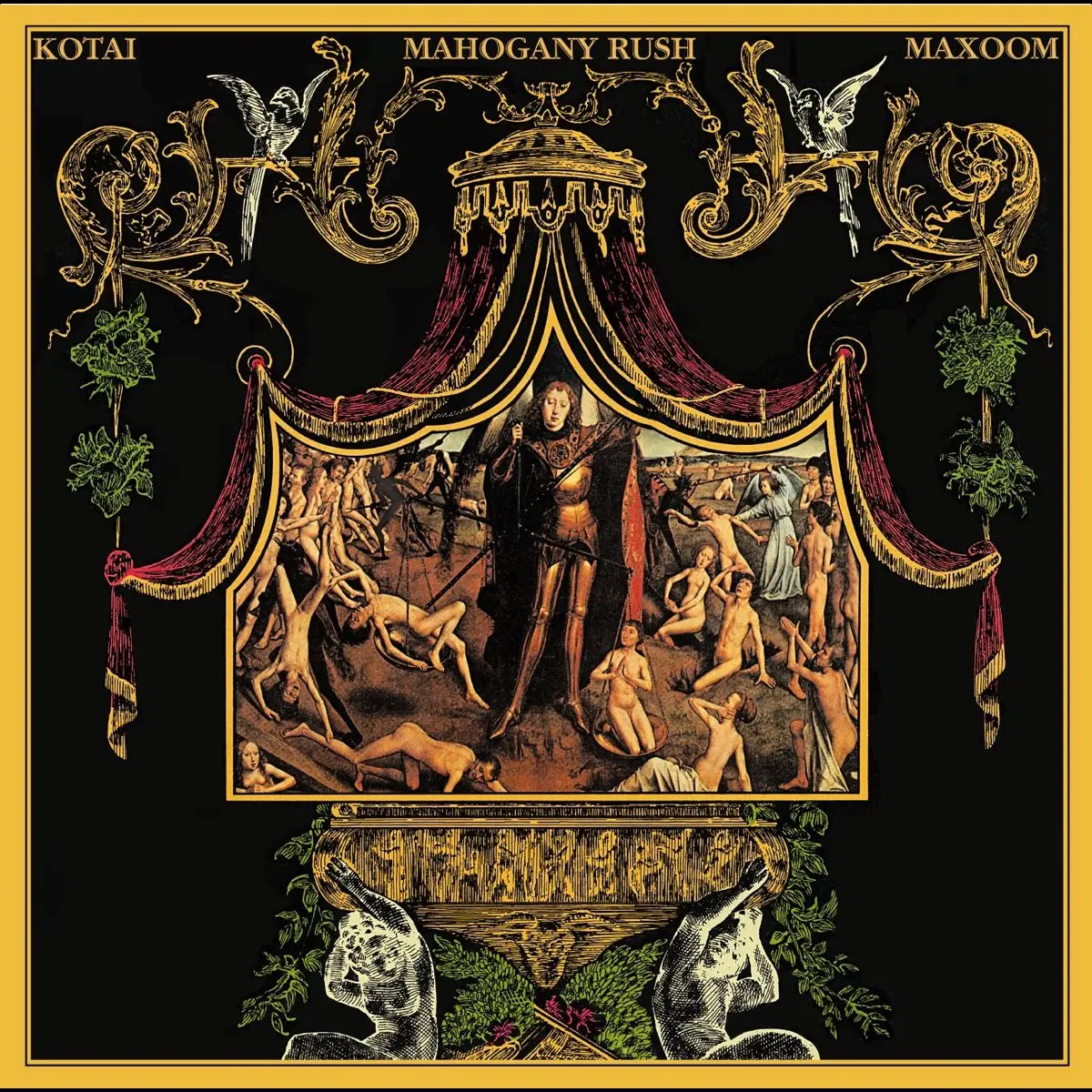 Mahogany Rush released their debut album, Maxoom, in October 1972 on Kot’ai.
Maxoom presents high-energy psychedelic blues-rock and hard rock, showcasing experimental textures, reversed drums, and wah-wah guitar effects that channel Jimi Hendrix while exploring forward-looking sonic ideas. Frank Marino leads on guitar and vocals, supported by Paul Harwood on bass and backing vocals, and Jimmy Ayoub on drums and percussion.
Frank Marino wrote all ten tracks, including “All In Your Mind,” “Magic Man,” “Funky Woman,” and “Boardwalk Lady.”
The record moves from introspective, calm openings to explosive, fuzz-laden jams. The title track begins with noise elements and psychedelic textures. “All In Your Mind” and “Back on Home” exhibit direct Hendrix devotion, while “Magic Man” features swaggering, fuzz-drenched guitar figures. “Funky Woman” incorporates backward tape effects for experimental color, and “Madness” builds slowly into a Trower-like potboiler. “Buddy” serves as a subtle homage to “Little Wing,” with lyrical passages showing Marino’s early songwriting development.
A1. “Maxoom” (2:59)
A2. “Buddy” (3:40)
A3. “Magic Man” (2:35)
A4. “Funky Woman” (3:13)
A5. “Madness” (4:50)
B1. “All in Your Mind” (3:10)
B2. “Blues” (7:06)
B3. “Boardwalk Lady” (2:38)
B4. “Back on Home” (3:18)
B5. “The New Beginning” (1:52) — opens with noise textures and experimental percussion
Marino produced the album with engineering by Robert Nickford and Yvon Caron (Champignons). The track “Blues” features pianist Phil Beck (Dionysos), who would later play on Michel Madore‘s 1976 release Le Komuso à Cordes. Organist John McDiarmid (Bombers, Boule de Son) appears on the closing track, “The New Beginning.”
The Maxoom cover features a painting by 15th century Flemish artist Hans Memling. In 1973, the album was issued stateside on 20th Century Records with a sleeve note stating “Dedicated to Jimi Hendrix.” In North America, “Buddy” was lifted as a single, backed with “All In Your Mind.”
Child of the Novelty
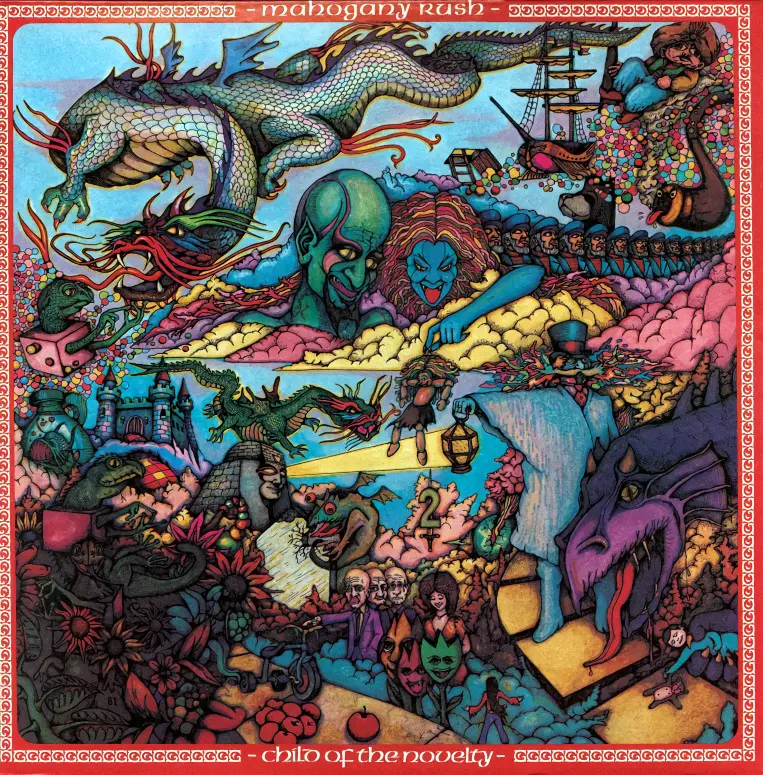 Mahogany Rush released their second album, Child of the Novelty, in August 1974 on Kot’ai (Canada) and 20th Century Fox (US).
The album continues Frank Marino’s fusion of psychedelic hard rock and electric blues, expanding on the band’s debut with tighter arrangements and a wider range of instrumental textures. Marino fronts the Montreal trio with bassist Paul Harwood and drummer James Ayoub, handling all guitars, keyboards, and vocals. The set emphasizes expressive soloing, multitracked guitar harmonies, and cosmic sound effects rooted in post-Hendrix experimentation.
Marino wrote all ten songs and co-produced the album with Bob Segarini.
The material alternates between concise riff-based rockers and atmospheric instrumentals. “Look Outside” and “Talkin’ ’Bout a Feelin’” showcase Marino’s contoured phrasing and syncopated rhythmic turns. “Thru the Milky Way” unfolds in layered guitar lines over spatial effects, while “Child of the Novelty” softens the pace with reflective tone and fluid soloing. “Makin’ My Wave” and “A New Rock and Roll” lean toward funk-inflected hard rock, contrasting with “Changing” and “Plastic Man,” both centered on percussive wah-guitar interplay. “Guit War” serves as a short instrumental duel of sustained effects, preceding the closing “Chains of (S)pace,” a slow, textural piece with sustained ambience and phased guitar layers.
A1. “Look Outside” (3:33)
A2. “Thru the Milky Way” (3:51)
A3. “Talkin’ ’Bout a Feelin’” (3:01)
A4. “Child of the Novelty” (4:02)
A5. “Makin’ My Wave” (4:40)
B1. “A New Rock and Roll” (3:00)
B2. “Changing” (3:13)
B3. “Plastic Man” (3:12)
B4. “Guit War” (3:40)
B5. “Chains of (S)pace” (5:58)
Sessions occurred at Studio Tempo in Montreal with producers Bob Segarini and Frank Marino, engineered by Ian Terry and Nelson Vipond, with Peter Burns assisting.
Child of the Novelty features cover illustration by Ivan Schwartz and photography by “Dolby” Barton, with design and layout by Bob Lemm.
20th Century Fox promoted the album to the North American market but did not issue a single.
Child of the Novelty consolidated Mahogany Rush’s identity as Marino’s vehicle, refining his Hendrix-inspired guitar work into longer instrumental passages that bridged psychedelic blues and progressive hard rock.
Strange Universe
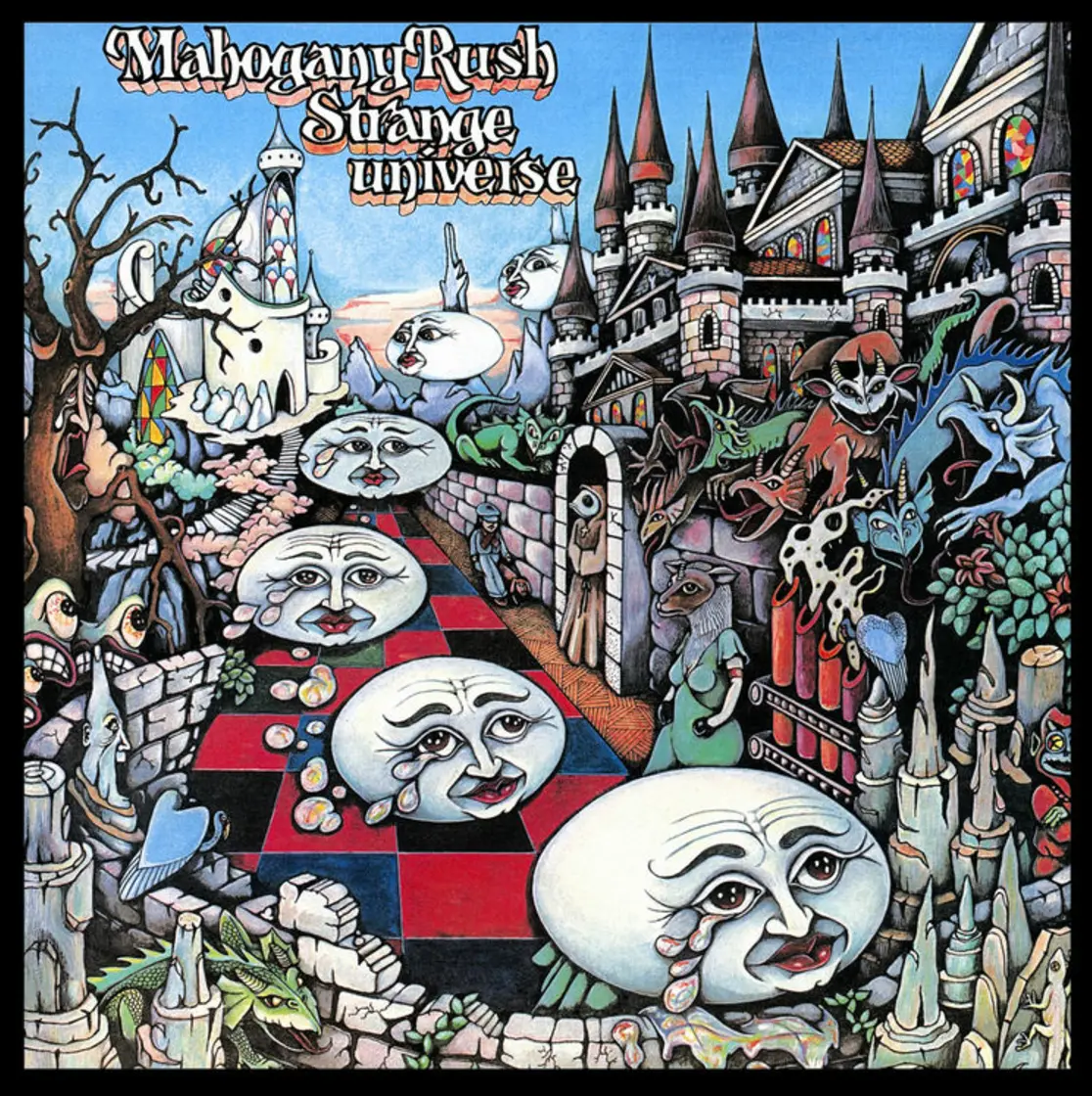 Mahogany Rush released their third album, Strange Universe, in May 1975 on Kot’ai and 20th Century Fox.
The album continues Frank Marino’s Hendrix-influenced sound, expanding the trio’s blend of hard rock, heavy blues, and psychedelic textures. The set mixes brisk funk-rock numbers and languid, effects-driven instrumentals with occasional excursions into fantasy-themed lyricism.
Guitarist Frank Marino wrote, arranged, and produced the album, playing lead guitar, vocals, and additional drums and synthesizer. He’s joined by bassist Paul Harwood and drummer Jimmy Ayoub.
The material divides between heavy rockers and slower, atmospheric pieces. “Tales of the Spanish Warrior” opens with martial rhythms and swirling guitar effects, setting a mythic tone carried through “The King Who Stole (…The Universe)” and “Land of 1000 Nights.” “Satisfy Your Soul” and “Dancing Lady” take a brisk, rhythmic approach, while the closing title track, “Strange Universe,” extends into seven minutes of spacey modulation and sustained tones, contrasting the tighter mid-album tracks “Tryin’ Anyway” and “Dear Music.”
A1. “Tales of the Spanish Warrior” (4:40)
A2. “The King Who Stole (…The Universe)” (3:53)
A3. “Satisfy Your Soul” (3:15)
A4. “Land of 1000 Nights” (4:30)
A5. “Moonlight Lady” (4:05)
B1. “Dancing Lady” (3:08)
B2. “Once Again” (3:31)
B3. “Tryin’ Anyway” (3:40)
B4. “Dear Music” (4:15)
B5. “Strange Universe” (7:00)
Sessions occurred at Tempo Studio in Montreal with Marino as producer and Ian Terry and Billy Szawlowski as engineers.
Strange Universe features cover art by Ivan Schwartz, whose image shows a procession of disembodied egg creatures along the checkered path of a haunted kingdom.
IV
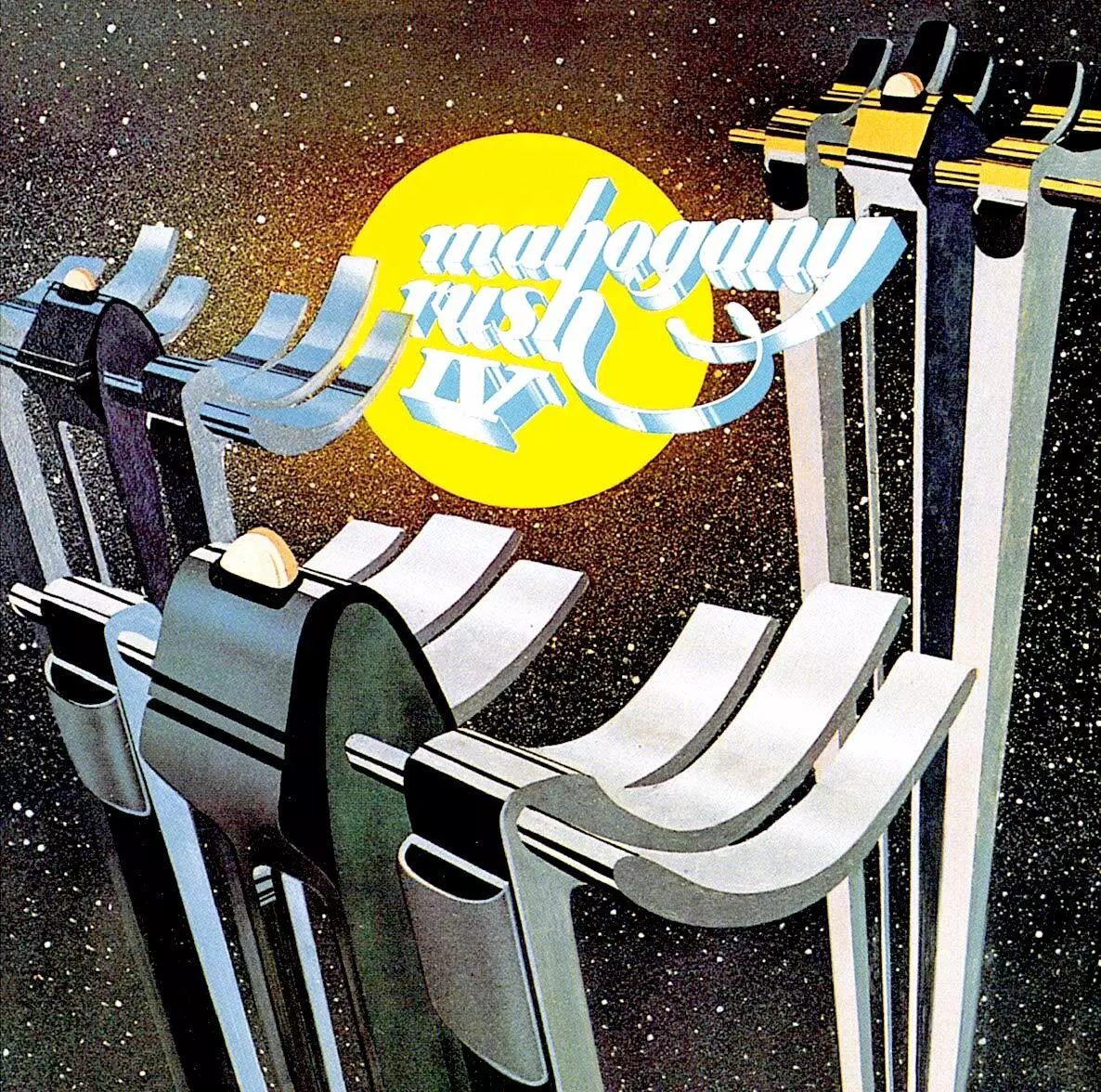 Mahogany Rush released their fourth album, IV, in May 1976 on Columbia.
The album expands Frank Marino’s command of guitar-centered hard rock into broader tonal and rhythmic settings, incorporating funk syncopation, progressive passages, and atmospheric blues forms. Marino’s use of Mellotron and synthesizer lends the trio a denser, symphonic presence than on earlier records.
Marino wrote, arranged, and produced the entire album, performing guitar, vocals, Mellotron, and synthesizer, with Paul Harwood on bass and Jimmy Ayoub on drums and percussion.
The songs alternate between high-energy electric numbers and spacious, reflective pieces. “I’m Going Away” opens the set with quick rhythmic changes and layered overdubs, followed by “Man at the Back Door,” which employs a percussive, funk-based structure. “The Answer” and “Jive Baby” retain the trio format in tighter form, while “It’s Begun to Rain” stretches to six minutes with slow, expressive phrasing and extended sustain. The second side balances the rhythmic drive of “Dragonfly” and “Little Sexy Annie” with the instrumental atmosphere of “Moonwalk” and the closing suite “IV… (The Emperor),” a seven-minute piece centered on Mellotron layers and dynamic shifts.
A1. “I’m Going Away” (4:06)
A2. “Man at the Back Door” (3:40)
A3. “The Answer” (4:36)
A4. “Jive Baby” (3:26)
A5. “It’s Begun to Rain” (6:27)
B1. “Dragonfly” (5:05)
B2. “Little Sexy Annie” (3:22)
B3. “Moonwalk” (5:48)
B4. “IV… (The Emperor)” (7:10)
Sessions occurred at Tempo Studios in Montreal with producer Frank Marino and engineers Ian Terry and Billy Szawlowski, assisted by Louis Gauthier and Paul Page.
IV features cover artwork by Fido, designed by Bob Lemm and Melvyn Mallet, with concert photography by Steven Szawlowski and studio photography by Daniel Poulin.
World Anthem
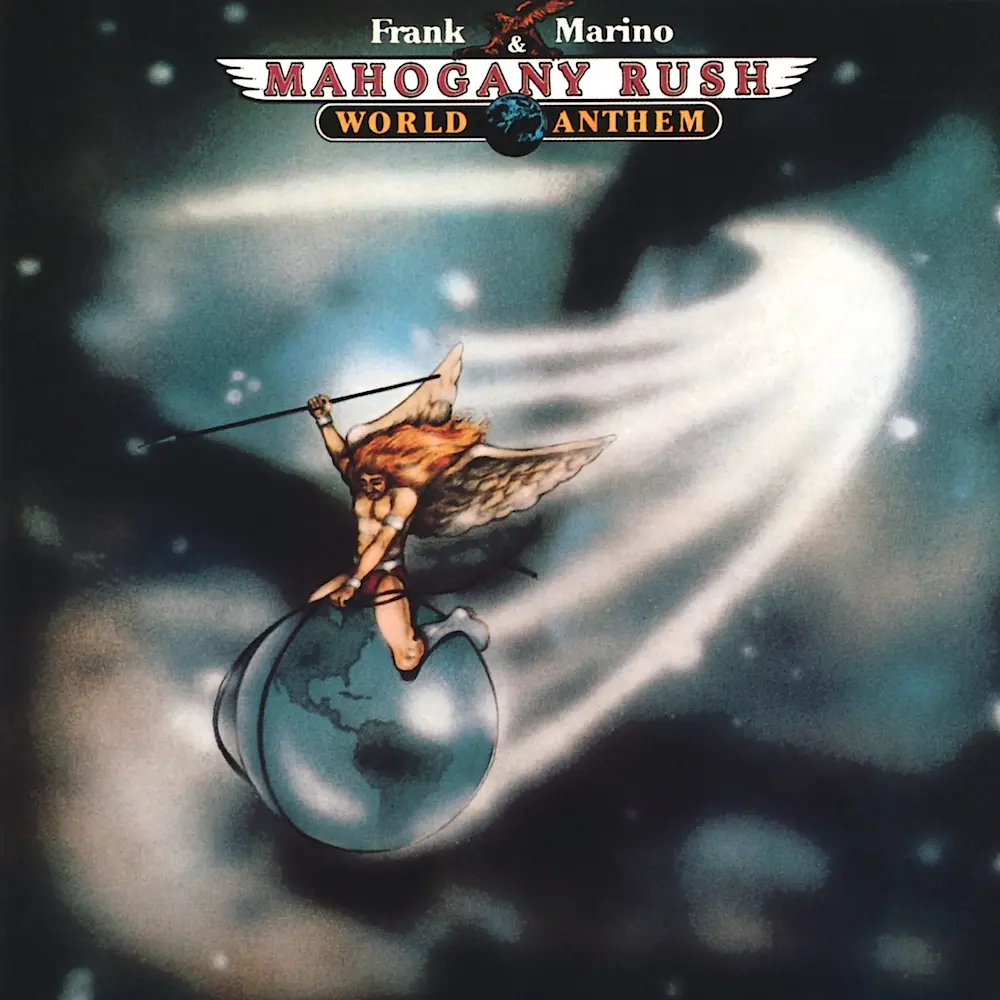 Mahogany Rush released their fifth album, World Anthem, in May 1977 on Columbia.
The album refines Frank Marino’s fusion of hard rock, psychedelia, and jazz-tinged improvisation, balancing tight riff structures with expansive solos and ambient passages. Marino fronts the Montreal power trio of bassist Paul Harwood and drummer Jimmy Ayoub, handling guitar, vocals, synthesizer, percussion, and timpani.
Marino wrote, arranged, and produced all eight songs. Keyboardist Phil Bech contributes a synthesizer solo on “Lady.”
The first side alternates between elaborate electric workouts and concise rock pieces. “Requiem for a Sinner” opens with phased sustain and Eastern inflections before resolving into a heavy mid-tempo theme. “Hey Little Lover” and “Broken Heart Blues” follow with brisk rhythmic interplay, while “In My Ways” stretches past six minutes of guitar tone layering and tempo changes. The second side centers on the instrumental “The World Anthem,” a three-minute statement of the album’s title concept. “Look at Me” and “Lady” pursue smoother harmonic phrasing, leading into the eleven-minute closer “Try for Freedom,” where Marino extends thematic motifs across shifting rhythmic sections.
A1. “Requiem for a Sinner” (6:01)
A2. “Hey Little Lover” (4:51)
A3. “Broken Heart Blues” (4:55)
A4. “In My Ways” (6:13)
B1. “The World Anthem” (3:09)
B2. “Look at Me” (4:07)
B3. “Lady” (4:38) — features a synthesizer solo by Phil Bech
B4. “Try for Freedom” (11:28)
Sessions occurred at Studio Tempo in Montreal between December 1976 and February 1977 with producer Frank Marino and engineers Billy Szawlowski and Gordon Gibson. George Marino and J. Messina mastered the album.
World Anthem features cover design by Bob Lemm with back photography by Daniel Poulin and interior photos by Steve Caraway.
The album marked Marino’s transition toward a broader artistic identity under his own name, bridging the exploratory psychedelic style of earlier Mahogany Rush releases with the structured, instrumental focus of his subsequent work.
Live
 In February 1978, Frank Marino and Mahogany Rush released Live, a document of their late-1977 tour of the US South.
The album presents high-energy blues-rock and hard rock performance, blending extended improvisations, classic covers, and Marino’s signature guitar virtuosity. Marino fronts the band on guitar and vocals, supported by Paul Del. Harwood on bass, backing vocals, and synthesizer, Jim Ayoub on drums and percussion, and R2D2 on backing vocals.
Frank Marino wrote two tracks, including “The Answer” and “Dragonfly.” The set also features covers of Jimi Hendrix (“Purple Haze”), Chuck Berry (“Johnny B. Goode”), Slim Harpo (“I’m a King Bee”), Willie Dixon/ Chester Burnett (“Back Door Man”), and Bo Diddley (“Who Do You Love”), all arranged to showcase the band’s improvisational energy.
The performance ranges from Hendrix-inspired guitar displays to funk-inflected blues passages. “The Answer” opens with a psychedelic riff and layered textures. “Dragonfly” combines jazzy basslines, flowing guitar, and expressive vocals. “I’m a King Bee” and excerpts from “Back Door Man” highlight traditional blues phrasing, while “Johnny B. Goode” features tempo shifts and intense soloing. Extended tracks like “Talkin’ ’Bout a Feelin’” explore dynamic interplay, and “Electric Reflections of War” and “The World Anthem” echo Hendrix-inspired motifs. “Purple Haze” closes the album with a tribute to Hendrix.
A1. “Introduction” (1:22)
A2. “The Answer” (4:53) — Marino original; opens with psychedelic guitar and layered instrumentation
A3. “Dragonfly” (5:11) — Marino original; funk-influenced bassline and jazzy licks over fluid guitar
A4. “I’m a King Bee” (8:44) — Slim Harpo cover; blues vocals and rhythmic interplay
A5. “Excerpt from ‘Back Door Man’” — Willie Dixon/Chester Burnett cover; excerpted blues section
A6. “A New Rock & Roll” (4:11) — Marino original; up-tempo, riff-driven performance
B1. “Johnny B. Goode” (5:05) — Chuck Berry cover; extended soloing, tempo shifts, Hendrix-style phrasing
B2. “Talkin’ ’Bout a Feelin’” (11:23) — Marino original; expansive improvisation, dynamic guitar-bass-drums interaction
— a. “Excerpt from ‘Who Do You Love’” — Bo Diddley cover; partial interpretation
— b. “Electric Reflections of War” — Hendrix-influenced, guitar-led instrumental exploration
— c. “The World Anthem” — Hendrix-inspired riffs and extended soloing
B3. “Purple Haze” (3:23) — Jimi Hendrix cover; closes set with virtuosic tribute
Sessions captured live across Southern US venues in late 1977, produced and arranged by Frank Marino with recording engineers Tom Arrison and Billy “The Cutter” Szawlowski, assisted by Perry Cheatham and Tom Betts, mixed by Gordon Gibson, and mastered by George Marino and J. Messina.
Live features album artwork and design by Bob Lemm, complementing the high-energy, psychedelic concert atmosphere.
Tracks “The Answer,” “Dragonfly,” and “A New Rock & Roll” appear only on this live set. “I’m a King Bee” and excerpts from “Back Door Man” and “Who Do You Love” do not appear on prior Mahogany Rush studio albums. “Johnny B. Goode” and “Purple Haze” were previously recorded by Berry and Hendrix, respectively, while “Electric Reflections of War” and “The World Anthem” draw from Hendrix-inspired motifs developed in live performance.
Tales of the Unexpected
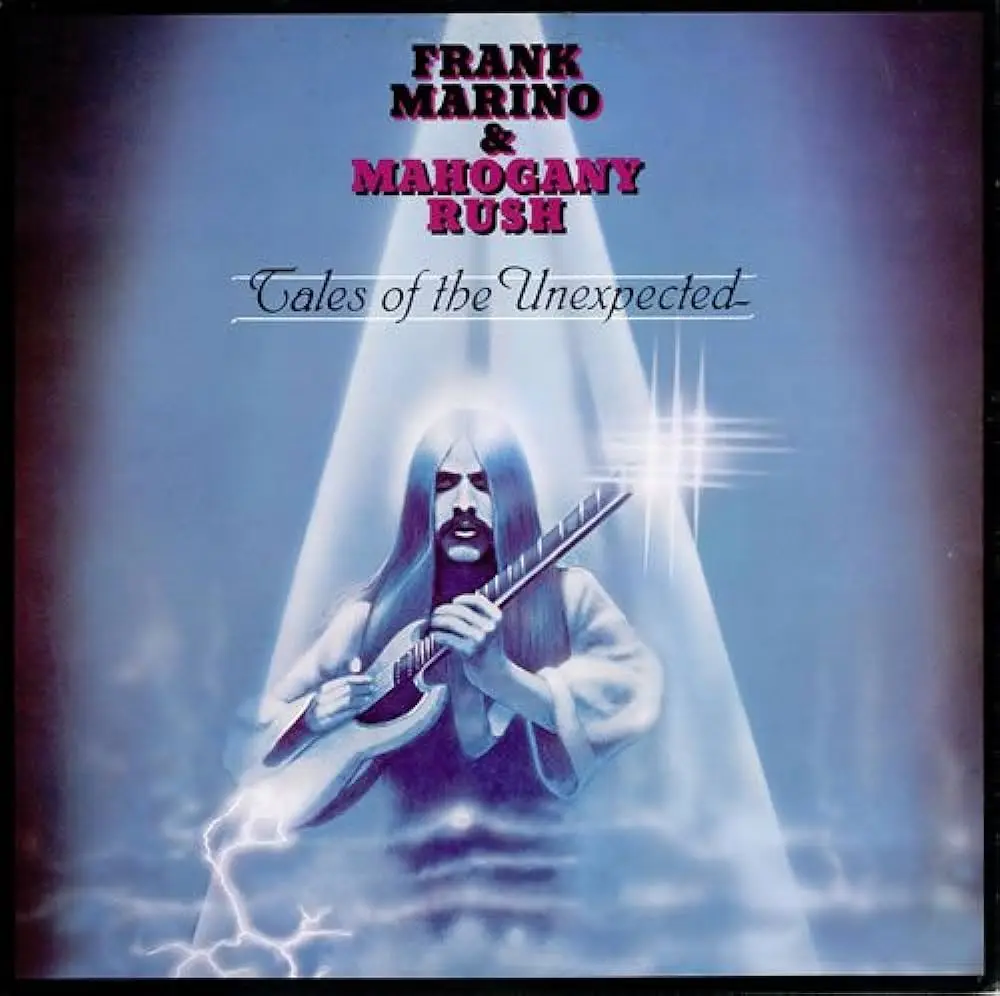 Frank Marino and Mahogany Rush released their sixth studio album, Tales of the Unexpected, in April 1979 on Columbia.
The album divides between four studio recordings and four live tracks, capturing the group’s late-1970s transition from psychedelic blues-rock toward extended fusion interplay. Marino fronts the trio with bassist Paul Harwood and drummer Jim Ayoub, augmenting his guitar and vocal duties with synthesizer textures and effects.
Marino wrote six of the eight songs and arranged the album. Side one includes his compositions alongside covers of Bob Dylan’s “All Along the Watchtower” (in the Jimi Hendrix arrangement) and The Beatles’ “Norwegian Wood (This Bird Has Flown).” Nanette Workman provides backing vocals on “Sister Change.”
The studio half opens with “Sister Change,” a syncopated funk-rock piece with layered wah phrasing, followed by “All Along the Watchtower,” where Marino filters Hendrix’s dynamics through controlled sustain. “Norwegian Wood” recasts the Lennon–McCartney ballad in lightly amplified electric tones, while the instrumental “Tales of the Unexpected” unfolds as a seven-minute suite shifting from dense electric fusion into quiet jazz voicings. The live half, recorded in Montreal, comprises “Down, Down, Down,” “Door of Illusion,” “Woman,” and “Bottom of the Barrel,” performed with amplified intensity and minimal overdubbing.
A1. “Sister Change” (4:43)
A2. “All Along the Watchtower” (4:34) — originated as a 1967 song by Bob Dylan, later popularized by Jimi Hendrix on Electric Ladyland (1968)
A3. “Norwegian Wood (This Bird Has Flown)” (3:09) — written by John Lennon and Paul McCartney; first appeared on Rubber Soul (1965)
A4. “Tales of the Unexpected” (7:45)
B1. “Down, Down, Down” (5:16)
B2. “Door of Illusion” (5:19)
B3. “Woman” (5:27)
B4. “Bottom of the Barrel” (4:26)
Mahogany Rush recorded Side A at Tempo Studios in Montreal, while side two was recorded live and mixed at the same facility with producer Frank Marino and engineers Billy Szawlowski and Louis Gauthier.
Tales of the Unexpected features cover artwork by Joseph Malec with layout by Bob Lemm.
The album sustained Marino’s position as Mahogany Rush’s creative core, bridging his Hendrix-inspired foundation with broader instrumental development that anticipated his subsequent 1980s output.
What’s Next
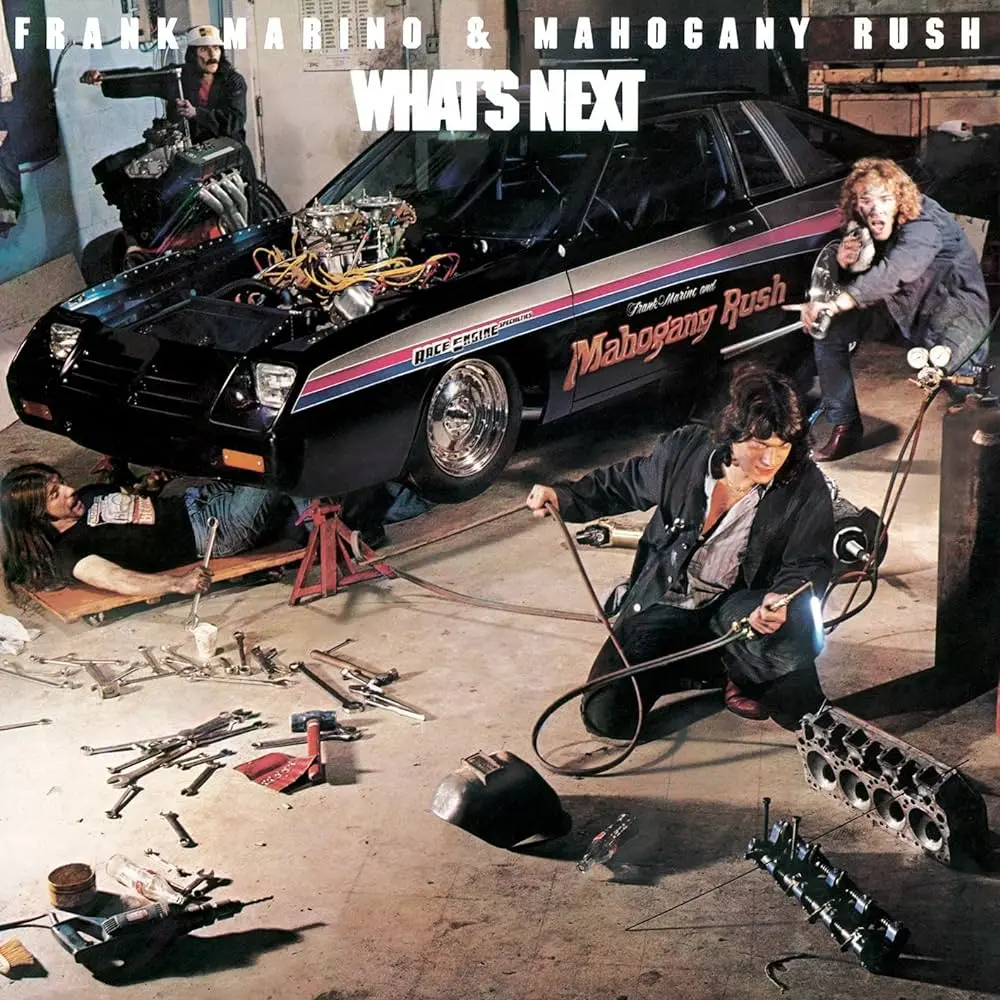 Frank Marino and Mahogany Rush released their seventh studio album, What’s Next, in February 1980 on Columbia.
The album returns to high-energy hard blues-rock with fast-paced riffs and extended solos, emphasizing the trio’s tight interplay. Marino leads on guitar and vocals, joined by bassist Paul Harwood, drummer Jim Ayoub, and his brother Vince Marino on rhythm guitar; Jim Zeller contributes harmonica on the Doors cover “Roadhouse Blues.”
Marino wrote five of the eight tracks, arranging the album and shaping the guitar-driven dynamics. Covers include a traditional “Rock Me Baby,” The Doors’ “Roadhouse Blues,” and Bo Diddley’s “Mona,” while all other compositions reflect Marino’s originals.
The music divides into uptempo rockers, blues covers, and expansive originals. “You Got Livin’” and “Finish Line” drive forward with angular riffs and forceful pacing. “Something’s Comin’ Our Way” extends nearly seven minutes of jagged, intense soloing. “Loved By You” explores slower, contoured blues turns. Covers maintain recognizable phrasing while inserting Marino’s sharp guitar articulations, with “Mona” closing the album with restrained intensity.
A1. “You Got Livin’” (4:36)
A2. “Finish Line” (4:07)
A3. “Rock Me Baby” (4:46) — traditional, arranged by Frank Marino
A4. “Something’s Comin’ Our Way” (6:42)
B1. “Roadhouse Blues” (5:27) — written by Jim Morrison, John Densmore, Ray Manzarek, Robby Krieger; first recorded by The Doors (1970)
B2. “Loved By You” (8:40)
B3. “Rock ’N’ Roll Hall of Fame” (4:06)
B4. “Mona” (4:24) — written by Ellas McDaniel (Bo Diddley); originally the B-side of 1957’s “Hey! Bo Diddley”
Sessions occurred at Columbia studios with Marino producing and Billy Szawlowski engineering. Pierre A. Gauthier photographed the cover.
Singles included “You Got Livin’” and “Finish Line,” released in sequence with no reported chart placements.
Discography:
- Maxoom (1973)
- Child of the Novelty (1974)
- Strange Universe (1975)
- IV (1976)
- World Anthem (1977 • Frank Marino & Mahogany Rush)
- Live (1978 • Frank Marino & Mahogany Rush )
- Tales of the Unexpected (1979 • Frank Marino & Mahogany Rush)
- What’s Next (1980 • Frank Marino & Mahogany Rush)
Sources:
Artist/Album Pages:
Pantincruel was a French jazz-rock band that self-released the 1979 album J'y Retourne Immédiateme...
Blind Faith was an English rock band that released a self-titled album on Atco in 1969. The band a...
Burning Spear — aka Winston Rodney (born March 1, 1945) — is a Jamaican dub/roots-reggae artist wh...
Duffy were an English hard-rock band that released the album Scruffy Duffy on PAN in 1973, followe...
The Stylistics were an American soul group from Philadelphia, formed in 1966. They released seven ...
Dieter Reith (Feb. 25, 1938 — April 1, 2020) was a German organist, pianist, composer, and band le...
Mick Ronson (May 26, 1946 — April 29, 1993) was an English guitarist and producer who rose to prom...
Wang Chung was an English New Wave/modern-rock band that released a self-titled album under the na...
The Fabulous Poodles were an English rock band that released the 1977–78 UK Pye albums Fabulous Pood...
Vitamin E was an American soul-funk combo from Oakland that released the 1977 Buddah album Sharing...
Sonny Sharrock (Aug. 27, 1940 — May 25, 1994) was an American avant-jazz guitarist, active for twe...
The Sound was an English post-punk band that made the 1980/81 Korova albums Jeopardy and From the ...