

Marcus was an American hard-rock band from Detroit that released a 1976 self-titled album on United Artists. They were the namesake of frontman Marcus Malone. Bassist Tim Bogert (Vanilla Fudge, Cactus, Beck Bogart & Appice) played bass on two tracks.
Members: Marcus Malone (vocals), Gene Bloch (guitar), Randall David (guitar), Jack Weber (guitar), Tim Bogert (bass), Dandy “Star” Holmes (drums)
Background
Marcus formed in Detroit in 1973 when singer Marcus Malone assembled a hard-rock band with drummer Dandy “Star” Holmes and guitarists Gene Bloch, Randall David, and Jack Weber.
Malone grew up on Detroit’s East Side in a Baptist church household; his parents sang in the church choir. His mother paid the choir director for voice lessons when he was about five. The future singer performed his first solo before the congregation as a child. Malone bought Motown 45s as a youth and attended annual Motown Revue shows in Detroit. He later saw James Brown at the Fox Theatre and spent time in Ann Arbor around the MC5 house.
During his teenage years, Malone started a band with a drummer from a teen group next door to the MC5. The teenage group opened area shows for The Stooges, Amboy Dukes, and the Bob Seger System. They impressed representatives of United Artists and moved to California at the behest of Ike Turner, who financed the group and gave them rehearsal time at his studio.
Marcus
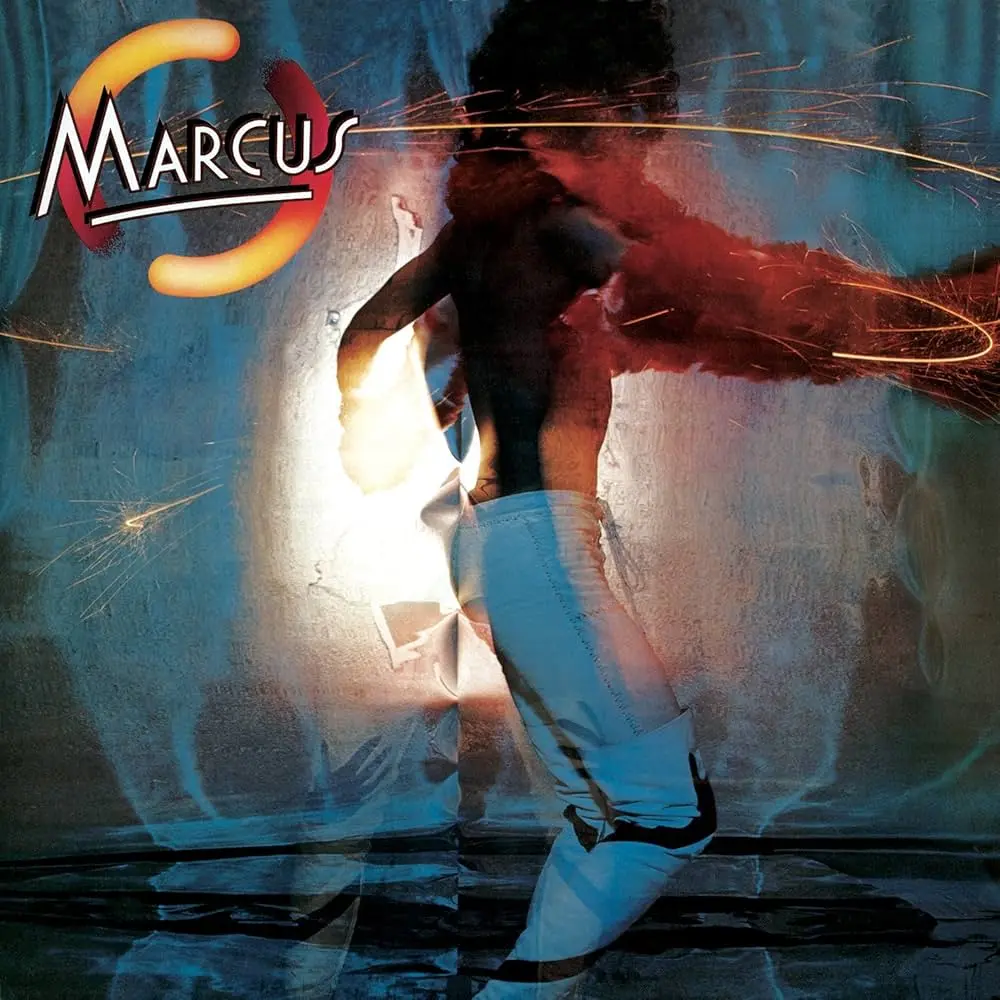 Marcus released their self-titled debut album in 1976 on United Artists.
The album presents hard-edged Detroit rock with mid-tempo riff cycles, extended guitar breaks, and tape-keyed passages, performed by Malone, Holmes, Bloch, David, and Weber with bassist Tim Bogert on two cuts.
“Black Magic” grinds through a blunt opening riff and a short synth break. “Salmon Ball” struts on syncopated accents and a clipped refrain, with Malone’s line set close to the band. “Kelly” glides through a softened verse, with flute-and-string shading around a centered romantic cadence. “Gypsy Fever” coils around wah-marked turns and a chorus chant, then leaves a faint choir hue at the close.
“Pillow Stars” lurches from a hard-accented opening into a looser central section, then climbs through high-register calls and guitar harmonies. “Highschool Ladies Streetcorner Babies” surges on a clipped street-corner refrain and compact replies. “Dream Wheel” swells around broad chorus entries and a high-sheen refrain. “Rise Unto Falcon” climbs through tape-hazed Mellotron layers, with extended lead phrases folded into the final arranged rise.
A1. “Black Magic” (5:50) – G. Beam / G. Bloch / Marcus
A2. “Salmon Ball” (6:15) – R. David
A3. “Kelly” (4:00) – G. Bloch / Marcus / K.J. Knight / T. Curry
A4. “Gypsy Fever” (6:15) – R. David / Marcus / G. Bloch
B1. “Pillow Stars” (5:44) – K.J. Knight / Marcus / G. Bloch / T. Curry
B2. “Highschool Ladies Streetcorner Babies” (5:06) – R. David / Marcus / G. Bloch
B3. “Dream Wheel” (3:42) – J. Weber
B4. “Rise Unto Falcon” (6:31) – R. David / Marcus / Y. Bear
Sessions occurred with prior Batteaux producer Stuart Alan Love, who worked in sequence on albums by Black Sheep, Charlie, Ethos, and Michael Quatro. Canadian soundman Mark Smith engineered Marcus back-to-back with titles by Moxy, Trooper, and Rick Springfield.
UA art director Bill Burks designed the Marcus sleeve, which shows a blur-motion photo (front) and a group-shot under fireworks (back).
Discography:
- Marcus (1976)
Sources:
Artist/Album Pages:
Gòtic was a Spanish symphonic-rock band that released the 1978 album Escenes on Movieplay. Membe...
Haze was an American Twin Cities soul-funk band that released a 1974 self-titled album on ASI Reco...
Jun Fukamachi — 深町純 (May 21, 1946 — Nov. 22, 2010) — was a Japanese jazz keyboardist. He moved int...
Alexis was an American hard-rock/pop band behind a 1977 self-titled album on MCA. Members: Eddi...
Wally Gonzalez is a Filipino guitarist and singer who fronted Manila hard-rockers Juan de la Cruz...
Pantha was an Australian Latin-jazz/rock band that released the 1975 album Doway Do Doway Do and thr...
Édition Spéciale was a French jazz-rock band that debuted with the 1976 UA title Allée des Tilleul...
Wanka was the Canadian hard-rock band behind The Orange Album, a 1977 release on Axe Records. Me...
Scorpions are a German hard-rock/metal band, best known for the songs "Loving You Sunday Morning,"...
Sahara was a German symphonic-rock band that evolved from Subject ESQ. As Sahara, they made the 19...
Crypto was a Dutch jazz-rock band that released a self-titled album on Negram in 1975. Members: ...
Jimmy Webb is an American singer, composer, producer, and arranger who emerged as a writer of late...