

Michael Quatro is an American keyboardist, singer, composer, and arranger from Detroit who released the 1972/73 Evolution albums Paintings and Look Deeply Into the Mirror, followed by the 1975–77 Prodigal titles In Collaboration With the Gods; Dancers, Romancers, Dreamers & Schemers; and Gettin’ Ready. He is the older brother of musician/actress Suzi Quatro.
Background
Michael Quatro was born on June 12, 1943, in Detroit, Michigan. Art Quatro, his father, led a jazz combo on the Detroit club circuit. The Quatro family also produced the Pleasure Seekers and Cradle, which featured his sisters Patti, Suzi, Arlene, and Nancy Quatro.
Quatro studied classical piano as a child and appeared as a teen pianist on The Lawrence Welk Show. By the late Sixties, Quatro worked in Detroit as a booking agent and promoter for Michigan rock acts, including the MC5. He organized the 1969 Detroit Black Arts Festival and the 1970 Cincinnati Pop Festival, followed by the televised Midsummer Rock program.
Quatro also managed Cradle. He brought producer Mickie Most to a Detroit performance before Suzi Quatro signed to RAK. The Michael Quatro Jam Band followed through Evolution Records.
Paintings
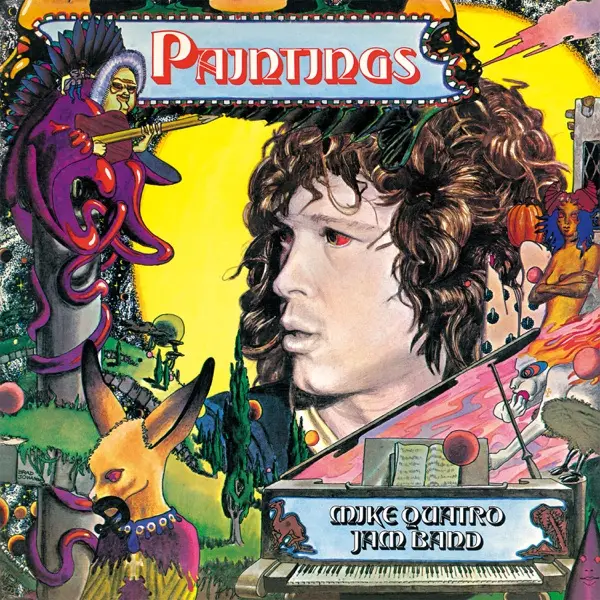 Michael Quatro Jam Band released its debut album, Paintings, in 1972 on Evolution.
Paintings contains seven Quatro originals and a version of Ian McDonald and Peter Sinfield’s “Court of the Crimson King.” Suzi Quatro co-wrote “Each Day I Want You More,” while Ted Nugent appears on the King Crimson title. The personnel credits place Quatro at keyboards, flute, effects, percussion, and voice beside lead singer John Finley, percussionist Terry Mullen, and singers Nancy Quatro and Patti Quatro.
“Paintings” unfurls from immediate Mellotron strings into flute figures, baroque-scale manual runs, and a faster closing passage. “Time Spent in Dreams” drifts across Romantic-period swells, piano interludes, and synth turns. “Circus (What I Am)” swivels on Latin-tinged percussion while electric-key figures run through the song. “Each Day I Want You More” slows into a torn Finley lead over romantic art-song contours.
“Life” romps through electric-key jubilance and ends under Ted Nugent’s feedback. “Rachmaninoff’s Prelude” swells through classical pomp and dense string-machine surges. “Detroit City Blues” pounds out barrelhouse piano with ragtime-boogie turns. “Court of the Crimson King” recasts the verse material, preserves the main chorus, and buries the cover under Mellotron and Moog mass.
A1. “Paintings” (8:00) – Quatro
A2. “Time Spent in Dreams” (4:39) – Quatro
A3. “Circus (What I Am)” (3:55) – Quatro
A4. “Each Day I Want You More” (3:25) – M. Quatro, S. Quatro
B1. “Life” (3:27) – Quatro
B2. “Rachmaninoff’s Prelude” (6:45) – Quatro
B3. “Detroit City Blues” (3:00) – Quatro
B4. “Court of the Crimson King” (5:26) – McDonald, Sinfield
Quatro produced and arranged Paintings for Evolution, which placed the album after the 1971 Lighthouse title Thoughts of Movin’ On in its 3000-series album sequence. Brad Johannsen designed the cover artwork, whose painted Quatro portrait sits inside a black ornamental field.
Evolution lifted “Circus (What I Am)” as a 1972 single (b/w “Time Spent in Dreams”), which reached No. 8 on the Billboard Bubbling Under Hot 100 Singles chart and No. 91 on the Cash Box Top 100 singles chart.
Look Deeply Into the Mirror
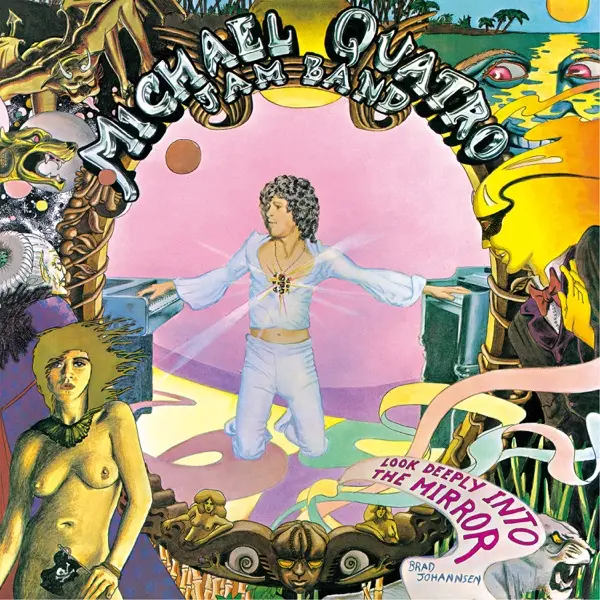 Michael Quatro Jam Band released its second album, Look Deeply Into the Mirror, in 1973 on Evolution.
Look Deeply Into the Mirror pairs Quatro’s keyboard arsenal with guitarist–singer Patti Quatro and percussionist Kirk Arthur Trachsel. John Ogen sings “We’ll Be Together” and “Won’t You Come Away.” Chris McKee sings the remaining vocal titles. Ted Nugent adds second guitar to “Won’t You Come Away.”
“Prelude in A♭ Crazy (Classical Variations)” charges through rocked-up classical figures and ornate keyboard runs. “Gypsy Caravan, Part 1” swells through oversized organ/Moog flourishes and long-form theatrical pressure. “Won’t You Come Away” bends through string-machine sheets and pitch-slurred lines. “Lullaby (Sleep Well Sweet Children)” settles into Mellotron flute figures and a softened closing hush.
A1. “We’ll Be Together” (3:50) – M. Quatro, P. Quatro
A2. “Prelude in A♭ Crazy (Classical Variations)” (5:08) – M. Quatro
A3. “Natural Way” (3:05) – M. Quatro, P. Quatro
A4. “Tomorrows” (4:54) – M. Quatro, P. Quatro
B1. “Gipsy Caravan Part 1 (with ending ‘Ode to Blumpi’)” (5:30) – M. Quatro, P. Quatro
B2. “Won’t You Come Away” (4:17) – P. Quatro
B3. “Gipsy Caravan Part 2” (3:10) – M. Quatro, P. Quatro
B4. “Lullaby (Sleep Well Sweet Children)” (3:57) – M. Quatro, P. Quatro
Quatro produced Look Deeply Into the Mirror for Evolution with Patti Quatro as assistant producer and arranger. Lee De Carlo and Rick Capreol engineered the sessions. Brad Johannsen created the cover artwork.
In Collaboration With the Gods
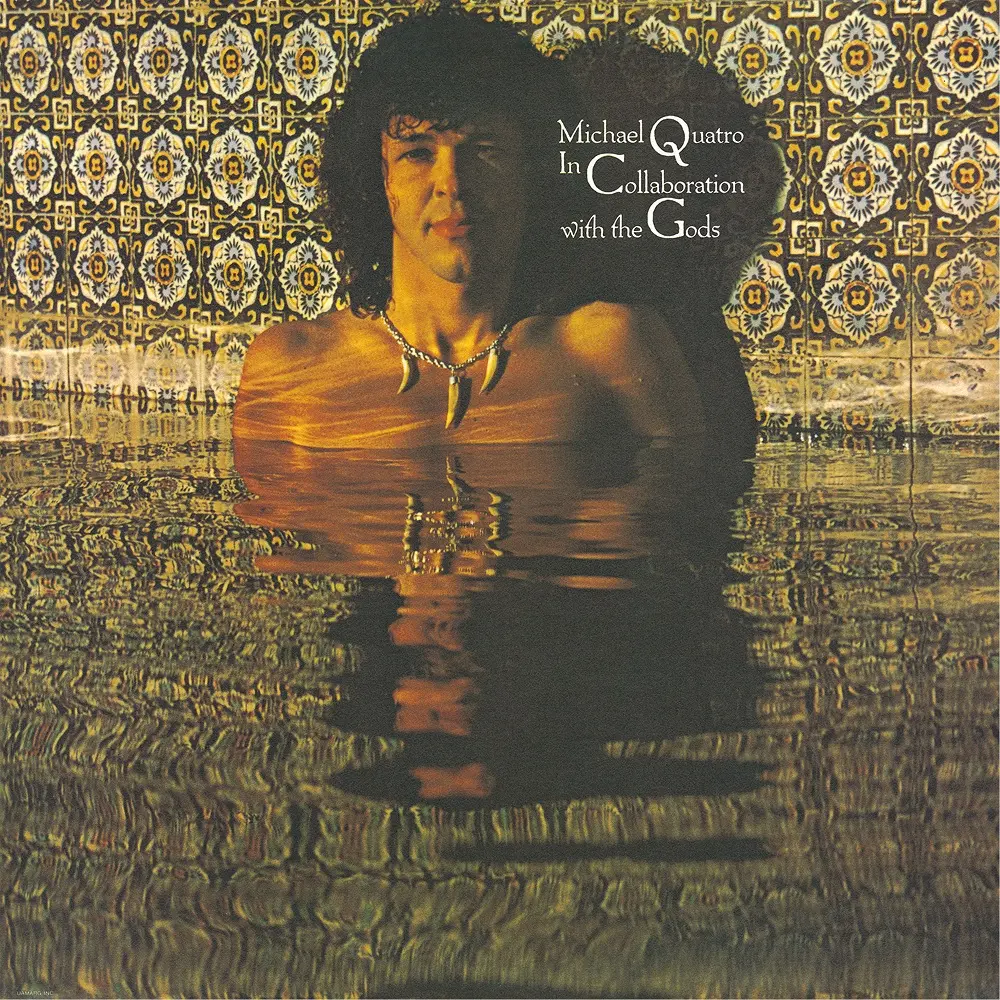 Michael Quatro released his third studio album, In Collaboration With the Gods, in 1975 on United Artists.
Quatro adopted a solo billing on In Collaboration With the Gods. The record places a mythological suite across side one and shorter songs across side two. Dave Kiswiney joins as bassist, lead singer, and arranging assistant, with Kirk Arthur Trachsel retained on drums. Teddy Hale takes the main guitar credit, while Rick Derringer appears on “Prelude in A♭ Crazy II” and Flo & Eddie add special voices.
“In Collaboration With the Gods (Theme)” unfurls through Mellotron mass, orchestral sweep, and bent string-machine lines. “Get Away” enters through solo classical keyboard figures before the song hardens into a band setting. “Ave Rock Maria” recasts Beethoven’s “Moonlight Sonata” through Moog-led symphonic drift. “Prelude in A♭ Crazy II” vaults through ornate manual runs and classical-rock flourishes.
A1. “In Collaboration With the Gods (Theme)” (4:10) – Quatro
A2. “Interlude of Ra / Pluto’s Lament / Loki’s Gloria” (4:22) – Quatro
A3. “Interlude of Ares / Amusement of Bacchus / Illusion of Circe” (1:25) – Quatro
A4. “A Letter to Venus (Theme)” (2:05) – Quatro
A5. “Neptune’s Nicromea / Deity’s Ditty / Messengers From Mars” (3:06) – Quatro
A6. “Waltz of the Gods / Orgy of the Gods” (4:17) – Quatro
B1. “Get Away” (4:02) – Kiswiney, Quatro
B2. “Rockmanninoff’s Prelude in C Blunt Funk” (4:49) – Quatro
B3. “Ave Rock Maria” (4:06) – Quatro
B4. “Prelude in A♭ Crazy II” (3:56) – Quatro
B5. “Sweet Lovin’” (2:59) – Hale, Kiswiney, Trachsel
Quatro recorded In Collaboration With the Gods at Record Plant in New York with producer Stuart Alan Love, engineer Ed Sprigg, and assistant engineer Corky Stasiak. Stasiak assisted the album amid Record Plant work on 1975 albums by Aerosmith, Alice Cooper, Bruce Springsteen, and the Dictators. Quatro arranged the album and served as assistant producer.
Bob Cato and Lloyd Ziff designed the sleeve with cover photography by Doug Metzler. United Artists lifted “In Collaboration With the Gods (Theme)” as a 1975 mono/stereo promo single. In Collaboration With the Gods reached No. 73 on the Kent Music Report album chart.
Dancers, Romancers, Dreamers & Schemers
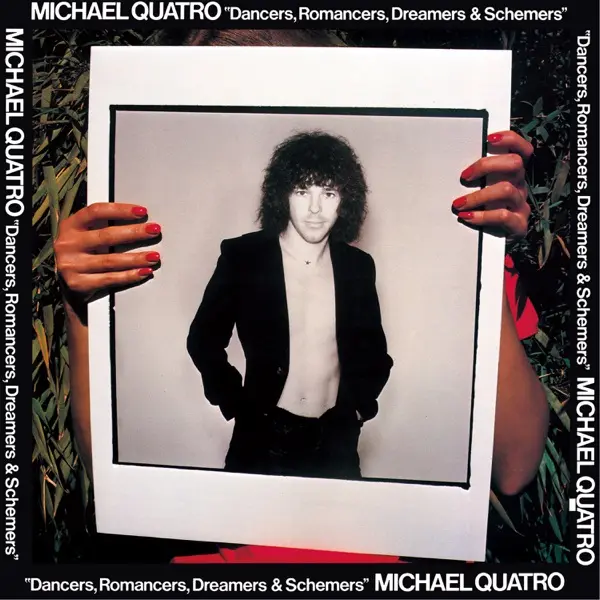 Michael Quatro released his fourth studio album, Dancers, Romancers, Dreamers & Schemers, in 1976 on United Artists and Prodigal.
Dancers, Romancers, Dreamers & Schemers retains the Stuart Alan Love production link and contains side-one songs with a side-two instrumental sequence. Tim Bogert and Lynn Kishkon join the vocal credits, while David Surkamp narrates “Ancient Ones.” Ray Parker Jr. appears on “Rollerbach,” and Bobby Womack appears on “Adagio.”
“Children of Tomorrow” ripples through an ethereal piano run and suspended synth wash. “Stripper” saunters on a laid-back guitar riff as synths sweep around the piano. “One by One” glides through restrained keyboard backing and a softened ballad line. “Rollerbach” tolls through church-organ sonority and Bach-derived figures.
“Ancient Ones” narrates its spacy side-two opening through Surkamp’s high, theatrical line. “Pure Chopin” recasts the Nocturne in E-flat major through Quatro’s formal keyboard arrangement. “Adagio” widens into instrumental romance with a light orchestral-pop trace.
A1. “Children of Tomorrow” (3:25) – Kiswiney, Quatro
A2. “Stripper” (3:43) – Kishkon, Quatro
A3. “One by One” (3:27) – Finley, Kishkon, Quatro
A4. “Rollerbach” (4:10) – Quatro
A5. “Circus (What I Am)” (3:00) – M. Quatro, S. Quatro
B1. “Ancient Ones” (7:27) – Palacion, Quatro
B2. “Pure Chopin” (3:09) – Chopin, arr. Quatro
B3. “Adagio” (6:32) – Quatro
B4. “Touch of Class” (4:49) – Quatro
Stuart Alan Love produced Dancers, Romancers, Dreamers & Schemers, with Quatro as co-producer and arranger. Steve Escallier engineered all titles except “Rollerbach,” where Frank Kejmar and Nat Jeffrey share engineering credits. Ria Lewerke designed the sleeve with cover photography by Moshe Brakha.
Prodigal issued “Pure Chopin” as an October 21, 1976, single (b/w “One by One”). The label also circulated “Pure Chopin” as a mono/stereo promo single.
Gettin’ Ready
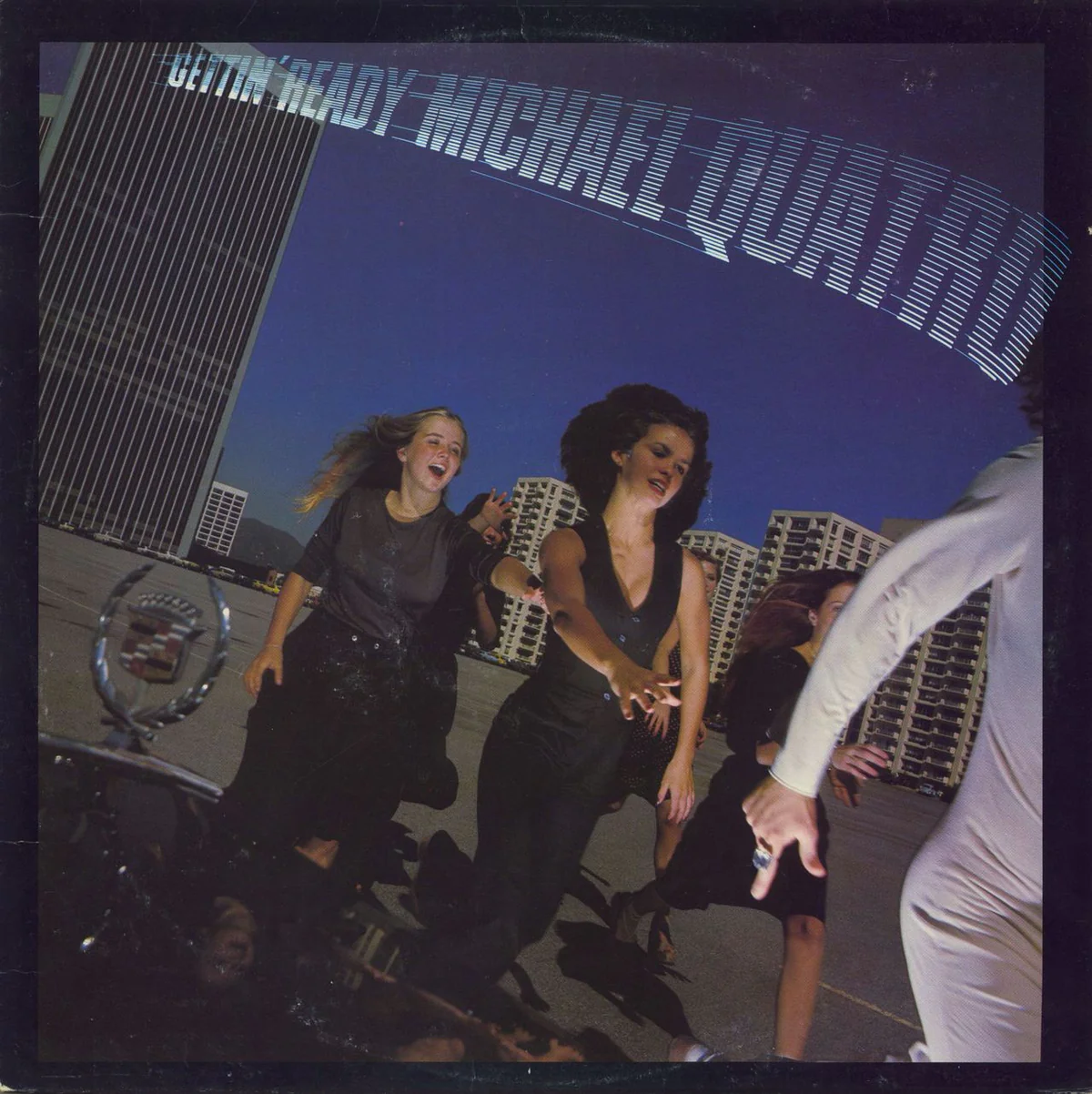 Michael Quatro released his fifth studio album, Gettin’ Ready, in 1977 on Prodigal.
Quatro recasts his album format around shorter vocal songs and outside material after the two United Artists albums. Patti Quatro co-writes two titles and adds guitar and background voice. The session credits include bassist Reggie McBride, drummers John Raines and Ollie E. Brown, keyboardist Don Randi, guitarists Jerry Cole and Ray Parker Jr., and synthesizer programmer Michael Boddicker. Quatro also covers Russ Ballard (“I’m Winning”) and Thin Lizzy (“Wild One”).
“Hollywood (Hallucination)” plunges into horns, backing-singer mass, dance-kit accents, and Ray Parker Jr.’s background guitar traces. “It’s Only a Love Song” floats faint Mellotron choir under real strings. “Last Man Alive” extends the R&B-leaning side-one setting with recessed choir tones.
“Detroit City Blues” struts through a restrained barroom-rock rewrite. “I’m Winning” eases into a lighter folk-leaning treatment. “Rockin’ All Night Long” snarls through louder amp pressure and roadhouse churn. “Wild One” charges through Lynott’s hard-rock source while faint choir tones recede behind the band.
A1. “Hollywood (Hallucination)” (4:07) – M. Quatro, P. Quatro
A2. “It’s Only a Love Song” (4:27) – M. Quatro, P. Quatro
A3. “Trouble in Paradise” (4:33) – Finley, Kishkon, Quatro
A4. “Last Man Alive” (4:47) – Kiswiney, Quatro
B1. “Get You Ready for Love” (2:07) – Bellotti, Longo
B2. “Detroit City Blues” (3:18) – Quatro
B3. “I’m Winning” (3:03) – Ballard
B4. “Rockin’ All Night Long” (2:39) – P. Quatro
B5. “Wild One” (3:21) – Phil Lynott
Quatro recorded Gettin’ Ready at The Heritage Recording Co. with producers Ray Ruff and Stuart Alan Love, recording and mixing engineer Randy Niklaus, consulting engineer Don Hermanson, and assistant engineer Tret Fure. Jack Andrews mastered the album at Motown/Hitsville USA Recording Studios.
Wriston Jones designed the sleeve with graphics by Carl Overr and photography by Moshe Brakha. Brakha’s mid-Seventies sleeve photography also appears on albums by the Isley Brothers, Mandrill, and The Sylvers.
Michael Quatro
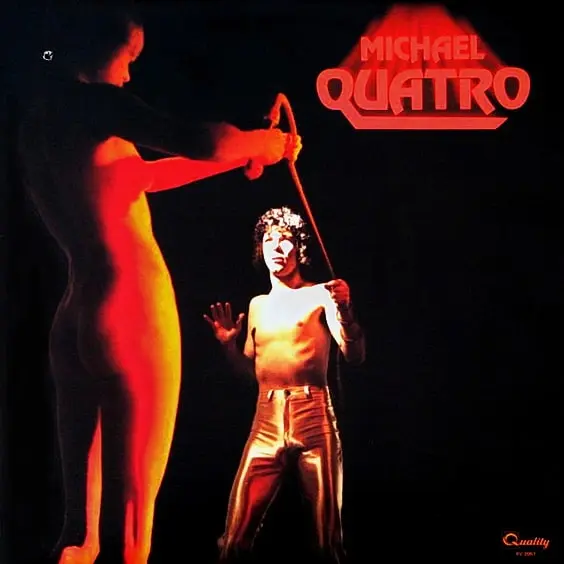 Michael Quatro released his sixth studio album, Michael Quatro, in January 1980 on Quality.
Quality issued Michael Quatro from Richardson-produced Nimbus Nine material plus Quatro-produced tracks from Cloudborne, Bayshore, and Polaris. The listed touring band pairs Quatro with lead guitarist Ted Hale, guitarist Tom Ciupak, bassist John MacIntyre, drummer Bill Reyna, and singer Belinda “Bomb” McClure. Lynn Kishkon-Quatro co-writes most titles, while “Tighter Tighter” carries the Tommy James–Bob King credit.
A1. “Can’t Leave You Alone” (4:30) – Addy, Kishkon-Quatro, Quatro
A2. “Give Me a Chance” (4:08) – Ciupak, Hale, Kishkon-Quatro, Quatro
A3. “Heart Bandit” (4:24) – Baxter, Quatro
A4. “Detroit City Blues” (4:00) – Kishkon-Quatro, Quatro
B1. “Jucy Lucy” (4:12) – Ciupak, Hale, Kishkon-Quatro, Quatro
B2. “Easy Street” (3:41) – Hale, Kishkon-Quatro, Quatro
B3. “Tighter Tighter” (3:13) – James, King
B4. “Hold You” (3:47) – Jackson, Kishkon-Quatro, Quatro
B5. “Space Strut” (4:10) – Kishkon-Quatro, Quatro
Jack Richardson produced most of Michael Quatro for B. “Bomb” Records at Nimbus Nine Studio in Toronto with engineers Curt Richardson and Mike McCarty. Quatro produced “Can’t Leave You Alone” at Cloudborne Studio with engineer Ken Sands and assistant Russ Palazzolo. He also produced “Space Strut” at Bayshore, Cloudborne, and Polaris studios.
Quality lifted “Can’t Leave You Alone” as a 1980 single (b/w “Space Strut”). The album also appeared in Europe as Michael Quatro Band.
Bottom Line
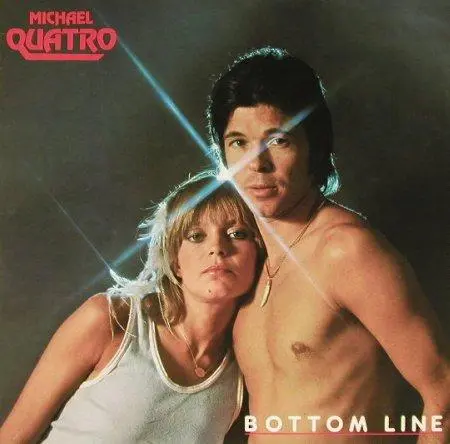 Michael Quatro released his seventh studio album, Bottom Line, in 1981 on Spector Records International.
Quatro recorded Bottom Line at Criteria Recording Studios in Miami with producers Ron Albert and Howard Albert. John Thorpe arranged the album, which credits Alain Salvati, Chuck Kirkpatrick, Howard Albert, Joe Galdo, John MacIntyre, Quatro, and Ted Hale as musicians. Chuck Kirkpatrick, Scott Kirkpatrick, MacIntyre, Quatro, and Hale carry the vocal credits.
A1. “Bottom Line” (3:14)
A2. “Let It Ride” (3:39)
A3. “Midnite Train” (3:47)
A4. “Born on a Monday” (2:50)
A5. “Wreckless” (3:34)
B1. “Feels Good” (4:20)
B2. “Ain’t All Nite, Ain’t Al’right” (3:27)
B3. “Melody” (2:26)
B4. “You’re Drivin’ Me Crazy” (7:25)
Quatro recorded Bottom Line at Criteria Recording Studios with producers Ron Albert and Howard Albert, co-producers Alain Salvati and Quatro, and arranger John Thorpe. Criteria mastered the album for Spector Records International, which issued the LP as SW-70003.
Spector Records International issued “Let It Ride” as a 1981 single (b/w “Melody”) and circulated a same-song promo. In September 1981, “Bottom Line” became a stock single (b/w “Melody”) after a same-song promo.
Postlude
During the early Eighties, Koala kept Quatro’s earlier catalog in circulation through re-recorded and reconfigured titles. The label issued The Selections of Paintings, Into the Mirror, and Selections of Dancers, Romancers from 1979 re-recordings. Koala also issued It’s Only a Love Song from remixed Gettin’ Ready material, followed by the mini-album Mirage and the 1981 compilation The Best of Mike Quatro.
After the Spector Records International singles, Quatro’s mainline album sequence resumed in the Nineties with Vision on Quatrophonic Music USA.
Discography:
- Paintings (1972)
- Look Deeply Into the Mirror (1973)
- In Collaboration With the Gods (1975)
- Dancers, Romancers, Dreamers & Schemers (1976)
- Gettin’ Ready (1977)
- Michael Quatro (1980)
- Bottom Line (1981)
Sources:
- Discogs: Michael Quatro
- RYM: Michael Quatro
- 45cat: Mike Quatro
- 45cat: Mike Quatro Jam Band
- ProgArchives: Michael Quatro
Artist/Album Pages:
Grant Green (June 6, 1935 — Jan. 31, 1979) was an American jazz guitarist and composer from who r...
S.O.U.L. — short for Sounds of Unity and Love — was an American soul-funk band from Cleveland that...
Heikki Koskinen — aka Mike Koskinen — is a Finnish trumpeter, composer, and bandleader active in t...
Tin Tin was an Australian orchestral-pop combo that released the 1970–71 albums Tin Tin and Astral T...
Indexi was a Yugoslav pop-rock and later post-psych band from Sarajevo, Bosnia-Herzegovina, that c...
Andy Fairweather Low (born Aug. 2, 1946) is a Welsh vocalist, guitarist, and songwriter who first ...
Daryl Hall (born Oct. 11, 1946) is an American vocalist, musician, songwriter, and producer from P...
Jack McDuff (September 17, 1926 — January 23, 2001) was an American soul-jazz/funk organist. He r...
Ange are a French symphonic-rock band that released ten studio albums between 1972 and 1983 on Phi...
Dane Donohue is an American vocalist and songwriter who released a self-titled album on Columbia i...
Trapeze was an English hard-rock band that released three albums on Threshold between 1970 and 1972....
Y&T (Yesterday and Today) is an American hard-rock/metal band, formed in 1972 in Oakland, Cal...