
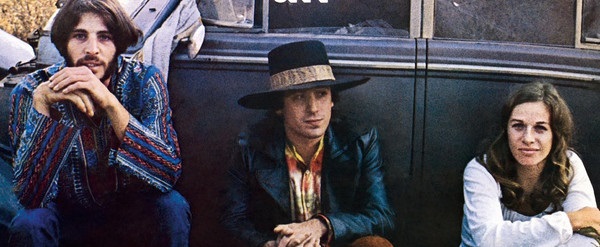
The City was an American folk-pop trio behind the 1968 album Now That Everything’s Been Said on Ode Records. They featured famed Brill Building songwriter Carole King and perennial sideman Danny Kortchmar.
King co-wrote numerous Sixties hits and launched a subsequent Platinum solo career. Kortchmar, a once-and-future James Taylor guitarist, played in the Seventies jazz-rock combos The Section and Attitudes. Bassist Charles Larkey hailed from politi-folk satirists The Fugs, where he first linked with Kortchmar; the two continued their partnership in Jo Mama. Larkey also played on King’s Seventies solo output.
Members: Charles Larkey (bass), Danny Kortchmar (guitar, vocals), Carole King (piano, vocals)
Background
The City formed in 1968 in Los Angeles when pianist-singer Carole King teamed with bassist Charles Larkey and guitarist-singer Danny Kortchmar. King wrote numerous hits from 1960 onward with her Brill Building husband, Gerry Goffin. Larkey and Kortchmar each started in unrelated northeast mid-Sixties garage bands named the King Bees.
Larkey’s group morphed into the Myddle Class, which established Goffin–King ties and cut two RCA singles. Kortchmar’s King Bees cut three RCA singles and morphed into the Flying Machine, a pre-fame vehicle for James Taylor. Larkey and Kortchmar converged in the 1968 Fugs lineup, then headed west and teamed with the now-divorced King.
Carole King
King began piano lessons at age four and formed the vocal quartet the Co-Sines at James Madison High School in Brooklyn. ABC-Paramount issued “The Right Girl” in May 1958, near the end of her senior year at James Madison High School. King met lyricist Gerry Goffin at Queens College, where she studied education.
Goffin and King married in 1959, then signed with Don Kirshner and Al Nevins at Aldon Music in 1960 as staff songwriters. The Shirelles took their “Will You Love Me Tomorrow” to No. 1 late that year. The couple wrote 1961/62 chart-topper for Bobby Vee (“Take Good Care of My Baby”) and Little Eva (“The Loco-Motion”). King also recorded her Goffin collaboration “It Might as Well Rain Until September,” which reached the U.S. Top 25 and No. 3 in Britain.
The partnership later supplied hits for the Drifters (“Up on the Roof”), the Chiffons (“One Fine Day”), the Animals (“Don’t Bring Me Down”), and the Monkees (“Pleasant Valley Sunday”). Aretha Franklin recorded the Goffin–King–Jerry Wexler song “(You Make Me Feel Like) A Natural Woman” in 1967 for Atlantic Records. King used her Aldon demos to specify piano figures, rhythm parts, and background vocals for producers, which gave her sustained experience as an arranger and studio performer.
Charles Larkey
Larkey came from Mountainside, New Jersey, and attended Governor Livingston Regional High School. In 1964, drummer Myke Rosa recruited Larkey into the suburban King Bees when the original bassist left the group. Larkey remained a novice on bass when he joined a lineup with singer Dave Palmer, guitarist Rick Philp, and organist Danny Mansolino. New York Post columnist Al Aronowitz became their manager and introduced the band to Goffin and King at the songwriting couple’s West Orange home.
The King Bees adopted the Myddle Class name in fall 1965 because the New York King Bees led by Kortchmar had just reached RCA Victor. Goffin and King established Tomorrow Records with Aronowitz and secured Atlantic-Atco distribution for the Myddle Class. Tomorrow issued “Free as the Wind” in late 1965 with the Bob Dylan cover “Gates of Eden,” followed in June 1966 with “Don’t Let Me Sleep Too Long,” backed with the Goffin–King song “I Happen to Love You.” The Myddle Class played the Night Owl, Cafe Au Go Go, and other New York venues as the singles circulated through regional markets. The group cut Goffin–King demos at Dick Charles Recording Service in late 1967, including “Goin’ Back” and “I Can’t Make It Alone.”
Danny Kortchmar
Kortchmar grew up in New York and met James Taylor as a teenager through family summers on Martha’s Vineyard. He formed the New York King Bees in early 1965 with organist-singer John McDuffy, bassist Dickie Frank, and drummer Joel O’Brien. RCA Victor issued “What She Does to Me” (b/w “That Ain’t Love”) as the group debut. The label followed in 1966 with “On Your Way Down the Drain” (b/w “Rhythm and Blues”) and “Lost in the Shuffle” (b/w “Hardly (Part 3)”).
Kortchmar then formed the Flying Machine with Taylor, O’Brien, and bassist Zach Wiesner. The quartet secured a regular engagement at the Night Owl Café in Greenwich Village and built a set around Taylor songs such as “Night Owl,” “Brighten Your Night with My Day,” “Rainy Day Man,” and “Knocking ’Round the Zoo.” The Flying Machine recorded six tracks at Select Sound Studio in winter 1966–67, including the Kortchmar theme “Kootch’s Song.” Rainy Day Records issued “Night Owl” in June 1967 (b/w “Brighten Your Night with My Day”).
Larkey took King to the Night Owl in 1967 to hear the Flying Machine and introduced her to Kortchmar at the club. Kortchmar introduced King to Taylor through the same Greenwich Village circle. Kortchmar joined the Fugs in 1967 for a Players Theatre engagement in New York. Larkey also joined the Fugs in time for their 1968 fourth album, Tenderness Junction, noted for “Exorcising the Evil Spirits from the Pentagon Oct. 21, 1967,” assembled from the Fugs antiwar action at the Pentagon. Kortchmar moved to Los Angeles in early 1968 for a place in Elektra group Clear Light, which started sessions for an unfinished second album.
Formation
King moved to Laurel Canyon in 1968 amid the end of her marriage to Goffin. Larkey joined King in Los Angeles that summer alongside Myddle Class guitarist Rick Philp. Both musicians arranged songs intended for a new album. Kortchmar entered the project from the Los Angeles music circle, which established King, Larkey, and Kortchmar as The City. King co-wrote “Paradise Alley” and “Victim of Circumstance” with Myddle Class singer David Palmer.
Bert Schneider of Raybert Productions introduced Screen Gems writer Toni Stern to King while Schneider produced the Monkees film Head. Stern co-wrote “Now That Everything’s Been Said,” “Why Are You Leaving,” and “I Don’t Believe It” with King. The trio also retained Goffin–King material including “Snow Queen,” “Wasn’t Born to Follow,” “A Man Without a Dream,” and “Hi-De-Ho (That Old Sweet Roll).” King already knew Lou Adler from the West Coast office of Aldon Music, where Adler represented the Goffin–King catalog in the early sixties.
Adler established Ode Records in 1968 and signed The City to the label. The trio entered Armand Steiner’s Sound Recorders in Hollywood with drummer Jim Gordon and Adler producing the sessions for Now That Everything’s Been Said.
Discography:
- Now That Everything’s Been Said (1968)
Sources
- Carole King official biography; PBS/American Masters; Songwriters Hall of Fame. King’s early piano study, Co-Sines, “The Right Girl,” Queens College, Aldon contract, Goffin partnership, solo single, and 1960s song chronology. (PBS)
- Lou Adler, PBS/American Masters. Adler describes the Aldon demo system and King’s practice of supplying piano, instrumental, and vocal arrangement information; he also confirms that he produced The City for Ode in 1968. (PBS)
- Garage Hangover, Myddle Class history. Larkey’s Mountainside/Governor Livingston background, Rosa recruitment, Aronowitz contact, the Goffin–King relationship, the King Bees/Myddle Class name change, Tomorrow deal, singles, late demos, Fugs move, and the summer 1968 Los Angeles arranging period with Rick Philp. The article draws heavily on member recollections and surviving group material. (Garage Hangover)
- Danny Kortchmar interview, SongwriterUniverse. First-person account of the King Bees, 1964 graduation, Flying Machine, Night Owl residency, childhood connection with James Taylor, and Larkey introducing King to Kortchmar at the Night Owl. (SongwriterUniverse)
- James Taylor Online; Flying Machine archive; 45cat. Flying Machine personnel, Night Owl engagement, repertoire, Select Sound recordings, and the June 1967 “Night Owl” b/w “Brighten Your Night with My Day” single. (James Taylor Online)
- Danny Kortchmar interview, Music-Illuminati; Tenderness Junction session documentation. Kortchmar’s move from the Flying Machine into the Fugs and his first-person account of the Tenderness Junction sessions; album personnel place Kortchmar on guitar/electric violin/percussion/vocals and Larkey on bass. (Music Illuminati)
- Lou Adler, PBS/American Masters. The City as a deliberate group setting for King, plus Toni Stern’s Screen Gems affiliation and Bert Schneider introduction. (PBS)
- Carole King official discography; Ode history. Album personnel, Lou Adler production, Eric Wienbang engineering, Armand Steiner’s Sound Recorders location, 1968 release chronology, Palmer and Stern songwriting credits, and The City as an early Ode signing. (Carole King)
Artist/Album Pages:
Xhol Caravan was a psychedelic German jazz-rock band that originated as Soul Caravan. In 1969, the...
The Glitterhouse was an American soul-psych band that released the 1968 album Color Blind on Dynov...
Circus was an English psych-rock band behind a 1969 self-titled album on Transatlantic Records. The...
Trapeze was an English hard-rock band that released three albums on Threshold between 1970 and 1972....
Anno Domini was an Irish folk-psych band from Dublin that released the 1971 Deram album On This New ...
Horslips was an Irish Celt-rock/folk band that released four albums on self-press Oats between 197...
Barbara Mason is an American soul singer and songwriter, best known for her 1965 hit "Yes, I'm Rea...
The Freedom Unity was a Japanese jazz-rock band behind the 1970 Liberty album Something, followed ...
Robert Fripp is an English guitarist, composer, and bandleader who masterminded King Crimson acros...
Jimmie Spheeris (Nov. 5, 1949 — July 4, 1984) was an American singer/songwriter who made the 1971–...
Gato Barbieri (Nov. 28, 1934 — April 2, 2016) was an Argentinian tenor saxophonist with a musical ...
Lamb was an American soul-rock trio that released the 1970 album A Sign of Change on Fillmore Record...