

Quincicasm was an English avant-garde jazz combo that made a self-titled album in 1973 on Saydisc. Keyboardist Julian Marshall later surfaced in the jazz-pop duos Marshall Hain and Eye to Eye.
Members: Dick Pearce (flugelhorn), Malcolm Bennett (bass, flute), Julian Marshall (keyboards, vibraphone), Ken Eley (saxophone), Michael Ormerod (drums, percussion), Nigel Smith (drums, percussion)
Background
Julian Marshall was born in March 1954 in Exeter, Devon. He attended Dartington Hall School from 1957 until leaving in 1972. Within a year, Marshall wrote and recorded an album of contemporary jazz under the Quincicasm name.
Flugelhornist Dick Pearce played in Bill Ashton’s National Youth Jazz Orchestra and worked with Graham Collier Music. He also appears on Collier’s 1973 Saydisc release Portraits, recorded in November 1972 at R.G. Jones Studios in London.
Marshall recorded the album with saxophonist Ken Eley, bassist–flautist Malcolm Bennett, and drummer–percussionists Michael Ormerod and Nigel Smith. Katy Zeserson joined the group for one song.
Quincicasm
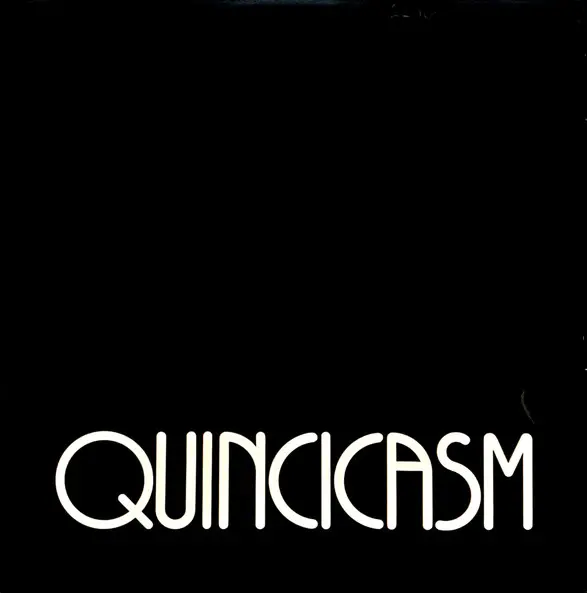 Quincicasm released their singular self-titled album in 1973 on Saydisc.
The record pairs the side-long group composition “Time & Motion” with three pieces by Marshall. Marshall plays keyboards and vibraphone alongside saxophonist Eley and flugelhornist Pearce. Bennett handles bass and flute, while Ormerod and Smith share drums and percussion. Zeserson sings on “Trent Park Song.” Saydisc issued the original pressing as SDL 249 in a run of 200 copies.
“Time & Motion” uncoils from sparse percussion through turbulent ensemble breaks and reflective interludes for vibraphone and flute. “Trent Park Song” hovers over meditative figures as Zeserson threads scat syllables through softly suspended passages. “Winds of Change” rises from a bass-and-electric-piano vamp into sharp punctuations before successive reed and brass leads yield to a wah-laced return. “Karen” follows a restrained instrumental theme.
A. “Time & Motion” (22:53) – Quincicasm
B1. “Trent Park Song” (7:30) – Marshall
B2. “Winds of Change” (9:09) – Marshall
B3. “Karen” (4:40) – Marshall
Quincicasm recorded the album at a 1973 concert in Dartington College Hall near Totnes. Saydisc founder Gef Lucena recorded and produced the performance with Genny Lucena and David Wilkins, who also received production and recording credits. Alistair McKenzie managed technical operations. The same production trio worked on the contemporary Saydisc anthology Music From Dartington, issued as SDLB 246.
Sorrell designed the sleeve with monochrome performance photography by Mike Ottley, also credited on Super Active Wizzo, the 1977 Wizzard follow-through by Roy Wood.
Jazzman included “Trent Park Song” on the 2015 compilation A New Life: Private, Independent and Youth Jazz in Great Britain 1966–1990. Eargong issued the first full-length vinyl reissue in 2022 through the label’s EG006LP series.
Postlude
From 1973 through 1976, Marshall studied at the Royal College of Music, where Ian Lake taught him piano and John Ludlow taught him violin. He also led jazz groups and recorded broadcasts for BBC Radio 3 and Capital Radio.
In 1976, Marshall formed Marshall Hain with singer Kit Hain. EMI signed the duo the following year, and the 1978 single “Dancing in the City” preceded the album Free Ride. Marshall joined the Flying Lizards for the 1979 hit “Money.” In 1980, he formed Eye to Eye with American singer Deborah Berg. Eye to Eye recorded two Warner Bros. albums with producer Gary Katz.
Pearce joined the Ronnie Scott Quintet in 1980 and remained in the group for fourteen years.
Discography:
- Quincicasm (1973)
Sources:
Artist/Album Pages:
Paul Brett (June 20, 1947 – January 31, 2024) was an English folk-psych guitarist and composer fro...
Bubble Puppy was an American psychedelic rock band from San Antonio, best known for their 1969 hi...
The Detroit Emeralds were an American soul group from Little Rock, Arkansas. Ivory Tilmon and Abri...
Michael Franks (born Sept. 18, 1944) is an American singer/songwriter who released eleven studio a...
Albatross was an Australian rustic-folk band from Sydney that released the 1973 Reprise album A Br...
Spooky Tooth was an English rock band that was active for two separate periods during the late 1960s...
Ten Years After were an English blues-rock band that released five 1967–70 studio albums and a liv...
Heaven & Earth were the American female folk duo of Pat Gefell and Jo D. Andrews. Their sole alb...
Jan Garbarek (March 4, 1947) is a Norwegian saxophonist who emerged in the 1960s through work with...
Tully was an Australian folk-psych band from Sydney that released a self-titled 1970 album on Columb...
Beck, Bogert & Appice were an English-American rock trio comprised of guitarist Jeff Beck and th...
Penetration was an English rock band that cut the 1977 Virgin single "Don't Dictate" and the 1978 ...