

Toad was a Swiss hard-rock trio that scored a national hit with “Stay” and made the 1971/72 albums Toad and Tomorrow Blue on Hallelujah, followed by the 1975 release Dreams. Further live and studio tracks surfaced on archival discs from Arkama.
Members: Vittorio “Vic” Vergeat (guitar, vocals, piano), Cosimo Lampis (drums, percussion, vocals), Werner Fröhlich (bass, vocals, 1970-72, 1975), Benjamin “Beni” Jaeger (vocals, 1970-71), Caesar Perrig (bass, 1972)
Background
Toad formed in 1970 as a spinoff of Brainticket, a Swiss-based psych collective that bassist Werner Fröhlich and Italian drummer Cosimo Lampis helped launch the prior year. Fröhlich played earlier in Les Sauterelles, a Swiss beat group with future Krokodil drummer Dude Durst. English guitarist Vic Vergeat, an early Hawkwind member, completed the power trio and emerged as Toad’s primary composer. They recorded their debut album that December in London with British producer Martin Birch, joined by vocalist Benjamin Jaeger, who departed shortly after the album’s release.
Toad
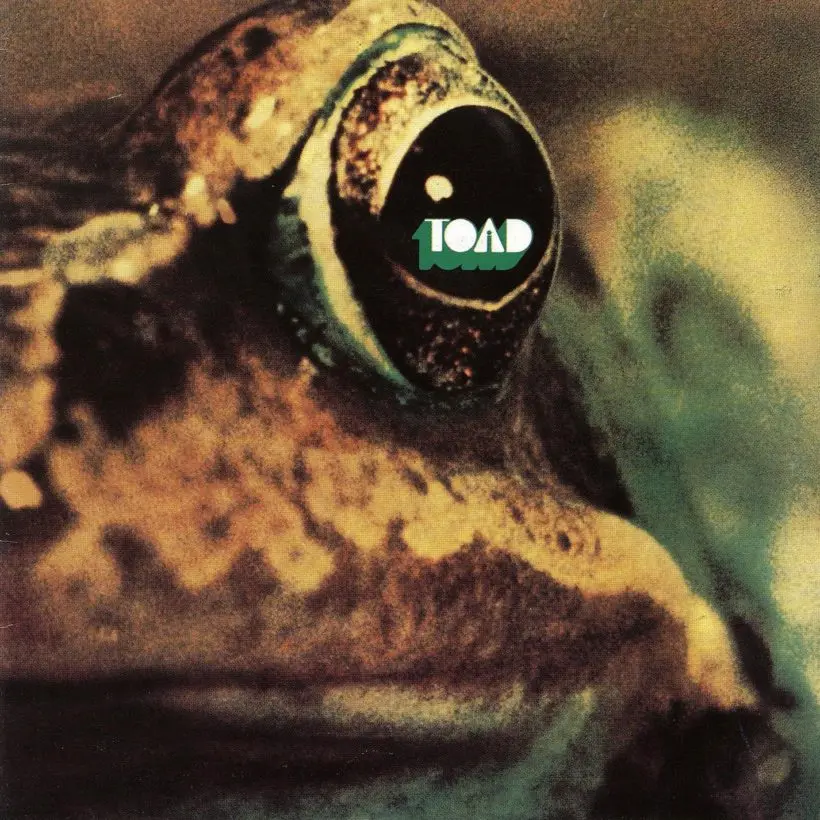 Toad released their self-titled debut album in April 1971 on Hallelujah (Switzerland, Italy) and Bellaphon (Germany).
The album balances long-form riff explorations with tense, rhythmically grounded passages. Guitarist Vic Vergeat drives the material with sharp-toned leads and extended solo breaks, shifting between blues-inflected patterns and compressed melodic bursts. Bassist Werner Fröhlich and drummer Cosimo Lampis anchor the trio with a tight, weighty backbeat that sustains and counterbalances Vergeat’s free-ranging attack. Vocalist Ben Jaeger adds forceful delivery on the album’s original seven tracks.
Toad moves between blunt, mid-tempo assaults and longer, pressure-building stretches driven by sustained distortion and elastic pacing. “Tank” locks into a fast, unbroken surge that prioritizes velocity and density, while “Pig’s Walk” slows the frame into a heavier, syncopated trudge with bass lines pushing against the guitar rather than shadowing it. Extended pieces like “Cottonwood Hill” and “Life Goes On” hinge on sectional shifts, welding compact riffs to open-ended passages without releasing tension. Across the album, Vic Vergeat’s guitar favors thick attack and spiraling solo runs, with Werner Fröhlich’s bass asserting its own rhythmic logic inside Lampis’s forceful, unyielding pulse.
A1. “Cottonwood Hill” (8:29) – Fröhlich, titled after the 1970 Brainticket album.
A2. “A Life That Ain’t Worth Living” (3:26) – Vergeat
A3. “Tank” (3:22) – Vergeat
A4. “They Say I’m Mad” (6:40) – Vergeat, Fröhlich
B1. “Life Goes On” (11:48) – Fröhlich
B2. “Pig’s Walk” (7:19) – Vergeat
B3. “The One I Mean” (2:28) – Vergeat, Fröhlich
Toad recorded the album in December 1970 at De Lane Lea Studios, London. Chris Schwegler produced the sessions for Hallelujah Records under license from Phonag, with engineering by Martin Birch. Elso Schiavo designed the gatefold cover art. Later CD reissues added the 1971 single sides “Stay” and “Animals World.”
Jaeger departed after Toad and later surfaced on Pictures, the classic 1977 album by symphonic-rockers Island.
Tomorrow Blue
 Toad released their second album, Tomorrow Blue, in January 1972 on Hallelujah.
The album shifts toward a heavier blues-based approach while retaining the trio’s dense instrumental interplay. Guitarist Vic Vergeat takes on expanded duties, alternating between overdriven riffing and restrained piano voicings, while violinist Helmut Lipsky intersects with Vergeat’s lead phrasing on select tracks in layered or conversational patterns. Bassist Werner Fröhlich and drummer Cosimo Lampis anchor the material with a taut, unrelenting backbeat that holds tension across the longer pieces and slows the pace without softening the impact. Vergeat and Fröhlich share vocal duties across the album’s seven tracks.
Tomorrow Blue shifts the band’s focus toward slower builds and extended instrumental passages, with several tracks unfolding through sectional variation and sustained pacing. “Change in Time” stretches across twelve minutes of cycling figures and dynamic breaks, including an isolated bass solo that reshapes the structure mid-track. “Thoughts” opens with hard-edged guitar phrasing and maintains thick momentum through distorted passages and percussive shifts. “Vampires” pushes a more compact format but centers on fractured riffing and an overdriven bassline that cuts through the mix. Throughout, the trio tightens their interplay, balancing heaviness against looser, drawn-out transitions and violin textures.
A1. “Thoughts” (6:27) – Vergeat, Fröhlich
A2. “Tomorrow Blue” (9:07) – Vergeat, Fröhlich
A3. “Blind Chapman’s Tales” (5:20) – Vergeat
B1. “Vampires” (5:42) – Vergeat, Fröhlich
B2. “No Need” (3:37) – Vergeat, Fröhlich
B3. “Change in Time” (12:28) – Vergeat, Fröhlich
B4. “Three O’Clock in the Morning” (0:49) – Vergeat
Toad recorded Tomorrow Blue at De Lane Lea Studios in London with returning engineer Martin Birch. Chris Schwegler produced the sessions for Hallelujah Records. Swiss artist Silvio Caduff designed the cover and Christian Vogt provided photography.
On reissues, the album includes three additional tracks: the studio outtake “Fly,” the Beatles cover “I Saw Her Standing There,” and the single “Green Ham,” which features prominent violin by Lipsky.
Dreams
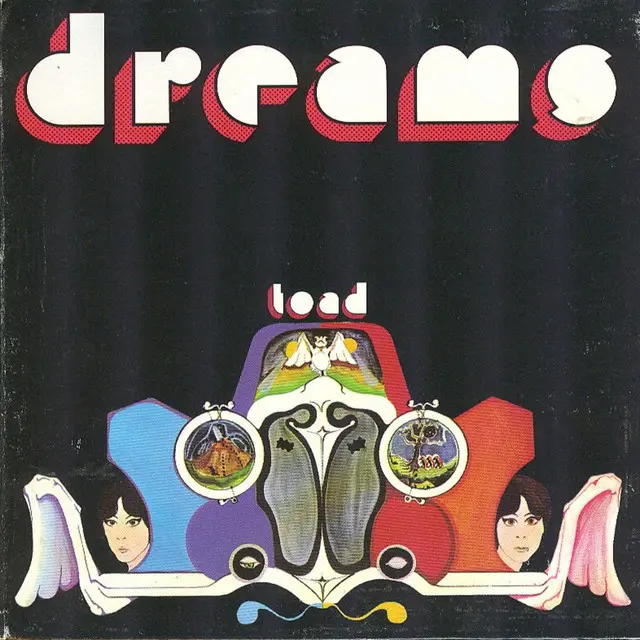 Toad released their third album, Dreams, in 1975 on Frog, a division of the Italian Carosello label.
The album integrates hard rock dynamics with occasional textural shifts, blending layered instrumentation and rhythmic density into a tighter ensemble sound. Guitarist Vic Vergeat alternates between riff-driven passages and electric piano overlays, threading compact leads through each arrangement while interacting with Werner Fröhlich’s Moog accents and Fender bass lines. Drummer Cosimo Lampis underpins the material with a firm, percussive fulcrum that adapts to each tonal shift without slackening the underlying tension.
Dreams moves with a looser, riff-centered energy, favoring short-form structures and straight rhythmic motion. “Electric Rider” stretches further than the rest, built on clipped vocal phrasing and phased guitar leads that thread in and out of a locked mid-tempo pulse. “Dreams” rotates between distorted repetition and half-time breakdowns without drifting, while “Boogin’ On a Saturday Night” keeps to a rigid backbeat under shifting keyboard and guitar textures. Across the set, the trio tightens their phrasing but gives each part more space, leaning on rhythm and impact over expansion.
A1. “Keep On Movin’” (4:19) – Vergeat
A2. “Dreams” (5:45) – Fröhlich
A3. “Let’s Get Hi” (3:20) – Vergeat
A4. “Electric Rider” (5:50) – Fröhlich
B1. “Because You’re Not” (4:23) – Vergeat
B2. “You Know Who I Am” (5:02) – Vergeat
B3. “Boogin’ On a Saturday Night” (4:10) – Vergeat
B4. “Break Down” (5:17) – Vergeat
Toad recorded Dreams in Italy with Gaetano Ria handling sound engineering. The band self-produced the album, which was released through Carosello’s Frog imprint and manufactured by C.E.M.E.D., with distribution by Dischi Ricordi and printing by Grafica Centonze.
A later CD edition added two non-album tracks: a version of “Purple Haze” by Jimi Hendrix and the Vergeat-penned “Making You Feel Right,” originally released as a standalone single.
Discography:
- Toad (1971)
- Tomorrow Blue (1972)
- Dreams (1975)
- Rarities (1992)
- B.U.F.O.: Blues United Fighting Organization (2003, recorded 1970)
- Live at St.Joseph, Basel 22.04.1972 (2005)
Sources:
Artist/Album Pages:
The Parlour Band was an English rustic art-pop band that released the album Is a Friend? on Deram ...
Extempore was a Czech avant-rock band that began life in 1973 as Naive Extempore Band. A string of...
Agitation Free was a German Krautrock band behind the 1972/73 Vertigo albums Malesch and 2nd. They f...
Ablution was a Swedish jazz-rock band behind a 1974 self-titled album on CBS. Four members played ...
Slapp Happy was a multi-national art-pop trio, formed in Hamburg, Germany, in 1972 by American singe...
Rush was a Canadian maximalist hard-rock trio from Toronto, Ontario, that was active for nearly five...
Petrus Castrus was a Portuguese symphonic-rock band that included musician/composer Júlio Pereira....
Vernon Burch (1955–2022) was an American soul singer and songwriter, best known for the Billboard...
Fifty Foot Hose was an American psych-rock band from San Francisco that released the 1968 album C...
Jean-Michel Jarre is a French keyboardist and sound technician who emerged in the early 1970s, fir...
Nebulosa was a Swedish symphonic/hard-rock/folk band that issued a self-titled album on Park Studi...
Jeronimo was a German hard-rock band behind the 1970/71 Bellaphon albums Cosmic Blues and Jeronimo...