
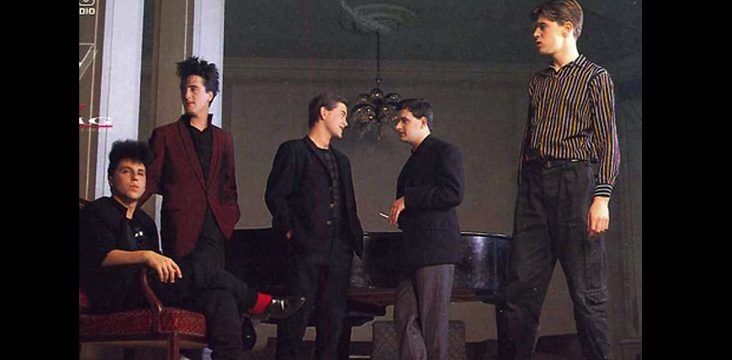
Danza Invisible was a Spanish new wave band that made the 1983–85 Ariola albums Contacto Interior and Maratón, followed by five albums through 1991 on the Twins label.
Members: Manuel Rubio (guitar), Antonio Luis Gil (guitar), Chris Navas (bass), Texidó (drums, 1981-93), Javier Ojeda (vocals, 1982-present)
Background
Danza Invisible formed in 1981 in Torremolinos, Spain, when drummer-singer Ricardo Texidó joined guitarist Manuel Rubio and bassist Chris Navas at a rehearsal room beneath El Capote, a pub owned by the father of Navas.
At age seven, Texidó moved with his family from Córdoba to Málaga. He learned guitar in adolescence and joined Éxodo at fifteen, then played briefly with Cámara. Navas and Rubio came from Adrenalina, a Torremolinos punk and new-wave group. In late 1981, guitarist Antonio Luis Gil joined from the unsigned Zahir.
Javier Ojeda followed the Málaga and Torremolinos new-wave circuit as a fan and planned a career in music journalism. In February 1982, Texidó invited the seventeen-year-old Ojeda to an audition, where he became lead singer. The five-piece rehearsed at El Capote and played early dates at Hardy’s in Torremolinos. They soon reached Málaga through university dining-hall concerts.
Through a local radio demo contest, the Danza Invisible track “Tinieblas en negro” landed on a Polifonía-label EP with cuts by Cámara, Spray, and Krazy Boys. Texidó and Navas hawked a subsequent demo to broadcasters and labels in Madrid, where Paco Martín signed Danza Invisible to MR Records. In August 1982, the quintet recorded the four-song maxi-single Sueños at Doublewtronics, the Madrid studio of Jesús Gómez.
In September, Danza Invisible won the first Concurso de Rock Alcazaba in Jerez de la Frontera. The prize financed a DRO maxi with “Mis ojos hacia ti,” “Gente especial,” and “Espíritu irreal.” On October 22 and 23, the group played two Rock-Ola dates in Madrid. MR handed Danza Invisible to Ariola, which assigned the band to producer Julián Ruiz, a recent soundman for Azul y Negro.
Discography:
- Contacto Interior (1983)
- Maratón (1985)
- Música de Contrabando (1986)
- Directo (live, 1987)
- A tu Alcance (1988)
- Catalina (1990)
- Bazar (1991)
Research notes
- Javier Ojeda — interview conducted for Jesús Ordovás, Esto no es Hawaii. Ojeda gives the formation sequence: Texidó from Cámara, Rubio and Navas from Adrenalina, Gil from Zahir, the recruitment of Ojeda, the first demo trip to Madrid, and the MR relationship. (Javier Ojeda)
- Ricardo Texidó — The Logical Web, July 2026. Texidó identifies El Capote as the original rehearsal site, confirms the initial trio, and supplies his Córdoba–Málaga childhood, early guitar study, Éxodo activity, and transition to drums. (The Logical Web)
- Ayuntamiento de Málaga — Danza Invisible 40th-anniversary exhibition material. The municipal account identifies El Capote, the early Hardy’s concerts, the university dining-hall dates in Málaga, the demo competition, and the Madrid move. (Web del Ayuntamiento de Málaga)
- Javier Ojeda profile, Málaga press archive. Ojeda describes his teenage involvement with the local music scene, his early contact with Sociedad Anónima, and the audition that brought him into Danza Invisible. (Javier Ojeda)
- Polifonía four-band EP documentation. Surviving record data confirms “Tinieblas en negro” alongside tracks by Spray, Cámara, and Krazy Boys on the Polifonía release. (Todo Colección)
- El Giradiscos — Javier Ojeda interview. Ojeda identifies Sueños as the MR recording made at Doublewtronics, the Madrid studio operated by Jesús Gómez. (El Giradiscos)
- El País, October 25, 1982. The contemporary Rock-Ola report confirms the Jerez victory, FM circulation of the demos, the Madrid audience response, and record-industry attendance at the Rock-Ola presentation. (El País)
- Rock-Ola and Alcazaba archival listings. Surviving listings place the Rock-Ola shows on October 22–23 and the first Alcazaba competition in September 1982. (No 80s Imprenta)
- La Fonoteca. Its group history traces the MR-to-Ariola transition and identifies Julián Ruiz as producer of Contacto Interior. (La Fonoteca)
Artist/Album Pages:
White Lion was a Danish-American metal band behind the 1985 Grand Slamm album Fight to Survive, f...
Deacon Blue are a Scottish sophisti-pop band that released the 1987–89 CBS albums Raintown and Whe...
Tank was an English hard-rock/metal band behind the 1982 Kamaflage albums Filth Hounds of Hades an...
John Abercrombie (Dec. 16, 1944 — Aug. 22, 2017) was an American jazz guitarist who played in the ...
Medina Azahara are a Spanish hard-rock band behind the 1979–82 CBS albums Medina Azahara, La Esqui...
Kamæleon was a Danish jazz-rock band behind the 1978–80 Amar albums Kamiæleon and Svajende Siv. ...
Everest was a Canadian melodic-rock band from Toronto that released a 1984 self-titled album on E...
Linx was an English soul-funk group from London led by singer David Grant and bassist Peter “Sketc...
Mark Sherman is an American malletist from the Bronx who debuted with the 1980 Unisphere album Ful...
Rictus was a French symphonic-rock band that released three albums on assorted labels between 1981...
Larry Coryell (April 2, 1943 — Feb. 19, 2017) was an American guitarist who emerged in the late-19...
Flyte was a Dutch symphonic-rock band behind the 1979 album Dawn Dancer on Don Quixote Records. ...