

Sahara was a German symphonic-rock band that evolved from Subject ESQ. As Sahara, they made the 1974 album Sunrise, followed by the 1976 Ariola release For All the Clowns.
Members: Hennes Hering (keyboards), Michael Hofmann (flute, woodwinds, Moog, Mellotron, vocals), Alex Pittwohn (harmonica, tenor saxophone, vocals), Harry Rosenkind (drums, percussion), Stefan Wissnet (bass, vocals), Nick Woodland (guitar), Holger Brandt (drums), Günther Moll (guitar, vocals, bass)
Background
Sahara first recorded as Subject ESQ., a Munich jazz-rock band that made a 1972 album on Epic. Their lineup featured reedist Michael Hofmann, bassist Stefan Wissnet, drummer Harry Rosenkind, and multi-instrumentalist Alex Pittwohn. After the album, keyboardist Peter Stadler cleared for Hennes Hering, who cut three albums with Out of Focus. The reconfigured band continued as Sahara with original Gift guitarist Nick Woodland.
Sunrise
 Sahara released their debut album, Sunrise, in March 1974 on PAn.
Sunrise presents Sahara in a more expansive, sectional mode, balancing compact songs against a side-long suite built from shifting tempos and contrasting densities.
“Marie Celeste” opens with a brief formal prelude before snapping into rapid guitar motion, then repeatedly brakes into quieter passages where organ, saxophone, and flute reshape the momentum before another surge resets the pace. “Circles” pares the texture down to acoustic strumming, harmonica, and close-set vocals, maintaining a steady, unforced tempo that contrasts sharply with the surrounding material. “Rainbow Rider” alternates between brisk verses and slower interior passages, with piano and guitar trading prominence before drifting into looser phrasing late in the track.
The title suite occupies the entire second side and unfolds as a multi-movement arc: water sounds and flute introduce a suspended opening, keyboards then stretch into long, sustained figures, and the piece cycles through extended instrumental spans marked by abrupt dynamic drops, thunder effects, and renewed climbs. Bass anchors the transitions while mellotron and organ widen the harmonic field, and the final sections intensify through layered keyboards and guitar before resolving in a sustained, high-register plateau rather than a conventional close.
A1. “Marie Celeste” (7:35) – music: Hering, lyrics: Woodland
A2. “Circles” (4:38) – Pittwohn
A3. “Rainbow Rider” (7:40) – music: Hofmann, lyrics: Woodland
Sunrise (27:20) – Hofmann
B1. Part 1
— a. “Sunrise”
— b. “The Divinity of Being”
— c. “Perception Including Devils Tune”
— d. “Paramount Confluence”
B2. Part 2
— a. “Aspiration”
— b. “Creativity”
— c. “Realisation”
Sessions occurred in autumn 1973 at Musicland Studios, Munich, with Reinhold Mack, a soundman on 1974 albums by Deep Purple, The Rolling Stones, Scorpions, and Uriah Heep.
Between albums, Alex Pittwohn stepped behind the scenes while Rosenkind and Woodland cleared, respectively, for Missing Link drummer Holger Brandt and session guitarist Günther Moll.
For All the Clowns
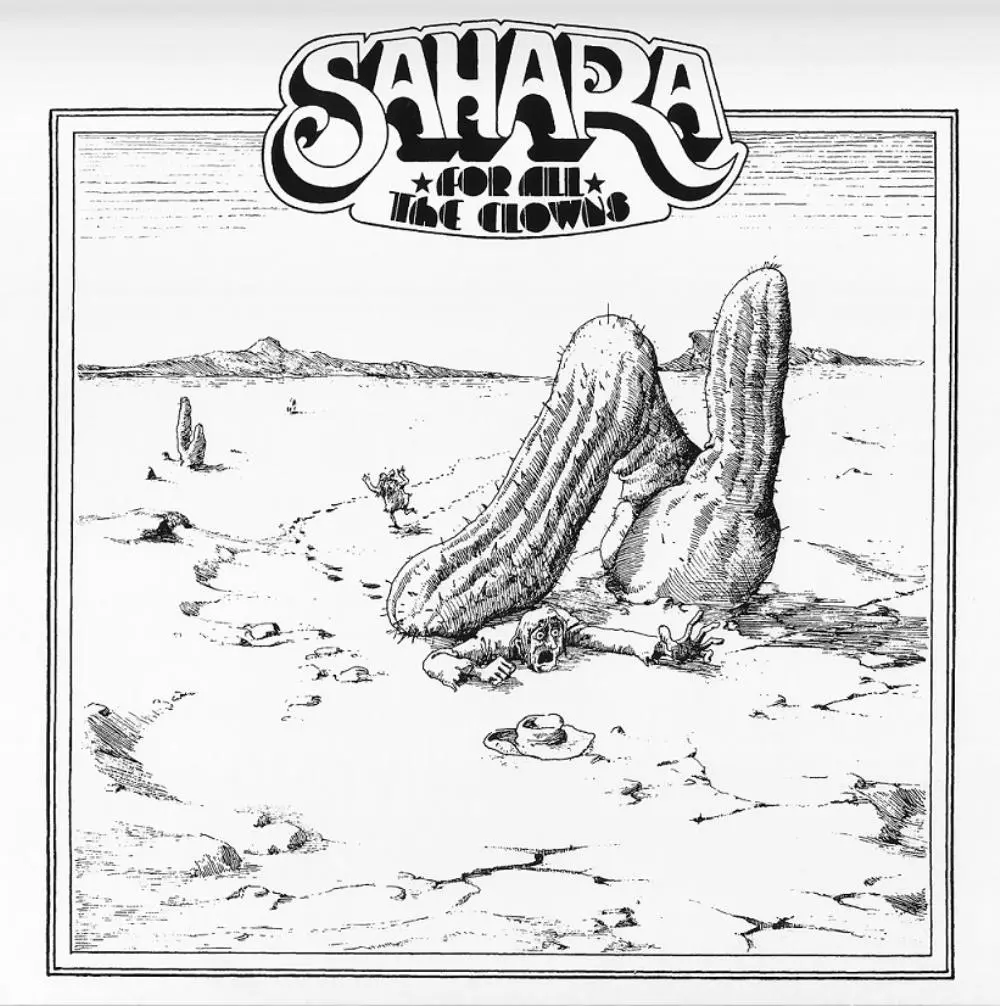 Sahara released their second album, For All the Clowns, in February 1976 on Ariola.
For All the Clowns trades Sahara’s prior eclecticism for more unified compositions shaped by slow-burning transitions, sectional interplay, and tightened arrangements.
“Flying Dancer” opens with staccato guitar and vocal unison lines before shifting into wider phrases supported by layered synth textures. “The Source” builds gradually from sparse drum and organ pulses into a midsection where distorted guitar threads through a slower harmonic turn; the second half introduces a darker motif that escalates in density with each pass before breaking into a descending cadence. The title track opens in whispered tones over minor synth washes, then unfolds into layered vocal sections punctuated by modal changes and long electric guitar phrases that stretch through the final third.
The brief “Prelude” opens side two with quiet piano lines that set up “The Mountain King,” which begins in rapid unison and tumbles into passages of syncopated flute, gliding Moog lines, and rhythmic shifts. Midway, the tempo drops as electric piano and guitar trade loose figures before a slow ascent leads into a sequence of sharp modulations and a final uptempo reprise. “Dream Queen” restores a subdued setting with 12-string arpeggios and ambient flute, expanding only briefly into overlapping vocals and a quiet interlude. “Fool the Fortune” closes the album with a short, pastoral reflection voiced in soft acoustic tones over natural background sounds.
A1. “Flying Dancer” (3:23) – Wissnet
A2. “The Source Part I & Part II” (7:10) – Wissnet
A3. “For all the Clowns” (10:59) – Hofmann, Meryl Creser
B1. “Prelude” (1:05) – Hering
B2. “The Mountain King Part I & Part II” (13:20) – Hofmann, Wissnet
B3. “Dream Queen” (5:05) – Wissnet
B4. “Fool the fortune” (1:19) – Hofmann
Sahara self-produced the album in August 1975 at Union Studio in Munich. English soundman Robin Black mixed For All the Clowns at Morgan Studios in London, where he worked in sequence on concurrent titles by Jethro Tull, Man, Murray Head, and Steeleye Span. Sunrise member played guest 12-string on “The Source.”
The cover depicts a sun-bleached desert, where a giant bent cactus crushes a screaming man into the cracked earth, while a second figure flees in panic—suggesting absurdist doom amid parodic Western imagery. The artist, Kurt Halbritter (1924–1978), was a German satirical illustrator and cartoonist best known for his work in Pardon magazine and his grotesquely humorous visual critiques of society, history, and culture.
Discography:
- Sunrise (1974)
- For All the Clowns (1975)
- Lost Tapes 1971-1975 (2016)
Sources:
Artist/Album Pages:
Speed Limit was a Hungarian-French jazz-rock supergroup that released a self-titled album on Le Ch...
Pete Townshend (born May 19, 1945) is an English musician, composer, and singer who rose to global...
Tim Blake (born Feb. 6, 1952) is an English electronic musician from London who played in Gong bet...
Merry Clayton (born Dec. 25, 1948) is an American soul singer from New Orleans who emerged throug...
Atmospheres was an American jazz-rock supergroup assembled by reedist Clive Stevens for the 1974 C...
Shalamar was an American soul-funk vocal trio from N.Y.C. that debuted with an album on Don Corne...
Yvonne Fair (Oct. 21, 1942 — March 6, 1994) was an American soul singer who emerged in the James ...
Nyl was a French psych-rock and Zeuhl band that released a 1976 self-titled album on Urus. Membe...
Karin Krog is a Norwegian jazz singer from Oslo who made her recording debut on Metropol Jazz in 1...
Peaches & Herb were an American soul duo formed in Washington, DC, by singers Herb Fame and F...
Gualberto is a Spanish guitarist, sitarist, and arranger who made two albums with Seville hard roc...
Pete Fine is an American is an American guitarist, singer, composer, and orchestrator from New Yo...