

Vortex was a French Zeuhl band that released a self-titled album on JBP in 1975, followed by the popular Les Cycles de Thanatos on F.L.V.M. in 1979.
Members: Jean-Pierre Vivante (keyboards), Jacques Vivante (bass), Jean-Francois Trouillet (flute, 1975-77), Gerard Jolivet (saxophone, clarinet), Francois Gerald (drums, 1975-77), Maurice Sonjon (vibraphone, xylophone, 1976-79), Alain Chaleard (xylophone, vibraphone, 1976-79), Jean-Michel Belaich (drums, gongs, 1977-79), Christian Boissel (oboe, English horn, keyboards, 1977-79), Jacques Guyot (saxophone, 1976-80), Vincent Daune (drums, 1979-80), Bruno Heitz (percussion, 1979-80), Michel Tardieu (keyboards, 1979-80), Jacques Dessert (cello, 1979), Philippe Matias (percussion, 1979), Bernard Monerri (guitar, 1979-80)
Background
Vortex evolved from Urantia, formed 1973 in Lyon, Auvergne-Rhône-Alpes. The band coalesced when keyboardist Jean-Pierre Vivante (piano, Fender Rhodes, organ) recruited local players for Testu Band, a Soft Machine covers outfit that laid groundwork for original material. Vivante, self-taught on piano from childhood, experimented with guitar and bass in his teens before a personal epiphany redirected him to keys; he attended no formal conservatory, drawing instead from family encouragement and solitary practice amid Lyon’s student scene.
Drummer François Gerald joined Vivante through neighborhood jams, where Gerald honed basic rhythms via informal group sessions—no structured schooling, just gig-driven trial. Flautist Jean-François Trouillet linked up via Testu Band’s rehearsal circuit, building flute technique through cover gigs and self-study influenced by Canterbury sounds. The trio gigged sporadically in Lyon basements.
Bassist/guitarist Jacques Vivante met his brother Jean-Pierre upon returning from engineering studies at a Paris technical institute, where he discovered Gong and Soft Machine via campus clubs; he started on guitar, switched to bass for the group, and contributed melodies to Jean-Pierre’s structures in their complementary partnership. The brothers rechristened the act Urantia, inspired by the esoteric 1955 book Livre d’Urantia, and shifted to originals blending jazz-rock spirals around serene cores.
Reedist Gérard Jolivet encountered the Vivantes at a 1974 Tartempion-affiliated workshop, adding saxophonist and flute layers shaped by his autodidact jazz immersion—no academy background, only scene associations. They performed once as Urantia at Jacques’s workplace school in early 1975, testing material in a low-key hall gig that drew student crowds.
Urantia attended a Magma concert that prompted their name change to Vortex, evading overlap with Christian Vander’s Urantian themes. Students invited the band to score M’dame S91, an avant-garde play for the July-August 1975 Avignon Festival, where Vortex adapted scripts to their jazz-fusion cues.
Vortex
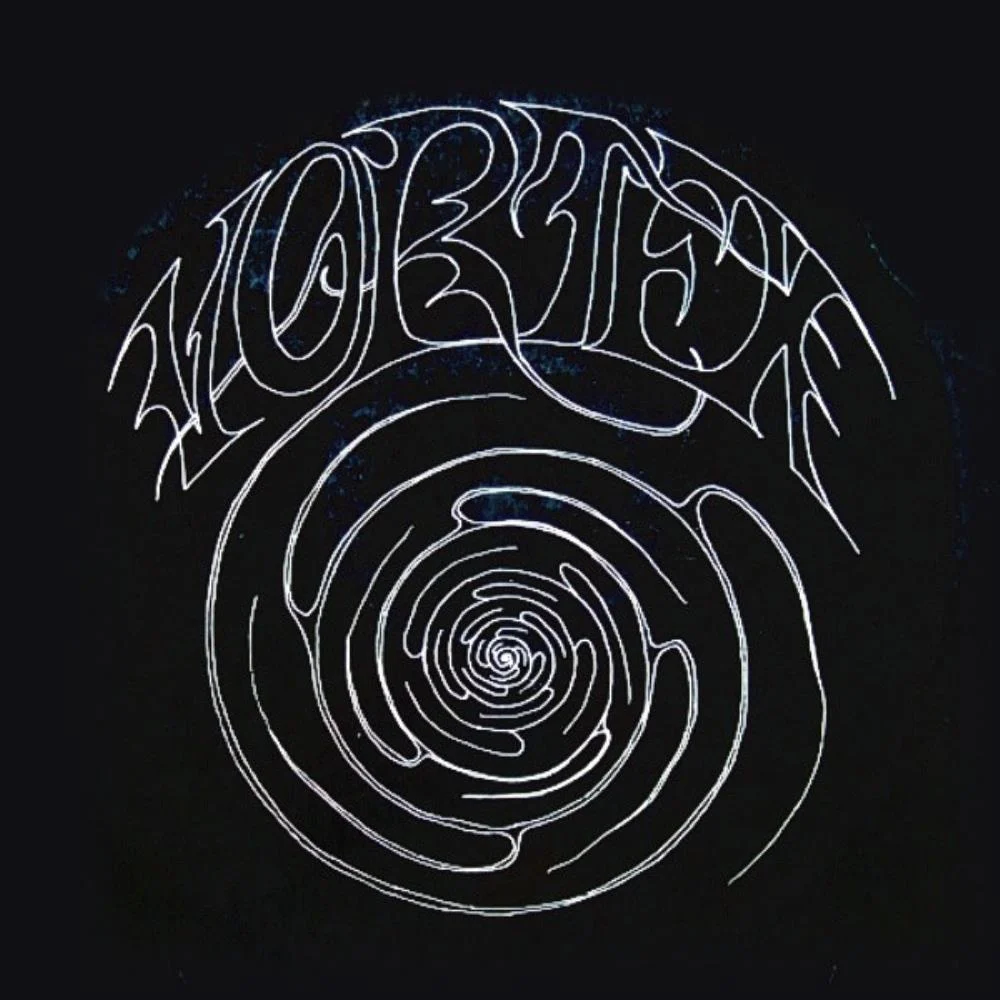 Vortex released their self-titled debut album in late 1975 on JBP Records.
Vortex marks the debut of the French avant-prog ensemble, released in late 1975 on JBP Records. The album establishes the group’s signature chamber-rock sound, blending jazz-inflected rhythms with dissonant, tightly arranged passages. Its interplay of flute, saxophone, and Fender Rhodes piano creates a textured, multidimensional palette that balances lyrical passages with angular improvisation.
Primary composers Jean-Pierre Vivante and Jacques Vivante wrote most of the material, with Jean Vivante contributing additional pieces. The music alternates between structured jazz-rock compositions and freer, experimental segments, highlighting the trio of brothers alongside François Gérald on drums, Jeff Trouillet on flute and percussion, and Gérard Jolivet on saxophone.
A1. “Haroun’ Thasckouack” (10:30) — opens with intricate drum patterns and layered flute and sax motifs over the Fender Rhodes, gradually building into ensemble interplay that shifts between psychedelic jazz-rock and chamber textures.
A2. “Ahsquoumboum” (6:30) — emphasizes darker tonalities and rhythmic tension, with bass and piano driving quasi-Kobaian motifs under agile saxophone and flute lines.
B1. “Délicieuse Créature” [Delicious Creature] (14:50) — features contrasting sections of restrained flute passages and fuller, almost chaotic jazz-rock bursts; the opening evokes Rodgers and Hammerstein-like chordal motifs before moving into extended, angular improvisations.
B2. “Abominable Créature” [Abominable Creature] (1:40) — concise finale with dissonant phrasing and abrupt tempo shifts.
Bonus tracks on some editions include “C’est Cool, Raoul,” a slow, atmospheric piece with Eastern-influenced chimes, flute, and uncredited cello-like textures, and “Prolégo 1,” a bass-driven, fast-tempo track with flute and saxophone interplay.
Sessions occurred in June 1975 at La Grange, Caluire, with the band arranging and Gilles Lançon engineering.
Vortex combines jazz precision with avant-prog exploration, balancing lush Rhodes harmonies against sharp-edged sax and flute lines, offering a complex but immersive chamber-rock experience.
Between Albums: 1975–1979
Vortex limited post-festival gigs and moved rehearsals across Lyon sites; they settled in early 1977 at a school managed by future percussionist Maurice Sonjon, which served as their three-room studio. The Vivante brothers immersed in 20th-century classical works by Bartók, Stravinsky, and Messiaen, adapting techniques like those in Messiaen’s 1964 Et Exspecto Resurrectionem Mortuorum to seed the epic “Les Cycles de Thanatos” on their sophomore effort; they borrowed a 15-second motif as structural template. The brothers eyed scoring a war sequence for Alejandro Jodorowsky’s unproduced Dune adaptation, but the project collapsed.
To realize the denser chamber-prog demands, Vortex recruited saxophonist Jacques Guyot and conservatory-trained percussionists Maurice Sonjon (vibraphone, xylophone, tubular bells, percussion) and Alain Chaleard (timpani, xylophone, vibraphone, tubular bells, percussion). Drummer François Gérald departed mid-1977, prompting Jean-Michel Belaïch (drums, gongs, percussion) to replace him. They also welcomed multi-instrumentalist Christian Boissel, who played oboe, English horn, Fender Rhodes, and synthesizer.
Tracks finalized by spring 1977, but recording dragged into May 1979 at Lyon studios; the octet layered rhythm beds first over six weeks, then overdubbed instruments sequentially due to intricacy, resuming for five weeks at Togo-Saga in August–September 1978. Vortex resumed stage work after nine months’ rehearsal hiatus, debuting April 28, 1978, at INSA hall. Labels rejected the 40-minute suite as uncommercial, so the band launched self-label Faites Le Vous Même (distributed by Le Chant du Monde), pressing ~3,000 copies.
Les Cycles de Thanatos
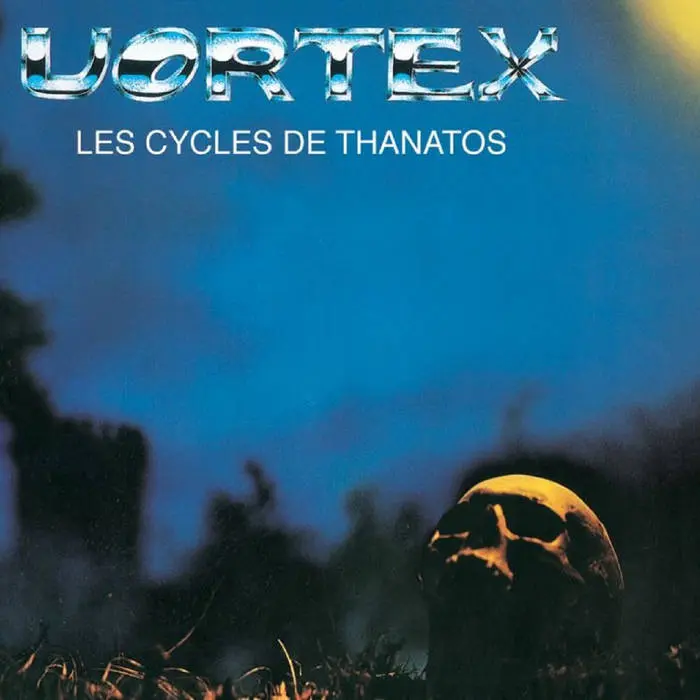 Vortex released their second album, Les Cycles de Thanatos, in 1979 on F.L.V.M.
The album expands on the dark, orchestral jazz-rock of their 1975 debut with longer, more intricate compositions and a denser ensemble sound. The eight-piece lineup — co-led by pianist Jean-Pierre Vivante and bassist Jacques Vivante — augmented their chamber-rock palette with expanded reeds, dual percussionists, and guest violin and bassoon players.
Jean-Pierre and Jacques Vivante co-wrote the entire album, which consists of three long-form instrumentals that merge the rhythmic freedom of jazz fusion with the structural rigor of modern classical composition.
The music moves through contrasting forms: “God Is Good for You, John” evokes Jean-Luc Ponty–style electric jazz with ornate violin and rhythmic interplay; “Prolégomènes” builds from Soft Machine–like ensemble phrasing into angular passages reminiscent of Henry Cow and Zao; the sidelong title work, “Les Cycles de Thanatos,” unfolds as a brooding, multipart suite in the spirit of Univers Zero and Art Zoyd, shifting from somber woodwind textures to percussive crescendos and zeuhl-like sequences.
A1. “God Is Good for You, John” (4:28)
A2. “Prolégomènes” (11:43)
B. “Les Cycles de Thanatos” (25:16)
Sessions took place at Studio Togo Saga in July 1977 and July 1978, produced by Togo Saga Music and Vortex with engineers Jacques Vivante, Jean-Claude Mercier, and Jean-Pierre Vivante.
Personnel: pianist/keyboardist Jean-Pierre Vivante; bassist Jacques Vivante; drummer Jean-Michel Belaich; percussionists Alain Chaleard and Maurice Sonjon; reedists Gérard Jolivet (contrabass clarinet, saxophones) and Jacques Guyot (saxophones); keyboardist/oboist Christian Boissel (electric piano, cor anglais, synthesizer); with guests Sunny Jammes (violin, A1) and Michel Boissel (bassoon, B).
Les Cycles de Thanatos appeared in a limited pressing on the independent Faites-Le-Vous-Même imprint, its title referencing the Greek personification of death. The cover design by Hélène Genard reflects the album’s conceptual austerity and dark tonal balance.
Postlude
Vortex promoted Les Cycles nationwide, including a joint rendition with Art Zoyd. Tensions peaked post-release: Boissel and Chaleard exited for a duo venture, Sonjon reverted to school duties, and Belaïch eyed departure pending successor.
Vortex regrouped for the 1979 Musiques Nouvelles festival alongside Art Zoyd, Univers Zéro, Neffesh Music, Xalph, and Uppsala, deploying a temp octet with returning Jolivet and Guyot on saxes, Belaïch on drums, Michel Tardieu (keyboards, ex-Terpandre), cellist Jacques Dessert, and multi-instrumentalist Philippe Matias (percussion, saxophone). A core sextet stabilized around the Vivantes, Jolivet, Guyot, Tardieu, new drummer Vincent Daune (ex-Terpandre), percussionist Bruno Heitz, and guitarist Bernard Monerri for rock heft; Tardieu penned the Bartók-infused Chronosophie, a concert staple alongside reworked Cycles.
The Vivantes partnered with the Dionysos label for a third LP, but financial strains—insufficient earnings for livelihoods—and pushes for vocals and accessible shifts clashed with the brothers’ vision. Vortex performed their final two concerts in June 1980, one in France and the other in Germany, their only show outside their homeland.
In 2003, archivists Trinton reissued both Vortex albums as a two-CD set with four bonus tracks:
1.5. “C’est cool, Raoul” (11:43)
1.6. “Prolégo 1” (5:01)
2.4. “Hipopotalamus Negrus” (5:46)
2.5. “Ivanoe” (4:35)
Discography:
- Vortex (1975)
- Les Cycles de Thanatos (1979)
Sources:
Artist/Album Pages:
Mustang was a Belgian hard-rock band that evolved from Guy Morgan & The Mustangs, a Sixties Br...
Ozzy Osbourne (December 3, 1948 – July 22, 2025) was an English hard-rock/metal singer who gained ...
Jigsaw was an English pop-rock band from Coventry that released a trio of singles on MGM/Music Fac...
The Steve Miller Band are an American classic-rock band from San Francisco that released fourteen...
Syncrisis was a German jazz-rock band that self-pressed the 1981 album Reflections in Musical Powe...
Hyldemor was a Danish psych-rock band behind the 1978 CBS album Glem det Hele. They evolved from ...
Ryuichi Sakamoto — 坂本龍一 (January 17, 1952 – March 28, 2023) — was a Japanese musician and composer...
Atlas was a Swedish symphonic-rock band behind the 1979 Bellatrix album Blå Vardag. Four-fifths of...
Sven Libaek (born Sept. 20, 1938) is a Norwegian-born/Australian-based keyboardist, composer, cond...
The Babys were an English rock band that released the 1976–77 Chrysalis albums The Babys and Broke...
Mars Everywhere was an American avant-rock/electronic band from Washington, DC, that debuted with...
Latte e Miele was an Italian symphonic-rock band that made the 1972/73 Polydor albums Passio Secun...