

Tangerine was a French folk-rock band that debuted with the album De l’autre côté de la forêt on Arcane in 1975, followed by Mémoire on Crypto in 1976.
Members: Valéry Btech (vocals, guitar, piano), Marc Donahue (guitar, flute, keyboards, saxophone, bongos, vocals), Gabriel Malka (guitar, vocals), Charlie Sabban (guitar, vocals), Francis Lockwood (keyboards), Jean My Truong (drums), Des Leprince (guitar, vocals), Alain Bedier (bass, vocals)
Background
Tangerine blossomed in 1972 as a Provence acoustic-folk trio composed of singer/guitarist Valéry Btesh and guitarist/singers Gabriel Malka and Charlie Sabban. In 1973, they welcomed American guitarist, reedist, and songwriter Marc Donahue (b. March 10, 1953; Los Angeles). They hired the auxiliary rhythm section of bassist Alain Carnel and drummer Roger Gremillot, both alumni of the 1970 post-psych one-off Introversion. Gremillot cut a 1973 jazz-rock album in Travelling.
De l’autre côté de la forêt
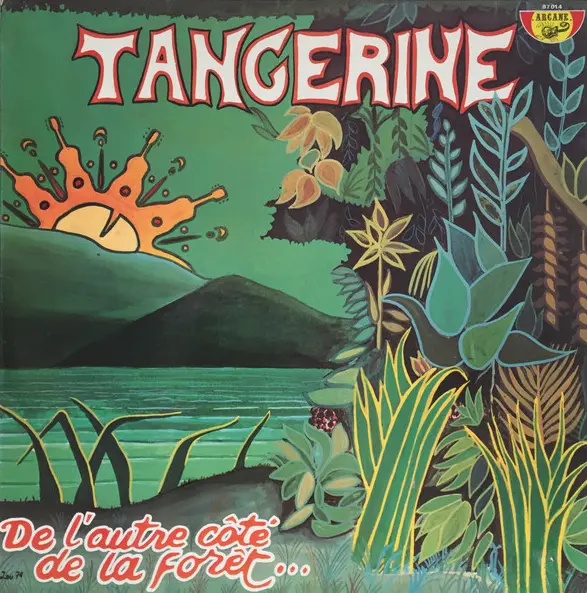 Tangerine released their first album, De l’autre côté de la forêt, in 1975 on Arcane.
The album presents a Franco-American hybrid of acoustic folk and soft rock, alternating between French and English lyrics with influences drawn from early 1970s California acts like America and Crosby, Stills & Nash, as well as from British folk collectives in the Fairport Convention tradition. It marks the group’s most pastoral and harmony-rich work before later lineup changes steered them toward a heavier direction.
Singer–guitarist Valérie Btesh composed or co-composed six of the album’s nine songs. Guitarist–flutist–keyboardist Marc Donahue co-wrote two and wrote one independently, while guitarist–vocalist Charlie Sabban collaborated on three. “De l’autre côté de la forêt” adapts America’s 1972 number “Sandman” with new French lyrics by Btesh and Bunnel.
Songs range from the airy folk-pop of “Liberté” and “Listen” to the meditative, seven-minute “Méditations,” where flute, saxophone, and layered acoustic guitars intertwine over a slow rhythmic pulse. “It’s Ending” features an intricate percussive pattern with Btesh’s solo vocal lead, while “Éveil” and “Direction Sud” close the album in a reflective, pastoral tone with acoustic textures and multi-part harmonies.
A1. “De l’autre côté de la forêt” [On the Other Side of the Forest] (2:56) — adapted from America’s 1972 song “Sandman,” written by Dewey Bunnell, with new French lyrics by Valérie Btesh and Bunnel.
A2. “Death” (2:45)
A3. “Méditations” (7:22)
A4. “Liberté” [Freedom] (3:50)
B1. “It’s Ending” (4:20)
B2. “Listen” (2:32)
B3. “Time” (3:30)
B4. “Éveil” [Awakening] (3:40)
B5. “Direction Sud” [Southbound] (3:16)
Sessions occurred at Studio de la Citadelle in Besançon with producer Jean-Claude Pognant, except “Liberté,” recorded at Studio Aquarium in Paris with engineer Sidney Hermann. Additional engineering came from Jean-Claude Robert.
De l’autre côté de la forêt features lakeside shrubbery artwork by Jean-Louis Macchi. Photography on the reverse sleeve is by Christian Zagaria.
Between albums, Valéry and Marc assembled a new Tangerine lineup with guitarist Pierre Calafat, bassist André Bouchaud, and two former Ergo Sum members: guitarist Jean-Pierre Testa and drummer B.B. Brutus. Before they re-entered the studio, Brutus cleared for Christian Schmid and Valéry took a leave of absence.
Mémoire
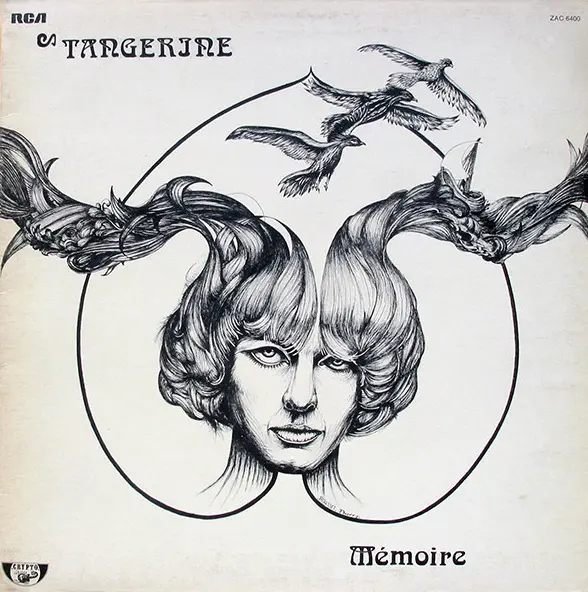 Tangerine released their second album, Mémoire, in October 1976 on Crypto.
The album marks a sharp stylistic shift from the folk-inclined debut toward a polished, West Coast–influenced soft-rock sound characterized by multi-part male vocals, acoustic–electric guitar layering, and smooth rhythmic pacing. It features a full-band effort by guitarist–keyboardist–flutist–saxophonist Marc Donahue, bassist–vocalist André Bouchaud, guitarist–vocalist Pierre Calafat, guitarist Jean-Pierre Testa, and drummer–percussionist Christian Schmidt.
Donahue composed five of the album’s nine songs and co-wrote two others. Schmidt co-wrote two pieces with Donahue and one with Testa, while Calafat and Arduca co-wrote one. The album also includes a cover of “The Way I Feel,” originally written and recorded by Canadian singer-songwriter Gordon Lightfoot.
The opening track, “Sad and Lonely,” moves in a fluid acoustic rhythm with harmonized vocals and lyrical themes of introspection and emotional loss. “Ship to Mars” blends strummed guitars and soft electric leads with imagery of escapism and distance. “Gueule de Bois” (“Hangover”) delivers a compact, French-sung narrative underscored by folk-rock dynamics. “Unexpected Visitor” develops over five minutes with tonal shifts between subdued verses and emphatic choruses.
Side two opens with “Era Verita,” a reflective song that merges acoustic guitar lines with sustained keyboard textures. “La Source de Vie” (“The Source of Life”) contrasts with its bright tempo and French lyrics. “The Way I Feel” follows in a relaxed pace with deep vocal phrasing and a minimalist arrangement. The two closing numbers, “Beggar Born to Die” and “Voice in My Mind,” return to English lyrics and extended structures with recurring chord patterns and overlapping guitar and vocal lines.
Tracklist
A1. “Sad and Lonely” (3:50)
A2. “Ship to Mars” (4:50)
A3. “Gueule de Bois” [Hangover] (3:30)
A4. “Unexpected Visitor” (5:00)
B1. “Era Verita” (3:50)
B2. “La Source de Vie” [The Source of Life] (3:20)
B3. “The Way I Feel” (3:50) — written by Gordon Lightfoot, first recorded by Lightfoot in 1965 on his debut album Lightfoot!, later covered by artists including Buffy Sainte-Marie and Harry Belafonte.
B4. “Beggar Born to Die” (6:30)
B5. “Voice in My Mind” (4:00)
Sessions occurred in July 1976 at Studio Antibes with producer Jean-Claude Pognant and engineers B. Belan and Jean-Pierre Massiera. G.S. Popeye served as artistic director.
Mémoire features cover artwork by Thierry Rousset.
Crypto distributed Mémoire through RCA. The album’s fusion of French and English songwriting with American-styled instrumentation made it Tangerine’s final release before their dissolution.
Postlude
Tangerine remained an off-recorded concern through 1981 with Valérie as the sole constant after Donahue’s 1977 departure. One final single, “L’Épouvantail” (b/w “Misery”) appeared in 1981 on GiG Records.
Marc Donahue co-arranged the 1977 Crypto folk-psych album Lettre Au Passé by singer/songwriter Jean Claude Vincent. Stateside, Donahue earned songwriting credits on 1979/80 albums by Roy Budd (“Dance With Death” – The Wild Geese soundtrack) and the Main Ingredient (“Catchin’ The Fever” – Ready for Love). He died in September 2022.
Valérie Btesh released a 1978 Crypto solo album, Rêves Cristal, backed by Pollen (not the French-Canadian prog band). She appeared on mid-Eighties albums by Bernard Lavilliers, Odeurs, and Urban Sax. In the 2000s, she resurfaced as a Latin-jazz singer under the name Manu Le Prince.
Discography:
- De l’autre côté de la forêt (1975)
- Mémoire (1976)
Sources:
Artist/Album Pages:
Barbarella was a Danish art-pop band behind a 1975 self-titled album, alternately issued as First ...
LEM was an American electro-rock band that released the 1977 album Machines on self-press Wavefron...
Il Volo was an Italian symphonic-rock supergroup that released the 1974/75 albums Il Volo and Esse...
GÄA was a German Krautrock band that made the 1974 album Auf der Bahn zum Uranus on Kerston. Track...
Aleph was an Australian symphonic-rock band from Sydney that released the album Surface Tension in...
Jigsaw was an English pop-rock band from Coventry that released a trio of singles on MGM/Music Fac...
Surya was a French jazz-rock band behind a 1979 self-titled album on Cornélia; re-released in 198...
Foehn was a French Zeuhl/jazz-rock band that self-released the 1985 CLC album Faëria. Members: A...
Jeremy Steig (Sept. 23, 1942 — April 13, 2016) was an American jazz-rock flutist from NYC, known ...
Grizzly was a Finnish hard-rock band behind the 1977 album Neon City on Titan. Members: Juha He...
Latinomusicaviva was a Chilean jazz-rock ensemble that released a 1978 self-titled album on RCA Vi...
Frank Pisani is an American recording artist and principal songwriter credited on the 1977 Dellwo...