

Stern Meissen was a German symphonic-rock band that released seven albums between 1977 and 1987 on AMIGA. They evolved from Stern-Combo Meißen, a beat combo formed in the mid-Sixties.
Members: Martin Schreier (drums, vocals), Norbert Jäger (keyboards, vocals), Bernd Fiedler (bass, 1964-80), Werner Bertram (saxophone, 1964-69), Günter Manicke (guitar, 1964-67), Gottfried Sieber (guitar, 1964-68), Dieter Schreiber (guitar, 1964-67), Thomas Kurzhals (keyboards, 1971-82), Lothar Kramer (keyboards, 1975-80), Peter “Bimbo” Rasym (bass, 1980-83), Uwe Haßbecker (guitar, 1980-84), Reinhard Fißler (vocals, guitar, 1972-80), Michael Behm (drums, vocals), Alexander Procop (bass), Eghard Schumann (keyboards), IC-Falkenberg (vocals)
Background
Stern Meissen formed in September 1964 in Meißen (Meissen), a vineyard town in the state of Saxony (Sachsen) in then-East Germany. Drummer Martin Schreier founded the group with keyboardist Norbert Jäger and bassist Bernd Fiedler. They played the local club circuit with a covers setlist drawn from British beat groups (The Beatles, The Kinks, Rolling Stones).
By the early 1970s, they welcomed keyboardist Thomas Kurzhals and singer Reinard Fißler. In 1975, they appeared alongide up-and-comer Nina Hagen in the film Hostess. By the time they signed with AMIGA, they onboarded second keyboardist Lothar Kramer. Their first single, “Söhnchen” (b/w “Hoch War Der Berg”), appeared that year with lyrics by Burkhard Lasch.
Stern Combo Meissen
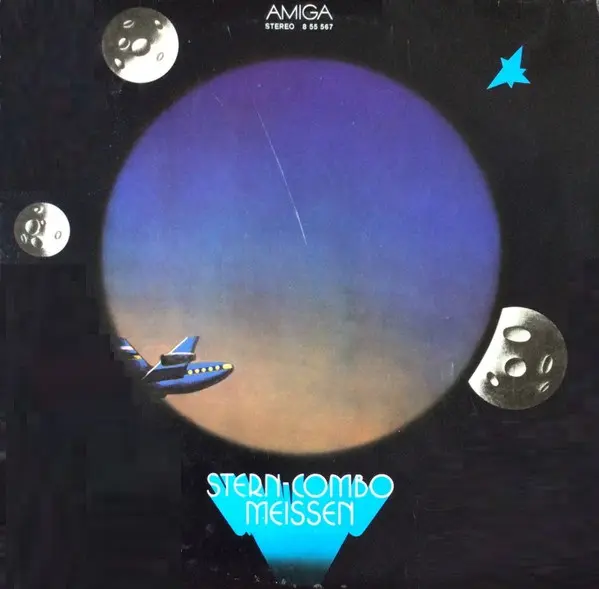 Stern Combo Meissen debuted with a self-titled live album in 1977 on AMIGA.
The album unfolds as an expansive stage work with extended arrangements shaped by the keyboard trio of Thomas Kurzhals, Norbert Jäger, and Lothar Kramer, whose layered interplay drives both the harmonic motion and thematic development. Kurzhals doubles as principal composer, offsetting Kramer’s tonal backdrops and Jäger’s percussive overlays with narrative lead lines. Guitar textures take a backseat to the dense keyboard spectrum, while Bernd Fiedler anchors the shifting structures with firm bass undercurrent. Martin Schreier provides a steady rhythmic fulcrum throughout, balancing theatrical pacing and sudden dynamic breaks. Reinhard Fißler delivers most of the vocals with sharp articulation, while Jäger takes the lead on one track.
“Der Kampf um den Südpol” opens with wind effects and layered synth drones that clear into sustained organ lines and ascending patterns on Moog. The arrangement shifts between sparse verses and full-instrumental surges, with contoured keyboard figures riding atop a pulse anchored by forward-moving bass. “Der Alte auf der Müllkippe” pivots toward clipped funk-style pacing with space-synth overlays, blending rhythmic clarity with synthetic texture. “Mütter gehn fort ohne Laut” moves at a measured tempo with soft organ tones and understated phrasing, setting a reflective mood under light rhythmic support.
“Eine Nacht auf dem Kahlen Berge,” adapted from Modest Mussorgsky, alternates between ominous keyboard swells and fast keyboard runs stacked in parallel voicings. The track culminates in a layered Moog sequence set against low-end sustain and thickened organ backing. “Licht in das Dunkel” opens with soft vocal overlays and steady bass phrasing, building into a series of cascading Moog motifs and tonal shifts driven by synth leads. Throughout the album, the keyboards alternate between foreground dialogue and harmonic scaffolding, while the bass remains a central propulsive element beneath fluctuating densities.
A1. “Der Kampf um den Südpol” [The Struggle for the South Pole] (8:54) – Stern Combo Meissen / Demmler
A2. “Der Alte auf der Müllkippe” [The Old Man on the Rubbish Heap] (4:57) – Stern Combo Meissen / Demmler
A3. “Mütter gehn fort ohne Laut” [Mothers Depart Without a Sound] (4:31) – Kurzhals / Demmler
B1. “Eine Nacht auf dem Kahlen Berge” [A Night on Bald Mountain] (10:19) – Modest Mussorgsky, Stern Combo Meissen / Jäger
B2. “Licht in das Dunkel” [Light Into the Darkness] (13:24) – Stern Combo Meissen / Demmler
They recorded the album live during a public performance held May 20–21, 1977, in Nünchritz near Riesa. AMIGA engineer–directors Helmar Federowski and Klaus Schmidt supervised both musical direction and sound engineering, with production by Jürgen Lahrtz. The record was pressed at VEB Deutsche Schallplatten Potsdam-Babelsberg and released through the Berlin-based VEB Deutsche Schallplatten. Dietrich Boddin handled the layout, and Jürgen Bischof supplied the concert photography.
Weißes Gold
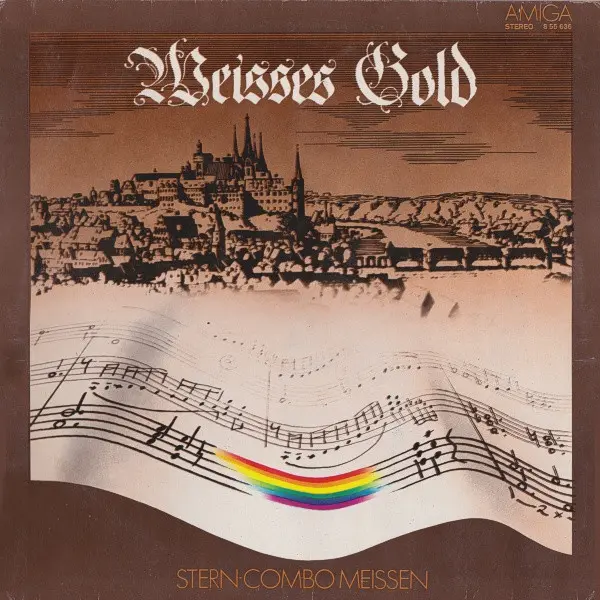 Stern Combo Meissen released their first studio album, Weißes Gold, in June 1978 on AMIGA.
The album unfolds as a suite-like production shaped by orchestral passages and layered synth–piano dialogues between keyboardists Thomas Kurzhals and Lothar Kramer, whose overlapping voicings shift between thematic and textural roles. Reinhard Fißler and Werther Lohse trade vocal narration and lead delivery across contrasting sections, while Bernd Fiedler underpins the arrangements with steady bass figures and Lohse provides a grounded rhythmic backbeat beneath the dense instrumental architecture.
On Weißes Gold, Stern Combo Meissen builds a continuous narrative arc out of orchestral swells, stacked keyboard choirs, and fast-switching dynamics that move from soft, atmospheric passages to dense climaxes with sudden rhythmic weight. “Ouvertüre” layers orchestration over rapid keyboard runs, with brief Mellotron-like shading buried inside the thicker ensemble sound, while “Der Traum” settles into a pastoral frame with restrained accompaniment and open air around the theme.
“Des Goldes Bann” tightens the pace with more urgent keyboard figures and a stronger vocal entry, then “Der Goldmacher” pivots into extended spoken narration over dramatic backing. Side two leans heavier: “Die Flucht” drives on organ/synth pressure and active drumming, “Zweifel” stretches into a dark choral soundscape after long narration, and the title track closes with pulsing keys reinforced by choir.
A1. “Ouvertüre” [Overture] (8:25) – Kramer, Kurzhals
A2. “Der Traum” [The Dream] (2:14) – Werneburg
A3. “Des Goldes Bann” [The Spell of Gold] (1:56) – Kurzhals
A4. “Der Goldmacher” [The Alchemist] (2:31) – Johann Kuhnau, arr. Kurzhals
A5. “Die Flucht” [The Escape] (4:11) – Kurzhals
B1. “Zweifel” [Doubt] (9:08) – Fißler, Kurzhals
B2. “Die Erkenntnis” [The Realization] (5:55) – Fißler
B3. “Weißes Gold” [White Gold] (3:36) – Kurzhals
The album was recorded under the direction of producer Volkmar Andrä with musical and technical supervision by Helmar Federowski. Sessions featured expanded instrumentation by the Sinfonieorchester der Hochschule für Musik “Hanns Eisler” Berlin, led by Horst Förster, with choral support from the Chor des Wachregiments “Feliks Dzierżyński.”
Thomas Kurzhals arranged the core material and adapted the classical source used on “Der Goldmacher,” while Wolfgang Müller scored additional parts for strings and winds. Norbert Jäger contributed lyrics based on motifs by Kurt Demmler. The ruby-label edition was pressed by VEB Deutsche Schallplatten Potsdam-Babelsberg and printed by VEB Gotha-Druck, with cover design by Jürgen Haufe and spoken narration by Ernst Kahler.
Der Weite Weg
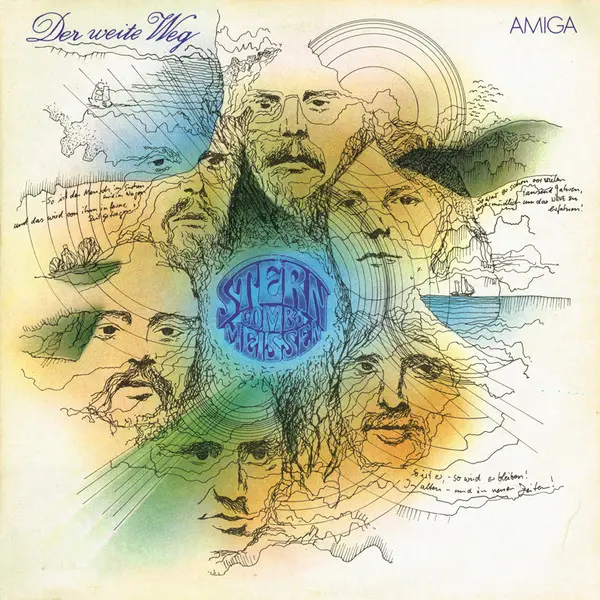 Stern Combo Meissen released their third album, Der Weite Weg, in 1979 on AMIGA.
The album expands the band’s symphonic direction with dual keyboard arrangements by Thomas Kurzhals and Lothar Kramer, whose parts interlock across shifting tonal planes while Martin Schreier shapes the overall framework. Kramer’s classical inflections complement Kurzhals’ sustained voicings, with added percussive detail by Norbert Jäger and vocal shifts shared between Reinhard Fißler, Werther Lohse, and Michael Behm. Bernd Fiedler anchors the transitions with a firm bass undercurrent, while Lohse and Behm alternate as a dynamic drum axis behind the ensemble’s layered constructions.
Der weite Weg alternates between restrained ensemble passages and synth-forward sections that emphasize tonal clarity and mood shifts. “Die Sage” opens in a spacious register with slow pacing and gradual instrumental layering, while “Was bleibt” uses harmonic pivots and multi-voice vocal overlays to form its structural shifts. “Der Motor” locks into a rigid rhythmic frame with a repetitive synth figure and clipped cadence. The title track expands dynamically with swelling keyboard patterns and long-line phrasing, and the adaptation of “Der Frühling” stays close to the Vivaldi original but overlays it with bright synth textures that drift into ornamental phrasing.
A1. “Die Sage” [The Legend] (7:50) – Kramer, Schreier / Jäger
A2. “Gib mir, was du geben kannst” [Give Me What You Can Give] (5:30) – Fiedler, Kurzhals / Gertz
A3. “Was bleibt” [What Remains] (4:47) – Kurzhals / Jäger
A4. “Der Motor” [The Engine] (4:40) – Schreier / Jäger
B1. “Der Frühling” [Spring] (12:20) – Antonio Vivaldi, arr. Kurzhals
B2. “Der weite Weg” [The Long Road] (6:25) – Kramer, Schreier / Jäger
Volkmar Andrä produced the album with recording handled by Rundfunk der DDR and VEB Deutsche Schallplatten Berlin. Helmar Federowski and Jürgen Crasser served as musical and sound engineers. Four of the six tracks were recorded at radio studios, with “Der Frühling” and “Der Motor” tracked separately. Jürgen Haufe designed the cover and VEB Gotha-Druck printed and lithographed the packaging. The album was pressed by VEB Deutsche Schallplatten Potsdam-Babelsberg and released later that year under the AMIGA label.
Reise zum Mittelpunkt des Menschen
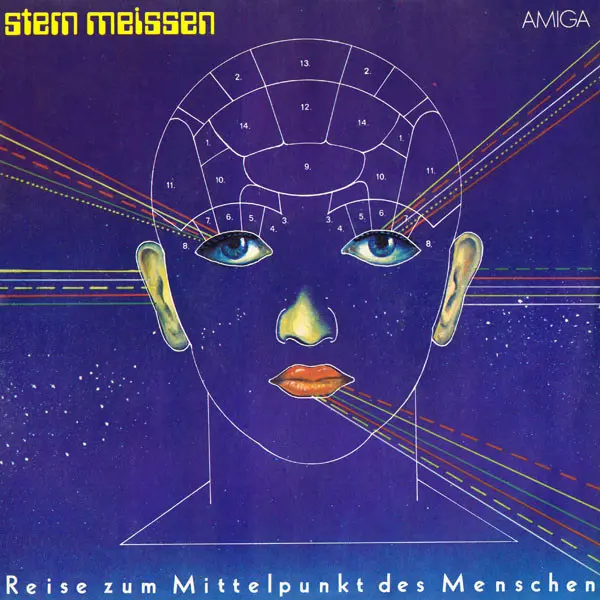 Stern Combo Meissen released their fourth album, Reise zum Mittelpunkt des Menschen, in 1981 on AMIGA.
The album centers around extended thematic development shaped by the interplay between keyboardists Thomas Kurzhals and Lothar Kramer, who alternate melodic foregrounds and harmonic layering in long-form movements. Guitarist Martin Schreier punctuates the keyboard textures with chordal accents and brief lines, while Peter Rasym provides a steady anchor beneath the compositions. Drummer Michael Behm reinforces the structural pacing with a firm backbeat, grounding the suite-like transitions around Reinhard Fißler’s vocal phrasing.
Reise zum Mittelpunkt des Menschen builds a continuous arc through interlinked instrumental movements shaped by thick keyboard layering, sparse vocals, and forward-leaning rhythm work. “Hinwendung” anchors the album’s center with long-form synth passages and stacked chord clusters, alternating between slow atmospheric planes and sharp rhythmic breaks.
“Romanze” pushes into darker tonal regions with clustered harmony and a brief, angular piano solo near the close. “Innenwelt” and “Menschenzeit” follow tighter structures but retain the album’s thematic unity, using steady pulses and smooth keyboard transitions to bridge sections. The bass, particularly in “Allein,” provides a colorful fulcrum under shifting harmonic blocks, while the drums maintain pace without pushing intensity beyond the ensemble balance.
A1. “Allein” [Alone] (3:42) – Kurzhals / Demmler
A2. “Hinwendung” [Turning Toward] (13:28) – Kurzhals / Demmler
B1. “Romanze” [Romance] (8:42) – Kurzhals / Demmler
B2. “Innenwelt” [Inner World] (6:50) – Kurzhals / Demmler
B3. “Menschenzeit” [Human Time] (6:03) – Kurzhals / Demmler
Volkmar Andrä produced the album for VEB Deutsche Schallplatten Berlin with recording and sound direction by Helmar Federowski. Kurzhals arranged all tracks and led the instrumental direction. Artwork was designed by Jürgen Haufe and printed by VEB Gotha-Druck, with the pressing handled at the Potsdam-Babelsberg facility. Released in 1981, the album marked the group’s final large-scale conceptual work under the classic lineup.
Discography:
- Stern Combo Meissen (live, 1977)
- Weißes Gold (1978)
- Der Weite Weg (1979)
- Reise zum Mittelpunkt des Menschen (1981)
- Stundenschlag (1982)
- Taufrisch (1985)
- Nächte (1987)
Sources:
Artist/Album Pages:
Didier Bocquet is a French electronic musician who released the 1977 album Eclipse on Le Kiosque D...
Witthüser & Westrupp were a German acid-folk duo who issued four albums between 1970 and 1972 ...
Inner City Unit was an English space-rock/post-punk band that self-released a 1980 album on Riddle...
Brégent was the namesake musical project of Québécois brothers Michel-Georges Brégent and Jacques ...
Katsutoshi Morizono — 森園勝敏 (born February 18, 1954) — is a Japanese jazz-rock guitarist who played...
Zthürehz was a Swedish art-rock band that self-released a 1981 album and a 1984 standalone single,...
Hiroshima are an American new age ensemble that debuted with a 1979 self-titled album on Arista, f...
Chilliwack was a Canadian rock band from Vancouver that debuted with a 1970 self-titled album on P...
Piramis was a Hungarian hard-rock band from Budapest, formed in 1974. The band released six albums...
Stanton Davis (born Nov. 10, 1945) is an American trumpeter from New Orleans who led the jazz-funk...
The Dancing Did was an English art-punk band that issued two singles on Fruit & Veg Records in...
Sweet Smoke was a German-based jam-rock/psych band comprised of expat Americans. In 1970, they rel...