

Saint Just was an Italian symphonic-folk band that released the 1973/74 Harvest albums Saint Just and La Casa del Lago.
Members: Jenny Sorrenti (vocals), Antonio Verde (guitar, bass, vocals), Robert Fix (saxophone, 1973), Tito Rinesi (guitar, vocals, 1974), Andrea Faccenda (guitar, keyboards, 1974), Fulvio Maras (drums, percussion, 1974)
Background
Saint Just formed in 1972 in Napoli as an acoustic trio blending symphonic-folk, psychedelia, and early music elements. The group coalesced around Welsh-Italian vocalist Jenny Sorrenti (credited as Jane on early releases), whose ethereal soprano guided their baroque-infused sound. Jenny, the sister of singer–composer Alan Sorrenti, envisioned a group rooted in medieval modality, romantic poetry, and the introspective qualities of British acid-folk.
English violinist Urban Blitz met Jenny during his travels in Italy and played a brief behind-the-scenes role in assembling the first Saint Just lineup before returning to London, where he co-founded the Doctors of Madness.
Saint Just coalesced with saxophonist Robert Fix and composer/multi-instrumentalist Antonio Verde. They took their group name from Louis Antoine de Saint-Just (1767–1794), the “Archangel of Terror” of the French Revolution, a Jacobin ideologue and close ally of Robespierre who was executed alongside him in July 1794 during the fall of the Mountain faction.
Saint Just
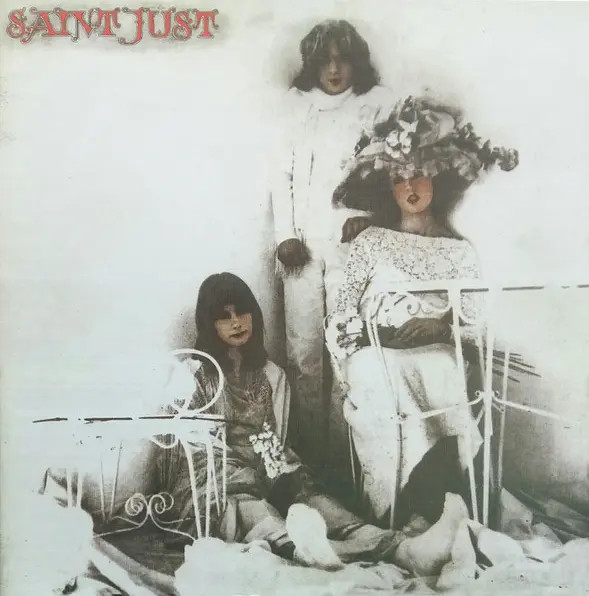 Saint Just released their self-titled first album in April 1973 on Harvest.
The core trio—Sorrenti, multi-instrumentalist Antonio Verde, and saxophonist Robert Fix—perform a hybrid of acid folk, classical chamber forms, and avant-garde improvisation, joined by guests on piano, organ, electric guitar, and percussion.
Sorrenti sings in a bright, piercing tone that alternates between sustained laments and stylized inflections reminiscent of East Asian folk intonation. Verde plays classical guitar, bass, and contrabass, often driving harmonic motion through arpeggios and modal cycles. Fix contributes tenor and alto saxophone, layering elongated, freely phrased motifs that blur between tonal center and noise. Guests include percussionist Antonio Esposito (marimba, bells, drums), guitarist Gianni Guarracino (electric, 12-string), and keyboardist Mario D’Amora (piano, celesta, organ. The textures remain sparse throughout, but frequent interruptions and contrasts create movement.
Saint Just revolves on quiet piano, fingerpicked guitar, and chamber phrasing that erupts into sudden passages of electric distortion, free-form saxophone, or vocal escalation. “Il fiume inondò” opens with subdued piano and acoustic guitar, then veers into overlapping vocal loops and sustained sax drones before erupting in electric flourishes. “Il risveglio” unfolds in a similar cycle, layering phased electric leads, circular piano themes, and sharply rhythmic vocal exchanges. “Dolci momenti” strips back to an almost lullaby-like setting.
On side two, “Una bambina” spirals through sectioned episodes with castanets, overdubbed vocals, and modal electric guitar; “Triste poeta di corte” shifts from dirge to breakdown; the closing “Saint Just,” sung in French, compresses the album’s chamber-folk character into a two-minute theatrical epilogue.
All six tracks are credited to Jane and Verde.
A1. “Il fiume inondò” [The River Flooded] (10:43) — alternating layers of piano, saxophone, and acoustic guitar build toward vocal modulations and sudden avant shifts
A2. “Il risveglio” [The Awakening] (6:16) — phased electric guitar and vocal escalation with a closing piano and saxophone descent
A3. “Dolci momenti” [Sweet Moments] (3:16) — lullaby form with celesta and softly phrased vocal melody
B1. “Una bambina” [A Little Girl] (8:02) — sectional suite with castanets, double-tracked vocals, and modal guitar interludes
B2. “Triste poeta di corte” [Sad Court Poet] (6:19) — dirge rhythm broken by a midtrack breakdown for sax and drum
B3. “Saint Just” (3:58) — sung in French; theatrical delivery with classical guitar and keyboard pulses
Sessions took place in early 1973 with Alan Sorrenti serving as mixer. Arrangements are credited to Toni Verde. Art direction and graphic design by Sigla/DEMA. Cover photography by Umberto Telesco.
The cover of Saint Just presents a washed-out, sepia-toned tableau: three women arranged in an antiquated white interior with wrought-iron furniture. One stands in white with long hair obscuring her face; another, seated in an elaborate floral hat, gazes ahead with a porcelain stillness. A third, barefoot and childlike, sits cross-legged below. The image evokes Victorian mourning portraiture or faded salon photography, underscoring the album’s spectral, archaic tone. The stylized band name in crimson serif caps offsets the pale composition.
La Casa del Lago
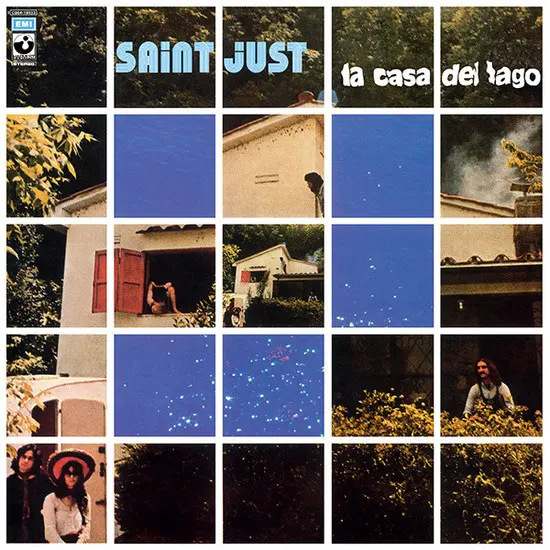 Saint Just released their second album, La Casa del Lago (The House on the Lake), in October 1974 on Harvest.
The album introduced a new five-piece lineup centered on returning vocalist Jenny (Jane) Sorrenti and bassist Antonio Verde, joined by drummer Fulvio Maras and multi-instrumentalists Tito Rinesi and Andrea Faccenda. Sorrenti and Verde
The saxophone-driven free-folk of the debut gives way to a denser, more coordinated suite structure, blending acoustic and electric folk elements with episodic shifts, Mediterranean textures, and expanded instrumentation. The presence of multiple composers and alternating vocal roles contributes to the album’s stylistic breadth, from cinematic folk scenes to syncopated chamber jazz and percussive detours.
Sorrenti sings lead on most tracks and plays twelve-string guitar and tambourine. Verde handles electric bass and fuzz bass, anchoring dynamic meter shifts and harmonic modulations. Faccenda contributes guitar, piano, organ, and harmonica, acting as the primary arranger and textural bridge between sections. Rinesi plays acoustic and electric guitar, autoharp, maracas, and harmonica, and sings lead on the closing track. Maras plays drums, frame percussion, and auxiliary rhythms. Additional wind and string textures were arranged by Vince Tempera, who also supervised production.
“Tristana” opens with layered electric guitar and organ over a rising rhythm that clears for dramatic vocal and violin episodes. A midsection of cascading piano and choral improvisation leads into a sudden, quiet acoustic coda. “Nella vita, un pianto” develops over eleven minutes in shifting scenes, beginning with plucked strings and harp, progressing into lively flamenco inflections and overlapping vocal counterpoint.
“Viaggio nel tempo,” the first of Rinesi’s contributions, alternates playful phrasing with sparse ensemble interplay and dual vocals. The title track unfolds gradually from atmospheric keyboard and fingerpicked guitar into melodic interplay between clarinet, piano, and wordless vocals. “Messicano” diverges with Latin-tinged percussion, interlocking guitars, harmonica, and shouted refrains. “La terra della verità,” sung by Rinesi with Sorrenti’s backing, closes the album in subdued acoustic form, returning briefly to the tone of the group’s earlier incarnation.
Sorrenti and Verde co-wrote everything apart from two Rinesi compositions that bookend Side B.
A1. “Tristana” (6:41) — electric intro, vocal layering, violin-driven climax, and acoustic coda
A2. “Nella vita, un pianto” [In Life, a Cry] (11:04) — longform suite for voice, harp, flamenco guitar, and shifting tempos
B1. “Viaggio nel tempo” [Journey Through Time] (6:33) — dual vocal passages over evolving acoustic ensemble
B2. “La casa del lago” [The House on the Lake] (6:28) — instrumental interplay between piano, woodwinds, and voice
B3. “Messicano” [Mexican] (5:28) — Latin-style percussion and guitar with harmonic layering and wordless vocals
B4. “La terra della verità” [The Land of Truth] (2:44) — closing duet for acoustic guitar and shared vocals
The album was produced by Corrado Bacchelli with artistic supervision by Vince Tempera. Recording engineer Giorgio Louiscek captured sessions at Studio Chantalain across spring and summer 1974. The original release came with a printed lyric inner sleeve.
La casa del lago replaces the debut’s symbolic portraiture with a gridded mosaic of photographs. Each square captures fragments of an outdoor villa—shutters, roof tiles, tree canopies—intercut with empty blue panels speckled with stars or light leaks. Scenes of the band at leisure flank the border: a woman framed in a window, two figures in a garden, a woman in hat and glasses near the bottom. The composite effect resembles a fragmented memory or broken filmstrip, echoing the album’s episodic structure and blurred narrative voice. Design and photography are credited to Bruno Fedetto and Umberto Telesco.
Postlude
Saint Just disbanded shortly after the release of La casa del lago. Jane Sorrenti began a solo career under the name Jenny Sorrenti, shifting her focus from avant-folk suites to structured songwriting. Her 1976 debut Jenny Sorrenti (also known as Suspiro) retained the ethereal quality of her earlier work but with a more defined song format. The album featured an array of accomplished collaborators, including Peter Kaukonen (brother of Jefferson Airplane guitarist Jorma Kaukonen), Francesco “Froggio” Francica (drummer from Raccomandata con Ricevuta di Ritorno and Procession), future star guitarist Pino Daniele, violinist Lucio Fabbri (PFM), and Toni Verde, her long-time musical partner from Saint Just.
Jenny continued to contribute vocals to various artists across the decades and re-emerged in 2001 with Medieval Zone, a solo album that fused Mediterranean folk with her Welsh-Celtic heritage. She followed it in 2004 with Com’è grande enfermidade, further refining her personal hybrid of archaic modality and ambient atmosphere.
In 2011, she revived the Saint Just name for Prog Explosion, a limited-release album that merged her solo aesthetics with progressive elements reminiscent of her 1970s work. This title received its first CD reissue in 2018 with four bonus tracks, including two vocal features by her brother Alan Sorrenti.
In 2017, Jenny participated in Sinfonia psichedelica, a collaborative LP spearheaded by Lodovico Ellena (Effervescent Elephants) that gathered figures from the Italian psychedelic scene.
In 2025, she partnered with musician–producer Tullio Angelini to form the electronic-folk duo Neos Saint Just, releasing a self-titled album (M+M MoreMusic MOMUS 015) that recontextualized her voice within ambient digital textures.
Discography:
- Saint Just (1973)
- La casa del lago (1974)
Sources:
- Discogs: Saint Just
- MusicBrainz: Saint Just
- RYM: Saint Just
- ItalianProg: Saint Just
- ProgArchives: Saint Just
Artist/Album Pages:
Steve Khan (born April 28, 1947) is an American jazz guitarist and composer from Los Angeles who e...
Mo.Do. was an Italian art-rock band that released the 1980 album La Scimmia Sulla Schiena del Re. ...
Maneige was a Québécois chamber|jazz-rock band that released the 1975 Harvest albums Maneige and ...
Alexis was an American hard-rock/pop band behind a 1977 self-titled album on MCA. Members: Eddi...
Burning Spear — aka Winston Rodney (born March 1, 1945) — is a Jamaican dub/roots-reggae artist wh...
Piramis was a Hungarian hard-rock band from Budapest, formed in 1974. The band released six albums...
Stephen Bishop (born Nov. 14, 1951) is an American singer/songwriter who debuted with the 1976 ABC...
Edip Akbayram (Dec. 29, 1950 — March 2, 2025) was a Turkish singer and songwriter who cut three si...
Trettioåriga Kriget was a Swedish symphonic/hard-rock band that released the 1974/75 CBS albums Tr...
Miroslav Vitous (born Dec. 6 1947) is a Czech jazz-rock bassist, active on the international scene...
Synergy is the recording/performance moniker of American electronic musician Larry Fast (born Dec...
Scarlet Rivera is an American violinist from Chicago who emerged as part of Bob Dylan's 1976 Rolli...