

Premiata Forneria Marconi — commonly known by the acronym PFM — are an Italian symphonic-rock band from Milano, Lombardia, formed in 1970. The band released four albums and a live disc on Numero Uno between 1972 and 1975, followed by two further titles on Zoo Records during the latter half of the decade. After a two-volume live collaboration with singer–songwriter Fabrizio De André, PFM returned to Numero Uno for another round of albums during the 1980s.
Members: Franco Mussida (guitar, vocals, 1970-2015), Franz Di Cioccio (drums, vocals), Flavio Premoli (keyboards, vocals, 1970-79, 1995-present), Mauro Pagani (vocals, flute, violin, 1970-75), Giorgio Piazza (bass, vocals, 1970-73), Patrick Djivas (bass, vocals, 1973-present), Bernardo Lanzetti (vocals, rhythm guitar, 1975-78), Gregory Bloch (violin, 1977), Lucio “Violino” Fabbri (violin, keyboards, 1979-87, 2001-present), Walter Calloni (drums, 1982-87)
Background
Premiata Forneria Marconi evolved from beatsters I Quelli, which issued numerous singles on Ricordi between 1965 and 1969, culminating in a self-titled album. In 1970, three Quelli members — guitarist/singer Franco Mussida, keyboardist Flavio Premoli, and drummer Franz di Cioccio — teamed with I Dalton violinist Mauro Pagani and session bassist Giorgio Piazza (Fabrizio De Andrē, Lucio Battisti).
 At Pagani’s suggestion, the new band named itself Forneria Marconi, Italian for “Marconi Bakery.” Producer Alessandro Colombini, an associate of the band, insisted they affix the word Premiata (“Award-winning”) to the nameplate.
In June 1971, PFM was one of three winners (along with Osanna and Mia Martini) at the first Festival d’Avanguardia e Nuove Tendenze, a talent festival held in Viareggio. Their prize was a contract with Numero Uno, an Italian division of RCA Records. They issued their first single, “La Carrozza di Hans” (b/w “Impressioni di Settembre”), that October. It’s notable as the first charting Italian record to feature the Minimoog synthesizer, which Premoli demonstrated that year on an RAI television broadcast.
Storia di un Minuto
 Premiata Forneria Marconi released their debut album, Storia di un Minuto (Story of a Minute), in January 1972 on Numero Uno.
The album introduced a fluid merger of classical structuring, romantic lyricism, electric interplay, and instrumental variation, spanning compact ballads and extended episodic suites.
Flutist and violinist Mauro Pagani wrote “La Carrozza di Hans” and co-wrote “Impressioni di Settembre” with keyboardist Flavio Premoli, who composed “Dove… Quando…” Guitarist Franco Mussida contributed “E’ Festa” and co-wrote “Grazie Davvero” with bassist Giorgio Piazza, who wrote the orchestral “Introduzione” with drummer Franz Di Cioccio. The band members share credit on the remaining tracks.
Storia di un Minuto unfolds as a sequence of sharply contrasted scenes, each built on clear shifts in tempo, texture, and dynamic weight. “Introduzione” starts with quiet acoustic figures and light flute before rising in a fast swell of guitar, brass, and drums that drops out as quickly as it arrives. “Impressioni di Settembre” moves from a soft vocal-and-guitar thread into a wide Moog refrain that repeats with growing force, alternating with quieter passages where electric guitar shades the line. “È Festa” runs on brisk, rotating figures that break for a brief vocal interlude, then tumble through quick rhythmic turns—bright flute, punctuated keyboard lines, and a final acceleration that mirrors its opening pulse.
“Dove… Quando (Parte I)” stays in a low-lit, acoustic frame with doubled vocals, flute accents, and no drums; “Parte II” recasts its theme with organ and violin before pivoting into a fast piano-and-drum passage, a slower string-and-piano ascent, and a late, smoky piano pattern under improvising flute. “La Carrozza di Hans” opens with a short, heavy burst, then settles into a quiet section led by acoustic guitar and close vocals, breaks into an unaccompanied guitar stretch, and closes with a driven restatement marked by violin and full rhythm section. “Grazie Davvero” shifts from a calm acoustic intro into sudden peaks—choral surges, brass flashes, and a mid-section weave of flute, bass, piano, and drums—before ending on a lifted, brassy reprise.
A1. “Introduzione” [Introduction] (1:09)
A2. “Impressioni di Settembre” [Impressions of September] (5:44)
A3. “E’ Festa” [It’s a Party] (4:52)
A4. “Dove… Quando… (Parte I)” [Where… When… (Part I)] (4:10)
B1. “Dove… Quando… (Parte II)” (6:01)
B2. “La Carrozza di Hans” [Hans’s Carriage] (6:46)
B3. “Grazie Davvero” [Thanks a Lot] (5:51)
Pagani plays flute, violin, and vocals. Mussida plays electric, acoustic, and 12-string guitar, mandolin, and vocals. Premoli plays organ, piano, Mellotron, and Moog synthesizer, and sings. Piazza plays bass and vocals. Di Cioccio plays drums, percussion, Moog, and vocals.
Sessions occurred in late 1971 at Fonorama Studios in Milan with producer Alessandro Colombini and engineer Gaetano Ria. The band recorded live in studio (in presa diretta) to preserve ensemble spontaneity.
Storia di un Minuto became the first Italian rock album to reach No. 1 on the Italian albums chart.
Per un Amico
 Premiata Forneria Marconi released their second album, Per un Amico, in November 1972 on Numero Uno.
The album expands their approach with tighter song structures, layered vocal arrangements, and greater textural contrast between pastoral passages and abrupt ensemble shifts.
Per un Amico moves through sharply drawn shifts in tone, pacing, and instrumental color, with each piece unfolding in distinct stages. “Appena un po’” fades in on quiet Mellotron and harp-like figures before a classical-guitar line and flute establish a baroque calm; the band then pushes into a heavier burst led by violin and drums, retreats to soft choral phrasing, and climbs toward a bright, keyboard-driven finale that drops into a brief, disorienting void. “Generale” runs through quick, clipped sections: a brisk drum lead-in, jump-cut violin and piano exchanges, a sudden military march for drums and flute, and a final rise shaped by organ and full band.
The title track opens with a light flute-and-piano line, shifts into a firmer pulse as bass and vocals enter, and builds an instrumental center where fast acoustic-guitar strumming underpins violin and Moog figures before settling into a calm closing ascent. “Il banchetto” begins with soft acoustic guitar and close harmonies, rises into a clear, open theme, then drifts into an extended middle section of shifting keyboard textures — first airy Mellotron, then an abstract synth passage, then a precise piano statement — before resolving back to its opening cadence. “Geranio” starts in near-whispered tones with piano, flute, and classical guitar, moves through alternating quiet stretches and sudden peaks, and eventually reaches a late, stark coda that carries a dark, almost processional weight.
Premoli wrote “Appena un Po’” and “Il Banchetto” and co-wrote “Generale” with Di Cioccio and Piazza. Mussida composed the title track. “Geranio” is a full-band collaboration.
A1. “Appena un Po’” [Just a Little] (7:43)
A2. “Generale” [General] (4:18)
A3. “Per un Amico” [For a Friend] (5:23)
B1. “Il Banchetto” [The Banquet] (8:37)
B2. “Geranio” [Geranium] (8:03)
Premoli plays piano, harpsichord, Hammond organ, Mellotron, Moog synthesizer, and sings lead on multiple tracks. Mussida plays guitar and vocals. Pagani plays violin, flute, and vocals. Piazza plays bass and vocals. Di Cioccio plays drums, percussion, and vocals.
Sessions occurred mid-1972 at Fonorama Studios with Alessandro Colombini and Gaetano Ria returning as producer and engineer, respectively.
Photos of Ghosts
 In October 1973, Manticore released Photos of Ghosts, an English-language rework of Per un Amico with new lyrics by King Crimson wordsmith Peter Sinfield. It includes remixed and resequenced tracks and one new instrumental, “Old Rain.”
“River of Life,” adapted from “Appena un Po’,” maintains the harpsichord-led intro and winding progression with new English phrasing. “Celebration” reworks “E’ Festa” with English vocals over the same accelerating pace and electric bursts. “Photos of Ghosts” is a retitled version of “Per un Amico.”
The newly recorded “Old Rain” is a quiet flute–acoustic piece with layered synths. “Mr. 9 ’Til 5” reimagines “Generale” with English lyrics and revised breaks. “Promenade the Puzzle” adapts “Geranio” with lyrical revisions and alternate sequencing. “Il Banchetto” appears in an English-language remix.
All compositions stem from the band’s original material. Peter Sinfield contributed all new English lyrics and co-produced the album with the band. The lineup mirrors Per un Amico with additional overdubs and remix treatments.
A1. “River of Life” (7:00) — based on “Appena un Po’”
A2. “Celebration” (3:53) — based on “E’ Festa”
A3. “Photos of Ghosts” (5:23) — based on “Per un Amico”
A4. “Old Rain” (3:41) — new recording
B1. “Il Banchetto” (8:36) — remix of original
B2. “Mr. 9 ’Til 5” (4:11) — based on “Generale”
B3. “Promenade the Puzzle” (7:29) — based on “Geranio”
Sessions occurred mid-1973 at Advision Studios (London), overseen by Peter Sinfield and engineered by Paul Northfield. Original tracks were recorded at Fonorama and remixed with added English vocals and instrumentation.
Photos of Ghosts reached No. 180 on the Billboard 200 and marked PFM’s first significant exposure in the Anglo-American market.
L’isola di Niente
 Premiata Forneria Marconi released their third proper album, L’isola di Niente, in March 1974 on Numero Uno.
The album marks the arrival of bassist Patrick Djivas and broadens the band’s scope with dense arrangements, expanded harmonic vocabulary, and fusion-inflected passages that alternate between sharp dynamic turns and layered modal atmospheres.
L’Isola di Niente opens with an extended choral ascent that drops into a dense, surging section for distorted guitar, organ, electric violin, and a driving rhythm line, then breaks into a quiet passage of classical guitar, piano, and light flute before returning through a fast electric turn and closing on guitar over soft arpeggios. “Is My Face On Straight” shifts between low-voiced verses, brisk electric runs, short flute breaks, and an upbeat middle stretch for drums, bass, and organ, ending on a playful accordion tag.
“La Luna Nuova” moves from a bright opening figure for violin and keys into alternating calm and high-energy sections: quiet vocals over light keyboard textures, rapid ensemble passages with sharp timing changes, and a final accelerating riff. “Dolcissima Maria” stays in a subdued frame of piano, acoustic guitar, hushed vocals, and violin, rising slightly at the midpoint with added flute and light rhythm before resolving softly. “Via Lumière” starts with an exposed bass lead, opens into a quick, intricate sequence for full band, drops to a slow piano interlude, and then builds again through flute-topped patterns to a gentle, fading close.
Guitarist Franco Mussida wrote “Via Lumière” and co-wrote “La Luna Nuova” with keyboardist Flavio Premoli, who composed “Dolcissima Maria.” Violinist Mauro Pagani contributed “L’isola di niente.” Drummer Franz Di Cioccio co-wrote “Is My Face on Straight” with lyricist Peter Sinfield and the band.
A1. “L’isola di Niente” [The Isle of Nothing] (10:42)
A2. “Is My Face on Straight” (6:38)
B1. “La Luna Nuova” [The New Moon] (6:21)
B2. “Dolcissima Maria” [Sweetest Maria] (4:01)
B3. “Via Lumière” [Lumière Street] (7:21)
Mussida plays electric, acoustic, and 12-string guitar and sings lead on multiple tracks. Premoli plays Hammond organ, piano, Mellotron, and Moog synthesizer and contributes lead vocals. Pagani plays violin, flute, and vocals. Djivas plays electric bass and vocals. Di Cioccio plays drums, percussion, and vocals.
Sessions occurred between November 1973 and February 1974 at Advision Studios (London) and Fonorama Studios (Milan) with producer Claudio Fabi and engineer Gaetano Ria.
The World Became the World
 In June 1974, Manticore released The World Became the World, an English-language version of L’isola di Niente.
The album reworks five of the six tracks from L’isola di Niente with new English lyrics by Peter Sinfield and adds a fresh version of their debut single “Impressioni di Settembre” under the new title track, as part of their international expansion.
“The Mountain” adapts the title suite with Sinfield’s lyrics intact over the original’s symphonic arc. “Just Look Away” rephrases “Dolcissima Maria” with hushed narration. “Four Holes in the Ground” and “Have Your Cake and Beat It” retain their musical forms, the former channeling rhythmic acceleration and instrumental dialogue, the latter recast from “Via Lumière.” “The World Became the World,” adapted from their 1971 hit “Impressioni di Settembre,” anchors side A with lush synths and pastoral vocal layering.
Mussida plays guitar and sings lead. Premoli handles Hammond organ, piano, Mellotron, Moog, and lead vocals. Pagani plays flute, violin, and vocals. Djivas plays bass and vocals. Di Cioccio plays drums, percussion, and vocals.
A1. “The Mountain” (10:46) — based on “L’isola di Niente”
A2. “Just Look Away” (4:03) — based on “Dolcissima Maria”
A3. “The World Became the World” (4:48) — based on “Impressioni di Settembre”
B1. “Four Holes in the Ground” (6:23) — based on “La Luna Nuova”
B2. “Is My Face on Straight” (6:40) — same version as on L’isola di Niente
B3. “Have Your Cake and Beat It” (7:26) — based on “Via Lumière”
Sessions occurred in late 1973 and early 1974 at Fonorama (Milan) and Advision (London) with production by Claudio Fabi and Peter Sinfield.
Cook / Live in U.S.A.
 In late 1974, Manticore released Cook, a live album culled from PFM’s recent US tour.
The album documents performances from their August 1974 North American tour and captures the band’s transition from symphonic formalism to full-blown fusion improvisation.
The set opens with “Four Holes in the Ground” (from The World Became the World) in an elongated form with fluid soloing and tempo modulation. “Dove… Quando…” (from Storia di un Minuto) pairs the two-part studio sequence into one extended live treatment that segues into “Just Look Away.” The suite “Celebration / The World Became the World” reworks their breakout Italian instrumental with English vocals and a slower pace. “Mr. Nine ’Til Five” (from Photos of Ghosts) charges forward with rhythmic snaps and playful phrasing. The final track, “Alta Loma Nine ’Til Five,” features a 12-minute jam that culminates in a rendition of Rossini’s “William Tell Overture.”
Mussida plays electric and acoustic guitar and sings lead. Premoli handles keyboards (Hammond organ, piano, Mellotron, Moog) and vocals. Pagani plays violin, flute, and vocals. Djivas plays bass and vocals. Di Cioccio handles drums, percussion, and vocals.
A1. “Four Holes in the Ground” (7:25) — from The World Became the World
A2. “Dove… Quando…” [Where… When…] (4:30) — from Storia di un Minuto
A3. “Just Look Away” (3:41) — from The World Became the World
A4. “Celebration / The World Became the World” (9:03) — from Photos of Ghosts and The World Became the World
B1. “Mr. Nine ’Til Five” (4:29) — from Photos of Ghosts
B2. “Alta Loma Nine ’Til Five / William Tell Overture” (15:38) — unique to Cook
Tracks were recorded live at Convocation Hall (Toronto) and Central Park (New York City) in August 1974. Mixing took place later that fall in London.
Cook appeared in the UK, France, German, Japan, and North America. In Italy, Numero Uno released the songs with different cover art as Live in U.S.A., which also appeared in South America on RCA.
Chocolate Kings
 PFM released their fourth studio album, Chocolate Kings, in September 1975 on Numero Uno.
It marks the studio debut of vocalist Bernardo Lanzetti (formerly of Acqua Fragile) and follows the departure of founding multi-instrumentalist Mauro Pagani.
Chocolate Kings opens with “From Under,” which alternates loud, abrupt instrumental bursts and quieter passages before locking into a fast, tightly played section where bass and drums push in a rapid, repeating pattern under violin, organ, and short vocal lines. “Harlequin” begins as a soft, acoustic-led piece with light keyboard color and measured pacing, then switches sharply into a louder, driving mid-section built on heavy keyboard motion, fast bass figures, and violin runs before dropping back into a gentle closing section for flute and keys.
The title track moves at a brisk pace with a bright rhythmic feel, shifting quickly between vocal phrases, organ motions, and short violin entries, and maintains a light, quick-stepping pulse throughout. “Out on the Roundabout” moves between quiet, suspended acoustic segments and louder ensemble passages, with violin and keyboards taking alternating leads and the rhythm section moving from steady patterns to more active, syncopated motion. “Paper Charms” starts with a slow vocal-and-organ introduction, then builds into a faster, more urgent stretch where violin, drums, and keyboards drive the pace in cycling patterns, easing again into quieter lines before rising once more in its final minutes.
Guitarist Franco Mussida composed the title track and co-wrote material with keyboardist Flavio Premoli, who plays piano, Hammond organ, Moog synthesizer, and Mellotron. Lanzetti sings lead throughout. Bassist Patrick Djivas and drummer Franz Di Cioccio handle rhythm section duties and contribute backing vocals.
 A1. “From Under” (7:34)
A2. “Harlequin” (7:53)
A3. “Chocolate Kings” (4:43)
B1. “Out of the Roundabout” (7:55)
B2. “Paper Charms” (8:32)
Mussida plays electric, acoustic, and 12-string guitar and sings backing vocals. Premoli plays piano, organ, Moog, and Mellotron and sings. Djivas plays bass guitar and vocals. Di Cioccio plays drums, percussion, and vocals. Lanzetti sings lead on all tracks.
Sessions took place in mid-1975 with Claudio Fabi as producer. The album was issued in multiple sleeve variations for Italian and export markets.
In 1976, Chocolate Kings appeared on Manticore (UK) and Asylum (US) with a chocalate-bar illustration tied to America’s Bicentennial theme.
Jet Lag
 PFM released their fifth album, Jet Lag, in early 1977 on Zoo (Italy).
The album introduces American violinist Gregory Bloch (ex–It’s a Beautiful Day, Mark-Almond) in place of Mauro Pagani and retains Bernardo Lanzetti as lead vocalist.
Jet Lag presents a shift toward extended, rhythm-driven pieces built around fretless bass motion, alternating keyboard textures, and violin leads. “Peninsula” opens with a standalone acoustic-guitar study in shifting arpeggios. The title track moves through long, sectional transitions: brisk vocal passages over active drumming and tight keyboard–violin lines, then a quieter mid-song stretch before rising again with a heavier rhythmic push. “Storia in ‘LA’” develops gradually from a soft keyboard introduction and light cymbal figures into slow violin and understated guitar patterns. “Breakin’ In” keeps a steadier mid-tempo pace with short vocal phrases, violin breaks, and percussion accents.
“Cerco la Lingua” begins with an extended violin lead before moving into a more animated section where bass, banjo-like guitar patterns, and violin alternate foreground roles. “Meridiani” unfolds as an instrumental with guitar figures stepping through a series of paced variations, later tightening into fast, interlocked runs. “Left-Handed Theory” builds from a long instrumental introduction with bright keyboard motion and violin detailing before moving into a vocal section. “Traveler” stretches a repeating groundwork across its first half with minimal change, eventually shifting tempo for a more active close shaped by guitar and violin.
Mussida plays electric, acoustic, and 12-string guitar and mandocello. Premoli plays organ, piano, Mellotron, harpsichord, and Minimoog. Bloch plays electric and acoustic violin. Djivas plays electric and fretless bass. Di Cioccio plays drums, percussion, Minimoog, and vocals. Lanzetti sings lead on the English-language tracks; “Cerco la lingua” appears in Italian.
 A1. “Peninsula” (2:35)
A2. “Jet Lag” (9:10)
A3. “Storia in ‘LA’” [Story in L.A.] (6:26)
A4. “Breakin’ In” (4:10)
B1. “Cerco la lingua” [I Search for the Language] (5:33)
B2. “Meridiani” [Meridians] (5:57)
B3. “Left-Handed Theory” (4:13)
B4. “Traveler” (5:46)
The songs are credited to various combinations of Mussida, Premoli, Djivas, Di Cioccio, and Lanzetti, with Italian lyric contributions on “Cerco la lingua.”
Recording took place in early 1977 at Kendun Recorders (Burbank, California) and Scorpio Sound Studios (London).
International Jet Lag copies on Manticore (UK, Europe) and Asylum (US) have different cover art.
Passpartù
 PFM released their sixth album, Passpartù, in 1978 on Zoo. It retains the core quartet of Franco Mussida, Flavio Premoli, Patrick Djivas, and Franz Di Cioccio with Bernardo Lanzetti on vocals.
Passpartù shifts to short, acoustic-leaning pieces built around guitar figures, light percussion, and steady mid-tempo patterns, with violin absent and fretless bass taking a central role. Several tracks adopt bright rhythmic motion with congas, timbales, or marimba reinforcing a Latin-tinged pulse, while others settle into slower, melodic frameworks with soft keyboards and lightly phrased vocals.
“Viene il Santo” and “Svita la Vita” use tightly arranged acoustic patterns and crisp ensemble punctuations; “Se Fossi Cosa” stretches into a gentler ballad space with longer chord sustains; and “Le Trame Blu” brings in repeated keyboard lines over an upbeat rhythmic foundation. The instrumental “Passpartù” runs on interlocked guitar motion and a buoyant pace, while “I Cavalieri del Tavolo Cubico” brings a more percussive, syncopated feel with changing textures. “Su una Mosca e Sui Dolci” moves through soft electric-guitar lines, drifting keyboards, and a slower vocal contour, and “Fantalità” closes the album on a brisker, lightly accented rhythmic cycle.
Premoli composed much of the music with Italian lyricist Gianfranco Manfredi credited across the set. Lanzetti co-writes and sings lead on selected titles, including “Fantalità.” Mussida, Djivas, and Di Cioccio contribute to arrangements and backing vocals.
A1. “Viene il santo” [The Saint Comes] (4:30)
A2. “Svita la vita” [Unscrew Life] (3:25)
A3. “Se fossi cosa” [If I Were Something] (4:30)
A4. “Le trame blu” [The Blue Plots] (4:50)
B1. “Passpartù” [Master Key] (4:40)
B2. “I cavalieri del tavolo cubico” [The Knights of the Cubic Table] (5:15)
B3. “Su una mosca e sui dolci” [On a Fly and on Sweets] (4:45)
B4. “Fantalità” [Fantality] (4:20)
Mussida plays acoustic and electric guitar and sings. Premoli plays piano, organ, and synthesizer and sings. Djivas plays bass and vocals. Di Cioccio plays drums, percussion, and vocals. Lanzetti sings lead vocals.
Sessions took place in Milan in 1978 for release on Zoo/Numero Uno, with artwork and credits tailored to the domestic market.
In concerto – Arrangiamenti PFM (live • Fabrizio De André con PFM)
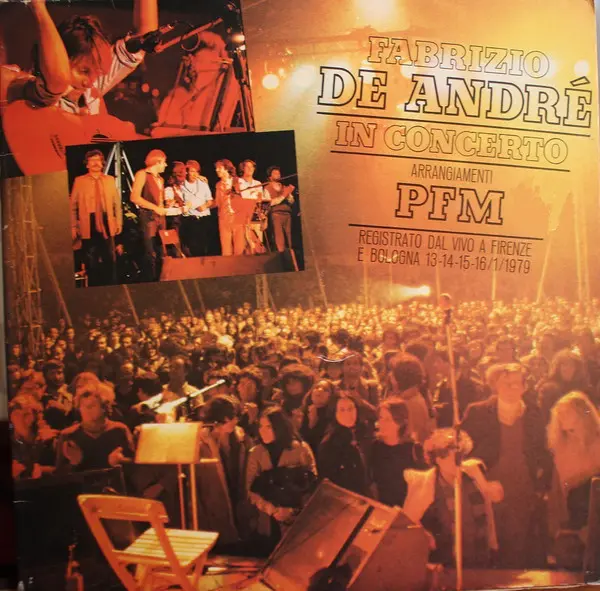 In 1979, Ricordi issued In Concerto – Arrangiamenti PFM, a live collaboration between PFM and singer/songwriter Fabrizio De André.
The album captures the first half of their November 1978 union. The band reimagines his earlier repertoire with new instrumental arrangements and extended dynamic interplay. The collaboration introduced De André’s folk-based material to symphonic rock audiences through electric textures, jazz-inflected breaks, and broader tonal contrast.
De André sings lead vocals on all tracks and co-wrote most of the lyrics with historical collaborator Francesco De Gregori or Massimo Bubola. PFM arranged all pieces for a five-piece electric lineup with additional percussion.
Franco Mussida plays electric and acoustic guitars. Flavio Premoli plays piano, synthesizer, and organ. Patrick Djivas plays electric bass. Franz Di Cioccio plays drums and vocals. Lucio “Violino” Fabbri plays violin, electric piano, and sings backing vocals. Walter Calloni plays auxiliary drums and percussion.
A1. “Bocca di Rosa” [Rosemouth] (4:40)
A2. “Andrea” (5:30)
A3. “Giugno ’73” [June ’73] (4:32)
A4. “Un Giudice” [A Judge] (3:37)
A5. “La Guerra di Piero” [Piero’s War] (3:30)
B1. “Il Pescatore” [The Fisherman] (4:16)
B2. “Zirichiltaggia” (2:36)
B3. “La Canzone di Marinella” [The Song of Marinella] (4:04)
B4. “Volta la Carta” [Turn the Page] (4:03)
B5. “Amico Fragile” [Fragile Friend] (9:27)
Performances were recorded live in concert in Padova and Firenze between November 3 and 6, 1978, and mixed at Stone Castle Studios in Carimate under supervision by PFM and De André.
In concerto – Arrangiamenti PFM, Vol. 2 (live • Fabrizio De André con PFM)
In 1980, Ricordi issued In Concerto – Arrangiamenti PFM, Vol. 2. It presents the second half of the November 1978 collaboration between Fabrizio De André and Premiata Forneria Marconi, continuing the reinterpretation of De André’s catalog in an electric, full-band setting with expanded orchestration and dramatic recasting of acoustic ballads.
De André again sings lead vocals and selects works from Rimini, Volume 8, Non al Denaro, and other prior releases, now presented with dynamic contrasts and instrumental coloration by PFM.
Franco Mussida plays electric and acoustic guitar. Flavio Premoli plays keyboards and backing vocals. Patrick Djivas plays bass. Franz Di Cioccio plays drums and percussion. Lucio Fabbri plays violin and electric piano. Walter Calloni contributes additional percussion and drums.
A1. “Avventura a Durango” [Romance in Durango] (5:32)
A2. “Presentazione” [Introduction] (3:34)
A3. “Sally” (5:07)
A4. “Verranno a Chiederti del Nostro Amore” [They Will Come to Ask About Our Love] (5:09)
B1. “Rimini” (5:07)
B2. “Via del Campo” [Field Street] (2:46)
B3. “Maria nella Bottega del Falegname” [Mary in the Carpenter’s Workshop] (4:08)
B4. “Il Testamento di Tito” [Titus’s Testament] (7:00)
Recordings stem from the same November 1978 live performances documented on Volume 1, compiled and mixed from the same Carimate sessions.
Suonare suonare
 Premiata Forneria Marconi released their seventh studio album, Suonare suonare, in 1980 on Numero Uno.
It marks the band’s return to studio work after their collaboration with Fabrizio De André and reflects a streamlined lineup and songwriting approach, focused on tightly structured, Italian-language songs with compact forms and fewer instrumental diversions.
PFM group-composed the eight songs with lyrics by Italian poet and playwright Gianfranco Manfredi. The material emphasizes rhythm-section interplay and unified song forms over extended instrumental development.
Franco Mussida plays electric and acoustic guitars and sings lead on multiple tracks. Flavio Premoli plays keyboards and contributes backing vocals. Patrick Djivas plays electric bass and backing vocals. Franz Di Cioccio plays drums, percussion, and lead vocals. Lucio Fabbri plays violin and keyboards. Roberto Haliffi contributes percussion.
A1. “Suonare Suonare” [Play, Play] (4:49)
A2. “Volo a Vela” [Glide Flight] (4:25)
A3. “Si Può Fare” [It Can Be Done] (4:51)
A4. “Topolino” [Mickey Mouse] (4:47)
B1. “Maestro della Voce” [Master of the Voice] (5:36)
B2. “Sogno Americano” [American Dream] (4:09)
B3. “Bianco e Nero” [Black and White] (5:47)
B4. “Tanti Auguri” [Best Wishes] (4:06)
Sessions occurred in early 1980 at Stone Castle Studios in Carimate with production by PFM and Claudio Fabi.
Come ti va in riva alla città
 Premiata Forneria Marconi released their eighth studio album, Come ti va in riva alla città, in 1981 on Numero Uno.
The album continues their streamlined, song-oriented direction with a blend of Italian pop-rock and electronic textures. It introduces modern production elements, reflecting shifts in post-prog songwriting and arrangement priorities, and marks the band’s final album with lyricist Gianfranco Manfredi.
All songs were co-written by the band with lyrics by Manfredi. The lineup remains stable from their previous release, with increased use of electronic keyboards and sequencers in tandem with traditional instrumentation.
Franco Mussida plays electric and acoustic guitars and sings. Flavio Premoli plays piano, synthesizer, and organ and provides backing vocals. Patrick Djivas plays electric bass and backing vocals. Franz Di Cioccio handles drums, percussion, and vocals. Lucio Fabbri contributes violin, keyboards, and vocals. Walter Calloni plays additional drums. Roberto Haliffi appears on auxiliary percussion.
A1. “Come Ti Va” [How’s It Going for You] (5:40)
A2. “Weekend” (4:51)
A3. “Quartiere Otto” [District Eight] (5:32)
A4. “Rock in LA” (4:25)
B1. “Chi Ha Paura della Notte” [Who’s Afraid of the Night] (4:31)
B2. “Indians” (4:38)
B3. “Poeta Mancato” [Failed Poet] (3:01)
B4. “Meno Male che ci Sei” [Good Thing You’re Here] (5:01)
Sessions occurred in late 1980 and early 1981 at Stone Castle Studios in Carimate with production by Claudio Fabi and the band.
PFM? PFM!
 PFM released their ninth studio album, PFM? PFM!, in 1984 on Numero Uno.
The album was recorded during a transitional period for the band, which had slimmed down to its core members and restructured its sound for the mid-1980s pop market. The result is a tighter, rhythmically focused set with minimalistic arrangements and shorter track durations.
All songs were composed by the band with lyrics by Vincenzo Incenzo and arrangements tailored to reflect contemporary production aesthetics, including gated drums and synthetic textures. The album marks the last appearance of longtime keyboardist Flavio Premoli until his return in the mid-1990s.
Franco Mussida plays guitar and sings lead vocals. Patrick Djivas plays bass and contributes to keyboards and sequencer programming. Franz Di Cioccio plays drums and sings. Flavio Premoli plays keyboards and backing vocals. Lucio Fabbri appears on violin, keyboards, and drum programming. Roberto Haliffi contributes auxiliary percussion. The album also features programming and engineering support from producers Walter Calloni and Mauro Malavasi.
A1. “Capitani Coraggiosi” [Courageous Captains] (5:04)
A2. “Sentimentalmente” [Sentimentally] (5:07)
A3. “Marlon Brando” (2:48)
A4. “Attimo di Musica” [Moment of Music] (3:47)
B1. “Tigre” [Tiger] (4:32)
B2. “46” (4:13)
B3. “Ego-Telecomunicazione” [Ego-Telecommunication] (4:22)
B4. “Bi Bi Bop” (3:57)
Sessions occurred in Milan in 1984 at Watermelon Studios under the band’s production supervision.
Miss Baker
 Premiata Forneria Marconi released their tenth studio album, Miss Baker, in 1987 on Ricordi.
The album caps the band’s 1980s studio output and features a polished, electronically driven sound with streamlined vocals and digital instrumentation. The title references 1920s performer Josephine Baker and reflects a conceptual, image-forward orientation consistent with late-1980s Italian pop.
The band wrote all music and lyrics in-house, working with contemporary session players and producers. This would be their final studio album before a long hiatus from studio recording.
Franco Mussida sings lead vocals and plays guitar. Patrick Djivas handles bass, synthesizer programming, and production. Franz Di Cioccio sings and contributes drums and percussion. Lucio Fabbri plays violin, keyboards, and contributes arrangements. Additional programming and sequencing were handled by Mauro Sabbione and demo sessions included auxiliary keyboardists and engineers.
A1. “Prima che Venga la Sera” [Before Evening Falls] (4:16)
A2. “Un Amore Vero” [A True Love] (5:31)
A3. “Finta Lettera di Addio di una Rockstar per Farsi Propaganda” [Fake Farewell Letter from a Rockstar to Generate Publicity] (6:21)
B1. “Josephine Baker” (6:48)
B2. “Tempo Tempo” [Time Time] (4:57)
B3. “La Chanson d’un Aviateur” [The Song of an Aviator] (4:09)
B4. “Colazione a Disneyland” [Breakfast at Disneyland] (4:13)
Sessions occurred in Milan across mid–late 1986 with final mixes completed at Ricordi Studios.
Discography:
- Storia di un Minuto (1972)
- Per un Amico (1972)
- L’isola di Niente (1974)
- Live in U.S.A. (live, 1974)
- Chocolate Kings (1975 • PFM)
- Jet Lag (1977 • PFM)
- Passpartù (1978 • PFM)
- In concerto – Arrangiamenti PFM (live, 1979 • Fabrizio De André con PFM
- In concerto – Arrangiamenti PFM, Vol. 2 (live, 1980 • Fabrizio De André con PFM)
- Suonare suonare (1980)
- Come ti va in riva alla città (1981)
- PFM? PFM! (1984 • PFM)
- Miss Baker (1987)
Sources:
- Discogs: Premiata Forneria Marconi
- Italian Albums Directory (page 6)
- 45worlds: Premiata Forneria Marconi
- 45cat: Premiata Forneria Marconi
Artist/Album Pages:
Museo Rosenbach are an Italian symphonic-rock band that released the 1973 album Zarathustra on Ric...
Locanda delle Fate was an Italian symphonic-rock band that released the 1977 Polydor album Forse l...
Planetarium was an Italian symphonic-rock band that released the 1971 album Infinity on Victory Re...
Madrugada was an Italian jazz-rock trio that made a 1974 self-titled album on Philips, followed by...
Libra was an Italian symphonic/jazz-rock/funk band that made the 1975 album Musica e Parole on Ric...
Nova was an Italian jazz-rock band that released four albums between 1975 and 1978 on Arista. They...
Corte dei Miracoli was an Italian symphonic-rock band that released a 1976 self-titled album on Gr...
Raccomandata Ricevuta di Ritorno was an Italian symphonic-rock band that released the 1972 album P...
Ibis was an Italian symphonic-rock band that released the 1973 Fonit Cetra album Canti d'innocenza...
Dedalus was an Italian jazz-rock band that released two albums in 1973/74 on Trident. Members: F...
Giorgio Moroder (born April 26, 1940) is an Italian composer, producer, and arranger who recorded ...
Stormy Six was an Italian multi-style band from Milan, active from 1966 to 1983. They cut two pop ...