

Octobre was a Québécois symphonic-folk band that released five studio albums, each on a different label, between 1973 and 1980.
Members: Pierre Flynn (vocals, keyboards), Jean Dorais (guitar), Mario Légaré (bass), Pierre Hébert (drums), Richard Pelletier (drums), Gerry Leduc (saxophone, keyboards, 1979-?)
Background
Octobre formed in 1972 when 18-year-old singer, keyboardist, and songwriter Pierre Flynn and his guitarist cousin, Jean Dorais, teamed with bassist Mario Légaré and drummer Pierre Hébert. Their name derived from the October Crisis, a political hostage situation that occurred in Greater Montreal in October 1970.
Octobre
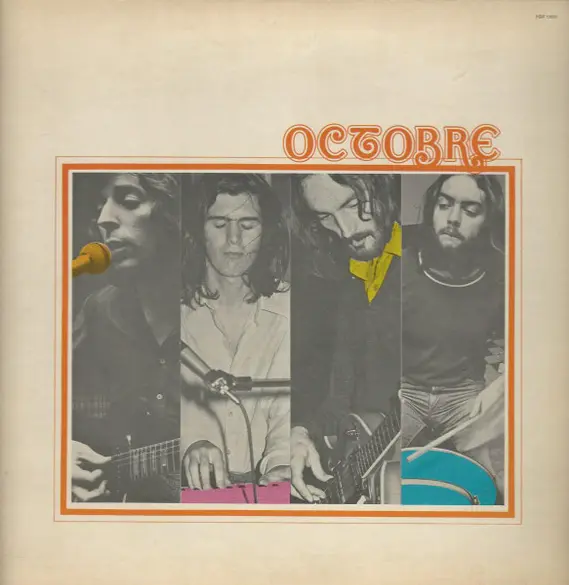 Octobre released their self-titled debut album in May 1973 on PGP.
The album introduced the group’s distinct fusion of chanson lyricism and progressive rock structure. Vocalist–keyboardist Pierre Flynn led the quartet of guitarist Jean Dorais, bassist Mario Légaré, and drummer Pierre Hébert through concise, socially charged compositions rooted in Quebec’s post–October Crisis atmosphere. The sound is compact yet intense, balancing piano-led reflection with sharp ensemble interplay.
Flynn wrote all eight songs, which form a thematic cycle on alienation, disillusionment, and perseverance. His lyrics examine urban confinement (“Dans ma ville”), personal estrangement (“Ça prend presque rien”), and mechanical dehumanization (“La maudite machine”). The music alternates between dramatic organ-driven sequences and contemplative passages that underline Flynn’s commanding vocal delivery.
The sequence divides neatly across two sides. “Si on partait” opens the set with organ and softly turning electric guitar beneath Flynn’s rising voice, its gentle choral refrain contrasting the lyrical longing to escape. “Ça prend presque rien” unfolds as a slow piano lament that crescendos into a bluesy organ solo. “Dans ma ville” adopts a theatrical tone with Brel-like phrasing over rock instrumentation, while “Les vivants” builds from delicate keyboards into a climactic guitar section.
Side B opens with “Viens vivre,” shifting between choral drama and dreamlike calm. “Au fond de tes yeux” extends the stage-inspired atmosphere with a tender chorus coda. “Bonjour” recalls late-sixties organ rock, and “La maudite machine” closes with a biting allegory on societal conformity.
A1. “Si on partait” [If We Left] (2:34)
A2. “Ça prend presque rien” [It Takes Almost Nothing] (4:06)
A3. “Dans ma ville” [In My City] (3:12)
A4. “Les vivants” [The Living] (4:20)
B1. “Viens vivre” [Come Live] (3:00)
B2. “Au fond de tes yeux” [Deep in Your Eyes] (4:19)
B3. “Bonjour” [Hello] (3:01)
B4. “La maudite machine” [The Damn Machine] (4:02)
Sessions occurred at PGP Studio in Montréal with producer Bill Hill and engineer Chuck Gray.
Octobre features photography by Robert Chiasson.
PGP issued “Si on partait” as the group’s debut single, followed by “La maudite machine,” which gained regional airplay and became a signature statement of the Quebec protest movement.
Les Nouvelles Terres
 Octobre released their second album, Les Nouvelles Terres, in November 1974 on Les Disques Zodiaque.
The album refines the quartet’s blend of chanson structure and progressive instrumentation, adding string and choral arrangements that expand their sound beyond the compact intensity of their debut. Vocalist–keyboardist Pierre Flynn leads guitarist Jean Dorais, bassist Mario Légaré, and drummer Pierre Hébert through nine tracks that alternate between theatrical expression, social reflection, and extended instrumental passages.
Flynn wrote all nine songs, several of which incorporate orchestral and brass embellishments arranged by co-producer Quentin Meek. The lyrics turn from urban alienation to generational introspection, with references to identity, displacement, and renewal.
The music spans solemn piano-driven narratives and multi-part compositions with shifting rhythmic sections. “Les nouvelles terres” opens with dramatic organ surges and thunder effects that segue into a declarative vocal section marked by Légaré’s syncopated bass lines and Dorais’s bright guitar. “Le chant du guerrier” follows with a darker tone—its slow pace and layered choir evoke ritual and lament.
“Quand la nuit se réveille” lightens the sequence with chiming electric piano and buoyant rhythm suggestive of nighttime city energy. “Violence” contrasts lyrical protest with full choral and brass flourishes, while “La passe du grand flambeau” develops intricate contrapuntal interplay between piano and 12-string guitar. The closing “Génération” unfolds as a gradual build from subdued electric piano to a climactic ensemble surge.
A1. “Les nouvelles terres” [The New Lands] (5:43)
A2. “Le chant du guerrier” [The Warrior’s Song] (4:30)
A3. “Quand la nuit se réveille” [When the Night Awakens] (3:00)
A4. “Ma chanson” [My Song] (3:09)
A5. “Violence” (5:44)
B1. “La passe du grand flambeau” [The Passing of the Great Torch] (5:05)
B2. “Il est déjà tard” [It’s Already Late] (3:07)
B3. “Voyage en mer” [Sea Voyage] (4:48)
B4. “Génération” (6:46)
Sessions occurred at Studio Six in Montréal with production by Octobre and engineer Quentin Meek, who also co-arranged and mixed the album.
Les Nouvelles Terres features a gatefold sleeve with design concept by Randy Saharuni. Its cover displays lipstick impressions that contrast the album’s introspective tone.
Les Disques Zodiaque promoted the album with the title track and “Violence,” both of which became staples of the band’s stage repertoire.
Survivance
 Octobre released their third album, Survivance, in October 1975 on Trans-World International.
The album marks Octobre’s move from chanson-inflected art rock toward a more defined symphonic and jazz-oriented progressive sound. Singer–keyboardist Pierre Flynn leads guitarist Jean Dorais, bassist Mario Légaré, and drummer Pierre Hébert through arrangements that feature clavinet, mellotron, and synthesizer textures alongside choral accents by Christiane Robichaud and Judy Richards.
Flynn wrote all eight songs. His lyrics alternate between social observation, romantic tension, and existential reflection, while the instrumentals highlight the band’s growing technical reach.
The album opens with “Tendre Torture,” a six-minute suite of shifting tempos and melodic turns that serves as a statement of intent. “La Valse à Onze Temps” unfolds in an 11/4 meter with sharp rhythmic interplay suggestive of King Crimson’s influence. “En Famille” evokes communal unity with clavinet-driven rhythm and celebratory group vocals, while “Baptême de l’Air” acts as the record’s second instrumental centerpiece, combining layered keyboards with choral refrains. “L’Oiseau Rouge” builds from a restrained piano–vocal intro to an expansive closing section of heightened intensity and vocal harmonies.
A1. “Tendre Torture” (5:26)
A2. “Cet Instant” (4:05)
A3. “La Valse à Onze Temps” [The Waltz in Eleven Time] (4:08)
A4. “En Famille” [With Family] (3:26)
B1. “Baptême de l’Air” [Baptism of the Air] (3:45)
B2. “Tu T’en Vas Encore Ce Soir” [You’re Leaving Again Tonight] (4:21)
B3. “L’Oiseau Rouge” [The Red Bird] (4:45)
B4. “Survivance” (3:42)
Sessions took place at Studio Six in Montreal with Octobre and Quentin Meek producing and engineering.
Survivance appeared during Quebec’s mid-70s progressive surge alongside releases by Harmonium, Maneige, and Offenbach. The album’s title track reflects Flynn’s own disillusionment with the music industry, while the ensemble’s intricate performances confirmed Octobre’s place among the province’s leading progressive acts.
L’autoroute des Rêves
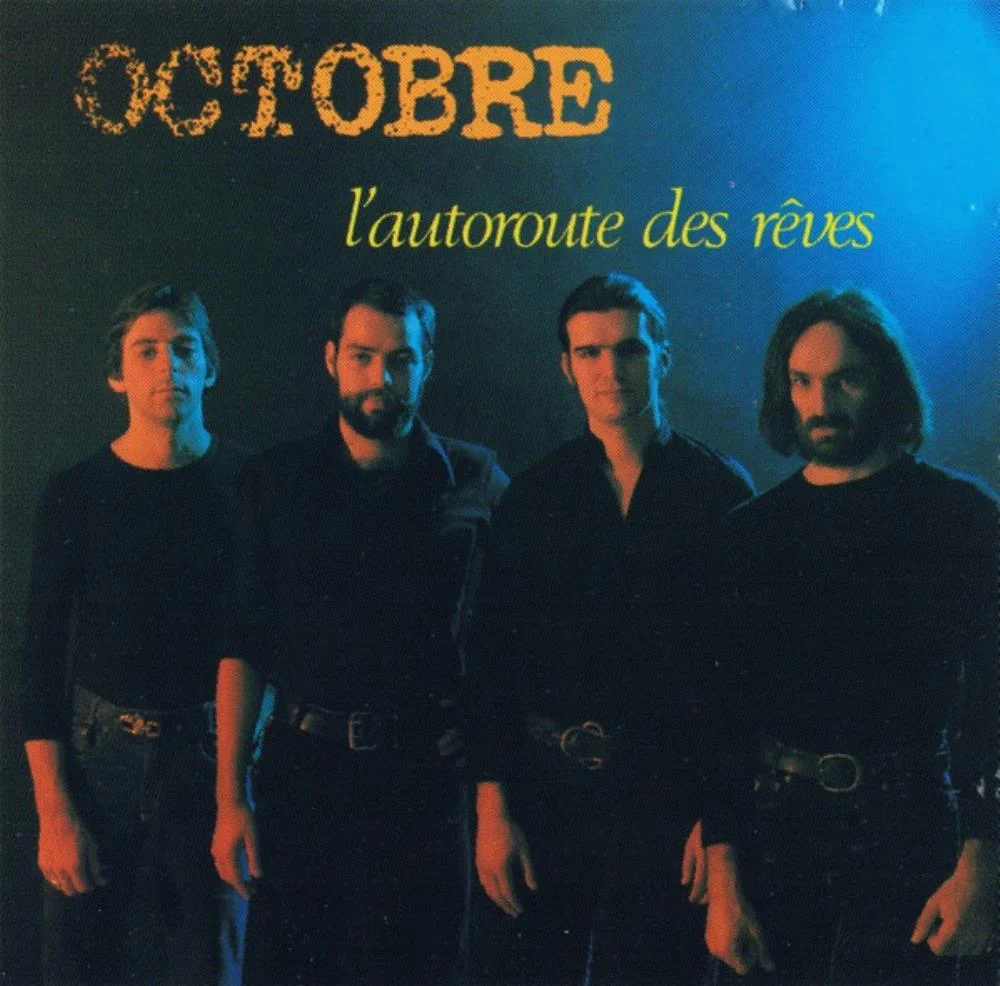 Octobre released their fourth album, L’autoroute des Rêves, in November 1977 on CBS.
The album departs from the group’s early symphonic-rock style toward a brass- and string-laden fusion of chanson, jazz-rock, and orchestral pop. Singer–keyboardist Pierre Flynn leads guitarist Jean Dorais, bassist Mario Légaré, and drummer Pierre Hébert through expansive arrangements directed and orchestrated by Richard Grégoire.
The sessions feature brass by Gary Nagels, Bernard Brien, Jean-Louis Gagnon, Jill Kirwan, Richard Charron, and Serge Chevanel; reeds by Joe Christie (soprano saxophone, flute), Pierre Daigneault (tenor saxophone, flute, bass clarinet), and Pierre Plante; harp by Margot Morris; percussion by Robert Leroux; and a twelve-piece string ensemble.
Flynn wrote all six songs. He thanks Légaré for the bass motif in the title track and A. Mathieu for a theme used in “Le Vent se Lève.”
The album opens with “Le Vent se Lève,” where Flynn’s restrained vocal delivery contrasts with ornate string passages and sharp rhythmic turns. “Insurrection” retains the group’s earlier rock tension with faster pacing and tighter interplay. The nine-minute title track unfolds in multiple movements that alternate between jazz piano passages, big-band brass breaks, and dynamic instrumental exchanges from Dorais and Hébert. “La Prochaine Décennie” and “Sud Profond” lean toward chanson form with subdued ensemble backing, while “Le Grand Départ” closes the album with extended orchestral phrasing and syncopated rhythmic peaks.
A1. “Le Vent se Lève” [The Wind Rises] (5:54)
A2. “Insurrection” (5:03)
A3. “L’Autoroute des Rêves” [The Highway of Dreams] (9:31)
B1. “La Prochaine Décennie” [The Next Decade] (4:50)
B2. “Sud Profond” [Deep South] (4:21)
B3. “Le Grand Départ” [The Great Departure] (8:39)
Sessions occurred at Studio Marko in Montreal with Octobre producing and André Perreault engineering.
L’Autoroute des Rêves appeared as Octobre’s final studio statement of the 1970s, highlighting the ensemble’s transition from symphonic progressivism to orchestrated chanson, framed by Flynn’s introspective writing and Grégoire’s detailed arrangements.
Live – Chants Dans la Nuit
In May 1978, Octobre released Live – Chants Dans la Nuit, a double-album culled from their March 9 show at Théâtre St-Denis.
Clandestins
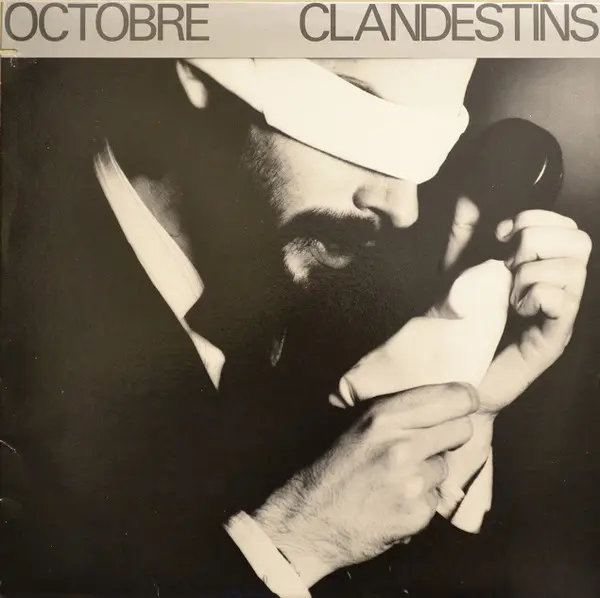 Octobre released their fifth studio album, Clandestins, in 1980 on Kébec-Disc.
The album captures the band renewed with a mix of brass arrangements, keyboards, and guitar-driven rock, integrating new saxophonist Gérard Leduc alongside returning drummer Pierre Hébert. The lineup includes Jean Dorais on e-bow guitar and vocals, Mario Légaré on bass and occasional lead vocals, Pierre Flynn on keyboards, percussion, and vocals, François Lanctôt on synthesizer, and brass contributions from Gary Nagels (trombone) and Roger Walls (trumpet), supported by vocalists Christiane Robichaud and Marie Philippe.
Flynn wrote the majority of the tracks, while Dorais contributed compositions, and Légaré sang lead on “Chanson-Parenthèse.” No tracks are covers.
The album opens with “Pour Te Retrouver,” a Springsteen-inspired rocker with extended organ and sax textures. The title track, “Clandestins,” features prominent sax lines reminiscent of Supertramp’s John Helliwell. “L’Imposteur” layers brass and rock elements with polished arrangements, while “Je Veux Rouler” delivers a brief, energetic rock statement. “Prière D’Asphalte” mixes brass with contemplative rhythms, and “L’Imaginoir” stands out with expressive saxophone and keyboards reflecting Flynn’s earlier style. The closing instrumental, “Le Bout de la Ligne,” provides a restrained conclusion.
A1. “Pour Te Retrouver” [To Find You Again] (4:28)
A2. “Clandestins” [Clandestines] (4:10)
A3. “L’Imposteur” [The Impostor] (4:24)
A4. “Je Veux Rouler” [I Want to Roll] (3:19)
A5. “Chanson-Parenthèse” [Parenthesis Song] (3:03)
B1. “Prière D’Asphalte” [Asphalt Prayer] (5:01)
B2. “L’Imaginoir” [The Imaginary Place] (5:45)
B3. “La Dernière Chance” [The Last Chance] (5:20)
B4. “Le Bout de la Ligne” [End of the Line] (2:32)
Sessions occurred at RCA Victor Studios with Ian Terry producing.
The album features self-produced arrangements with a brass-rock and keyboard-forward approach.
Following Clandestins, Octobre undertook a semi-national tour spanning Ontario to the Atlantic provinces, sustaining the group through 1982.
Discography:
- Octobre (1973)
- Les Nouvelles Terres (1974)
- Survivance (1975)
- L’autoroute des Rêves (1977)
- Live – Chants Dans la Nuit (1978)
- Clandestins (1980)
Sources:
Artist/Album Pages:
Pastoral was an Argentine folk duo of guitarist-singers Alejandro De Michele and Miguel Angel Erau...
Gonzalez was an English soul-funk and Latin-rock big band that released the 1974–75 albums Gonzale...
L.A. Express was an American jazz-funk band that released four albums between 1974 and 1976, the f...
Mandrill is an American soul-funk band from Brooklyn that released five albums on Polydor between ...
Michel Ripoche is a French violinist who emerged in the brass-rock band Zoo at the turn of the 197...
Roger Glover (born Nov. 30, 1945) is a Welsh bassist, composer, and producer with a six-decade mus...
Takehiro Honda — 本田竹曠 (Aug. 21, 1945 — Jan. 12, 2006) — was a Japanese keyboardist who headed six ...
Perfume Azul do Sol was a Brazilian folk-psych band behind the 1974 album Nascimento on Chantecler...
The Outsiders were an English punk-rock band from London that made the 1977/78 albums Calling On Y...
Jukka Hauru is a Finnish guitarist, composer, producer, and music columnist for Helsingin Sanomat....
Bruford was an English jazz-rock supergroup that released four albums on Polydor/EG between 1978 a...
Alan Hawkshaw (born March 23, 1937) is an English pianist and composer who released 25 albums of l...