

New Trolls were an Italian symphonic-rock band that released five albums on Fonit Cetre between 1968 and 1972, followed by six further titles through the close of the 1970s on Magma and Warner Bros.
Members: Vittorio De Scalzi (guitar, keyboards, flute, vocals), Nico Di Palo (guitar, vocals), Mauro Chiarugi (keyboards, 1967-70), Giorgio D’Adamo (bass, vocals, 1967-72, 1976-81), Gianni Belleno [aka Johnny Dei Tritons] (drums, vocals, 1967-72, 1976-92), Maurizio Salvi (keyboards, 1971-72), Frank Laugelli (bass, 1972), Ricky Belloni (guitar, vocals, 1976-95), Giorgio Usai (keyboards, 1977-80)
Background
New Trolls formed in Genoa in 1966 when vocalist–guitarist Vittorio De Scalzi (formerly of I Trolls) teamed with guitarist–vocalist Nico Di Palo, keyboardist Mauro Chiarugi, bassist Giorgio D’Adamo, and drummer Gianni Belleno.
The five members had circulated in the city’s beat scene and were regarded among the most technically accomplished musicians in Liguria. They named their new project in reference to De Scalzi’s prior group and debuted with a residency in local clubs before landing a national support slot on the Rolling Stones’ April 1967 Italian tour.
That summer, they released their debut single “Sensazioni” backed with “Prima c’era luce” on the Genoa-based label Mag, issued in conjunction with the band’s rising profile as one of Italy’s most commanding live acts. By year’s end, New Trolls had become a fixture of the national music press and began composing material for a longform release while continuing a steady stream of standalone singles.
Senza Orario Senza Bandiera
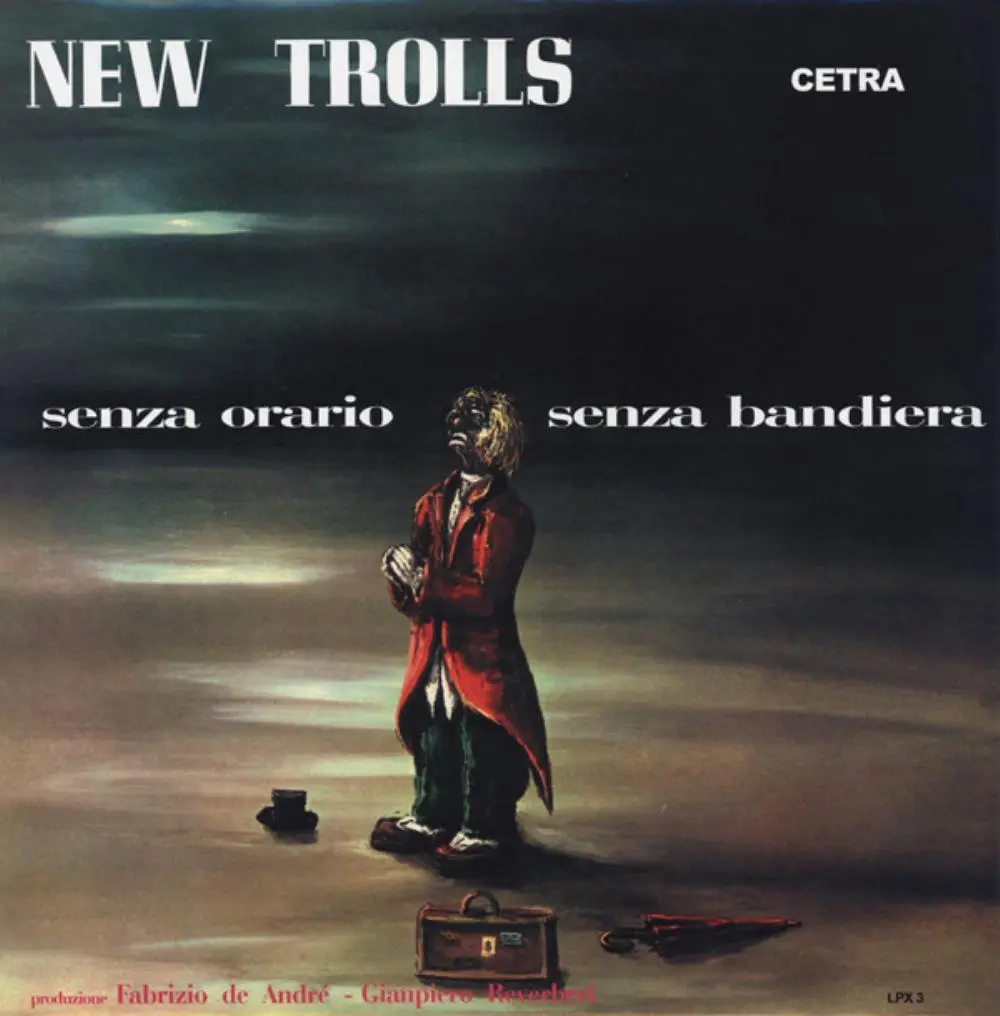 New Trolls released their debut album, Senza Orario Senza Bandiera, in 1968 on Fonit Cetra.
The album presents a unified song cycle, with connected segments and recurring lyrical motifs, making it the first Italian concept album. Its theme follows a poet’s introspective journey through places and characters across the world. It also marks the group’s collaboration with lyricist Riccardo Mannerini, singer-songwriter Fabrizio De André, and arranger Gian Piero Reverberi.
Vittorio De Scalzi plays rhythm guitar and electric piano, shaping many arrangements around chiming arpeggios and simple modal figures. Nico Di Palo provides lead vocals and rhythm guitar, often countering De Scalzi’s phrasing. Giorgio D’Adamo anchors the harmonic structure on electric bass. Gianni Belleno maintains crisp rhythmic control on drums, supporting the album’s transitional pacing. Mauro Chiarugi contributes organ and harpsichord, adding tonal depth to interludes and backing layers.
All music is credited to De Scalzi and Di Palo except where noted. Reverberi composed “Signore, io sono Irish” and co-wrote “Vorrei comprare una strada” with De André, De Scalzi, and Di Palo. Mannerini supplied the original text, which De André adapted to fit the musical metrics. Reverberi also composed the linking orchestral passages and co-produced the album with De André.
The album alternates vocal narratives with transitional segments, forming a continuous 27-minute suite. “Ho veduto” opens with acoustic figures beneath a poetic monologue. “Vorrei comprare una strada” and “Susy Forrester” use layered vocal harmonies to animate vignettes of urban life and lost beauty. “Signore, io sono Irish” merges lamentation with orchestral backing, portraying a man’s prayer for dignity. “Duemila” contrasts rhythmic bounce with string-laced fantasy, while “Ti ricordi Joe?” stages a wartime dialogue. The closing “Andrò ancora” reprises themes from the opener, completing the cycle.
A1. “Ho veduto” [I have seen] (3:15) — Introduces the wandering narrator through a survey of sights and emotions, from arctic dawns to shark-infested waters and social extremes.
A2. “Vorrei comprare una strada” [I would like to buy a street] (2:08) — Describes a fantasy of buying a childhood street filled with lights and laughter; features intricate vocal layering.
A3. “Signore, io sono Irish” [Lord, I am Irish] (3:15) — Written by Reverberi; depicts a man’s plea for a bicycle as a symbol of personal freedom and dignity.
A4. “Susy Forrester” (2:30) — Focuses on a woman aging in isolation as she waits in vain for love.
A5. “Al bar dell’angolo” [At the corner bar] (2:28) — Narrates a gambler’s losses; underpinned by horns and call-and-response vocal refrains.
B1. “Duemila” [Two thousand] (2:40) — Juxtaposes poverty and progress through the image of a ragged child beneath a sky of starships; builds to an orchestral climax.
B2. “Ti ricordi Joe?” [Do you remember Joe?] (2:48) — Anti-war dialogue between two marines reflecting on their time in the Philippines.
B3. “Padre O’Brien” [Father O’Brien] (2:54) — Presents a priest’s wish to redirect war funds toward poverty relief.
B4. “Tom Flaherty” (2:18) — Portrays a man too shy to confess love; orchestrated with subdued textures.
B5. “Andrò ancora” [I will go on] (2:15) — Recapitulates the opening theme with renewed resolve and imagery of tireless travel through joy and hardship.
Sessions took place in 1968 with Gian Piero Reverberi as arranger and co-producer. Fabrizio De André assisted in the lyrical adaptation and production. The album was issued on Fonit Cetra.
The cover depicts a forlorn street performer in tattered clothing standing under dim light, flanked by scattered belongings—a suitcase, hat, and umbrella—against a shadowy, featureless backdrop, underscoring the album’s introspective and literary tone.
1968–70 Singles
Between 1968 and 1970, New Trolls released ten non-album singles that track their rapid evolution from vocal harmony beat music to exploratory psychedelia and amplified hard rock. All but one of the tracks compiled on the New Trolls (1970) LP were originally released on 7″ between 1967 and 1970. Most compositions stem from the Di Palo–De Scalzi partnership, with arrangements handled internally by the band. This run of singles marks the gradual emergence of fuzz guitar, layered Hammond organ, and multipart vocal arrangements that would culminate in their 1971 breakthrough Concerto grosso per i New Trolls.
A. “Visioni” [Visions]
B. “Io ti fermerò” [I Will Stop You]
Cetra SP 1334 (1968)
— “Visioni” combines beat-era harmony vocals with swirling organ and a tumbling rhythm section. The main refrain alternates with angular guitar stabs and percussive keyboard fills.
A. “Cristalli fragili” [Fragile Crystals]
B. “Ehi, tu ritorna” [Hey, Come Back]
Cetra SP 1346 (1968)
— B-side appears in the film La più bella coppia del mondo (dir. Camillo Mastrocinque). “Cristalli fragili” matches its title with light vocal harmonies and brittle rhythmic patterns, pivoting mid-verse into a denser organ-led arrangement.
A. “Annalisa”
B. “Allora mi ricordo” [Then I Remember]
Cetra SP 1351 (1969)
— “Annalisa” opens with textural interplay between modulated organ and clipped fuzz guitar before settling into a vocal-led ballad with sectional contrasts and brief bursts of harmonic dissonance.
A. “Davanti agli occhi miei” [Before My Eyes]
B. “Proud Mary”
Cetra SP 1355 (1969)
— A-side features sharp guitar fills and a clipped rhythmic vocal line, interrupted by ascending organ flourishes. The B-side is a translated version of the Creedence Clearwater Revival hit by John Fogerty.
A. “Davanti agli occhi miei”
B. “Quella musica” [That Music]
Cetra SP 1356 (1969)
— Alternate pressing with a different B-side. “Quella musica” begins as a sentimental ballad with string backing but breaks midway into a sustained group chant and soaring guitar solo underpinned by urgent percussion.
A. “Io che ho te” [I Who Have You]
B. “Lei mi diceva” [She Told Me]
Cetra SP 1357 (1969)
— “Lei mi diceva” layers a descending vocal melody over galloping drums and gritty guitar leads. “Io che ho te” uses acoustic figures and soft strings in a Sanremo-style ballad mode.
A. “Signore io sono Irish” [Sir, I Am Irish]
B. “Duemila” [Two Thousand]
Cetra SP 1358 (1969)
— A-side is the only pre-1970 single included on Senza orario senza bandiera (1968). Its baroque intro and narrative structure reflect the De André collaboration.
A. “Un’ora” [An Hour]
B. “Cosa pensiamo dell’amore” [What Do We Think of Love]
Cetra SP 1359 (1969)
— “Cosa pensiamo dell’amore” alternates asymmetric 10/8 rhythm with call-and-response organ stabs and clipped vocal lines, ending with a paraphrase of A Whiter Shade of Pale. “Un’ora” follows with tremolo strings and Spanish guitar flourishes but lacks the formal complexity of its A-side.
A. “Una miniera” [A Mine]
B. “Il sole nascerà” [The Sun Will Rise]
Cetra SP 1360 (1969)
— “Una miniera” opens with mournful strings and a dirge-like vocal in tribute to the Marcinelle mining disaster. The piece builds intensity through stepwise harmonic tension and climaxes in a rapid instrumental coda.
A. “Autostrada” [Highway]
B. “Il nulla e la luce” [The Void and the Light]
Cetra SP 1362 (1970)
— “Autostrada” uses tom-heavy drumming and riff-based guitar phrasing to simulate forward momentum. “Il nulla e la luce” slows the pace with a hymn-like vocal over sustained organ.
A. “Una nuvola bianca” [A White Cloud]
B. “Corro da te” [I Run to You]
Cetra SP 1363 (1970)
— “Una nuvola bianca” cycles between distorted verses and a wide-open choral refrain. “Corro da te” features syncopated riffs, thick bass tones, and feedback-rich interludes, reflecting Di Palo’s deepening Hendrix influence.
A. “La più bella sei tu” [You Are the Most Beautiful]
B. “Come Cenerentola” [Like Cinderella]
Cetra SP 1364 (1970)
— “La più bella sei tu” uses vocal unison and call-and-response layering, while “Come Cenerentola” employs harpsichord flourishes and a waltz rhythm to underscore its fairy-tale theme.
Across these twelve singles, New Trolls shift from structured beat pop to episodic song forms with increasing use of instrumental contrast and tonal layering. Songs like “Sensazioni” (1967), “Annalisa,” and “Quella musica” introduce stop-start transitions, wordless refrains, and modal solos. Even the ballads experiment with internal dynamics and arrangement quirks, foreshadowing the group’s symphonic ambitions.
Concerto Grosso per i New Trolls (OST)
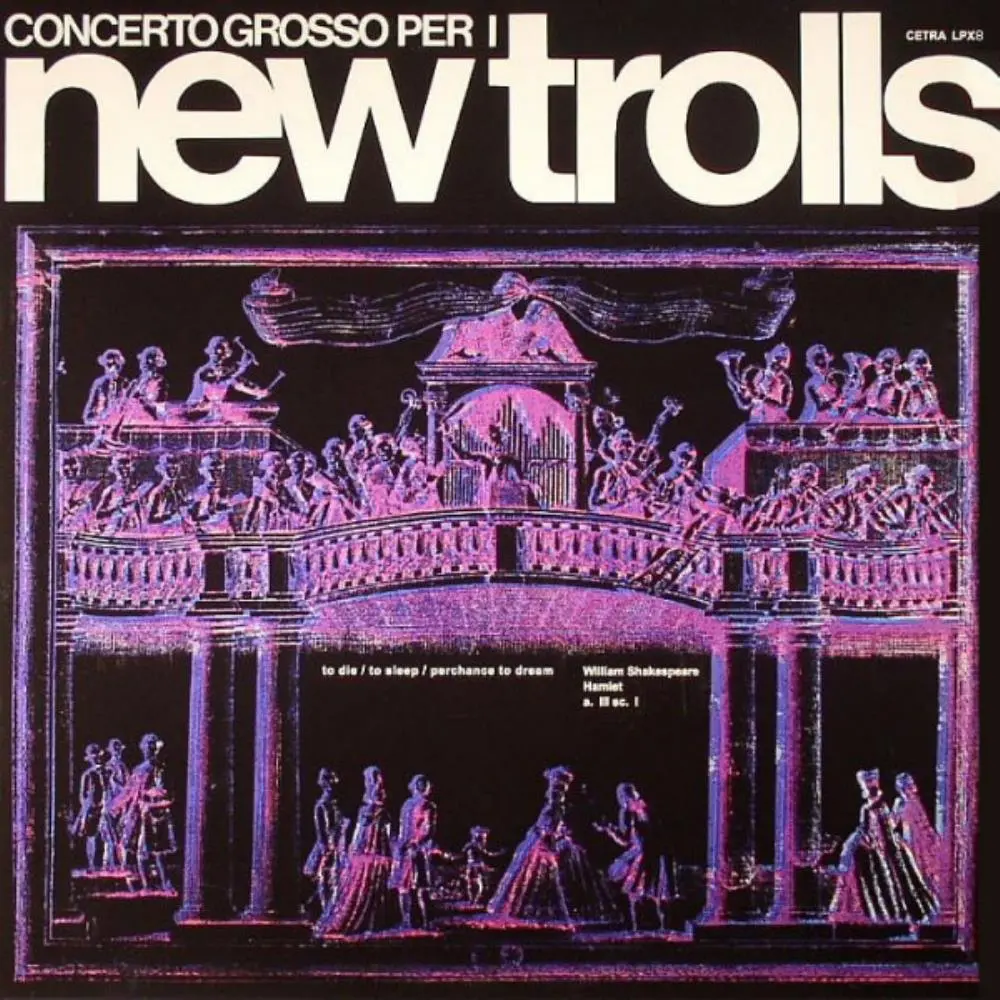 New Trolls released their second album, Concerto Grosso per i New Trolls, in 1971 on Fonit Cetra.
The album consists of a four-part suite arranged by Luis Enriquez Bacalov for rock group and orchestra, followed by a 20-minute studio jam. It marks a stylistic shift from song-based material to formal structure and baroque integration, drawing on Vivaldi and film score idioms. Side B abandons the orchestra for a loose, blues-based live-in-studio exercise that foregrounds the band’s instrumental abilities.
Vittorio De Scalzi plays electric guitar and flute, alternating lead roles in the orchestral suite with melodic phrasing and feedback-laced flourishes. Nico Di Palo sings lead in English and plays electric guitar, including wah-inflected passages and Hendrix-inspired leads on the fourth movement. Maurizio Salvi commands the Hammond organ and Fender Rhodes, driving the group improvisation and anchoring dynamic transitions. Giorgio D’Adamo supports with firm, melodic basslines and vocal backing. Gianni Belleno maintains pulse and intensity with cymbal-rich fills and concludes side B with a lengthy, tom-driven solo.
The orchestral suite was composed and conducted by Luis Enriquez Bacalov. All four movements of side A appear in the soundtrack to the 1971 film La vittima designata by Maurizio Lucidi. The vocal line in three of the four movements includes the refrain “to die, to sleep, maybe to dream,” drawn from Shakespeare’s Hamlet.
The opening movement “Allegro” stages a call-and-response between strings and amplified band, using flute interjections and scalar guitar figures over counterpoint strings. “Adagio (Shadows)” introduces the theme in ballad form, sung in English with soft orchestral textures, violin counterlines, and sparse electric guitar. “Cadenza – Andante con moto” opens with solo violin before layering harpsichord, wordless vocals, and string sections over recurring Shakespearean fragments. The fourth part, “Shadows (per Jimi Hendrix),” recasts the adagio theme as a slow-build guitar meditation with tremolo flute and bluesy interjections, ending in escalating feedback.
A1. “Concerto grosso per i New Trolls” [Concerto grosso for the New Trolls] (16:45)
— a. “Allegro” [Fast] (2:15) — opening overture alternating orchestra and amplified band motifs with baroque phrasing and flute.
— b. “Adagio (Shadows)” [Slow (Shadows)] (4:50) — vocal ballad with string swells, twangy guitar, and repeated Hamlet-derived lyrics.
— c. “Cadenza – Andante con moto” [Solo – Moderately slow with movement] (4:10) — opens with violin; includes harpsichord, layered strings, and vocal reprises of prior themes.
— d. “Shadows (per Jimi Hendrix)” [Shadows (for Jimi Hendrix)] (5:30) — Hendrix-inspired instrumental with wah guitar, organ backing, and feedback coda.
B1. “Nella sala vuota, improvvisazioni dei New Trolls registrate in diretta” [In the empty room, improvisations by New Trolls recorded live] (20:30) — jam-oriented instrumental suite with changing dynamics, Hammond leads, distorted guitar, brief reprise of “Il sole nascerà” vocals, and extended drum solo.
Sessions occurred in 1971 with Bacalov conducting the orchestra on Side A. New Trolls improvised Side B live in the studio.
The front cover presents a stylized neon rendering of a Baroque theatrical scene, depicting courtly figures on balconies and walkways beneath an inscription from Hamlet (“to die / to sleep / perchance to dream”), linking the album’s orchestral concept to themes of tragedy and illusion.
Concerto Grosso per i New Trolls doubles as the soundtrack to La vittima designata (1971), a psychological thriller directed by Maurizio Lucidi. The film stars Tomas Milian as Stefano Augenti, a Milanese ad executive trapped in a failing marriage to the wealthy Luisa (Marisa Bartoli) while conducting an affair with Fabienne (Katia Christine). A chance encounter with the aristocratic and manipulative Count Matteo Tiepolo (Pierre Clémenti) draws Stefano into a deadly game of moral erosion and psychological entrapment. As their meetings grow increasingly fateful, Matteo proposes a sinister “exchange of murders.” When Luisa is found strangled, Stefano becomes the prime suspect and struggles to clear his name, only to find himself ensnared in a premeditated frame-up. The story culminates in a shocking act of misdirection and fatal irony, set against the backdrop of Venice. The film features a split score: Luis Bacalov composed the dramatic orchestral segments, performed by New Trolls as the three-part Concerto Grosso, while Sergio Bardotti and Bacalov arranged the pop tracks performed by the group.
New Trolls issued two non-album singles in 1971 on Cetra: “Una storia” backed with “Il vento dolce dell’estate” (SP 1449), and “Venti o cent’anni” backed with “Una vita intera” (SP 1453).
Searching for a Land
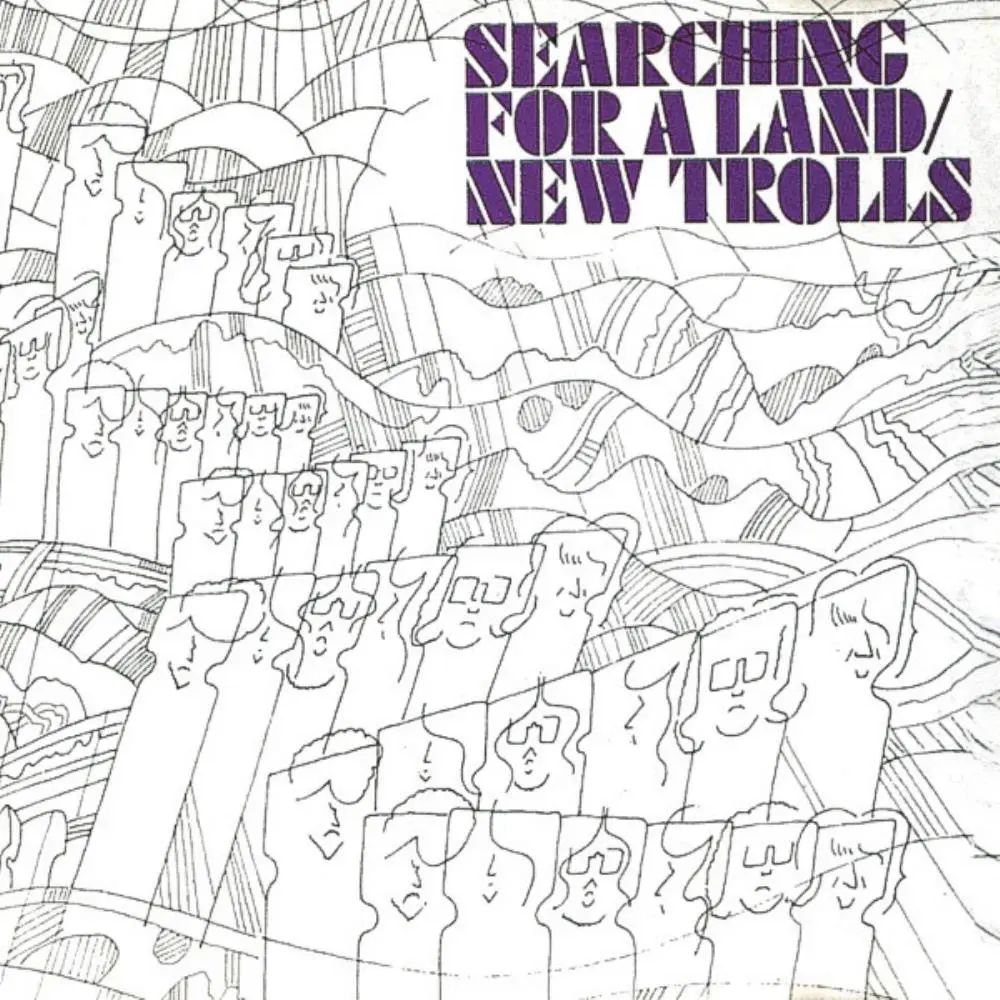 New Trolls released their third album, Searching for a Land, in 1972 on Fonit Cetra.
The band followed Concerto grosso per i New Trolls with a double album that juxtaposed two contrasting halves: a studio-recorded acoustic symphonic side and a live-recorded heavy rock performance. It marked their first full-length with Italian-Canadian bassist Frank Laugelli and was entirely sung in English.
Vittorio De Scalzi plays acoustic and electric guitars, flute, and synthesizer, and provides lead and backing vocals across the studio and live material. Nico Di Palo contributes overdriven rhythm and fuzz-toned lead guitar, handling principal vocals on the heavier tracks and layering background harmonies. Maurizio Salvi commands piano, Hammond organ, harpsichord, and Eminent strings to frame and bridge numerous sections with baroque textures and modally shifting passages. Gianni Belleno multi-tasks on drums, tom rolls, and sparse percussion. Frank Laugelli anchors most sectional changes with active electric bass lines and supplied lyrics credited under the alias Rhodes. Former member Giorgio D’Adamo plays bass on the live numbers “Bright Lights” and “Muddy Madalein.”
All lyrics were written by Frank Laugelli (credited as Rhodes). Compositional duties are shared between De Scalzi, Di Palo, Salvi, and Belleno across both sides of the album, with Di Palo taking lead on the live suite.
The studio disc opens with a sequence of acoustic-based tracks framed by slow cadences and introspective lyrics. “Searching” progresses from arpeggiated acoustic guitar and plaintive verses into a piano-centered section and staggered harmonic resolution. “Percival” sustains this texture with distant, filtered vocals and fragmented phrasing that rise into a brisk acoustic solo. “In St. Peter’s Day” transitions between soft organ ambience and scalar folk refrains, punctuated by flute-like timbres and layers suggestive of Eminent strings.
“Once That I Prayed” introduces declamatory piano and tentative lyrical cadences over sparse harmonic shifts. “A Land to Live a Land to Die” unfolds as a slow-lurch instrumental that alternates between dreamy Hammond figures and distant rhythm undercurrents, culminating in a prolonged fuzzed-out solo. “To Edith,” prefaced by the interlude “Giga,” sets Bertrand Russell’s text to a rising arrangement with steady synth lines, pulsed drumming, and delayed guitar flourishes.
A1. “Searching” (4:45) — Opening acoustic track built on chordal repetition and alternating vocal–piano sections
A2. “Percival” (4:22) — Features filtered vocals and arpeggiated acoustic guitar, culminating in a solo
A3. “In St. Peter’s Day” (5:00) — Religious-themed ballad with Eminent string layers and organ interjections
A4. “Once That I Prayed” (4:00) — Classical-style piano framing lyrics of solitude and freedom
B1. “A Land to Live a Land to Die” (8:25) — Instrumental with organ-led opening and dreamlike slow-blues descent
B2. “Giga” (2:05) — Acoustic interlude for two guitars
B3. “To Edith” (8:40) — Based on a Bertrand Russell poem; includes synth, guitar overlays, and theatrical vocals
The live disc presents an abrupt shift in tone. “Intro” features extended solo segments on each instrument over a hard-driving rhythm section, leading into “Bright Lights,” a compact blues rocker built on syncopated riffs, crashing cymbals, and distorted upper-register vocalizations. “Muddy Madalein” features a pentatonic riff undergirded by blues phrasing and a flute solo, framed around lyrics of an uneasy encounter.
“Lying Here” spans over seventeen minutes: its first six composed of Gregorian-style motifs and contrapuntal flute and organ passages; its latter half builds into a multi-stage jam alternating between soaring organ and guitar solos with hard rock inflection and Colosseum-style breakdowns.
C1. “Intro” (7:20) — Extended instrumental with isolated solos from each player
C2. “Bright Lights” (6:45) — Hard rocker with screamed vocals, synth solo, and heavy rhythmic shifts
C3. “Muddy Madalein” (2:25) — Riff-based blues track with Tull-style flute
D. “Lying Here” (17:25) — Begins with organ and Gregorian lines, expands into a long instrumental jam
Sessions took place at Studio Fonit Cetra in Milan. The band recorded the live material to multitrack tape and later overdubbed audience sounds. Gianfranco Guarnieri engineered the recordings.
Cesare Monti created the artwork, which features a continuous-line drawing of faceless figures arranged in marching rows across a stylized landscape, their minimalist forms set against contoured hills and sky patterns, suggesting mass movement in search of identity or purpose. The original gatefold pressing features a fold-up flap that encloses both discs, a format replicated in the 2020 Vinyl Magic reissue.
UT
 New Trolls released their fourth album, UT, in late 1972 on Fonit Cetra.
UT marked the final release by the classic lineup before internal division split the band into two rival factions. The album returned to Italian-language lyrics and positioned itself as a high point of the group’s symphonic and heavy rock explorations, featuring both classical miniatures and extended riff-based epics.
Nico Di Palo plays lead guitar and sings principal vocals, phrasing with heightened expressivity and handling all vocal peaks across the album’s heavier passages. Vittorio De Scalzi contributes guitar on the third track and withdraws from the spotlight, his role minimized amid growing creative tension. Maurizio Salvi commands the piano, Eminent organ, and early synthesizer voicings, defining transitions and anchoring the classical material. Frank Laugelli (credited as Rhodes) supplies bass lines with phrasing shaped by jazz and hard rock, maintaining harmonic support across all tracks. Gianni Belleno drums with emphatic fills and metric shifts, sharing vocal duties on ensemble refrains and atmospheric passages.
The lyrics reflect an internalized view of conflict and identity, often drawing on literary and allegorical imagery. The title UT references the first note of the medieval hexachord, as coined by Guido d’Arezzo, and also nods to Dante Alighieri—whose Paolo e Francesca story features on Side B.
Salvi opens the album with two back-to-back instrumentals. “Studio” adapts a Johann Baptist Cramer étude into an episodic piano prelude framed by a low gong and stately organ resonance. “XXII strada” [22nd Street] jumps into a fast-paced jazz-rock miniature with syncopated keys, sharp guitar outbursts, and a tempo modeled on a waltz inversion. “I cavalieri del lago dell’Ontario” [The Knights of Lake Ontario] enters on a martial drum cadence before shifting into a harmonized vocal passage describing a lost battalion. Organ and flute shadow the melody’s descent into somber modal territory, punctuated by dynamic shifts and textural swells.
“Storia di una foglia” [Story of a Leaf] presents an acoustic-led interlude with pastoral coloring and flowing phrasing. Salvi lays gentle piano behind Di Palo’s vocals while the arrangement centers on brushed percussion and sustained chord intervals. “Nato adesso” [Born Now] begins as a reflective ballad but transitions into an expansive sequence that features Di Palo’s longest solo on record—a freeform lead that expands over five minutes, rising atop fixed piano chords and a slow-building rhythm section. Salvi introduces discreet string textures from the Eminent, thickening the harmonic field while De Scalzi overlays single-note support.
“C’è troppa guerra” [There’s Too Much War] establishes a heavy-set opening riff followed by distorted, near-recitative vocals from Di Palo. It shifts from abrupt stop-time breaks into mid-tempo interludes and psychedelic overlays before a sudden intensification six minutes in. A searing wah-driven solo crosses the remaining runtime, layered over phased organ chords and locked rhythm figures. “Paolo e Francesca” returns to a soft-focus ballad mode. Di Palo sings over minimalist guitar lines and alternating chord shifts, with subtle stereo panning used for dual guitar voicings. The closing “Chi mi può capire” [Who Can Understand Me] begins with a church-like organ figure and unfolds as a stately final statement. Vocal refrains cycle over arpeggiated piano with incremental crescendos, ending in sustained chords and open cadences.
A1. “Studio” (3:10) — Classical piano étude by Salvi, based on a theme by Johann Baptist Cramer, framed by gong and organ
A2. “XXII strada” [22nd Street] (1:51) — Jazz-waltz instrumental with rapid piano and angular rhythm guitar
A3. “I cavalieri del lago dell’Ontario” [The Knights of Lake Ontario] (5:02) — Epic narrative over martial drums and shifting harmonic structure
A4. “Storia di una foglia” [Story of a Leaf] (2:57) — Pastoral ballad with acoustic guitar and light piano texture
A5. “Nato adesso” [Born Now] (7:53) — Piano-led ballad that expands into a multi-minute freeform guitar solo
B1. “C’è troppa guerra” [There’s Too Much War] (9:53) — Hard rock suite with distorted vocals, stop-time shifts, and a five-minute closing solo
B2. “Paolo e Francesca” (6:06) — Ballad drawn from Dante’s Inferno, with dual-panned guitar voicing and subdued rhythmic flow
B3. “Chi mi può capire” [Who Can Understand Me] (4:35) — Closing lament with organ prelude, vocal refrain, and slow-building finale
Sessions occurred in Milan in late 1972 with engineer Gianfranco Guarnieri.
UT features cover art by Gian Carlo Greguoli. The cover design features bold vertical alignment of the band name and title in stark black, white, and red blocks, reflecting the minimalist aesthetic of the album’s studio-oriented production.
N.T. Atomic System
 New Trolls released their fifth album, N.T. Atomic System, in 1973 on Magma.
Formed by Vittorio De Scalzi following the split of the classic New Trolls lineup, N.T. Atomic System represents a decisive turn toward symphonic progressive structures layered with jazz instrumentation, modal transitions, and elaborate ensemble passages. It diverges from the heavier rock leanings of UT and centers instead on keyboard complexity and formal experimentation, establishing De Scalzi’s post-Concerto Grosso vision. The album reunites De Scalzi with bassist Giorgio D’Adamo and introduces keyboardist Renato Rosset, saxophonist Giorgio Baiocco, and session drummer Tullio De Piscopo. Percussionist Ramasandiran Somusundaram and a trio of female vocalists (Giulietta, Annarita Pirastu, Piero Darini) round out the ensemble. A post-release single featuring a Mussorgsky adaptation was appended to the 1990s CD reissue.
Vittorio De Scalzi plays electric and acoustic guitar, flute, ARP synthesizer, spinet, piano, and delivers all Italian-language lead vocals. He centers most arrangements on modular layering and dynamic shifts, alternating flute and synth across tonal extremes. Renato Rosset commands piano, Moog, Mellotron, Hammond, and electric piano, constructing dense keyboard clusters and contrapuntal voicings that define the album’s harmonic terrain. Giorgio Baiocco phrases all tenor saxophone and flute leads and provides melodic counterpoint using an Eminent string machine. Giorgio D’Adamo anchors most of the material with slow-sprung bass figures, stepping forward on select modal sections. Tullio De Piscopo supports the ensemble with syncopated tom and cymbal work, supplying key dynamic bursts in transitional moments. Ramasandiran Somusundaram adds auxiliary rhythm with hand percussion.
De Scalzi composed the entire album apart from “Ibernazione,” co-credited to Rosset and Baiocco. All lyrics are in Italian, with the exception of “Butterfly,” sung in English. Female backing vocals appear on tracks A1, A3, and B3.
The album opens with two classically structured compositions. “La nuova predica di Padre O’Brien” [The New Sermon of Father O’Brien] interweaves ARP themes, organ pedal work, and modal flute motifs with alternating vocal and instrumental sections. “Ho visto poi” [Then I Saw] layers phased Hammond chords and flute arpeggios over offset guitar fragments before pivoting to a brief saxophone-led jazz bridge. Both tracks employ shifting timbral contrasts between synthesizer, piano, and Mellotron pads.
“Tornare a credere” [To Believe Again] opens in a ballad form with slow piano phrases and choral backing, then accelerates into a midsection marked by polyrhythmic piano-synth interlock, landing in a fuzzed-out instrumental passage that reprises the intro theme. “Ibernazione” [Hibernation] introduces spinet-led counterpoint and light vocal flourishes before a solo flute section veers into early music territory; a rhythm break reveals modal jazz structures, driven by walking bass and Moog layering. “Quando l’erba vestiva la Terra” [When the Grass Dressed the Earth] begins on sustained Hammond figures and solemn vocals before transitioning to a metrically unstable suite of pastoral guitar phrases and tenor sax soloing. “Butterfly,” the only English-language track, presents light folk-rock ornamented with vocal harmonies and acoustic guitar, with brief appearances by flute and ARP textures.
A1. “La nuova predica di Padre O’Brien” [The New Sermon of Father O’Brien] (6:40) — switches between symphonic motifs and choral jazz phrasing; features layered flute and synth dialogue.
A2. “Ho visto poi” [Then I Saw] (7:28) — juxtaposes heavy Hammond patterns with fluid instrumental breaks; includes tenor sax improvisation.
A3. “Tornare a credere” [To Believe Again] (8:30) — ballad with shifting structure; closes on Moog-led resolution.
B1. “Ibernazione” [Hibernation] (5:45) — blends spinet and flute with modal jazz segments; includes prominent bass work.
B2. “Quando l’erba vestiva la Terra” [When the Grass Dressed the Earth] (7:15) — opens on ecclesiastical organ voicing; transitions into a sax-led fusion sequence.
B3. “Butterfly” (8:05) — English-language track with acoustic rhythm and layered female backing vocals; flute appears in midsection.
Sessions took place in 1973. De Scalzi produced the album and performed all overdubs. The title track from their 7″ single — “Una notte sul Monte Calvo” [A Night on Bald Mountain], an adaptation of Mussorgsky’s Ночь на Лысой горе — was included as a bonus on later CD pressings.
Artwork was designed by Gian Carlo Greguoli. The cover shows a claw hammer plunged into a raw egg on a smooth white surface, the yolk violently split and oozing outward—an image of precision impact and fragile rupture that hints at the band’s explosive offshoot from New Trolls.
“Tornare a credere” appeared on back of the non-album “Una notte sul Monte Calvo.”
Tempi Dispari
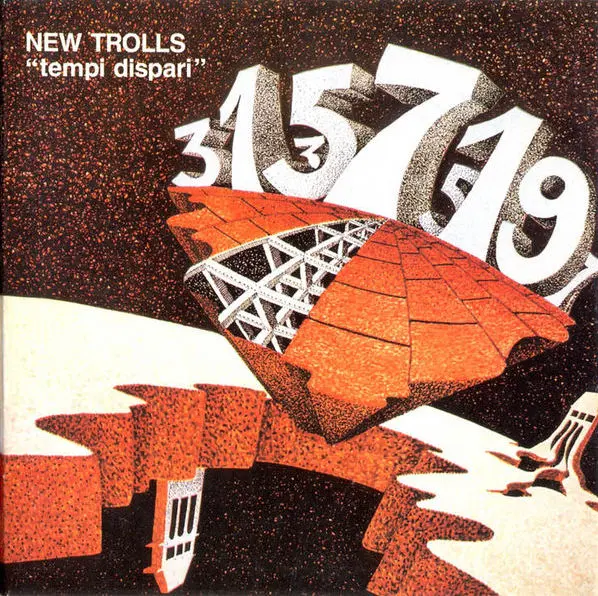 New Trolls released their sixth album, Tempi Dispari, in 1974 on Magma.
Recorded live at Teatro Alcione in Genoa, Tempi Dispari documents the peak improvisational power of the De Scalzi-led quintet during the short-lived New Trolls Atomic System era. Dropping the “Atomic System” credit but retaining the entire N.T. Atomic System lineup, the album comprises two extended instrumentals centered on complex time signatures and modal interplay.
Departing from the baroque textures of Concerto Grosso and the symphonic-jazz hybrid of Tornare a credere, this performance embraces full-on electric jazz-rock, drawing comparisons to the Mahavishnu Orchestra, Perigeo, and Soft Machine.
Vittorio De Scalzi plays electric guitar, flute, and keyboard, alternating between spiraling riff patterns and modal solos. He takes extended lead passages across both suites, switching freely between phrased motifs and staccato chromatic bursts. Renato Rosset commands Hammond organ, electric piano, and Moog, using a broad palette of voicings and effects to articulate dynamic shifts and tonal contrast. Giorgio Baiocco plays tenor saxophone and flute, contributing angular themes, multiphonic flares, and freeform cadenzas across both sides. Giorgio D’Adamo underpins the shifting structures with nimble fretwork and compound-meter ostinatos, anchoring most time changes and leading transitional modulations. Tullio D’Episcopo sustains the suite-like movements with layered polyrhythms, tom-heavy accents, and flurried cymbal sequences, alternating between metric precision and loose, off-time phrasing.
The two compositions are named for their respective time signatures and develop over multi-section arcs. “7/4 (Settequarti)” begins on a slow-sprung bass ostinato, layered with chromatic runs on electric piano and fragmented rimshot figures. After two minutes, the track accelerates into a hard-fusion passage with sharp sax–guitar interplay and irregular rhythm breaks. At 6:09, Rosset takes over with a Moog-led solo framed by fuzz guitar and modulating percussion. A midsection flute-and-bass duet breaks the meter briefly before Baiocco reintroduces the central 7/4 structure, delivering an extended Coltrane-inspired lead over De Scalzi’s cycling harmonic bed. The final section features double-time soloing, culminating in a reprise and abrupt rhythmic cutoff.
“13/8 (Trediciottavi)” opens with Moog and guitar in unison before the ensemble enters a layered call-and-response between sax and keyboards. At 3:00, the band interpolates a variation on the second movement from Concerto Grosso per i New Trolls, provoking spontaneous audience applause. Rosset and De Scalzi double the theme, then collapse into a distorted passage centered on delayed guitar leads and arpeggiated synth clusters. Around 6:00, Baiocco re-enters with overblown tenor sax lines against clustered rhythm bursts from D’Episcopo. The group shifts into the titular 13/8 meter at 8:30, during which D’Adamo outlines the complex structure with insistent sixteenth-note patterns. De Scalzi overlays fuzzed-out guitar swells as Rosset’s synths spiral across the upper register. At 10:50, the quintet engages in a full-scale group climax with crashing drums, sustained guitar distortion, and layered sax runs, closing in a reprise of the earlier motif over cycling delays and fading crowd noise.
A. “7/4 (Settequarti)” (16:18) — includes extended modal soloing; features a Moog-led midsection and Coltrane-styled saxophone finale
B. “13/8 (Trediciottavi)” (15:41) — interpolates material from Concerto Grosso No. 1; centers on a 13/8 free-fusion movement and climactic ensemble escalation
They performed this 1974 set at the Teatro Alcione in Genoa. Magma issued the album with minimal post-production edits. De Scalzi retained leadership credit and presented the release under the New Trolls name despite the absence of co-founder Nico Di Palo.
The front cover shows an angular, orange-tiled landform levitating over a ruptured landscape, with odd numbers (3, 5, 7, 9) rising from its surface; the geometric distortion and numerical motif evoke the album’s title (“Odd Times”).
Concerto Grosso n°2
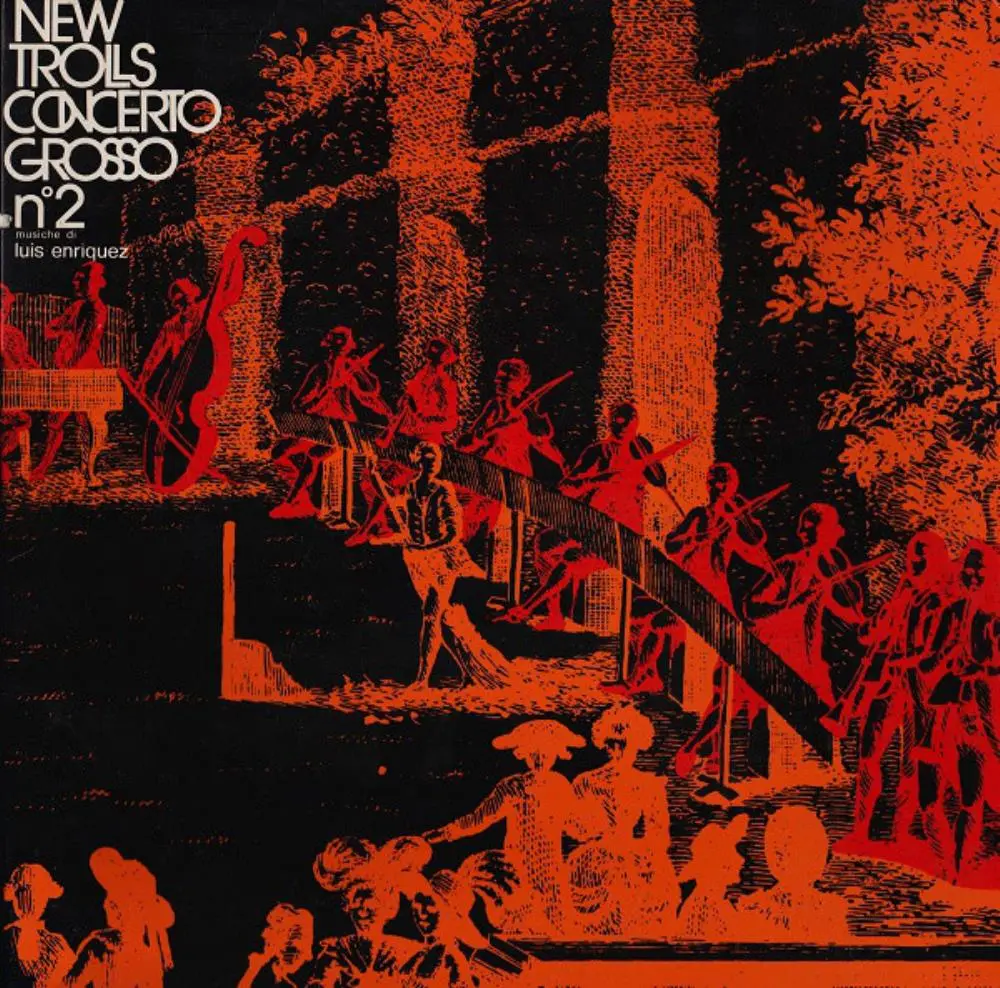 New Trolls released their seventh album, Concerto Grosso n°2, in 1976 on Magma.
Discography:
- Senza orario senza bandiera (1968)
- Concerto grosso per i New Trolls (OST, 1971)
- Searching for a Land (1972)
- UT (1972)
- N.T. Atomic System (1973 • New Trolls Atomic System)
- Tempi dispari (1974)
- Concerto Grosso n°2 (1976)
- Live (1976)
- Aldebaran (1978)
- New Trolls (1979)
- FS (1981)
- America O.K. (1983)
Sources:
- Discogs: New Trolls
- 45cat: New Trolls
- MusicBrainz: New Trolls
- RYM: New Trolls
- ProgArchives: New Trolls
- ItalianProg: New Trolls
Artist/Album Pages:
Hedzoleh Soundz was a Ghanaian highlife/Afrobeat band that debuted as a backing act to South African...
Alamo was an American hard-rock band from Memphis that released a 1971 album on Atlantic. Membe...
Paul Brett's Sage were an English folk-rock band that released a 1970 self-titled album on Pye, fo...
Rocky's Filj was an Italian jazz-rock band that released the 1973 Ricordi album Storie di Uomini e...
Blood, Sweat & Tears were an American brass-rock/soul band from N.Y.C., formed in 1967 by Blue...
Herbana — aka Nicoletta Bozzai — is an Italian library musician who released two albums on Piero U...
Il Balletto di Bronzo was an Italian symphonic/psych band that released the 1970 album Sirio 2222,...
Sun was an Australian jazz-rock-soul band from Sydney that released the album Sun 1972 on RCA Victor...
String Driven Thing was a British folk-rock band, originally formed in Scotland as a harmony combo...
Thrice Mice was a German classical/jazz-rock band that released a 1970 self-titled album on Philip...
Howard Riley (born Feb. 16, 1943) is an English jazz pianist and composer from Huddersfield, West ...
Richard Clapton is an Australian singer-songwriter who debuted with the 1973 Infinity album Prussi...