

Michael Fennelly (born May 4, 1949) is an American singer, guitarist, and songwriter who released the 1973 Epic album Lane Changer, followed by the 1975 Mercury release Stranger’s Bed.
Background
Michael Fennelly was born on May 4, 1949, in New York City. He grew up in Pennsylvania and Westfield, New Jersey, where he attended high school after early guitar lessons. At seventeen, Fennelly hitchhiked to Los Angeles and performed in local clubs. By 1967, Fennelly had a publishing deal with Curt Boettcher’s Mee Moo Music and a place in the Association producer’s studio circle. Sagittarius used Fennelly on electric sitar and vocals for Present Tense. The Millennium placed him among five singer-guitarist-songwriters for Begin, with Joey Stec as a collaborator in the Boettcher network.
Drummer Phil Jones brought Fennelly into Stonehenge after an encounter at Thee Experience on the Sunset Strip. Fennelly led the renamed Crabby Appleton as singer-guitarist and principal songwriter under Elektra. Don Gallucci produced the 1970 debut Crabby Appleton, where the band reached No. 36 on the Billboard Hot 100 with “Go Back.” A 1971 second Elektra album, Rotten to the Core, preceded the band’s breakup.
Fennelly added background vocals to the 1973 Steely Dan album Countdown to Ecstasy. He also played guitar on 1974 Ray Manzarek albums The Golden Scarab and The Whole Thing Started With Rock and Roll Now It’s Out of Control. Epic picked up Fennelly’s post-Crabby Appleton demos and sent him to London for sessions with producer Chris White.
Lane Changer
 Michael Fennelly released his debut album, Lane Changer, in March 1974 on Epic.
Lane Changer contains eleven Fennelly originals. The sessions link Fennelly with Crabby Appleton keyboardist Casey Foutz and the Argent circle around producer Chris White. Argent bassist Jim Rodford and drummer Robert Henrit play on seven titles. Bassist Dave Wintour appears on three titles; drummers Henry Spinetti and Mike Giles cover the remaining rhythm credits.
Trumpeter Mike Cotton and trombonist John Beacham join reed player Alan Holmes on “Touch My Soul” and “Over My Dead Body.” Gaspar Lewel adds percussion to “Won’t You Please Do That” and “Flyer”; soprano saxophonist Nick Newall joins “Flyer.” Jeff Beck adds lead guitar to “Watch Yerself.”
“Lane Changer” careens through busy, slippery turns, with Fennelly’s high singing bound to wiry fretwork. “Touch My Soul” slows around gentle Fennelly singing, gospel-tinted swell, and folk-contoured lyric flow. “Won’t You Please Do That” charges through explosive rhythm, hypnotic leads, and group replies. “Over My Dead Body” sways through 3/4 meter. “Dark Night” withdraws to up-front Fennelly singing, simple bass motion, and Mini-Moog flourishes. “Easy To Love” settles into acoustic strum and exposed Fennelly phrasing.
“Shine a Light” cruises at mid-tempo with a short solo break and breathless lead singing. “Bad Times” stamps from a long intro into heavy boogie motion and blazing guitar. “Watch Yourself” darts around Jeff Beck’s lead break and Fennelly’s intricate rhythm part. “Give Me Your Money” feints with syncopated keys and torch-song hush, blasts into fast boogie, then drops back to slower dark tones.
A1. “Lane Changer” (2:34)
A2. “Touch My Soul” (4:03)
A3. “Won’t You Please Do That” (3:14)
A4. “Over My Dead Body” (2:36)
A5. “Dark Night” (4:25)
A6. “Easy to Love” (3:03)
B1. “Shine a Light” (3:02)
B2. “Bad Times” (5:54)
B3. “Flyer” (2:51)
B4. “Watch Yerself” (3:29)
B5. “Give Me Your Money” (4:03)
Sessions occurred at CBS Studios in London with producer Chris White and engineer Mike Ross. White held adjacent producer credits on 1973/74 Argent albums In Deep and Nexus. Epic art director Ron Coro oversaw a package with drawings and design by John Van Hamersveld and photography by Peter Read Miller. The front cover shows a monochrome line portrait of Fennelly with the nameplate and title in the upper-right corner.
Epic lifted “Shine a Light” as a May 1974 US single (b/w “Easy to Love”). In August 1974, “Touch My Soul” followed as a US single (b/w “Flyer”). Epic also issued “Lane Changer” in Britain as an April 1974 single (b/w “Over My Dead Body”). “Touch My Soul” received a July 1974 UK issue (b/w “Easy to Love”).
Stranger’s Bed
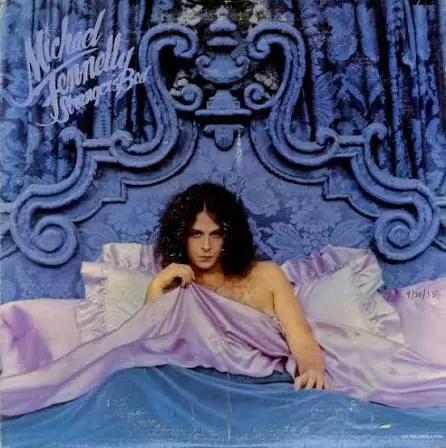 Michael Fennelly released his second album, Stranger’s Bed, in September 1975 on Mercury.
Stranger’s Bed contains ten Fennelly songs across nine indexed tracks; “Pretty Face/Hard Bargain Driver” joins two titles in the opening sequence. Fennelly assembled a compact Los Angeles band with guitarist Brian Page, bassist Dave Catron, and drummer-percussionist Dana Green.
“Pretty Face/Hard Bargain Driver” barrels through a two-part opening surge, with Fennelly’s singing above hard riff figures. “Turn To Me” charges through electronic streaks, amplified riffs, and pleading Fennelly phrasing inside a taut arrangement. “Sweet Pain” smolders through slow heavy motion and dark guitar tone.
A1. “Pretty Face/Hard Bargain Driver” (5:46)
A2. “Tomorrow’s Star” (2:10)
A3. “Only a Child” (3:41)
A4. “Stranger’s Bed” (3:20)
A5. “Dreamer” (6:02)
B1. “Turn to Me” (2:58)
B2. “Sweet Pain” (8:35)
B3. “Sad Dream of Louise” (4:39)
B4. “The Day of the Fire” (5:14)
Sessions occurred at Sound City in Los Angeles with producer Denny Bruce and engineer Keith Olsen. Bruce produced Stranger’s Bed amid 1974/75 producer credits for Leo Kottke albums Ice Water, Dreams and All That Stuff, and Chewing Pine. Olsen engineered the album during the year of his production and engineering credit on the self-titled Fleetwood Mac album. The front cover shows Fennelly centered on an ornate canopied bed against a blue field.
Mercury lifted “Turn to Me” as a November 1975 US single (b/w “Only a Child”). In the Netherlands, Mercury issued “Sad Dreams of Louise” as a 1975 single (b/w “Stranger’s Bed”).
Postlude
After Mercury, Fennelly shifted to band work and demo projects. In the early 1980s, he fronted Big Shot, which produced demo recordings. He continued to compose songs and perform with bands until the end of the Eighties. Fennelly retired from music in 1989 and moved to Oregon, where he worked in nonprofit fundraising.
In 2013, Fennelly’s Boettcher-era recordings appeared with Crabby Appleton leftovers on Love Can Change Everything: Demos 1967-1972, a 24-track disc on Sundazed Records.
Discography:
- Lane Changer (1973)
- Stranger’s Bed (1975)
Sources:
- Discogs: Michael Fennelly
- RYM: Michael Fennelly
- 45cat: Michael Fennelly
- MusicBrainz: Michael Fennelly
Artist/Album Pages:
Earth and Fire was a Dutch symphonic art-rock band that released eight albums and numerous singles...
Fábio is a Paraguayan-Brazilian singer/songwriter who released several shortplayers and a self-tit...
Writing On the Wall was a Scottish post-psych band that released a standalone single and the album...
My Ship was a Danish post-psych band behind the 1972 album Morning Song on BASF. Members: Bent ...
Titanic was a Norwegian hard-rock band that released four albums on CBS between 1970 and 1975, fol...
Marva Whitney (May 1, 1944 — December 22, 2012) was an American soul singer who toured with the J...
Nara Leão (January 19, 1942 — June 7, 1989) was a Brazilian singer and actress who carried Rio bos...
Jacques Thollot (October 9, 1946 — Oct. 2, 2014) was a French keyboardist, percussionist, and comp...
Solar Plexus was an American jazz-rock band that released the 1975/76 albums Solar Plexus and Voic...
Bachdenkel was an English post-psych band based in France. In 1970, they recorded Lemmings, which ...
Nancy Wilson (Feb. 20, 1937 — Dec. 13, 2018) was an American soul and jazz singer who released thi...
Ambrosia is an American rock band that released the 1975–76 20th Century albums Ambrosia and Somew...