

Megadeth are an American metal band from Los Angeles that Dave Mustaine formed in 1983 after his exit from Metallica. The group debuted with Killing Is My Business… And Business Is Good! on Combat in 1985 and began its Capitol run one year later with Peace Sells… But Who’s Buying? They carried that run through So Far, So Good… So What!, Rust in Peace, Countdown to Extinction, Youthanasia, Cryptic Writings, and Risk.
Bassist David Ellefson remained Mustaine’s main foil across those years, while Chris Poland, Gar Samuelson, Jeff Young, Chuck Behler, Marty Friedman, and Nick Menza marked key lineup phases. The catalog charts a long stretch of lineup change, label stability, and steady output from 1985 through 1999.
Members: Dave Mustaine (guitar, vocals), David Ellefson (bass, 1983-2002, 2010-present), Greg Handevidt (guitar, 1983-84), Dijon Carruthers (drums, 1983), Lee Rausch (drums, 1984), Gar Samuelson (drums, 1984-87), Chris Poland (guitar, 1984-87), Chuck Behler (drums, 1987-88), Jeff Young (guitar, 1987-88), Nick Menza (drums, 1989-98), Marty Friedman (guitar, 1990-99)
Background
Dave Mustaine entered the Los Angeles metal circuit through Panic, the first band he treated as a working unit. That group gave him early writing stock, including “Jump in the Fire” and the riff that became “Mechanix,” before Panic collapsed during 1981. Metallica then brought him in as lead guitarist, but the band dismissed him in April 1983 during its New York run. On the bus ride back to California, Mustaine lifted the term “megadeath” from a political handbill and turned it into the name for his next band.
Back in Hollywood, Mustaine first assembled a short-lived group called Fallen Angels, then linked with bassist David Ellefson after hearing him rehearse in the apartment below. Ellefson had arrived from Jackson, Minnesota, and guitarist Greg Handevidt joined the new group at the outset. Drummer Dijon Carruthers completed the first lineup, with singer Lor Kane in the earliest version. Kane left within weeks, Mustaine took the vocal role in December 1983, and Megadeth played its first show at Ruthie’s Inn in Berkeley on February 17, 1984, with Kerry King filling the second-guitar spot for the first five dates.
A three-song demo with drummer Lee Rauch followed later in 1984. Gar Samuelson then replaced Rauch, guitarist Chris Poland entered that December, and Combat signed the band in November. Poland and Samuelson came in from Dunkirk, New York, which gave Mustaine and Ellefson the four-man unit that carried Megadeth into its first album cycle.
Killing Is My Business… And Business Is Good!
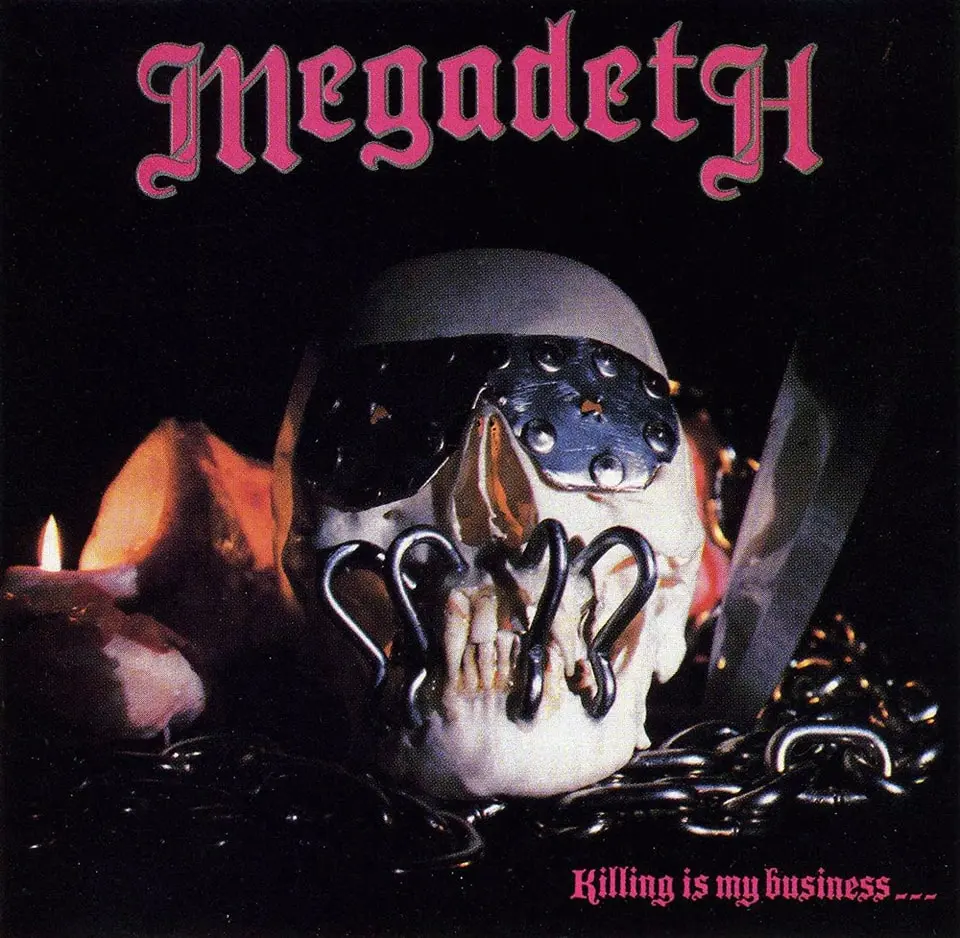 Megadeth released their debut album, Killing Is My Business… And Business Is Good!, on May 17, 1985, on Music for Nations in the UK and on June 12, 1985, on Combat in the US.
Fast-picked riffs, clipped rhythmic turns, and abrupt sectional breaks drive the album from end to end. Guitarist Chris Poland answers Dave Mustaine with coiled lead runs, tight harmony lines, and quick solo exchanges, while bassist David Ellefson and drummer Gar Samuelson lock the backbeat under constant accents, hard stops, and sudden bursts of speed. Mustaine wrote seven of the eight tracks; A4 carries Lee Hazlewood’s song with Mustaine’s altered lyric sheet.
“Last Rites/Loved to Death” opens with piano before the band cuts into a violent love-song setup. The title track takes its spark from the Punisher but follows a hired killer, “The Skull Beneath the Skin” ties torture imagery to black magic and Vic Rattlehead’s origin, and “Rattlehead” serves as a salute to the mascot and the crowd. “Looking Down the Cross” began in 1983 as “Speak No Evil” and sets Christ before crucifixion through religious imagery, “Chosen Ones” pulls part of its idea from Tim the Enchanter, and “Mechanix” carries Mustaine’s pre-Metallica song in its original Megadeth form. A4, “These Boots,” recasts Nancy Sinatra’s hit at higher speed and later drew Lee Hazlewood’s objection over Mustaine’s rewritten words.
A1. “Last Rites/Loved to Death” (4:38) — Mustaine
A2. “Killing Is My Business… And Business Is Good!” (3:05) — Mustaine
A3. “The Skull Beneath the Skin” (3:46) — Mustaine
A4. “These Boots” (3:44) — Lee Hazlewood; altered lyrics Dave Mustaine
B1. “Rattlehead” (3:42) — Mustaine
B2. “Chosen Ones” (2:54) — Mustaine
B3. “Looking Down the Cross” (5:01) — Mustaine
B4. “Mechanix” (4:20) — Mustaine
Megadeth recorded Killing Is My Business… And Business Is Good! at Indigo Ranch in Malibu and at Crystal Sound Labs in Hollywood during December 1984 and January 1985 with producers Dave Mustaine and Karat Faye. The original issue credits Mustaine on guitars, vocals, and the opening piano passage, Poland on guitars, Ellefson on bass and backing vocals, and Samuelson on drums, with timpani on “Rattlehead.”
Combat used an improvised cover that replaced Mustaine’s intended Vic Rattlehead design, which had drawn on the three wise monkeys image and had already appeared in painted form on early Megadeth merchandise. Loud recut the package on February 5, 2002 with Michael Mueller’s redesign from Mustaine’s 1985 sketches, restored “These Boots” in censored form, and added the 1984 demos; Legacy followed on June 8, 2018 with The Final Kill, new mixes, live material, and a new “These Boots” version that restored Hazlewood’s original lyric sheet.
Peace Sells… But Who’s Buying?
 Megadeth released their second album, Peace Sells… But Who’s Buying?, in September 1986 on Capitol.
The album hardens the band’s attack through tighter riff chains, sharper breaks, and a more exact sense of dynamic control than the debut. Guitarist Chris Poland cuts across Dave Mustaine’s rhythm figures with quick lead replies, long solo arcs, and clipped harmony runs, while bassist David Ellefson and drummer Gar Samuelson anchor the backbeat under sudden accents, off-center stops, and rapid directional shifts. Mustaine wrote seven of the eight tracks; B3 carries Willie Dixon’s song.
“Wake Up Dead” sets a cheating narrative inside a furtive domestic setup, “The Conjuring” and “Bad Omen” draw on black-magic and occult imagery, and the title track channels Mustaine’s political and social distrust through the album’s best-known refrain. “Devils Island” places a condemned prisoner in the French Guiana penal colony, “Good Mourning/Black Friday” opens with an instrumental prelude before a serial-killer scenario takes over, and “My Last Words” turns on Russian roulette and fear. “I Ain’t Superstitious” lifts Willie Dixon’s 1961 song into the band’s own arrangement, and “Peace Sells” surges into a faster second half with extra guitar breaks and a high harmony over the refrain.
A1. “Wake Up Dead” (3:40)
A2. “The Conjuring” (5:04)
A3. “Peace Sells” (4:04)
A4. “Devils Island” (5:05)
B1. “Good Mourning/Black Friday” (6:41)
B2. “Bad Omen” (4:05)
B3. “I Ain’t Superstitious” (2:46) — Willie Dixon
B4. “My Last Words” (4:57)
Megadeth recorded Peace Sells… But Who’s Buying? at Music Grinder, Track Record, Rock Steady, and Maddog during February and March 1986 with co-producer Randy Burns and engineers Burns and Casey McMackin. Capitol bought the album from Combat after the sessions and brought in Paul Lani for the final mix, with Stan Katayama also credited on mixing.
Ed Repka designed the sleeve from a Dave Mustaine and Andy Somers concept and placed Vic Rattlehead in front of a ruined United Nations headquarters, posed as a real-estate salesman over the wreckage. Mustaine remixed and remastered the album in 2004, and Capitol expanded it again for the 25th-anniversary edition in 2011.
Capitol issued “Wake Up Dead” as the lead single in 1986. The UK 7-inch paired it with “Good Mourning/Black Friday,” and the song reached No. 65 on the UK Singles chart. Its video, directed by Penelope Spheeris, places the band inside a fenced stage while the crowd surges the barrier.
“Peace Sells” appeared as a promotional single in November 1986. The track gave Megadeth their first video, and its opening bass line later served as the intro for MTV News. The album itself reached No. 76 on the Billboard 200.
So Far, So Good… So What!
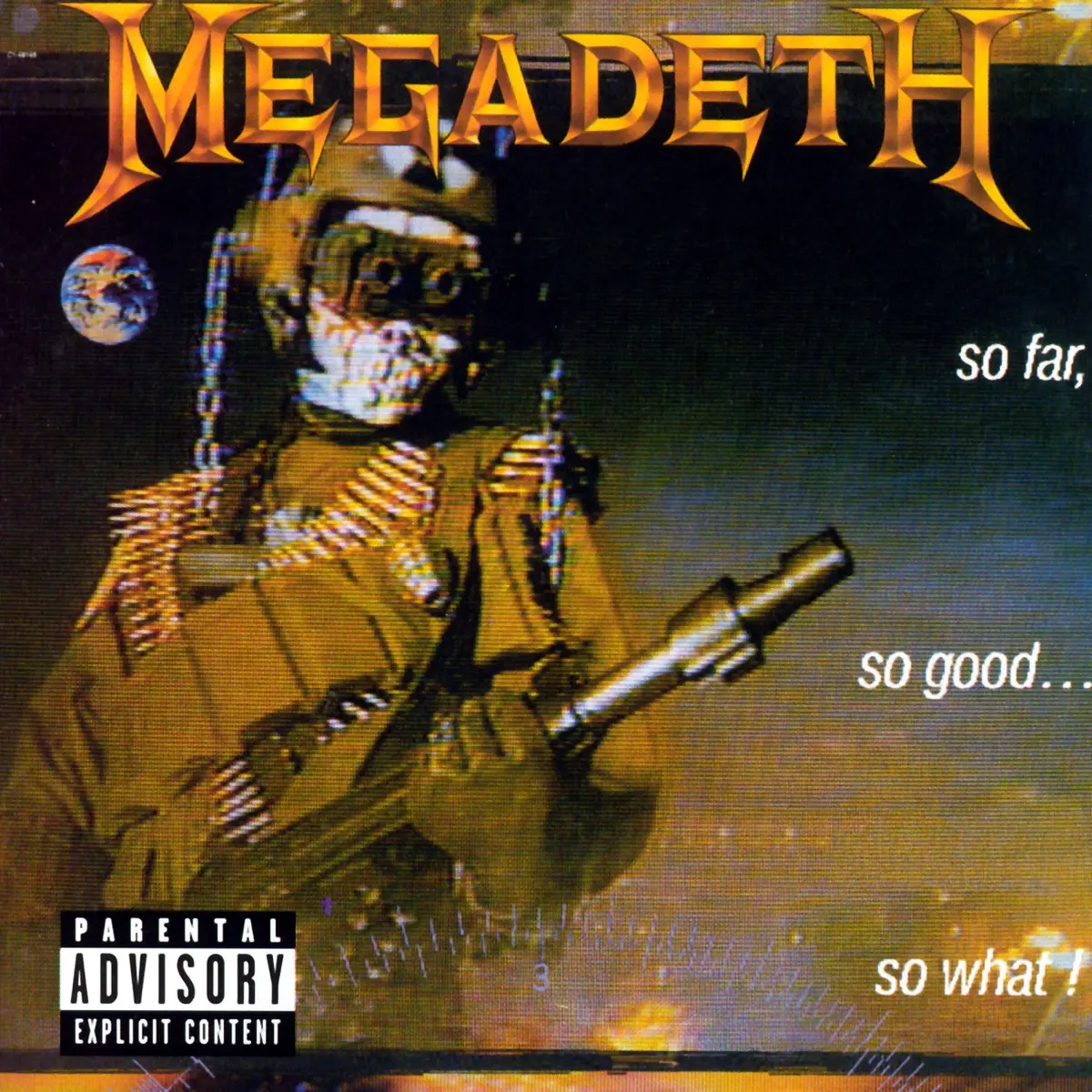 Megadeth released their third album, So Far, So Good… So What!, on January 19, 1988, on Capitol.
Rapid downstrokes, clipped rhythmic pivots, and abrupt sectional breaks shape the record from front to back. Guitarist Jeff Young threads quick lead replies and long solo lines through Dave Mustaine’s riff chains, while bassist David Ellefson and drummer Chuck Behler hold the backbeat under hard stops, sudden accents, and fast directional shifts. Mustaine wrote the album’s core material, and Ellefson shared lyric or music credit on half the set, the first time another Megadeth member entered the writing sheet on that scale.
“Into the Lungs of Hell” opens the side with an instrumental built from synthesized horns, winds, and percussion before “Set the World Afire” cuts in with lyrics Mustaine began on the bus ride home after his Metallica dismissal and a taped fragment of the Ink Spots’ “I Don’t Want to Set the World on Fire.” “Mary Jane” draws on the Loon Lake burial legend and enters with a spoken invocation before descending guitar figures take over, “502” ties its title to the California drunk-driving code and a fast-car chase, and “Liar” turns its attack toward Chris Poland. “In My Darkest Hour” came together in one sitting after Mustaine learned of Cliff Burton’s death and channels isolation through one of the album’s longest structures, while “Hook in Mouth” aims its language at censorship and the PMRC.
A1. “Into the Lungs of Hell” (3:29) — Mustaine
A2. “Set the World Afire” (5:48) — Mustaine
A3. “Anarchy in the U.K.” (3:00) — Rotten, Jones, Matlock, Cook
A4. “Mary Jane” (4:25) — Mustaine, Ellefson
B1. “502” (3:28) — Mustaine
B2. “In My Darkest Hour” (6:16) — Mustaine, Ellefson
B3. “Liar” (3:20) — Mustaine, Ellefson
B4. “Hook in Mouth” (4:40) — Mustaine, Ellefson
Megadeth recorded So Far, So Good… So What! at Music Grinder in Los Angeles during 1987 with co-producer Paul Lani and engineer Lani, assisted by Matt Freeman. Work began while Jay Reynolds still occupied the second-guitar slot, continued after Jeff Young entered the band, and ended with Michael Wagener’s final mix after Mustaine dismissed Lani during post-production. Steve Jones added a guest guitar part to “Anarchy in the U.K.”
“Hook in Mouth” appeared as a promotional single on January 11, 1988, eight days before the LP reached stores. Capitol used the track to introduce the album’s censorship theme at the start of the campaign.
“Anarchy in the U.K.” became the next single on February 17, 1988. UK 7-inch copies paired it with “Liar,” UK 12-inch copies added “502,” and the single reached No. 45 in the UK and No. 13 in New Zealand.
On May 12, 1988, “Mary Jane” became the second single from the album. The 7-inch paired it with “Hook in Mouth,” and 12-inch copies added “My Last Words.”
“In My Darkest Hour” appeared as a promotional single on June 17, 1988. The song also closed The Decline of Western Civilization Part II: The Metal Years and received a video through that film tie-in. So Far, So Good… So What! reached No. 28 on the Billboard 200 and later earned platinum certification in the US.
Rust in Peace
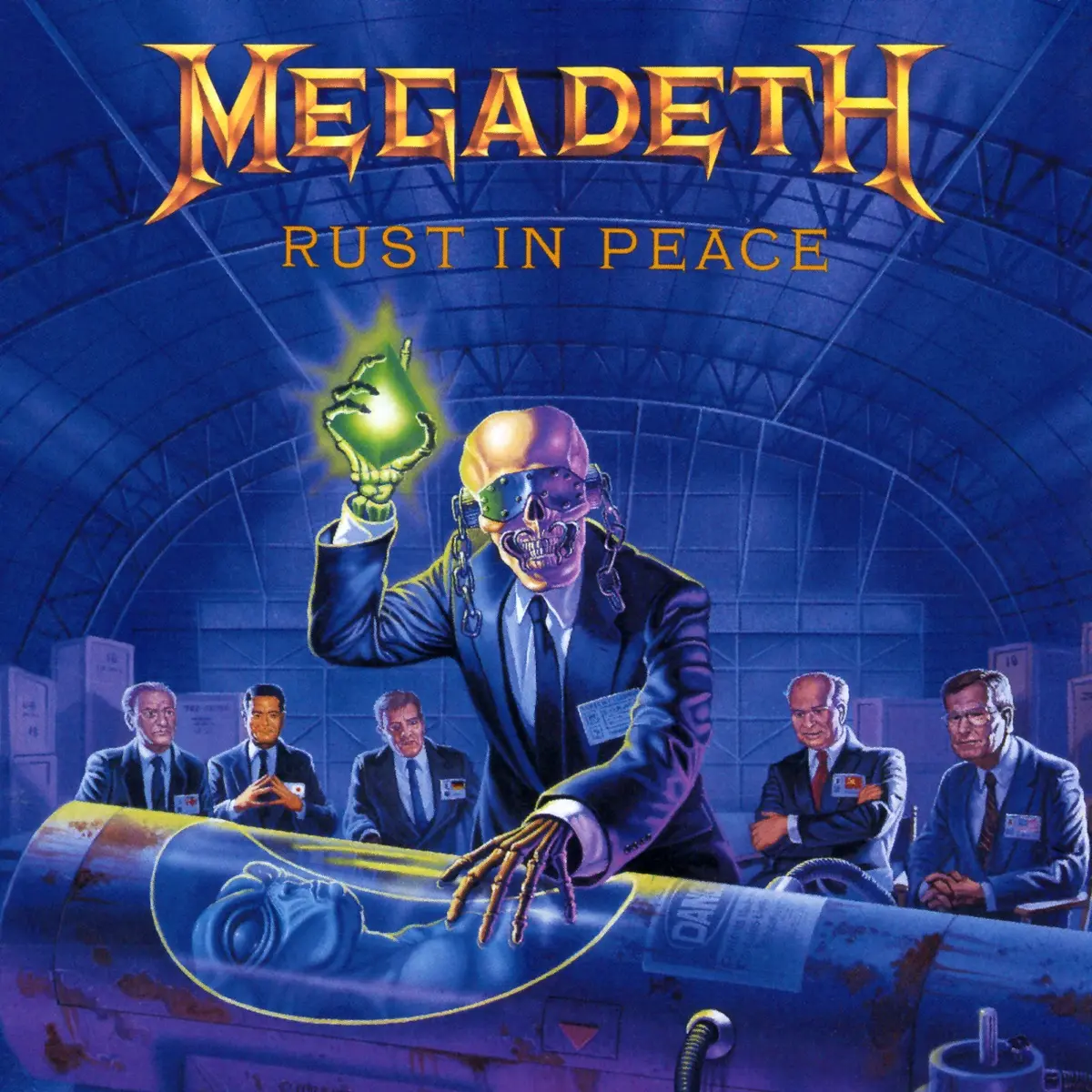 Megadeth released their fourth album, Rust in Peace, on September 24, 1990, on Capitol.
Knife-edged riff chains, rapid directional turns, and long solo passages give the album a more exact, high-wire design than the earlier records. Guitarist Marty Friedman cuts through Dave Mustaine’s rhythm figures with fluid lead lines, mirrored runs, and extended solo tradeoffs, while bassist David Ellefson and drummer Nick Menza lock the backbeat into brisk snaps, sudden halts, and hard resets. Mustaine wrote six tracks and shared three with Ellefson.
“Holy Wars… The Punishment Due” opens with a headlong first section, breaks at 2:26 through Friedman’s acoustic bridge, then drops into the slower “Punishment Due” passage before the tempo surges again. “Hangar 18” follows with a UFO-conspiracy narrative and a long run of twin guitar solos after the verse, while “Rust in Peace… Polaris” closes on nuclear-war imagery tied to the Cold War missile system in the title. “Poison Was the Cure” also carries older material that the band had worked since the Peace Sells… But Who’s Buying? period before refining it for this record.
A1. “Holy Wars… The Punishment Due” (6:36) — Mustaine
A2. “Hangar 18” (5:14) — Mustaine
A3. “Take No Prisoners” (3:28) — Mustaine
A4. “Five Magics” (5:42) — Mustaine
B1. “Poison Was the Cure” (2:58) — Mustaine
B2. “Lucretia” (3:58) — Mustaine, Ellefson
B3. “Tornado of Souls” (5:22) — Mustaine, Ellefson
B4. “Dawn Patrol” (1:50) — Mustaine, Ellefson
B5. “Rust in Peace… Polaris” (5:36) — Mustaine
Megadeth recorded Rust in Peace at Rumbo Recorders in Canoga Park during 1989 and 1990 with co-producer Mike Clink and recording engineer Micajah Ryan. Max Norman handled the final mix, and Mustaine completed much of the guitar and vocal work with Ryan after Clink left to resume other commitments.
Ed Repka drew the sleeve from Mustaine’s concept and returned Vic Rattlehead to the front cover. The art ties to “Hangar 18” and places him before an alien body under the gaze of Toshiki Kaifu, Richard von Weizsäcker, Mikhail Gorbachev, George H. W. Bush, and an unidentified British representative.
On September 23, 1990, “Holy Wars… The Punishment Due” became the lead single. The 7-inch paired it with “Lucretia,” while 12-inch and CD formats added an edited Dave Mustaine interview. The single reached No. 24 in the UK.
“Hangar 18” appeared as the second single on February 4, 1991. The US CD paired an AOR edit and LP version with live takes of “The Conjuring” and “Hook in Mouth” from Wembley Arena, while the UK 12-inch added a live “Hangar 18.” The single reached No. 26 in the UK and No. 25 in Ireland. Paul Stephen Boyington’s video places the band and captured aliens inside a cryogenic torture setting. Rust in Peace reached No. 8 in the UK and later earned platinum certification in the US.
Countdown to Extinction
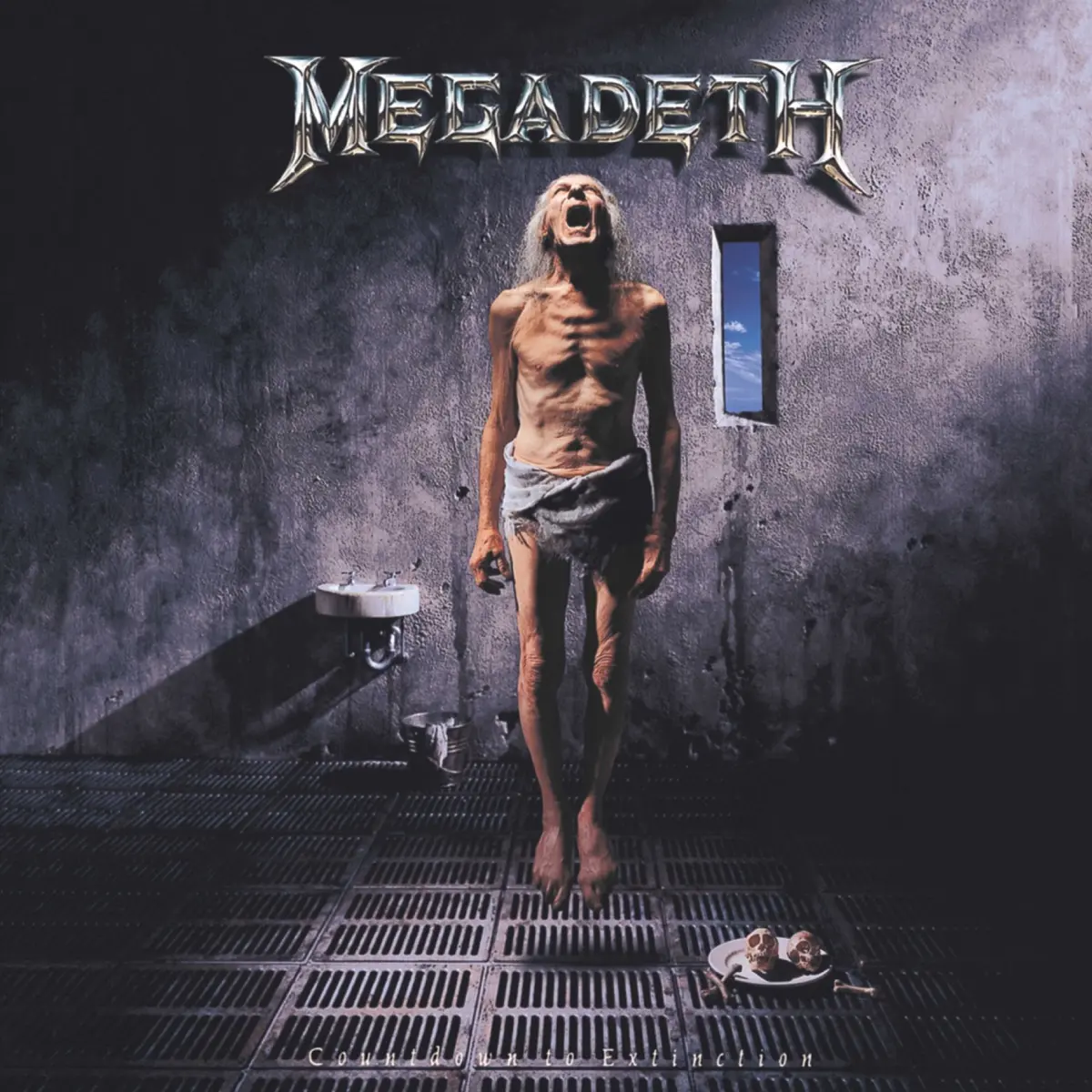 Megadeth released their fifth album, Countdown to Extinction, on July 14, 1992, on Capitol.
Lower-tempo riff patterns, blunt choruses, and broader spaces between the breaks give the record a heavier, more deliberate pull. Guitarist Marty Friedman threads fluid lead lines, mirrored figures, and long solo arcs through Dave Mustaine’s rhythm lattice, while bassist David Ellefson and drummer Nick Menza hold the underpin through hard snaps, locked accents, and clipped halts. All four members entered the writing sheet.
“Skin o’ My Teeth” opens on self-destruction imagery, “Symphony of Destruction” turns political control into a puppet-state scenario, and “Foreclosure of a Dream” ties debt, taxation, and social strain to the wreckage of the American promise. “Sweating Bullets” stages Mustaine’s inner dialogue as a paranoid split, the title track attacks trophy hunting and environmental ruin, “High Speed Dirt” draws on skydiving, “Psychotron” takes its cue from Deathlok, “Captive Honour” enters prison abuse, and “Ashes in Your Mouth” closes on war’s aftermath.
A1. “Skin o’ My Teeth” (3:14) — Mustaine
A2. “Symphony of Destruction” (4:02) — Mustaine
A3. “Architecture of Aggression” (3:34) — Mustaine, Ellefson
A4. “Foreclosure of a Dream” (4:17) — Mustaine, Ellefson
A5. “Sweating Bullets” (5:03) — Mustaine
A6. “This Was My Life” (3:42) — Mustaine
B1. “Countdown to Extinction” (4:16) — Mustaine, Menza, Ellefson, Friedman
B2. “High Speed Dirt” (4:12) — Mustaine, Ellefson
B3. “Psychotron” (4:42) — Mustaine
B4. “Captive Honour” (4:14) — Mustaine, Ellefson, Menza
B5. “Ashes in Your Mouth” (6:10) — Mustaine, Menza, Ellefson, Friedman
Megadeth recorded Countdown to Extinction at The Enterprise in Burbank from January 6 to April 28, 1992 with co-producer Max Norman, engineer Fred Kelly Jr., and additional engineer Micajah Ryan. Norman and Kelly handled the final mix.
Hugh Syme handled art direction and design. Tommy Steele supplied creative direction, Cameron Wong photographed the cover elements, Chris Cufarro shot the band, and John Taylor Dismukes rendered the logo.
Capitol issued “Symphony of Destruction” as the lead single on July 21, 1992 on CD, cassette, 12-inch, and limited 7-inch formats. US and UK CD copies paired it with “Breakpoint” and “Go to Hell,” while the limited UK 7-inch used a live “In My Darkest Hour.” Wayne Isham’s video cuts between band performance and a black-and-white political-assassination sequence that MTV later edited. The single reached No. 15 in the UK and No. 71 on the Billboard Hot 100.
“Foreclosure of a Dream” appeared as the second single on October 13, 1992. CD editions paired it with a live “Skin o’ My Teeth,” and some pressings added the edit or the “Symphony of Destruction” Gristle mix.
On February 16, 1993, “Sweating Bullets” became the third single from the album. Capitol issued it in multiple CD, vinyl, and cassette configurations with live 1992 material or edited versions on various editions. Wayne Isham’s video traps Mustaine in a room full of his own doubles and places the rest of the band in cells. The single reached No. 27 on US Mainstream Rock and No. 26 in the UK.
Capitol closed the run with “Skin o’ My Teeth” on April 12, 1993. UK formats tied the single to a Megadeth board-game promotion and paired the title cut with the General Schwarzkopf mix of “Holy Wars… The Punishment Due,” plus live “High Speed Dirt,” “Lucretia,” and “Skin o’ My Teeth” on expanded editions. The single reached No. 13 in the UK and No. 11 in Ireland. Countdown to Extinction reached No. 2 on the Billboard 200 and No. 5 on the UK Albums Chart, drew a Best Metal Performance nomination at the 1993 Grammy Awards, and the title track later won a Genesis Award from the Humane Society.
Discography:
- Killing Is My Business… And Business Is Good! (1985)
- Peace Sells… But Who’s Buying? (1986)
- So Far, So Good… So What! (1988)
- Rust in Peace (1990)
- Countdown to Extinction (1992)
Sources:
Artist/Album Pages:
Cocteau Twins were a Scottish goth/dream-pop trio that was active for 16 years, starting in 1981. ...
Loose Tubes were an English 21-piece jazz cooperative during the 1984–90 span. In 1988, Editions E...
Fly by Night was an American progressive hard-rock band from Pennsylvania that released the 1980 ...
Full Moon was an American hard-rock band from central Pennylvania that released a 1980 self-title...
Edgewood was an American hard-rock/psych band from Memphis that released the 1972 album Ship of L...
Neuronium are a Spanish electronic combo from Barcelona, formed in 1976 by keyboardist Michel Huyg...
Chris Eaton (born Sept. 16, 1958) is an English musician and songwriter from Sedgley, Staffordshir...
IQ are an English symphonic-rock band that released the 1983 album Tales From the Lush Attic on Th...
Leyden Zar was a Québécois modern-rock band behind a 1981 album on A&M, followed by a second s...
Toshiki Kadomatsu — 角松敏生 (born Aug. 12, 1960) — is a Japanese soul-pop musician and songwriter who...
Claire Hamill is an English singer–songwriter who debuted at seventeen with the 1971 Island releas...
Orkiestra Ósmego Dnia was a Polish experimental folk and chamber-music ensemble from Poznań, activ...