

Metallica is an American metal band that spearheaded the US thrash scene with the 1983–84 albums Kill ‘Em All and Ride the Lightning. They shot to fame with their 1986 Elektra release Master of Puppets and its 1988 two-record followup …And Justice for All.
Members: Lars Ulrich (drums), James Hetfield (guitar, vocals), Hugh Tanner (guitar, 1981), Lloyd Grant (guitar, 1981), Ron McGovney (bass, 1981-82), Dave Mustaine (guitar, 1982-83), Cliff Burton (bass, 1982-86), Kirk Hammett (guitar, 1983-present), Jason Newsted (bass, 1986-2001), Robert Trujillo (bass, 2003-present)
Background
Metallica formed in Los Angeles in late October 1981 after Danish-born drummer Lars Ulrich (b. December 26, 1963, Gentofte) placed an ad in The Recycler seeking musicians influenced by Diamond Head and Iron Maiden. James Hetfield (b. August 3, 1963, Downey), a local guitarist and vocalist, answered the ad with his then-bandmate Hugh Tanner of Leather Charm. Ulrich, who had recently moved to Newport Beach after failing to qualify for his high school tennis team, had turned his focus to drumming after early inspiration from a 1973 Deep Purple concert and subsequent obsession with the New Wave of British Heavy Metal. Hetfield, who came from a family of Christian Scientists and lost his mother to cancer in 1980, had played in garage bands like Obsession, Phantom Lord, and Leather Charm, where he began writing songs and covering NWOBHM acts.
Although Ulrich initially had no band, he secured a spot on the upcoming Metal Massacre compilation through Metal Blade founder Brian Slagel. He convinced Hetfield to record a track, leading to the band’s official formation on October 28, 1981. Ulrich named the group Metallica, a title he commandeered from friend Ron Quintana, who was considering it for a fanzine. Early 1982 saw the arrival of guitarist Dave Mustaine (b. September 13, 1961, La Mesa), who had played in the band Panic and impressed Ulrich and Hetfield with his gear and technique. The band solidified with bassist Ron McGovney (b. November 2, 1963), Hetfield’s childhood friend and bandmate from Leather Charm.
Metallica made their live debut on March 14, 1982, at Radio City in Anaheim. They soon opened for Saxon on the LA leg of the British band’s U.S. tour. During 1982, the band rehearsed extensively in McGovney’s family garage, circulated early demos—including Power Metal and No Life ‘Til Leather—and gained traction in the local metal scene. Their first recorded track, “Hit the Lights,” appeared on Metal Massacre Vol. 1, mistakenly credited to “Mettallica.” Internal tensions eventually led to McGovney’s departure by the end of the year, paving the way for a more stable and ambitious phase of the band’s development.
No Life ’til Leather
In 1982, Metallica cut No Life ’til Leather, a one-sided cassette demo EP with seven songs.
In early 1982, Metallica began self-producing a series of rough demo tapes from Ron McGovney’s garage in Los Angeles. The first, a basic “Whiskey Audition Tape” recorded in March, featured covers and secured the band a high-profile opening slot for Saxon at the Whisky a Go Go on March 27. Over the next few months, they refined their lineup and material with successive demos: Ron McGovney’s ’82 Garage Demo, Power Metal (April), and the pivotal No Life ’til Leather (July), a seven-track cassette that circulated widely on the tape-trading underground and drew early attention from industry insiders.
At this stage, Metallica comprised James Hetfield, Lars Ulrich, lead guitarist Dave Mustaine, and bassist Ron McGovney. After a brief attempt to add a second guitarist—Brad Parker briefly played a single April gig—Hetfield took up rhythm guitar duties full-time in May. By mid-1982, Mustaine’s “The Mechanix” and Hetfield’s “Motorbreath” expanded their set of originals. The No Life ’til Leather demo, which included early versions of “Hit the Lights,” “Seek & Destroy,” and “Jump in the Fire,” showcased the band’s fast-evolving songwriting.
A1. “Hit the Lights” (4:22)
A2. “The Mechanics” (4:29)
A3. “Motorbreath” (3:19)
A4. “Seek & Destroy” (4:59)
A5. “Metal Militia” (5:19)
A6. “Jump In the Fire” (3:52)
A7. “Phantom Lord” (3:35)
Dissatisfied with McGovney’s lack of creative input, Hetfield and Ulrich sought a replacement. They discovered bassist Cliff Burton (b. February 10, 1962) at a Trauma show at the Whisky in late 1982, captivated by his use of wah-wah pedal and unorthodox stage presence. Burton agreed to join on the condition that the band relocate to the San Francisco Bay Area. By early 1983, Metallica had moved to El Cerrito and began rehearsing in the East Bay.
On April 11, 1983, Mustaine was dismissed due to growing tensions, fueled by alcohol abuse and erratic behavior. He returned to California and soon founded Megadeth. That same day, Exodus guitarist Kirk Hammett (b. November 18, 1962) flew to New York and auditioned successfully. Hammett had co-founded Exodus in 1979 and played on its formative demos. His arrival completed the classic Kill ‘Em All lineup.
No Life ’til Leather reached concert promoter Jon Zazula, who offered to secure a record deal. After major labels passed, Zazula signed Metallica to his own label, Megaforce Records, and financed their debut sessions. The band recorded Kill ‘Em All (originally titled Metal Up Your Ass) in May 1983 in Rochester, New York, launching the band’s official recording career and the first wave of American thrash metal.
Kill ‘Em All
 Metallica released their debut album, Kill ‘Em All, on July 25, 1983, on Megaforce.
The album introduced a new template of high-velocity riffing, sharp rhythmic precision, and lyric themes centered on warfare, death, and defiance. It fuses the structural complexity of British heavy metal with the raw speed and blunt attack of hardcore punk. Kirk Hammett and Cliff Burton drive much of the album’s tonal extremity—Hammett with spiraling, fast-picked solos partly derived from Dave Mustaine’s original lines, and Burton with overdriven bass runs and wah-tinged tonal shifts. “(Anesthesia) – Pulling Teeth” stands as Burton’s extended solo showcase, recorded in one take and punctuated by wah and fuzz pedal effects rarely heard on electric bass.
A1. “Hit the Lights” (4:17) – Metallica’s first recorded original, “Hit the Lights” began as a Leather Charm song by James Hetfield and was reworked with Lars Ulrich for Metal Massacre. It established their intent to outpace and outplay the NWOBHM scene they idolized.
A2. “The Four Horsemen” (7:13) – Adapted from Dave Mustaine’s “Mechanix,” the song gained a slower middle section and apocalyptic lyrics by Hetfield. The restructured version contrasted Mustaine’s later Megadeth rendition, highlighting the diverging aesthetics after his 1983 dismissal.
A3. “Motorbreath” (3:08)
A4. “Jump in the Fire” (4:41) – Initially about teen lust per Mustaine’s 1970s draft, Hetfield rewrote the lyrics post-Mustaine to depict eternal damnation. The band aimed to echo the appeal of Iron Maiden’s “Run to the Hills,” though Mustaine later disputed this.
A5. “(Anesthesia) – Pulling Teeth” (4:14) – Cliff Burton recorded the entire bass solo alone in one take using distortion, wah, and fuzz pedals, showcasing his lead-style technique. A drum entrance by Ulrich midway anchors its shift from melodic to chaotic.
A6. “Whiplash” (4:08)
B1. “Phantom Lord” (5:01)
B2. “No Remorse” (6:26)
B3. “Seek & Destroy” (6:54) – One of Metallica’s most enduring live staples, the track draws structural influence from Diamond Head and Saxon. Its ominous lyrics channel metaphorical aggression, with extended jams often pushing its live runtime past 15 minutes.
B4. “Metal Militia” (5:11)
Metallica recorded the album in May 1983 at Music America Studios in Rochester, New York, with producer Paul Curcio and engineer Chris Bubacz. Jon Zazula funded the sessions with a $15,000 budget and handled release logistics through Megaforce Records. The band stayed in borrowed rooms and rehearsed in makeshift quarters to save costs. Curcio captured the sessions with a standard hard rock setup, which the band later adjusted via remix to favor rhythm guitar over drums. Zazula pressed the band to re-title the album from Metal Up Your Ass to Kill ‘Em All, a name Burton coined in frustration over distributor resistance. Hammett’s solos preserved much of Mustaine’s structure but reflect a tighter, more modal execution. Burton’s contributions—including the album title and the bloodied hammer cover motif—shaped the album’s thematic identity.
“Whiplash” was released as the lead single on August 8, 1983. “Jump in the Fire” followed as a UK-only single in February 1984 with dubbed crowd noise on the B-sides. Neither single charted, but both circulated widely on tape-trading circuits. By the end of their 1984 European tour, Kill ‘Em All had sold 60,000 copies worldwide and began charting retroactively, peaking at No. 155 on the Billboard 200 in 1986 after the success of Master of Puppets.
To promote the album, Metallica joined Raven on the Kill ‘Em All for One tour across the US from July to September 1983. In February 1984, they supported Venom on the Seven Dates of Hell tour in Europe, highlighted by a 7,000-capacity show at the Aardschok Festival in the Netherlands. These tours established the band’s foothold in both American and European metal scenes.
Ride the Lightning
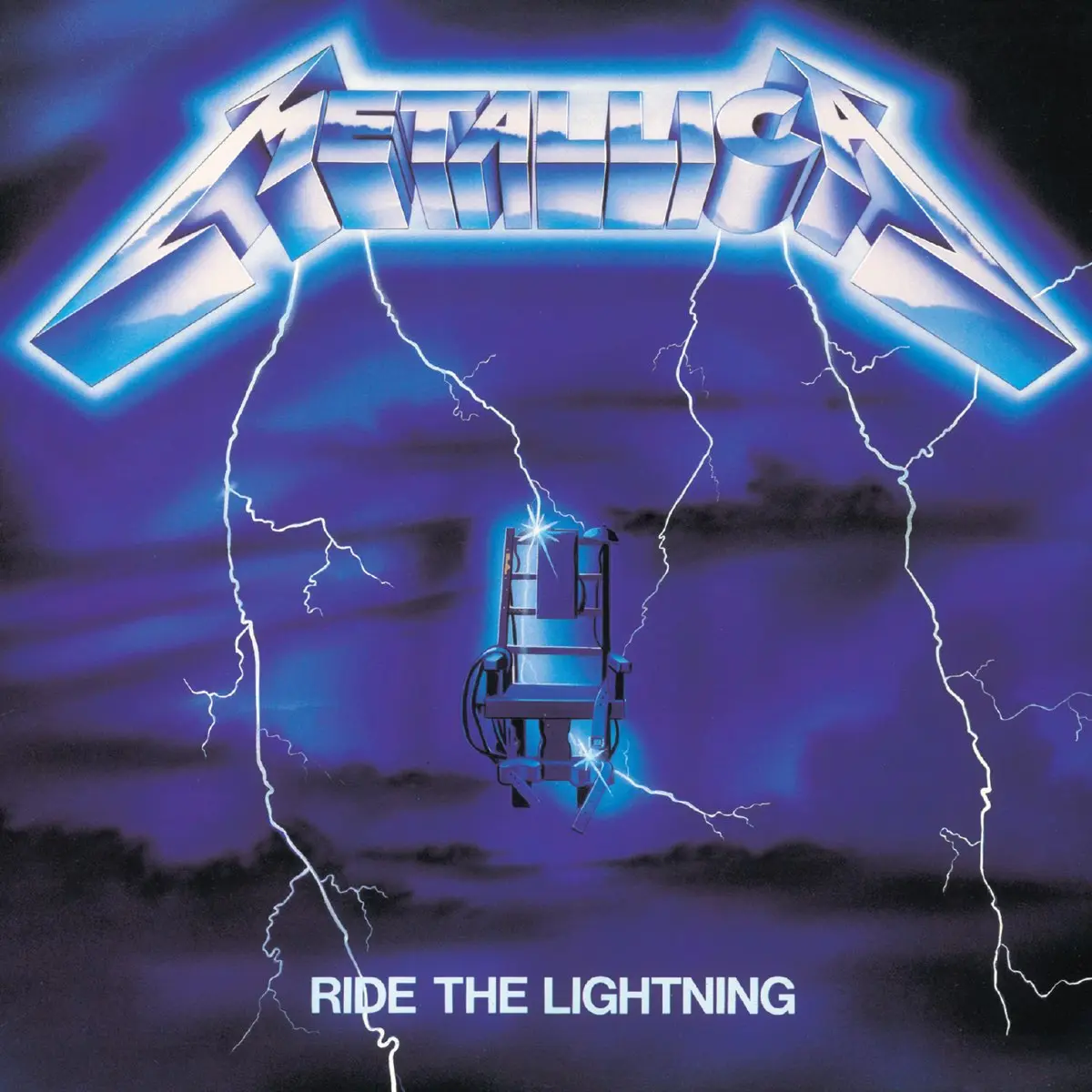 Metallica released their second album, Ride the Lightning, on July 27, 1984, on Megaforce.
Expanding beyond the raw speed of their debut, the band introduced greater harmonic depth, longer compositions, and a more varied emotional and tonal palette. Guitarist Kirk Hammett contributes refined leads and expressive phrasing that engage with James Hetfield’s rhythm tracks in more spacious arrangements.
Bassist Cliff Burton anchors the harmonic development throughout and dominates the instrumental closer “The Call of Ktulu,” where his melodic basslines frame and elevate the track’s dramatic arc. On “For Whom the Bell Tolls,” he overlays a distorted wah-driven lead bass over a march-like riff structure. Hammett’s solos reach their most expansive in “Fade to Black” and the title track, where he weaves slow-building phrasing into Burton’s countermelodies. Drummer Lars Ulrich adds percussive texture on “For Whom the Bell Tolls” with an anvil, in addition to double-time patterns and accent shifts that expand the rhythmic terrain beyond the band’s earlier work.
A1. “Fight Fire with Fire” (4:44) – Inspired by Hemingway’s novel and its portrayal of battlefield death, the song centers on the futility of modern warfare. Cliff Burton composed the iconic distorted bass intro prior to joining Metallica and layered it with harmonics and overdubs. Lars Ulrich created the bell sound by striking an anvil, blended with a sound effects reel.
A2. “Ride the Lightning” (6:37)
A3. “For Whom the Bell Tolls” (5:11)
A4. “Fade to Black” (6:55) – Written after the theft of the band’s gear and during a period of depression, Hetfield conceived the song as a reflection on despair and suicidal thoughts. It was Metallica’s first ballad, with a soft acoustic opening that builds into an extended crescendo, mirroring emotional descent.
B1. “Trapped Under Ice” (4:04)
B2. “Escape” (4:24)
B3. “Creeping Death” (6:36) – Based on the tenth plague of Egypt and told from the Angel of Death’s perspective, the lyrics were sparked by the band’s repeated viewings of The Ten Commandments at Cliff Burton’s house. The chant-driven bridge, originally written by Hammett in Exodus as “Die by His Hand,” draws from Phrygian mode progressions.
B4. “The Call of Ktulu” (8:55)
Metallica recorded the album from February 20 to March 14, 1984, at Sweet Silence Studios in Copenhagen with engineer and co-producer Flemming Rasmussen. Sessions followed weeks of rehearsals in Mercyful Fate’s practice space, with the band arranging fragments from Hetfield and Ulrich’s “riff tapes” into complete songs. Recording began with live tracking of drums and rhythm guitar, followed by overdubs from Hammett and Burton. Ulrich recorded drums in a non-soundproof warehouse space behind the studio, producing a sharp, reverberant effect. Burton introduced counterpoint and modal voicing into the arrangements, while Rasmussen worked closely with Ulrich to improve meter and phrasing. The final production budget exceeded $30,000, funded by Music for Nations after Megaforce was unable to cover the costs. Metallica slept in the studio during night sessions and completed tracking in less than a month.
Metallica released “Creeping Death” as a single on November 23, 1984, backed with covers of Diamond Head’s “Am I Evil?” and Blitzkrieg’s “Blitzkrieg.” The single was first issued as a limited-edition pressing in the UK by Music for Nations, selling 40,000 copies as an import in the U.S. Two of the three tracks were later included on the 1988 Elektra reissue of Kill ’Em All. Around the same time, Elektra Records A&R director Michael Alago and Q Prime co-founder Cliff Burnstein attended a Metallica show in September 1984. Impressed by the band’s live performance, they quickly signed Metallica to Elektra and brought them under Q Prime management.
Elektra reissued Ride the Lightning on November 19, 1984. The label also circulated promotional singles for “Fade to Black” and “For Whom the Bell Tolls,” the latter in both album-length and radio edit versions. The album eventually peaked at No. 48 on the Billboard 200 and was certified 6× platinum by the RIAA in 2012.
To support the release, Metallica launched the Bang That Head That Doesn’t Bang European tour on November 16, 1984, which included their first major overseas run with British metal band Tank, playing to average crowds of 1,300. A U.S. tour followed in early 1985, first co-headlining with W.A.S.P. and later headlining with support from Armored Saint.
Metallica’s profile rose further with major festival appearances. They played before 70,000 people at the Monsters of Rock festival at Castle Donington on August 17, 1985, sharing the stage with Bon Jovi and Ratt. In Oakland, California, they performed at Day on the Green for a crowd of 60,000. The tour concluded with a New Year’s Eve hometown show in San Francisco featuring Exodus, Metal Church, and Megadeth—where Metallica debuted “Master of Puppets” live for the first time.
Master of Puppets
 Metallica released their third album, Master of Puppets, on March 3, 1986, on Elektra.
Expanding on the structural ambition of their earlier work, the album presents eight tightly constructed tracks marked by precise tempo shifts, layered harmony lines, and thematic unity. Kirk Hammett’s lead work alternates between modal phrasing and rapid alternate picking, often interlocking with James Hetfield’s rhythmic accents in compound passages.
Cliff Burton’s bass lines shape melodic transitions, particularly on the instrumental “Orion,” where his arrangement centers around an overdubbed, effects-treated lead motif. On “The Thing That Should Not Be,” his low-end sustain underscores Hammett’s dragging riff figures, while “Welcome Home (Sanitarium)” and “Disposable Heroes” use contrasting tone colors to balance tension and release. Lars Ulrich provides off-meter snare cues, accelerative breaks, and steady double-time flourishes, particularly on “Battery” and “Damage, Inc.,” maintaining cohesion between shifting dynamic layers.
A1. “Battery” (5:13) – Hetfield improvised the central riff in London; the title references San Francisco’s Battery Street and symbolizes the thrash scene’s unity and defiance. The acoustic intro contrasts with the aggressive shift, mirroring Ride the Lightning‘s structure.
A2. “Master of Puppets” (8:36) – Built around Ulrich’s riff, expanded by Hetfield and Burton, the song explores drug addiction as a loss of control. Rasmussen sped up the final mix, creating its tightly wound precision; a Bowie quote is buried in the arrangement as homage.
A3. “The Thing That Should Not Be” (6:37)
A4. “Welcome Home (Sanitarium)” (6:28)
B1. “Disposable Heroes” (8:17) – Hetfield wrote the lyrics as an anti-war narrative of a soldier manipulated into destruction. Hammett based the verse transitions on music from war films, while an omitted riff became part of “Damage, Inc.” in the final sequence.
B2. “Leper Messiah” (5:40)
B3. “Orion” (8:28) – Cliff Burton composed most of the multi-part instrumental, including both solos and the layered harmonic bridge, originally intended to be played entirely on bass. The track’s structure evolved from an earlier composite with “Welcome Home (Sanitarium).”
B4. “Damage, Inc.” (5:33) – Opens with layered bass harmonics by Burton before detonating into full-speed thrash. The lyrics mock blind aggression and groupthink, while the final riffs incorporate a section lifted from an earlier demo of “Disposable Heroes.”
Metallica recorded the album from September 1 to December 27, 1985, at Sweet Silence Studios in Copenhagen with producer Flemming Rasmussen. Most tracks were written in El Cerrito during the preceding summer and pre-arranged through demos. The band recorded instruments separately, starting with guide guitar and click tracks. Sessions ran longer than prior albums as they pursued a more refined approach, balancing tempo changes with expanded harmony sections. Mixing was completed by Michael Wagener in early 1986. Don Brautigam painted the cover illustration, based on a concept by Metallica and Peter Mensch. The artwork shows white crosses tethered to puppet strings under a red sky, symbolizing themes of control and death. Elektra issued the album in the US, while Music for Nations handled its European release.
“Master of Puppets” was released as a single on July 2, 1986. Without radio promotion or music videos, the album reached No. 29 on the Billboard 200 and remained on the chart for 72 weeks. It earned gold status within a year and was later certified 8× platinum by the RIAA. Metallica supported the release on the Damage, Inc. tour, opening for Ozzy Osbourne in US arenas from March to August. During the European leg, bassist Cliff Burton died in a bus crash in Sweden on September 27. The band returned to San Francisco and later resumed activity with new bassist Jason Newsted.
Damage, Inc. Tour
The Damage, Inc. Tour, launched on March 27, 1986, served as Metallica’s most ambitious and harrowing road campaign to date. Named after the closing track on Master of Puppets, the tour spanned nine legs across North America, Europe, and Asia, totaling 144 shows before concluding on February 13, 1987. It marked a major turning point in the band’s career, both musically and personally, as it was the final tour to feature bassist Cliff Burton, whose death midway through the European leg reshaped the band’s future.
Metallica opened the first wing of the tour by supporting Ozzy Osbourne across the US from March through August. They appeared in large arenas from Boston’s Orpheum (April 13) to Chicago’s UIC Pavilion (April 5), and delivered a powerful performance in Portland, Oregon at the Memorial Coliseum on June 19. From May 23 to June 7, they broke away for a headlining run with Armored Saint, hitting smaller venues like Tulsa’s Cain’s Ballroom and the Aragon Ballroom in Chicago (May 25). On May 29, Metallica played Eau Claire, Wisconsin’s Old Mill Expo Center—bringing the thunder to a sold-out crowd.
Between July 27 and September 25, roadie John Marshall filled in on rhythm guitar after James Hetfield broke his wrist in a skateboarding accident. Despite internal tensions—Hetfield, Hammett, and Burton reportedly discussed replacing Lars Ulrich at tour’s end—the group moved forward until tragedy struck. On September 27, 1986, en route from Stockholm to Copenhagen, the band’s tour bus flipped outside Dörarp, Sweden. Burton, who had swapped bunks with Hammett that night, was ejected through a window and crushed beneath the bus. He was 24.
Metallica postponed their October dates and returned to San Francisco to grieve and regroup. With the Burton family’s blessing, they held auditions for a new bassist. Jason Newsted, formerly of Flotsam and Jetsam, won the spot after demonstrating fluency with the band’s full setlist and fitting in quickly on a personal level. His first performance with Metallica was at the Country Club in Reseda, California on November 8, 1986, shortly before the tour resumed in New England with dates in Providence (November 26), Passaic (November 29), and New York City (December 1).
The tour resumed with a heavy schedule: December included shows across Quebec and Ontario, a swing through Manitoba and Alberta, and a December 19 performance at Vancouver’s Pacific Coliseum. On December 20, Metallica tore through Seattle Arena and closed the year with a homecoming stop in San Francisco—where the band’s bond with Bay Area fans ran deepest.
In January 1987, Metallica crossed the Atlantic for a final European stretch. Highlights included a performance at Le Zénith in Paris (February 5) and a historic pair of shows behind the Iron Curtain in Katowice, Poland, on February 10 and 11—the first by any of the “Big Four” thrash bands. On February 13, the tour concluded in Gothenburg, Sweden, where the band had last performed with Burton less than five months earlier.
Newsted’s formal initiation into Metallica extended beyond performance. He absorbed pranks (including being tricked into eating a ball of wasabi) and endured scrutiny as the band navigated grief, press attention, and growing expectations. By the tour’s close, Metallica had emerged not only as survivors, but as the undisputed leaders of a newly global thrash movement.
The $5.98 E.P. – Garage Days Re-Revisited
Metallica issued The $5.98 E.P. – Garage Days Re-Revisited on August 21, 1987, in the US (and August 10 in the UK) as their first release following the death of bassist Cliff Burton and the debut recording with his replacement, Jason Newsted. Recorded in six days during July 1987 at A&M and Conway Studios in Los Angeles, the EP comprises five covers of late-’70s and early-’80s NWOBHM and punk songs, originally rehearsed in drummer Lars Ulrich’s El Cerrito garage—newly soundproofed by Newsted himself, drawing on his pre-band experience as a construction worker.
Rather than unveil new material, Metallica opted for covers due to tight deadlines and James Hetfield’s broken arm from a skateboarding injury. The resulting EP balances raw rehearsal energy with a tight studio finish. Newsted, credited as “Master J Newkid,” integrates seamlessly on bass and backing vocals. Kirk Hammett takes the bulk of lead guitar solos, particularly dynamic across the longer-form tracks “Helpless” and “The Small Hours.” The closing “Last Caress/Green Hell” medley surges with punk brevity, while the band punctuates the EP’s tail with a deliberately mangled snippet of Iron Maiden’s “Run to the Hills.”
A1. “Helpless” (6:39) – originated on Lightning to the Nations, the 1980 debut album by Diamond Head. written by Brian Tatler and Sean Harris.
A2. “The Small Hours” (6:43) – originated on Live (Hot Curry & Wine), the 1983 live album by the NWOBHM band Holocaust, written by their guitarist John Mortimer.
B1. “The Wait” (4:55) – originated on the 1980 debut album by Killing Joke, written by Jaz Coleman, Kevin “Geordie” Walker, Youth, and Paul Ferguson.
B2. “Crash Course in Brain Surgery” (3:10) – originated on In For The Kill!, the 1974 fourth album by Budgie, written by Burke Shelley, Tony Bourge, and Ray Phillips.
B3. “Last Caress / Green Hell” (3:30) – originated on Beware EP (1980) and Earth A.D./Wolfs Blood (1983) by Misfits, both written by Glenn Danzig.
Metallica self-arranged and intentionally minimized production, labeling the EP “not very produced.” Csaba “The Hut” Petocz engineered the sessions with Greg Dennen and Marnie Riley assisting. Ron Lewter handled the original mastering at The Mastering Lab. The EP’s budget-conscious title referenced cassette pricing, with a sticker that read: “If they try to charge more, STEAL IT!”
The EP entered the Billboard 200 at No. 28 and reached No. 27 on the UK Singles Chart. It remained out of print from 1989 to 2018, when it was reissued on vinyl and CD by Metallica’s Blackened Recordings label. All tracks were later included on the 1998 compilation Garage Inc.
…And Justice for All
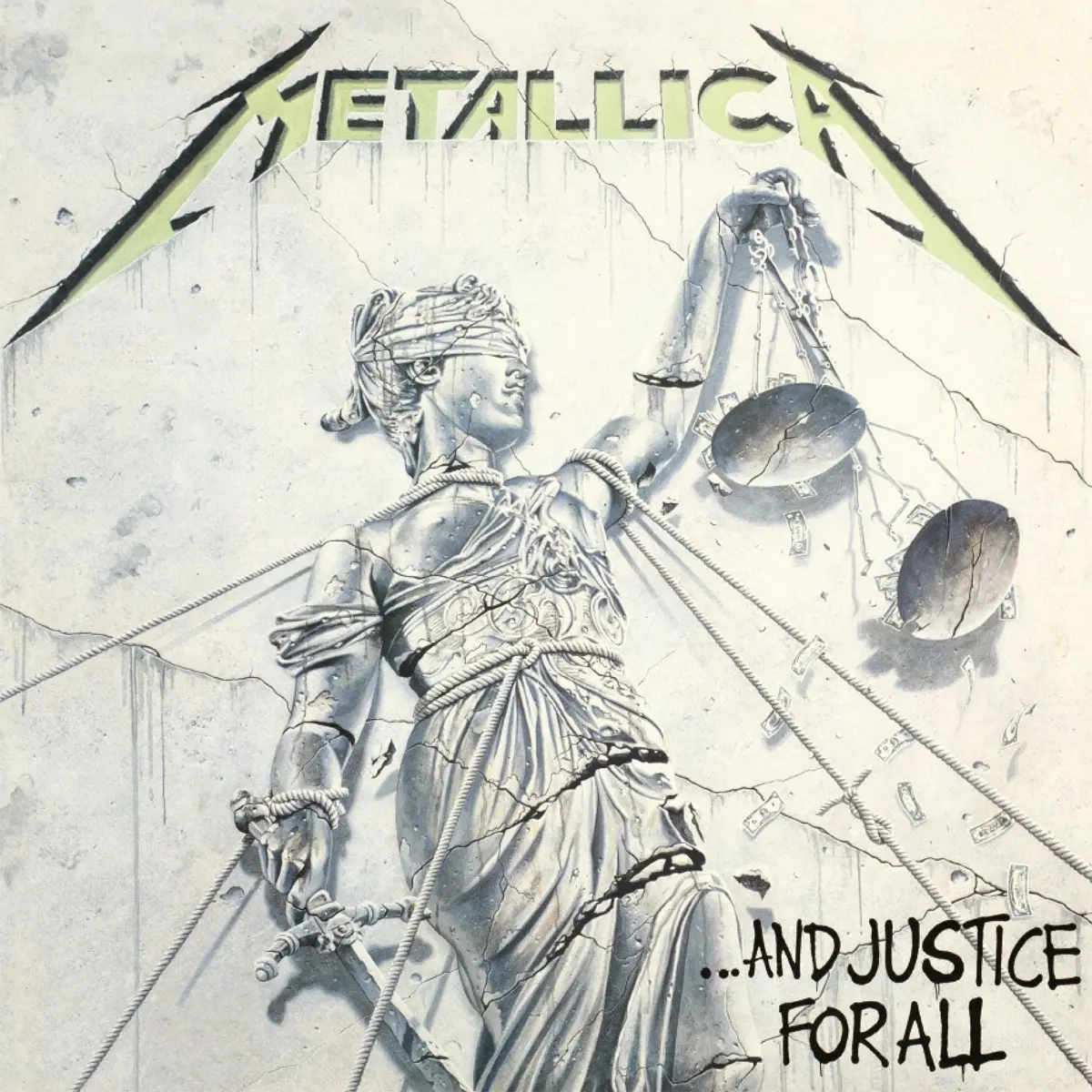 Metallica released their fourth album, …And Justice for All, on August 25, 1988, on Elektra.
The album pushed the band’s songwriting into long-form complexity, emphasizing abrupt tempo shifts, staggered rhythmic figures, and extended instrumental sections. Kirk Hammett’s leads appear in interlocking dialogue with James Hetfield’s tightly gated rhythm figures, often deploying modal phrasing and chromatic turns over shifting meter. Jason Newsted, in his first full-length appearance with the band, tracked the bass parts separately, though his presence is nearly buried in the final mix. His uncredited contribution to the arrangement of “To Live Is to Die” follows sketches left by Cliff Burton, whose posthumous co-writing credit draws from pre-recorded themes. Hetfield overlays acoustic lines on the instrumental passages in “One” and “To Live Is to Die,” while producer Flemming Rasmussen shaped the mid-album tone during the guitar layering phase and oversaw the guide-track sequence structure.
A1. “Blackened” (6:40) – Built on Jason Newsted’s reversed bass riff and 19 tempo changes, “Blackened” critiques environmental ruin and nuclear destruction. It was the first song written for the album and the only one with a Newsted writing credit.
A2. “…And Justice for All” (9:44) – Structured around a drum pattern by Lars Ulrich, this track depicts systemic corruption where justice is manipulated by power and wealth. Live renditions feature a collapsing Lady Justice statue and a pre-recorded triple-guitar intro.
B1. “Eye of the Beholder” (6:25) – The lyrics confront constraints on civil liberties, with verses in 4/4 and a chorus in 12/8—a shift Ulrich later criticized. The band stopped playing it live after 1989, though it occasionally appeared in medley form.
B2. “One” (7:24) – Inspired by Johnny Got His Gun, the song follows a WWI soldier trapped in a paralyzed body. Hetfield drew the intro’s chord change from Venom’s “Buried Alive,” and the iconic “machine gun” breakdown defined a template for metal double-kick sections.
C1. “The Shortest Straw” (6:35)
C2. “Harvester of Sorrow” (5:42) – Debuted live before the album’s release, the song narrates a man’s descent into addiction and domestic violence, culminating in implied familial murder. It marked the first Metallica single to feature Jason Newsted.
C3. “The Frayed Ends of Sanity” (7:40)
D1. “To Live Is to Die” (9:48) – Conceived as a restrained tribute to Cliff Burton, the piece develops from an unused Master of Puppets–era riff and unfolds as a largely instrumental, multi-section elegy. Hetfield recites a poem assembled from Burton’s own lines alongside passages adapted from Paul Gerhardt and Stephen R. Donaldson, underscoring themes of truth, loss, and gratitude.
D2. “Dyers Eve” (5:12)
Metallica tracked the album from January 28 to May 23, 1988, at One on One Recording Studios in Los Angeles. Mike Clink engineered early drum sessions before Rasmussen arrived in March to take over production. Songs were built from click-tracked guides laid down by Hetfield, followed by Ulrich’s final drum tracks, then guitar overdubs, vocals, and Hammett’s solos. Newsted recorded his parts in isolation with minimal input from the band. Steve Thompson and Michael Barbiero mixed the album without Rasmussen, using only close-mic drum tracks and dropping the bass nearly out of audibility, a decision driven by Hetfield and Ulrich. Bob Ludwig handled the mastering.
“Harvester of Sorrow” was released in Europe on August 28, 1988, and reached No. 20 on the UK Singles Chart, backed with another Budgie cover, “Breadfan,” sourced from the Welsh trio’s 1973 album Never Turn Your Back on a Friend. “Eye of the Beholder” followed in the US on October 30. “One” appeared on January 10, 1989, backed by the band’s first music video, which incorporated footage from Johnny Got His Gun. The single gained widespread attention and won Metallica their first Grammy Award in 1990. …And Justice for All peaked at No. 6 on the Billboard 200 and remained on the chart for 83 weeks. It was certified 8× platinum by the RIAA and topped charts in Finland, with high placements across Germany, Sweden, and the UK.
Damaged Justice Tour (1988–1989)
Metallica launched the Damaged Justice tour on September 11, 1988, in Budapest, marking their first full-length world tour with bassist Jason Newsted, who had joined the band in the aftermath of Cliff Burton’s death. Spanning five legs over 13 months, the tour comprised 219 dates across Europe, North America, Australia, Asia, and South America, and supported the band’s fourth album, …And Justice for All. The tour’s name likely played on the album title and the song “Damage, Inc.” from Master of Puppets.
The opening European leg included club and arena dates across Hungary, Italy, Spain, France, Scandinavia, the UK, and West Germany, with support from RAF, Anthrax, Danzig, and Queensrÿche. The band performed in major capitals—London (October 9–11), Paris (October 31), and Frankfurt (November 1)—before closing the leg in the Netherlands on November 5. A North American run followed in mid-November, launching in Toledo and hitting key cities such as Chicago (November 17), Detroit (November 25), San Diego (December 5), and San Francisco with three packed dates at the Cow Palace (December 10–12). Newsted performed in his native Bay Area for the first time as a full band member.
The 1989 North American winter and spring circuit began in Knoxville on January 11 and focused on the Deep South and East Coast, with stops in Miami (February 12), Atlanta (February 18), and Philadelphia (March 12). The tour included a Valentine’s Day performance in North Fort Myers (February 14) and a high-energy Fourth of July show in Cincinnati (July 4). Metallica played Boston’s Centrum in Worcester on both March 16 and July 25 and returned to New York for multiple nights in March and July at Uniondale’s Nassau Coliseum and East Rutherford’s Brendan Byrne Arena.
In April, the band crossed into Canada for major stops in Toronto, Montreal, Ottawa, and Halifax, with multiple dates in Quebec. A summer circuit of US sheds and amphitheaters began in late May, with Vancouver (May 31) and Minneapolis (June 10) among early shows, followed by an Independence Day run through the Midwest, including Clarkston, Michigan (July 3), Cincinnati again (July 4–5), and Chicago’s Poplar Creek (July 7).
Notably, Metallica headlined a raucous club show at Newark, Delaware’s Stone Balloon on August 7—still their only concert in the state. Throughout the summer and early fall, the band continued to play across the US with Faith No More and The Cult, hitting Portland, Oregon on September 1 and Salt Lake City on September 8.
The final leg brought Metallica to South America for the first time, with massive crowds in Rio de Janeiro (October 4), São Paulo (October 6), and Porto Alegre (October 8), where they closed the tour. Throughout the run, One rose up international charts, supported by the band’s first music video and setlist placement as a nightly centerpiece.
Several key performances were professionally recorded. The Seattle Center Coliseum shows (August 29–30, 1989) later formed the basis for Live Shit: Binge & Purge. Select recordings from the February 5, 1989 Dallas show were used as b-sides to the “One” single, marking the band’s first official release of live material.
Discography:
- No Life ’til Leather (cassette EP, 1982)
- Kill ‘Em All (1983)
- Ride the Lightning (1984)
- Master of Puppets (1986)
- …And Justice for All (1988)
- Metallica (1991)
- S&M (live, 1999)
Sources:
Artist/Album Pages:
Naked Eyes were an English electro/art-pop duo composed of singer Pete Byrne and keyboardist Rob F...
New England was an American hard-rock band from Boston that released a 1979 self-titled album on I...
The Belle Stars were an English new wave septet on Stiff Records that released eleven singles betw...
Tom Browne (born Oct. 30, 1954) is an American jazz-funk trumpeter from Queens. He emerged behind...
Toyah Willcox (born May 18, 1958) is an English New Wave vocalist, actress, and television persona...
The Planets was an English new wave band that released the 1979–80 Rialto albums Goon Hilly Down and...
Aurora Borealis was an American jazz-rock band behind a 1982 self-titled album on Red Hot. Membe...
Eye to Eye was an English/American duo behind the 1982/83 Warner albums Eye to Eye and Shakespeare S...
Starfire was an American hard-rock/psych band from California that released a 1974 self-titled alb...
Hinn íslenski þursaflokkur was an Icelandic art-rock/folk band that released three albums between ...
Chain were an Australian revolving-door blues-rock band that released two live and two studio albu...
pragVEC was an English avant post-punk band that released two 1978–79 singles and the 1980 album N...