

Madura was an American jazz-rock trio from Chicago that released the 1971–73 Columbia albums Madura and Madura II. Bassist–keyboardist David “Hawk” Wolinski subsequently joined Rufus and became a songwriting collaborator with Chicago drummer Danny Seraphine.
Members: David “Hawk” Wolinski (bass, keyboards, vocals), Alan De Carlo (guitar, vocals), Ross Salomone (drums, percussion)
Background
Madura formed from the ashes of Bangor Flying Circus, a psychedelic rock trio with Wolinski and guitarist–singer Alan De Carlo. After their 1969 self-titled album on Dunhill, Bangor drummer Michael Tegza cleared for Ross Salomone. The new trio named itself Madura after Madurai, India, the site of the Meenakshi temple, a source of inspiration for the band.
Madura signed with Columbia and linked with Chicago manager/producer James William Guercio.
Madura
 Madura released their self-titled debut double album in September 1971 on Columbia.
The album opens with “Hawk Piano,” an abstract minute-long keyboard etude that leads into the soulful, FM-friendly “Drinking No Wine,” followed by the melodic pop of “Dreams.” “Plain As Day” weaves multiple motifs into an fusion of jazz, rock, and experimentation, replete with one of Alan De Carlo’s most searing guitar solos. Side one ends with “My Love Is Free,” a harmony-laden ballad suffixed with jazz.
Side two forms a six-part suite starting with De Carlo’s fuzz-tinged rocker “Free From the Devil” and the brief, high-spirited “My My What a World.” Drummer Ross Salomone contributes the solo-driven “Stimulation.” “Don’t Be Afraid” provides tight, compact relief before the slinky, bluesy “Damnation” and the gospel-tinged “See for Yourself,” a soul-jazz number that dissolves into vocal scatting.
Side three opens with the falsetto-led pop of “I Think I’m Dreaming,” followed by the lush, harmony-rich soul of “It’s a Good Time for Loving.” The jazzy, extended “Trapped” mixes Chicago-style vocals with frenetic jamming. They close the side with a reworking of Chuck Berry’s “Johnny B. Goode,” rendered in loungey soul-jazz mode with added scatting—released as the album’s lone single.
Side four forms the conceptual suite Reflections. It opens with “Realization” and the two-part “Man’s Rebirth Through Childbirth,” which mix gospel choruses with fusion breakdowns. The harmonized “Joy in Old Age by Way of Self Observation” finds common ground between psych-soul and spiritual rock. The finale, “Talking to Myself,” is a bittersweet orchestral ballad with horn and string overdubs.
A1. “Hawk Piano” (1:23)
A2. “Drinking No Wine” (4:18)
A3. “Dreams” (4:24)
A4. “Plain As Day” (5:35)
A5. “My Love Is Free” (7:09)
B. Free From the Devil
a. “Free From the Devil” (2:10)
b. “My My What a World” (1:01)
c. “Stimulation” (3:56)
d. “Don’t Be Afraid” (2:01)
e. “Damnation” (3:49)
f. “See for Yourself” (5:59)
C1. “I Think I’m Dreaming” (4:23)
C2. “It’s a Good Time for Loving” (4:55)
C3. “Trapped” (7:45)
C4. “Johnny B. Goode” (6:02)
D. Reflections
a. “Realization” (3:17)
b. “Man’s Rebirth Through Childbirth, Pt. 1” (2:52)
c. “Man’s Rebirth Through Childbirth, Pt. 2” (1:12)
d. “Joy in Old Age by Way of Self Observation” (4:03)
e. “Talking to Myself” (4:53)
The album was produced by James William Guercio, who guided the early output of Chicago and The Buckinghams. It was released under Columbia’s parent company, CBS Inc., and issued through Big Elk and Arc Music. Though the album contained no horn players, the sound frequently nods to Chicago’s early fusion aesthetic, replacing brass with intricate vocal harmonies and layered keyboard textures. The sole single, a two-part edit of “Johnny B. Goode,” appeared on Columbia 4-45483.
The gatefold cover shows an aerial photo of a grassy field with the band’s name MADURA spelled in block letters carved into the terrain.
Madura toured with Chicago in 1971 and 1972. They appear in a brief live performance scene in James William Guercio’s 1973 film Electra Glide in Blue, performing “Free From the Devil.” Wolinski also appears in the film as a character known only as “the driver.”
Madura II
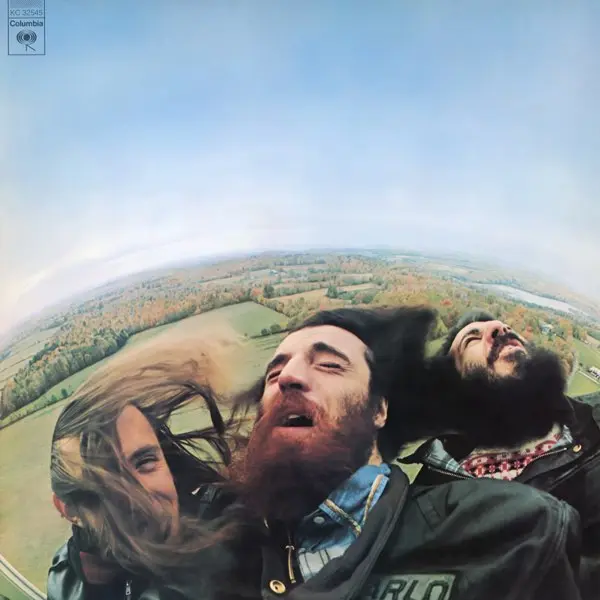 Madura released their second album, Madura II, in January 1974 on Columbia.
The trio—keyboardist–bassist David “Hawk” Wolinski, guitarist Alan De Carlo, and drummer Ross Salomone—returned with a shorter, more polished set split between originals and eclectic covers. Wolinski handles most of the songwriting with four solo contributions, while De Carlo and Salomone share credits on two arrangements.
Side one features a co-write with Terry Kath and producer James William Guercio, as well as a fusion interpretation of Joe Zawinul’s “Doctor Honoris Causa” and a brief cover of the 1935 jazz standard “I’m in the Mood for Love.”
Side two continues the genre cross-pollination with medleys, folk-blues reinterpretations, and an orchestrated finale. Orchestral arrangements were handled by Jimmie Haskell and backing vocals came courtesy of the Blackberries (Clydie King, Shirley Matthews, and Vanetta Fields). Phil Ramone and Wayne Tarnowski engineered the mix.
A1. “Livin’ In America” (5:03)
A2. “Doctor Honoris Causa” (8:27) is a tribute by Joe Zawinul to Herbie Hancock; first recorded on Zawinul’s 1971 self-titled album.
A3. “I’m In the Mood for Love” (1:38) is a 1935 popular song by 1935 by Frances Langford, written by Jimmy McHugh and Dorothy Fields and covered by Louis Armstrong, Fats Domino, and Lord Tanamo.
A4. “If You Got the Dime” (4:11)
B1. “First Time” (2:44)
B2. “My Favorite Things / Funky Broadway” (5:42) merges Rodgers & Hammerstein’s Broadway classic with Dyke & the Blazers’ 1967 funk hit.
B3. “Windy One” (3:44)
B4. “Stagger Lee” (3:44) is an enduring American murder ballad first recorded in 1923 and popularized by Lloyd Price’s 1959 R&B rendition
B5. “Save the Miracle” (4:22)
Madura II was recorded at Guercio’s Caribou Ranch and mastered at The Mastering Lab. The album appeared on CBS/Columbia and was issued through Big Elk Music.
The front cover shows the trio tilted backward in a windswept pose at high altitude, with a panoramic view of Earth’s curvature under a fisheye lens. The back cover reprises the aerial shot of the MADURA-etched field from their debut.
After Madura
David “Hawk” Wolinski joined Rufus in time for their 1977 fifth album Ask Rufus, contributing to seven albums with the group through their 1983 finale Seal in Red. He also played on five Chicago studio albums between 1974’s Chicago VII and 1979’s Chicago 13, and co-wrote eight tracks with drummer Danny Seraphine that appeared across multiple Chicago releases.
Alan DeCarlo and Ross Salomone resurfaced on Chicago keyboardist Robert Lamm’s 1974 solo album Skinny Boy. Salomone later appeared on albums by Air Supply, Gerard, Hollins & Starr, and Chicago.
Discography:
- Madura (2LP, 1971)
- Madura II (1973)
Sources:
Artist/Album Pages:
Patty Pravo (born April 9, 1948) is an Italian singer and media personality who emerged from the R...
Blue Mountain Eagle was an American psych-rock band from Los Angeles that released a 1970 self-tit...
Locomotive was an English brass-rock/psych band that was active with multiple lineups between 1966 a...
Chava Alberstein is a Polish-born Israeli folk singer/songwriter and guitarist who debuted with the ...
Leon Ware (1940–2017) was an American R&B singer, songwriter, and producer who released a 1972...
Harsh Reality was an English psychedelic hard-rock band behind the 1969 Philips album Heaven & H...
Som Imaginário are a Brazilian jazz-rock and psych band that emerged in 1969 as the backing group ...
Ronnie Foster is an American organist and arranger who released eight albums between 1972 and 1986...
Spooky Tooth was an English rock band that was active for two separate periods during the late 1960s...
The Masters Apprentices were an Australian rock band from Adelaide that emerged as one of the nati...
Unicorn was an English rustic-rock band behind the 1971 album Uphill All the Way on Transatlantic ...
Uriah Heep are an English hard-rock band that released twenty-five albums between 1970 and 2023. T...