

Eric Dolphy (June 20, 1928 – June 29, 1964) was an American jazz saxophonist, flautist, and clarinetist from Los Angeles.
He gained national attention in 1958 as a member of Chico Hamilton’s quintet. Dolphy launched his career as a leader in 1960 with Outward Bound on Prestige Records, the first of thirteen albums he recorded for the label over two years. He expanded his approach on Out There (1960), which reflected his interest in Third Stream composition. At the same time, he joined Charles Mingus’s Jazz Workshop, contributing to Charles Mingus Presents Charles Mingus (1960) and Pre-Bird (1961). Dolphy also partnered with trumpeter Booker Little, recording Far Cry (1960) and the live set At the Five Spot (1961), which captured one of his most important working groups.
In 1961, Dolphy became a full member of John Coltrane’s quintet, appearing on The Complete 1961 Village Vanguard Recordings, which documented the group’s exploratory live sets. He also collaborated with Ornette Coleman on Free Jazz: A Collective Improvisation (1960) and worked with Oliver Nelson on The Blues and the Abstract Truth (1961). Dolphy’s versatility as an alto saxophonist, flutist, and bass clarinetist distinguished him within every ensemble. His compositions, including “Out There,” “Serene,” and “Hat and Beard,” added to the modern jazz repertoire.
In February 1964, Dolphy recorded Out to Lunch! for Blue Note Records, a landmark of avant-garde jazz that highlighted his writing and improvisational range. Before its release, Dolphy died in Berlin after falling into a diabetic coma. Posthumous recognition included his induction into the DownBeat Hall of Fame and tributes from peers such as John Coltrane, who called him “one of the greatest people I’ve ever known.” Composer Frank Zappa honored Dolphy’s legacy with “The Eric Dolphy Memorial Barbecue” on the 1970 album Weasels Ripped My Flesh.
Background
Eric Allan Dolphy Jr. was born on June 20, 1928, in Los Angeles, California. He began music lessons at age six, studying clarinet and saxophone. In junior high, he added oboe and considered a career in orchestral performance. He earned a two-year scholarship to the University of Southern California’s music school and won a “Superior” award for clarinet at a local festival. At Los Angeles City College, he performed contemporary classical works and further developed his skills as a woodwind player.
By 1947, Dolphy joined drummer Roy Porter’s 17 Beboppers, with whom he made eight recordings through 1949. He played alto, baritone, and soprano saxophones as well as flute and clarinet. From 1950 to 1953, Dolphy served in the U.S. Army, performing in military ensembles. After his discharge, he returned to Los Angeles, where he collaborated with Buddy Collette and Gerald Wilson. His father built a backyard studio that became a hub for rehearsals and jam sessions. Recordings made there in 1954 with trumpeter Clifford Brown, later released as Clifford Brown + Eric Dolphy – Together, capture Dolphy’s early voice.
Dolphy gained wider attention in 1958 when he joined Chico Hamilton’s quintet. With Hamilton, he recorded The Chico Hamilton Quintet with Strings Attached and Gongs East! (both released in 1959). The group’s appearance at the 1958 Newport Jazz Festival, filmed in Jazz on a Summer’s Day, further raised Dolphy’s profile. Extensive touring with Hamilton through 1959 solidified his reputation as a versatile multi-instrumentalist. After leaving the group, Dolphy relocated to New York to pursue broader opportunities.
In 1960, Dolphy emerged as a bandleader on Prestige Records. At the same time, he joined Charles Mingus’ Jazz Workshop, recording Charles Mingus Presents Charles Mingus and Pre-Bird (later retitled Mingus Revisited). He also collaborated with Oliver Nelson, George Russell, and Ornette Coleman, appearing on Coleman’s Free Jazz: A Collective Improvisation. Pre-leader credits also included work with Eddie “Lockjaw” Davis on Trane Whistle (1960). These early recordings positioned Dolphy as a central figure in the new directions of modern jazz.
Outward Bound
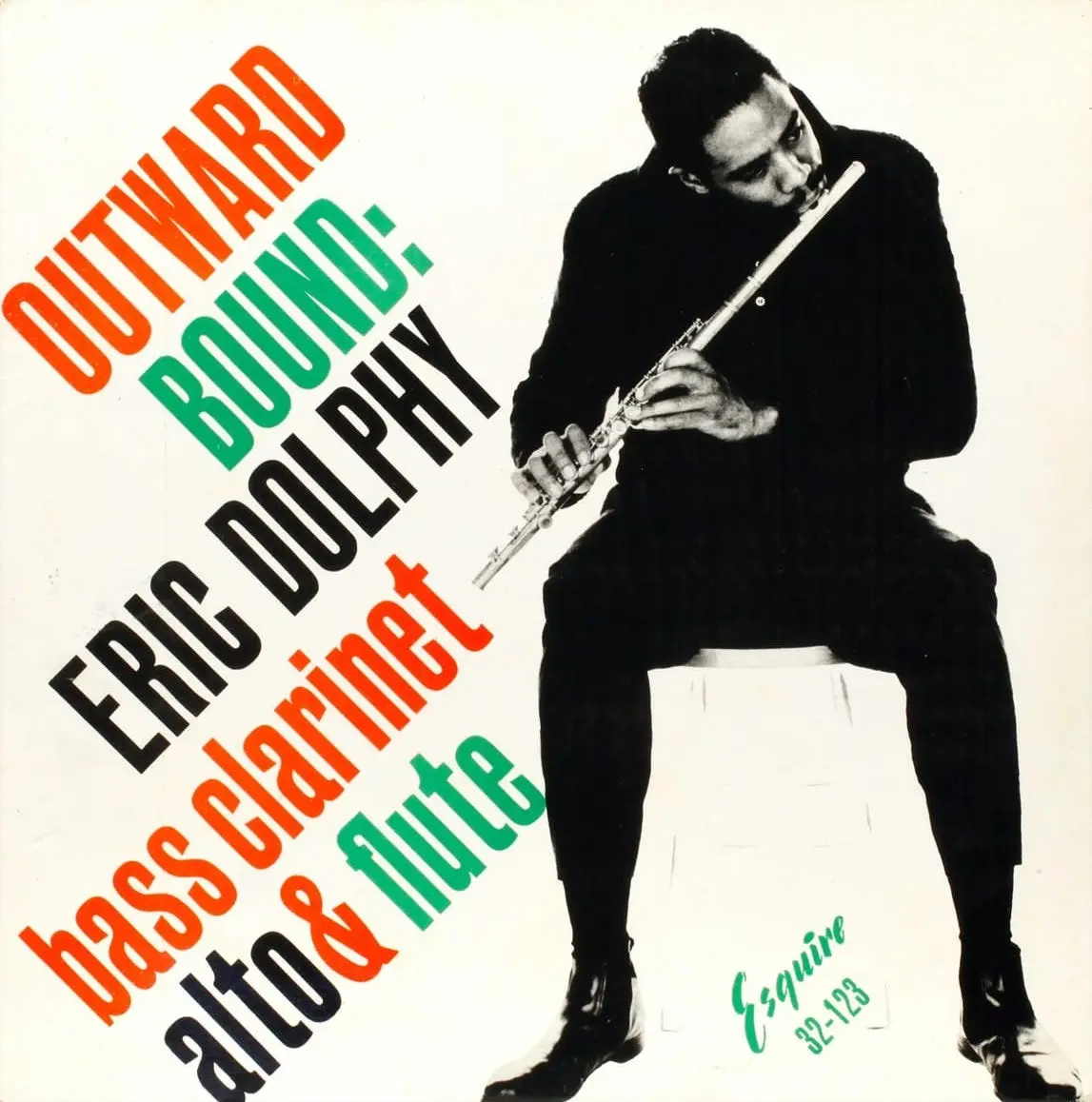 Eric Dolphy released his debut album, Outward Bound, in August 1960 on New Jazz.
Outward Bound presents Dolphy in a quintet setting that emphasizes hard bop while hinting at his future avant-garde explorations. The album features him on alto saxophone, bass clarinet, and flute, supported by an ensemble that balances rigorous swing with sharp, angular improvisations. It captures the interplay between Dolphy and a rising generation of jazz players at the start of the 1960s.
Dolphy wrote three of the six tracks on the album. The remaining songs include covers of Bronisław Kaper and Ned Washington (“On Green Dolphin Street”) and Richard Rodgers and Lorenz Hart (“Glad to Be Unhappy”), as well as a composition by Charles “Majeed” Greenlee (“Miss Toni”). The originals “G.W.,” “Les,” and “245” anchor the session with concise, hard bop frameworks.
The material divides between Dolphy originals, which serve as platforms for energetic solos, and more flexible standards that allow for freer instrumental interplay. “G.W.” features an alto saxophone solo that traces sudden, contoured leaps over a stable rhythm section. “Les” highlights the trumpet of Freddie Hubbard weaving warmth against Dolphy’s angular lines. On “245,” the quintet navigates a blues structure with precise rhythmic variations, while “On Green Dolphin Street” and “Glad to Be Unhappy” showcase Dolphy’s bass clarinet and flute against flowing harmonic settings.
A1. “G.W.” (7:57) – Dolphy opens his debut with a vigorous dedication to Gerald Wilson, his alto lines darting in sharp turns over a brisk foundation while Hubbard’s trumpet counters with bold phrases. Haynes drives the pace with clipped accents that keep the exchanges taut.
A2. “On Green Dolphin Street” (5:44) – Dolphy moves to bass clarinet, shaping the familiar theme with unexpected contours while Hubbard threads lyrical bursts around him. The rhythm section maintains a steady propulsion that allows both horns to stretch the form.
A3. “Les” (5:12) – Named for trombonist Lester Robertson, this piece launches into spirited dialogue between alto and trumpet. Dolphy’s lines vault unpredictably, while Byard punctuates with angular piano figures that prod the ensemble forward.
B1. “245” (6:49) – The tune, titled after Dolphy’s Brooklyn address, balances a blues framework with sudden rhythmic turns. Hubbard’s trumpet surges with fiery clarity, and Dolphy’s alto pushes phrases to the edge before rejoining the theme.
B2. “Glad to Be Unhappy” (5:26) – Dolphy sets aside the horn for flute, tracing the Rodgers and Hart ballad with understated lyricism. The reading lingers in quiet spaces, framed by Byard’s gentle voicings and Haynes’ brushwork.
B3. “Miss Toni” (5:40) – Charles Greenlee’s composition closes the session with Dolphy on bass clarinet, pressing deep-toned lines against Hubbard’s trumpet. The rhythm section locks in a firm pulse, giving Byard room to branch into expansive runs.
Sessions occurred at Van Gelder Studio in Englewood Cliffs, New Jersey, with producer Esmond Edwards and engineer Rudy Van Gelder.
Outward Bound features cover artwork by Richard “Prophet” Jennings, depicting abstract line work that emphasizes motion and energy in the ensemble.
Out There
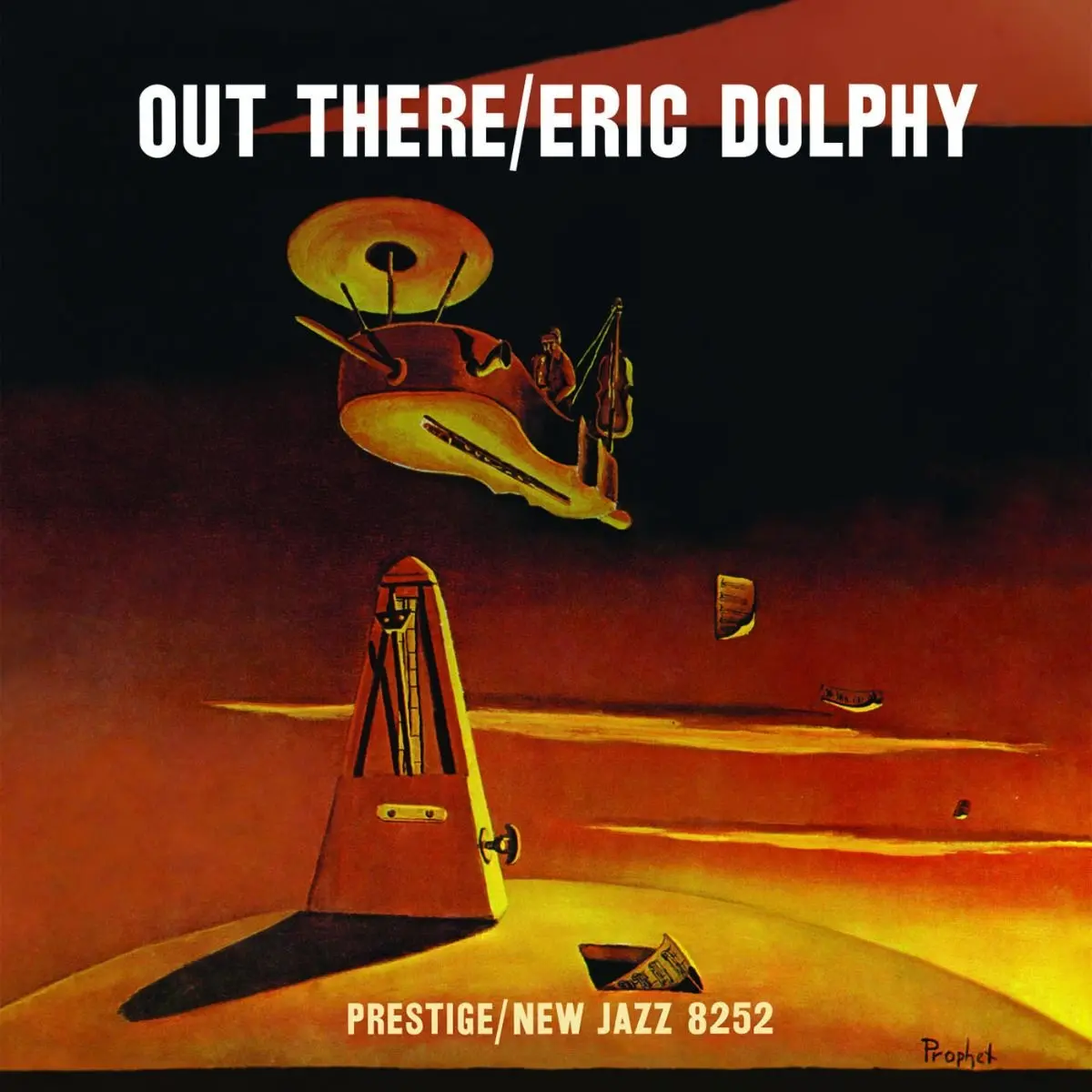 Eric Dolphy released his third album, Out There, in September 1961 on New Jazz.
Out There presents Dolphy in a quartet with Ron Carter on cello, George Duvivier on bass, and Roy Haynes on drums, removing piano and trumpet to create a freer, chamber-like ensemble. The album balances avant-garde exploration with structured passages, emphasizing Dolphy’s multi-instrumental versatility across alto saxophone, bass clarinet, B♭ clarinet, and flute.
Dolphy composed four of the seven tracks, including one co-written with Charles Mingus. The remaining songs include covers of Charles Mingus (“Eclipse”), Randy Weston (“Sketch of Melba”), and Hale Smith (“Feathers”).
The tracks alternate between structured originals and reimagined compositions by peers. The title track opens with alto saxophone over a duo of cello and bass, intertwining Dolphy’s angular lines with intricate string counterpoints. “Serene” and “The Baron” feature bass clarinet paired with cello, exploring low-register interplay and tense harmonic textures. “17 West” spotlights flute against cello and bass in a sparse, chamber-like setting, while “Sketch of Melba” delivers a delicate clarinet-led interpretation. “Feathers” closes with alto saxophone soaring over staccato cello punctuations and restrained percussion, combining mournful phrasing with sudden bursts of energy.
A1. “Out There” (6:55) – Dolphy’s alto leads a pointed theme that locks in with Carter’s bowed cello, the two voices stretching the ensemble into unexpected harmonic space while Duvivier and Haynes hold a taut rhythmic undercurrent.
A2. “Serene” (7:01) – On bass clarinet, Dolphy shapes a minor blues into long, shadowed lines. Cello and bass trade roles between arco and pizzicato, giving the piece a layered texture beneath his low-register flights.
A3. “The Baron” (2:57) – Dolphy and Carter open in tight unison before parting ways, the bass clarinet climbing in restless figures while the cello answers with nervous precision. The brevity amplifies its urgency.
B1. “Eclipse” (2:45) – Dolphy switches to B♭ clarinet, phrasing Mingus’s theme with restrained clarity as Carter threads expansive lines around him. The chamber-like texture shifts the focus from pulse to color.
B2. “17 West” (4:50) – Dolphy’s flute traces bright contours against Carter’s double-stopped cello, the two moving in and out of counterpoint. Haynes inserts brief breaks that fracture the flow before the ensemble circles back.
B3. “Sketch of Melba” (4:40) – Dolphy’s flute carries Randy Weston’s piece with delicate phrasing, the bass and drums pared down to hushed punctuation. The arrangement hovers in near-weightless suspension.
B4. “Feathers” (5:00) – Closing on alto, Dolphy unfolds Hale Smith’s composition in a mournful arc. The rhythm section supports with dark swells while Carter interjects sharp accents, intensifying the final ascent.
Sessions occurred at Van Gelder Studio in Englewood Cliffs, New Jersey, with producer Esmond Edwards and engineer Rudy Van Gelder.
Out There features cover artwork by Richard Jennings, depicting surreal imagery that includes an oversized double bass integrated with abstract objects and a navigational figure, complementing the album’s chamber-jazz experimentation.
Far Cry
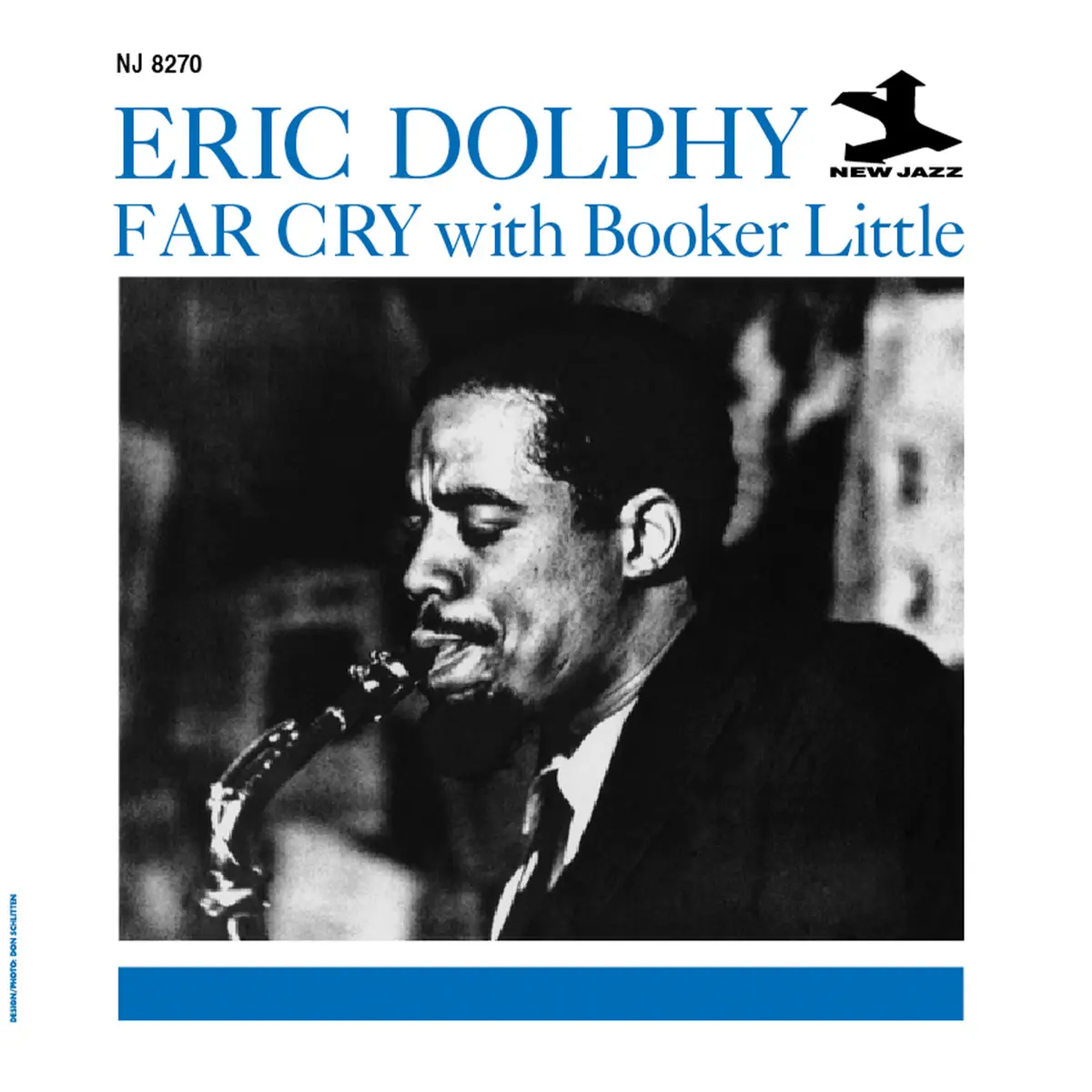 Eric Dolphy released his fourth studio album, Far Cry, in 1962 on New Jazz.
Far Cry presents a transitional stage in Dolphy’s development, blending bebop roots with emerging avant-garde sensibilities. It features a quintet co-led with trumpeter Booker Little, with Jaki Byard on piano, Ron Carter on bass, and Roy Haynes on drums, and showcases Dolphy switching between alto sax, bass clarinet, and flute. The album opens with a suite of tributes to Charlie Parker, then moves through original compositions and standards, highlighting both ensemble interplay and soloistic exploration.
Dolphy composed two tracks, including the title piece “Far Cry” and “Miss Ann.” Pianist Jaki Byard contributed two compositions, both dedicated to Charlie Parker or his mother. Mal Waldron composed the Billie Holiday tribute “Left Alone,” and the album includes covers of songs popularized by Walter Gross and Jack Lawrence (“Tenderly”) and Jule Styne and Sammy Cahn (“It’s Magic”).
The music divides into tributes, originals, and standards. The first side centers on Parker, with Byard’s “Mrs. Parker of K.C. (Bird’s Mother)” and “Ode to Charlie Parker” and Dolphy’s “Far Cry,” which mirrors his earlier composition “Out There.” Side two features Dolphy’s portrait “Miss Ann,” Waldron’s reflective “Left Alone,” and solo and ensemble explorations of “Tenderly” and “It’s Magic,” highlighting Dolphy’s control of tone, intervallic leaps, and rhythmic elasticity.
A1. “Mrs. Parker of K.C. (Bird’s Mother)” (8:03) – Byard’s composition unfolds in shifting tempos and accents, Dolphy’s bass clarinet and Little’s trumpet bending the theme in different directions while the rhythm section moves restlessly beneath.
A2. “Ode to Charlie Parker” (8:42) – Dolphy takes up the flute, carrying the line in long arcs as Little answers with compressed trumpet phrases. The piece layers tribute with exploration, the ensemble stretching Parker’s legacy into broader space.
A3. “Far Cry” (3:55) – Dolphy’s alto sets the theme in clipped figures before breaking it apart through jagged runs. The brevity heightens its impact, compressing the energy into a pointed gesture.
B1. “Miss Ann” (4:17) – Little rejoins here, his trumpet trading with Dolphy’s alto in brisk exchanges. The head’s compact form gives way to solo flights that push hard against the pulse.
B2. “Left Alone” (6:41) – Dolphy moves to flute, tracing Waldron’s elegy to Billie Holiday with stark clarity. The band shades the background in muted tones, allowing the line to hover with quiet tension.
B3. “Tenderly” (4:20) – Alone on alto, Dolphy expands the ballad into a study of contour and pause. Each phrase cuts sharply, balancing intimacy with structural daring.
B4. “It’s Magic” (5:40) – Dolphy’s bass clarinet twists the standard into deep, resonant shapes. Byard, Carter, and Haynes weave a restrained framework that lets his lines carry the weight.
CD bonus track:
8. “Serene” (6:37) – Revisiting a theme from Out There, Dolphy’s bass clarinet opens against a flexible pulse. The ensemble builds in layers, giving the familiar piece new urgency.
Sessions occurred at Van Gelder Studio in Englewood Cliffs, NJ, with producer Esmond Edwards and engineer Rudy Van Gelder.
Out to Lunch
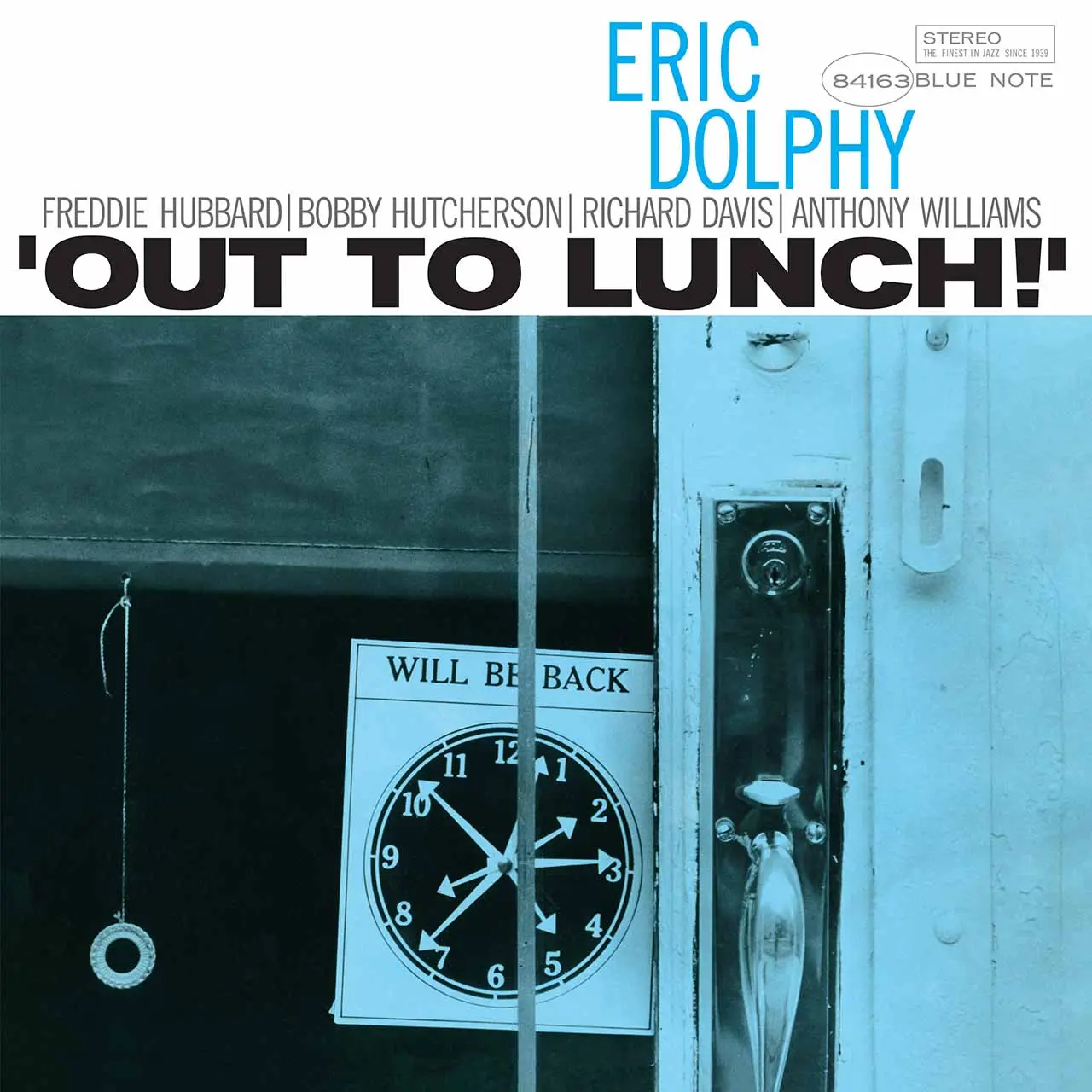 In August 1964, Blue Note issued Out to Lunch, the last-recorded album by Eric Dolphy.
Out to Lunch! is Dolphy’s only Blue Note session as a leader. The quintet features trumpeter Freddie Hubbard, vibraphonist Bobby Hutcherson, bassist Richard Davis, and drummer Tony Williams. The album blends structured compositions with free-spirited interplay, highlighting Dolphy’s multi-instrumental command and the ensemble’s responsive chemistry.
Dolphy composed all five primary tracks. No standard covers appear, and all writing credits remain with him.
The first two tracks showcase Dolphy on bass clarinet. “Hat and Beard” opens with jagged, discursive lines and a percussive interlude between Williams and Hutcherson. “Something Sweet, Something Tender” pairs bowed bass with ghostly bass clarinet in a scored duet with Davis. “Gazzelloni” highlights Dolphy’s flute, balancing a conventional bebop-based theme with expansive soloing. The title track features Dolphy on alto saxophone with an implied pulse underpinning the ensemble’s elastic improvisation. “Straight Up and Down” concludes the session with Dolphy’s alto delivering blues-inflected, free jazz lines over an animated ensemble dialogue.
A1. “Hat and Beard” (8:24) – Dolphy’s bass clarinet sets a fragmented theme that splinters into shifting pulses. Williams and Hutcherson stage a percussive dialogue, their interplay stretching the tune’s Monk-inspired skeleton into unpredictable shapes.
A2. “Something Sweet, Something Tender” (6:02) – Bass clarinet and bowed bass open in stark unison before expanding into spare, lyrical lines. The ensemble moves with restraint, letting the quiet architecture carry both tension and release.
A3. “Gazzelloni” (7:22) – Dolphy’s flute traces rapid, contoured figures above elastic rhythms. Hubbard and Hutcherson exchange phrases that bend the structure outward while keeping the theme tethered to bebop formality.
B1. “Out to Lunch” (12:06) – Alto saxophone cuts through an implied pulse as the rhythm section fractures and reforms around it. Davis’s bass solo suspends time, and the group drifts between collapse and cohesion with deliberate force.
B2. “Straight Up and Down” (8:19) – The clattering theme staggers forward with carnival-like sway. Dolphy’s alto solo shifts from blues cries to angular bursts, as the band joins in a collective surge that blurs history and experiment.
CD Bonus tracks:
6. “Hat and Beard (alternate take)” (8:35) – The ensemble reshapes the opening piece with altered pacing, emphasizing sharper contrasts between percussion and low-register lines.
7. “Something Sweet, Something Tender (alternate take)” (5:42) – Dolphy and Davis again begin in duet, this time unfolding more compressed arcs, setting a tauter frame for the ensemble’s restrained entry.
Sessions occurred at Van Gelder Studio in Englewood Cliffs, New Jersey, with producer Alfred Lion and engineer Rudy Van Gelder.
Out to Lunch! features cover photography and design by Reid Miles, depicting a “Will Be Back” sign with a seven-handed clock in a shop window.
Iron Man
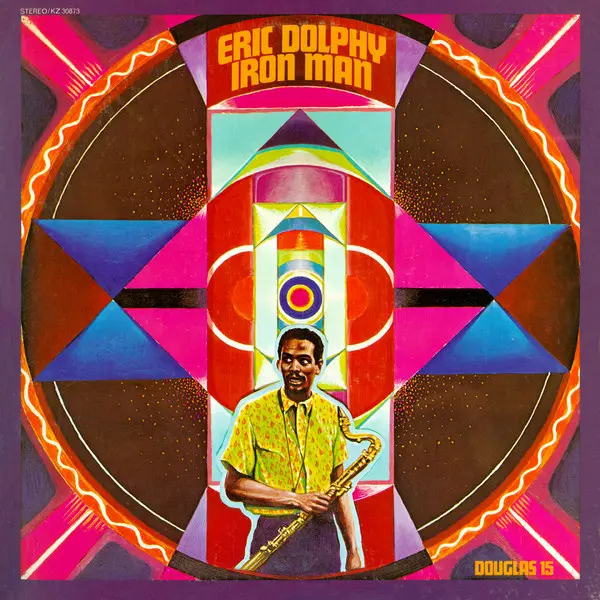 In 1968, Douglas International issued Iron Man, the penultimate recordings of Eric Dolphy.
Iron Man compiles sessions from July 1963, recorded a year before Dolphy’s Out to Lunch. The album alternates between duets with bassist Richard Davis and mini big-band arrangements, highlighting Dolphy’s alto saxophone, bass clarinet, and flute. It presents a mix of energetic bebop-inspired tracks and ballad duets, balancing structural invention with avant-garde freedom.
Dolphy wrote three of the five tracks. Duke Ellington wrote “Come Sunday,” and Jaki Byard composed “Ode to Charlie Parker.”
The title track and “Mandrake” open with high-energy ensemble passages featuring Dolphy, Woody Shaw, and Bobby Hutcherson, showcasing tight, angular lines and inventive rhythm interplay. “Burning Spear” employs the horn ensemble in expansive, loosely structured improvisation. The ballads “Come Sunday” and “Ode to Charlie Parker” pair Dolphy with Davis in intimate duets, eschewing piano and conventional harmonic roles while preserving melodic invention.
A1. “Iron Man” (9:07) – Alto saxophone drives a restless theme that breaks into surging exchanges. Hutcherson’s vibraphone punctuates the texture, while Shaw’s trumpet pushes against the ensemble’s dense arrangement.
A2. “Mandrake” (4:50) – A brisk pace frames darting alto lines and sharp ensemble responses. The rhythm section keeps the undercurrent taut, leaving Dolphy free to stretch the phrasing in abrupt turns.
A3. “Come Sunday” (6:24) – Dolphy and Davis render Ellington’s hymn as a stark duet. Bass clarinet and arco bass intertwine, balancing gravity with moments of luminous openness.
A4. “Burning Spear” (11:49) – Expansive in scale, the large group layers reeds, brass, and percussion into shifting blocks of sound. Dolphy’s alto cuts through the ensemble’s turbulence, steering the piece through volatile passages.
A5. “Ode to Charlie Parker” (8:05) – Flute and bass duet in quiet dialogue, shaping the theme with elongated arcs and careful pauses. The pared-down setting leaves every inflection exposed.
Sessions occurred at Music Maker’s Studios in New York City with producer Alan Douglas.
Discography:
- Outward Bound (1960 • Eric Dolphy Quintet)
- At the Five Spot, Vol. 1 (1961)
- Newport Rebels (1961 • Charles Mingus / Max Roach / Eric Dolphy / Roy Eldridge / Jo Jones)
- Out There (1961)
- Caribé (1961 • The Latin Jazz Quintet + Eric Dolphy)
- Far Cry (1962)
- Conversations (1963)
- At the Five Spot, Vol. 2 (1964)
- Out to Lunch (1964)
- Last Date (1964)
- Iron Man (1968)
- Playing: Epistrophy (1975 • Eric Dolphy, Misha Mengelberg, Jacques Schols & Han Bennink)
- Stockholm Sessions (archival, 1981)
- Dash One (archival, 1982)
- Naima (archival, 1987)
- Other Aspects (archival, 1987)
- Candid Dolphy (archival, 1989)
Sources:
- Discogs: Eric Dolphy
- RYM: Eric Dolphy
- JazzDisco.org: Eric Dolphy
- JazzMusicArchives: Eric Dolphy
- MusicBrainz: Eric Dolphy
- SecondHandSongs: Eric Dolphy
Artist/Album Pages:
Hubert Laws (born Nov. 10, 1939) is an American flutist from Houston. He is the eldest of kin in t...
Hank Crawford (Dec. 12, 1934 — Jan. 29, 2009) was an American post-bop/jazz-funk alto saxophonist...
Freddie Hubbard (1938–2008) was an American jazz trumpeter who released seven post-bop albums on B...
Roland Kirk — aka Ronald Theodore Kirk (August 7, 1935 — December 5, 1977) — was an American multi...
Herbie Hancock (born April 12, 1940) is an American jazz and funk keyboardist active since the late ...
Odyssey is a jazz-funk album by American keyboardist/composer Charles Earland, released in 1976 on M...
George Benson (March 22, 1943) is an American jazz-funk guitarist and singer from Pittsburgh. He ...
Red Clay is an album by American jazz trumpeter Freddie Hubbard, released in June 1970 on CTI. ...
Open Your Eyes, You Can Fly is the fourth album by Brazilian experimental samba/jazz vocalist Flora ...
Sonny Fortune (May 19, 1939 — Oct. 25 2018) was an American jazz saxophonist who rose to prominenc...
Chick Corea (June 12, 1941 – Feb. 9, 2021) was an American jazz pianist, composer, and bandleader ...
Cannonball Adderley (September 15, 1928 – August 8, 1975) was an American jazz alto saxophonist of t...