

Ensemble Havadià was an Italian avant-garde band that released a self-titled album on L’Orchestra in 1981, followed by a five-song EP for the label in 1982.
Members: Moni Ovadia (vocals), Mariuccia Colegni (vocals, electric bass), Valemir Dugina (violin), Mario Arcari (oboe, saxophone), Diego Ruvidotti (trumpet), Alfredo Lacosegliaz (classical guitar, percussion), Lorenzo Leddi (electric guitar, keyboards), Mauro Minucci (contrabass), Aldo Di Marco (vibraphone, drums)
Background
Ensemble Havadià emerged from Milan’s fertile left-field folk scene in the late 1970s, evolving out of the Gruppo Folk Internazionale, a multicultural acoustic collective founded by Bulgarian-born singer, writer, and performer Moni Ovadia.
Raised in a Yiddish-speaking Sephardic Jewish family steeped in Eastern European culture, Ovadia studied political science in Milan while apprenticing under ethnomusicologist Roberto Leydi. He began performing with Sandra Mantovani’s Gruppo dell’Almanacco Popolare before founding the Gruppo Folk Internazionale, which blended Eastern European, Mediterranean, and Jewish folk traditions with a theatrical sensibility and avant-garde presentation.
By 1980, the group adopted the name Ensemble Havadià, solidifying around a lineup of classically trained and improvisation-minded musicians: singer/bassist Mariuccia Colegni, violinist Valemir Dugina, oboe/saxist Mario Arcari, trumpeter Diego Ruvidotti, guitarist Alfredo Lacosegliaz, guitar/keyboardist Lorenzo Leddi, and contrabassist Mauro Minucci. Their drummer and vibraphonist, Aldo Di Marco, played on the second Picchio Dal Pozzo album Abbiamo Tutti I Suoi Problemi.
The group developed a hybrid idiom rooted in polyphonic vocal interplay—often evoking liturgical, operatic, or Zeuhl-like registers—and intricate acoustic-electric textures, informed equally by Balkan modalism, medieval tonality, and the avant-folk experiments circulating in Italy and Central Europe at the time. Prior to the album, several members had contributed to earlier folkloric recordings such as Festa Popolare and Daloy Politzei, but the Ensemble Havadià project marked their most formally challenging and conceptually unified work.
Their shared interest in ethnofolk forms, contemporary chamber music, and politically engaged performance aligned them with the Stormy Six–led cooperative L’Orchestra.
Ensemble Havadià
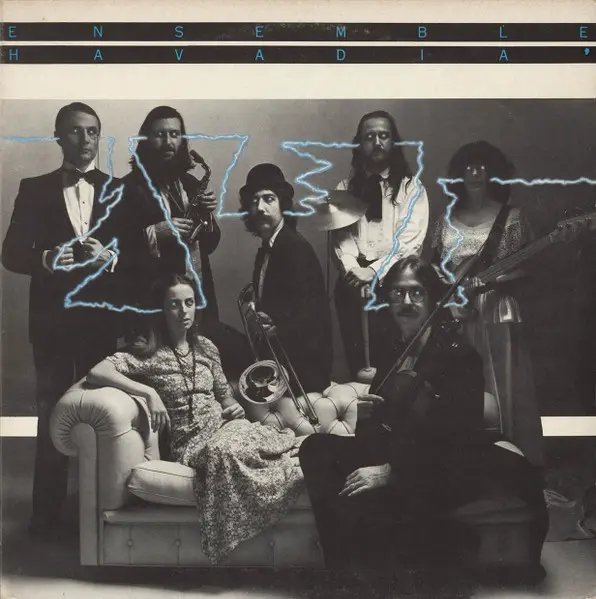 Ensemble Havadià released their self-titled album in 1981 on L’Orchestra.
The album comprises eight original compositions and one excerpted classical quotation, structured as a continuous sequence of theatrical chamber pieces with mixed vocals and shifting instrumentation. The material merges North Italian folk and fanfare elements with modernist chamber textures and abrupt tempo modulations.
Alfredo Lacosegliaz plays classical guitar, percussion, acoustic bass, a modified cello (labeled “schiavoncello da coscia”), and contributes vocals and sonic textures, enmeshed by the violin of singer Gianfrancesco Calabrese and multi-instrumentation from Mony Ovadia (violin, trumpet, guitar), Mariuccia Colegni (electric bass, glockenspiel), and Silvia Paggi (percussion, organ). Mario Arcari juggles saxophone, oboe, and a variant dubbed “oboazzo.”
All tracks are composed or co-composed by Lacosegliaz. Guest lyricists include B. Mariani and G. Calabrese on “I Benandanti,” “Il Serpente Burocratico,” and both versions of “Aria Del Serpente,” while C. Cergoly contributes to “Fuma El Camin.” The closing “Sigla” quotes a theme by Jacques Offenbach.
Ensemble Havadià consists of nine continuous pieces arranged with chamber instrumentation and multi-part vocals that span theatrical, folk, and neoclassical modes. Much of the album centers on intersecting string and wind lines—typically violin, oboe, and saxophone—supported by glockenspiel, classical guitar, and acoustic bass. Vocal sections range from choral hymnody (“I Benandanti”) to spoken-word passages, layered male/female chant, and non-lyrical phrasing. “Il Serpente Burocratico” shifts between rhythmically punctuated voice patterns and contrapuntal instrument passages, while “Gocce Amare” and “Fuma El Camin” stretch out into episodic forms with voice and instrumentation working in alternating sections. Though harmonically experimental, the album avoids harsh dissonance, instead balancing unusual vocal stylings with structured, acoustic ensemble interplay.
A1. “Finale” (5:14) – vocals: Marzia Mestek
A2. “I Benandanti” [The Good Walkers] (6:18)
A3. “Aria Del Serpente” [Air of the Serpent] (1:32)
A4. “Il Serpente Burocratico” [The Bureaucratic Serpent] (2:55)
A5. “Aria Del Serpente” [Air of the Serpent] (2:02)
B1. “Gocce Amare” [Bitter Drops] (6:01)
B2. “Konik” (2:46)
B3. “Fuma El Camin” [The Chimney Smokes] (7:25)
B4. “Sigla” (0:53)
 Sessions were engineered by Lino Remor (credited as Esaù) and Lino Castriotta with sound technician Maurizio Dugoni. Mixing was handled by Roberto Villicich Di Muro. Claudio Gaiaschi and Luisa Valieri contributed photography. Silvano Portalupi designed the Fulmine graphics, with additional art direction by Lele Panzeri. Micael Alexander Obolensky served as lighting director for associated performances.
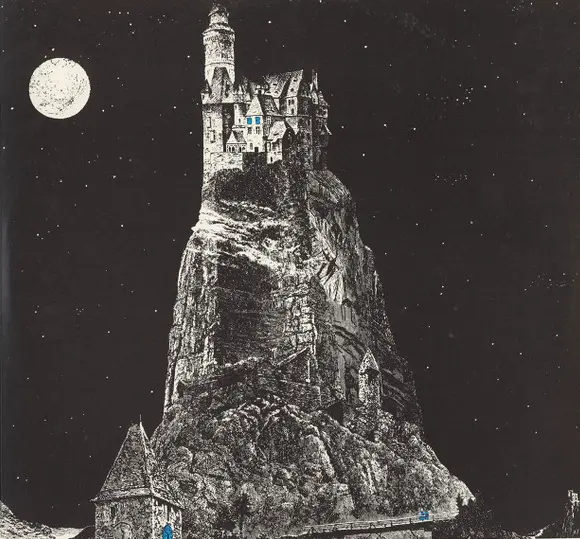
The inner gatefold contains a surreal, high-contrast photomontage. Set against a pitch-black star field with a full moon, a steep crag supports a towering fantasy castle rendered in etched textures. The landscape below is sparsely dotted with human-scale structures, including a small house and an arched tunnel, with a faint blue accent marking select windows and doorways.
“Finale” and “Gocce Amare” also appeared on a 7″ single released by L’Orchestra in 1981.
Specchi
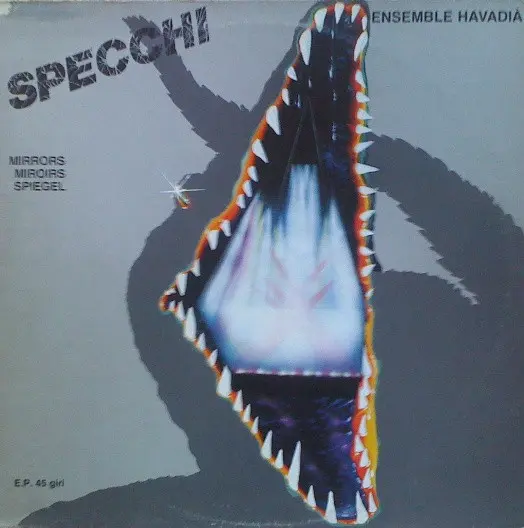 In 1982, Ensemble Havadià released Specchi, a five-track EP on L’Orchestra.
The EP contains music developed for the group’s theatrical concert Specchi (“Mirrors”), which combined instrumental performance with choreographed movement, lighting, and scenographic design built around a luminous pyramid structure.
The program spans compact instrumental miniatures and one extended piece. Ensemble Havadià composed the material collectively, with Alfredo Lacosegliaz authoring or co-authoring three of the five tracks. Mario Arcari and Lorenzo Leddi also contribute as co-writers, with “Rumba ‘An Den Leser’” crediting Arcari alongside poet Franz Werfel.
Alfredo Lacosegliaz plays classical guitar and percussion on Specchi, which features singer Mony Ovadia, bassist Mariuccia Colegni, violinist Velemir Dugina, trumpeter Diego Ruvidotti, contrabassist Mauro Minucci, and dual-instrumentalists Lorenzo Leddi (electric guitar, keyboards), Mario Arcari (oboe, saxophone), and Aldo Di Marco (vibraphone, drums).
A1. “Apertoure” [Apertures] (1:07)
A2. “L’Eternità” [Eternity] (4:08)
A3. “Straziato Assai” [Much Tormented] (1:35)
A4. “Rumba ‘An Den Leser’” [Rumba “To the Reader”] (4:44)
B1. “Treno” [Train] (9:28)
Ensemble Havadià self-produced the EP in February/March 1982 at Regson Studio in Milan. Alfredo Di Muro Villicich engineered the sessions. Gabriele Amadori designed the graphics. The record accompanied the group’s live performances of Specchi across Italy during 1982.
In 2006, Warner Strategic Marketing Italy gathered Ensemble Havadià and Specchi onto a fourteen-track CD titled ’81-’82.
Discography:
- Ensemble Havadià (1981)
- Specchi (EP, 1982)
Sources:
Artist/Album Pages:
Jean-Baptiste Barrière is a French electronic musician who released two 1979 albums titled Pandémo...
Mauro Pelosi (born Aug. 26, 1949) is an Italian singer-songwriter who emerged with the 1972/73 Pol...
Red Summer was an English instrumental art-rock combo behind the 1982 album Release on Rimshot Rec...
Leisure Process were an English sophisti-pop duo that released four singles on Epic between 1981 a...
Elkie Brooks (born Feb. 25, 1945) is an English soul-pop vocalist who recorded three singles apiec...
Phil Daniels & the Cross were an English rock band that made a 1979 self-titled album on RCA. ...
Shock was an American synth-funk band that debuted with an album on Nebula Circle Records in 1980,...
Avtograf (Автограф) was a Russian symphonic rock band formed in Moscow in 1979 by guitarist Alexan...
Saxon are an English hard-rock/metal band that released six albums and a live disc between 1979 an...
Picchio dal Pozzo are an Italian avant-jazz/rock band from Genova, Liguria, formed in 1973. The band...
Simple Minds are a Scottish rock band that released eleven studio albums between 1979 and 1995. Th...
Badfinger was a Welsh pop-rock band first called The Iveys, which released the 1969 album Maybe T...