

Connivence was a Québécois symphonic-folk band that released two albums between 1977 and 1979 on Kébec, followed by a 1984 third on Amplitude.
Members: Paul Pugnaire (guitar, composer, vocals), Marc Sommer (bass, vocals), Jean-Luc Gotteland (keyboards, vocals), Thierry Durbano (drums, percussion), Lionel Dugas (vocals, guitar)
Background
Connivence formed in the Outaouais in 1977 when organizer Mireille Lavoie and oboist Frédéric Hodgson recruited Hull–Ottawa musicians into a shared recording and concert collective. The project drew its first core from singer-songwriters Robert Soucy and Steve Burman, keyboardist Philippe Legault, the Paul Lacasse–Gilles Legault duo Nous Autres, and Charles Fairfield’s group Oasis.
Lacasse and Gilles Legault had worked together since the mid-1970s in Nous Autres, which played its first show at the Berceau des Artistes on rue Laurier in Hull after a 1974 notice in Le Droit. In September 1975, Philippe Legault brought Nous Autres and bassist Mario Gratton into the stage music for Jean Barbeau’s Citrouille at the new Cégep de l’Outaouais. Lacasse and Gilles Legault added the instrumental “Norma Jean Baker” to that program; Connivence later recorded the piece as “Blanc-Blême.”
Lavoie and Hodgson used their theater-music link to bring Philippe Legault and Nous Autres into the wider Connivence circle, with Syncope bassist Robert T. Villeneuve inside the Nous Autres lineup. The participants planned the first Connivence album as a joint promotional demo, with each artist or group contributing separate material under one name. The organizers used support from a government project, the Canada Council, and CAPAC to pay for the studio time and cover work.
Connivence
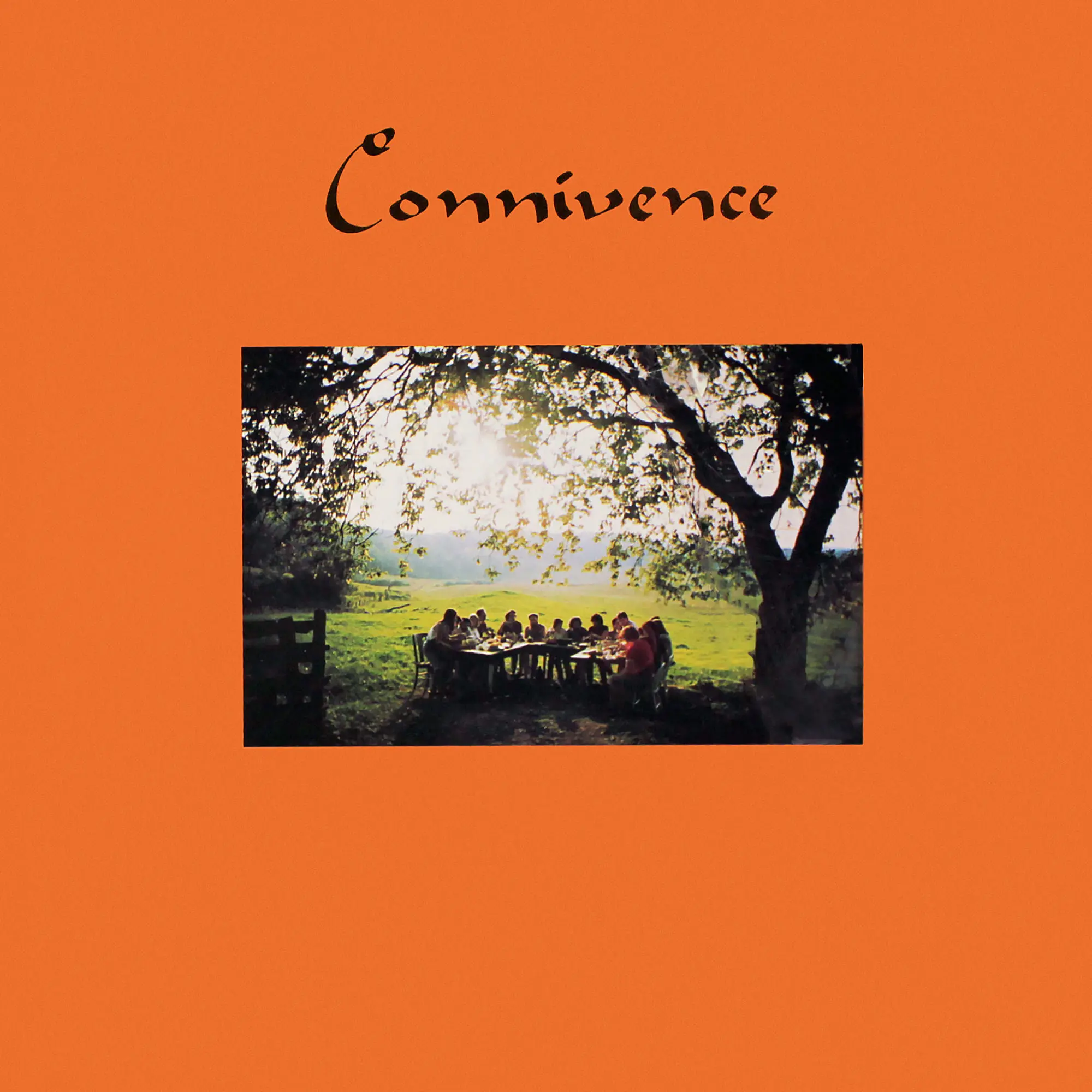 Connivence released their self-titled debut album in 1977 on Kébec-Disc.
The album features a core lineup of guitarist Robert Soucy, singer Micheline Scott, reedist Peter Gould (alto saxophone, baritone saxophone, tambourine), singer-guitarists Paul Lacasse and Gilles Legault, keyboardists Steve Burman and Philippe Legault (Elka organ), and multi-instrumentalists Charles Fairfield (recorder, piano) and Peter Chapin (banjo, synthesizer, piano).
Connivence also includes guitarist Bob Stark, drummer Rameau, clarinetist Luc Fradette, oboist Frédéric Hodgson, cellist Valerie Munn, flutist Raymond Leblanc, violinists Daniel Kushner and Suzanne Sabourin, and bassists Doug Orr, Robert Villeneuve, and Michel Gervais,
“Gigue” prances through an instrumental jig with quick section turns and arranged ensemble figures. “Dans ta fenêtre” lingers over acoustic strums and sensitive vocal placement. “Le boyau en liberté” scurries through fast keyboard figures and hard-bowed lines. “Le pit de sable de Lucerne” cuts through chamber-rigged reed passages, severe piano accents, and sharp clarinet turns. “La villageoise en ville” glides through delicate flute phrases, soft harmonic support, and female-choir haze. “Happy Endings” skips across a jazzed-up jig with firm rhythm-section motion, string figures, and saxophone replies. “Lapin” spins from pastoral string passages into woodwind-string interplay and abrupt section breaks.
A1. “Gigue” [Jig] (2:11) – Soucy
A2. “Dans ta fenêtre” [In Your Window] (3:04) – Gilles Legault
A3. “Le boyau en liberté” [The Hose on the Loose] (2:33) – Burman
A4. “La dernière grande valse” [The Last Grand Waltz] (2:45) – Soucy
A5. “Le pit de sable de Lucerne” [The Sand Pit of Lucerne] (4:05) – Burman
A6. “La villageoise en ville” [The Village Woman in Town] (4:50) – Philippe Legault; arr. Leblanc
B1. “Happy Endings” (6:00) – Fairfield; arr. Oasis
B2. “Blanc-blême” [Ashen White] (3:57) – Lacasse, Gilles Legault
B3. “L’eau de la vie” [The Water of Life] (4:24) – Gilles Legault
B4. “Lapin” [Rabbit] (6:07) – Fairfield; arr. Oasis
Quentin Meek produced and engineered the album. Connivence recorded the sessions at Productions Marc in Ottawa and Listen Audio in Montréal. Meek mixed the album at Studio Six in Montréal.
Connivence appeared in an orange cover package with photography by Pierre St-Jacques. The front image shows a long outdoor table beneath trees.
II
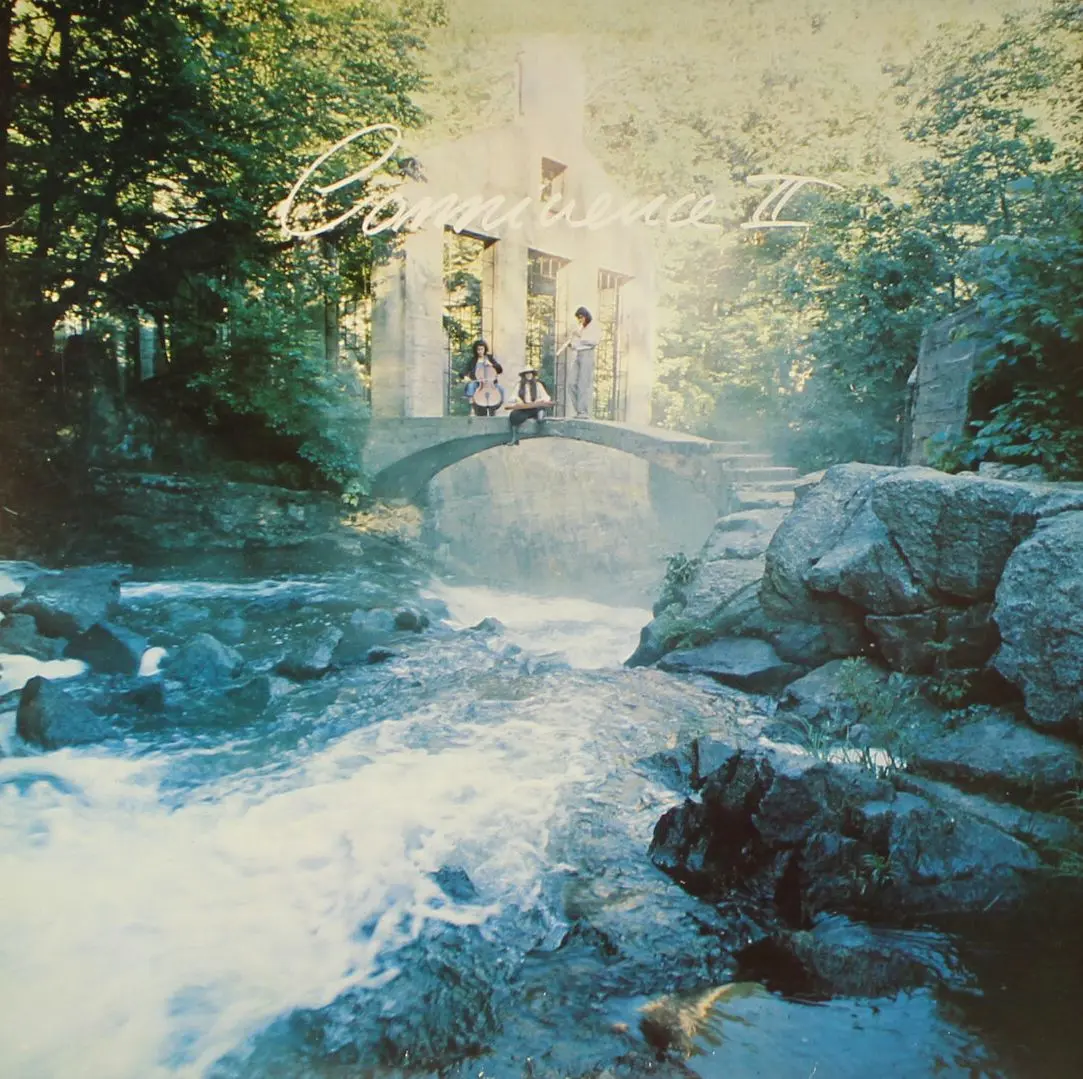 Connivence released their second album, II, in 1979 on Kébec-Disc.
II retains Gilles Legault, Philippe Legault, Lacasse, Burman, Villeneuve, Munn, Hodgson, and Gould from the debut. The album adds singer France Charron, guitarist Guy Lafrance, accordionist Paul Brisson, flutist Lina Binet, keyboardist François Groulx, saxophonist Sylvain Soucy, trombonist Bernard Grenier, violinist Gilles-Laurent Martin, trumpeters Michel Villeneuve and Serge Mercier, and drummers Charles Gay and Jean Dumontier.
“Québec au printemps” settles into plain folk-song cadence, with direct verse motion and modest arrangement density. “Le mât” drifts through chamber-softened vocal lines, cello undercurrent, and string shading. “Chanson d’amour pour France” winds flute phrases through jazz-tilted section changes. “Dac” tightens the same field into compact arranged turns. “Les cocottes de Kazou” circles a related folk-jazz pattern. “Saskatoon” crests toward jig-like motion in its final developments. “S’il y a d’l’amour” sways on close harmony vocals and chorus repetition.
A1. “Québec au printemps” [Quebec in Spring] (4:04) – Philippe Legault
A2. “Le mât” [The Mast] (2:22) – Gilles Legault
A3. “Chanson d’amour pour France” [Love Song for France] (5:28) – Lafrance
A4. “Dac” (3:15) – Burman
A5. “Les cocottes de Kazou” [Kazou’s Hens] (3:18) – Burman
B1. “Saskatoon” (4:03) – Burman
B2. “S’il y a d’l’amour” [If There Is Love] (3:27) – Gilles Legault
B3. “1959” (3:02) – Burman; arr. Groulx
B4. “Une goutte de sang” [A Drop of Blood] (4:21) – Gilles Legault
B5. “Le bateau” [The Boat] (2:41) – Gilles Legault
B6. “Accouche qu’on baptise” [Get on With It] (4:11) – Viau, Lafrance
Frédéric Hodgson produced II for Éditions Pesqhelbach. Connivence recorded the album in April and May 1979 at Productions Marc in Ottawa. Quentin Meek engineered the sessions and served as musical producer. The mix also took place at Productions Marc.
II appeared in a standard sleeve with an inner sleeve. The front image shows figures on a stone bridge above running water and rocks.
III
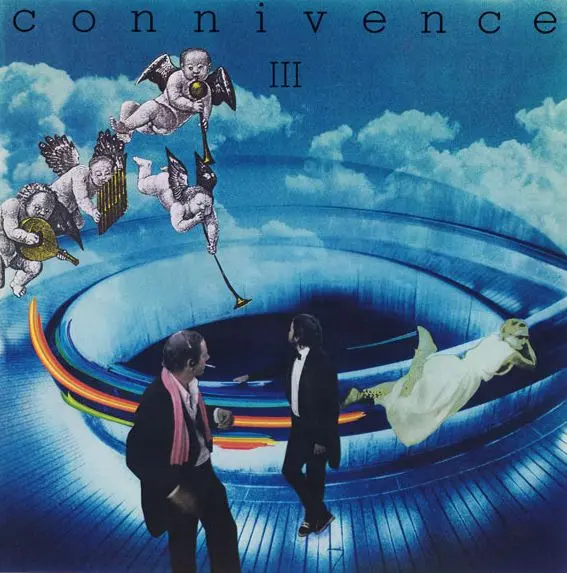 Connivence released their third album, III, in 1984 on Amplitude.
III retains Scott, Gilles Legault, Gould, Fairfield, Villeneuve, Charles Gay, Burman, and Sabourin from earlier albums. Connivence adds bassist Claude Gay, drummer Robert Fontaine, saxophonist Jack McGowan, cellist Norman Adams, percussionist René Fortier, and violinist Cathy Allen. Charles Fairfield arranged and directed the album; Gould arranged and directed “Ton aura.”
“Le reggae de la buanderie” saunters on a reggae-tilted lilt. “Ou vent frisonne” sings in a brief, plaintive register, with Gilles Legault’s vocal line placed at close range. “Détour” gathers the album’s progressive side into its clearest instrumental passagework.
A1. “Le Reggae de la Buanderie” [The Laundry Room Reggae] (3:32) – Scott
A2. “Y’en a qui l’ont” [Some Have It] (2:58) – Gilles Legault
A3. “Où vent frissonne” [Where Wind Shivers] (2:20) – Gilles Legault
A4. “Ton aura” [Your Aura] (3:29) – Scott
A5. “L’Homme-Caméléon” [The Chameleon Man] (3:46) – Scott
B1. “Minou” [Kitty] (2:20) – Burman
B2. “Le rêve de Céline” [Céline’s Dream] (2:58) – Gilles Legault
B3. “Fugèreville” (2:42) – Burman
B4. “Solitairement femme” [Woman Alone] (4:14) – Scott
B5. “Détour” [Detour] (4:23) – Burman
Connivence recorded III at Productions Marc in Ottawa. René Godbout engineered the sessions and co-produced the album. The final mix took place at Studio Saint-Charles in Longueuil under Godbout.
Les Illustrateurs de l’Outaouais Inc. designed the cover package with photographs and site scouting by Sylvie Janvier and Vincent Charette. The front image shows cutout figures and winged players around a circular interior, with cloud forms and a rainbow band in the surrounding field.
Discography:
- Connivence (1977)
- II (1979)
- III (1984)
Sources:
- Discogs: Connivence
- RYM: Connivence
- MusicBrainz: Connivence
- Disqu-O-Québec: Connivence
- CitizenFreak: Connivence
Artist/Album Pages:
Isaiah was an Austrian jazz-rock/psych sextet behind a 1975 self-titled album on CBS. Before their...
Cox Orange was a Danish jazz-rock band that released two albums on Amar between 1978 and 1980, fol...
Stanton Davis (born Nov. 10, 1945) is an American trumpeter from New Orleans who led the jazz-funk...
Rick Mason and Rare Feelings were an American soul-funk band that released the 1976 album The Inne...
Shriekback was an English ethno/art-funk band that released multiple 1982–84 shortplayers and the ...
Maximum Joy are an English art-funk/dub band that cut the 1981/82 Y Records singles "Stretch," "Wh...
Errata Corrige was the Italian symphonic/chamber-folk combo behind the 1976 album Siegfried, il Dr...
The Mysterious Flying Orchestra were an American jazz-funk big band arranged by conductor–composer...
Lewis Furey is a Québécois cabaret/art-pop singer/songwriter who released the 1975–79 Aquarius alb...
Positive Noise was a Scottish new wave band on Statik Records that released the 1981–82 albums Hea...
Harold Vick (April 3, 1936 — Nov. 13, 1987) was an American post-bop/jazz-funk saxophonist and fl...
The Bruce Clarke Quintet was an Australian jazz-rock band that released the 1974 album Stratusphun...