

C. J. & Co. were an American soul-funk studio group from Detroit that released the 1977/78 albums Devil’s Gun and Deadeye Dick on Westbound Records.
Members: Dennis Coffey, Cornelius Brown Jr., Curtis Durden, Joni Tolbert, Connie Durden, Charles Clark
Background
The project evolved from C.C. & Co., assembled by producers Dennis Coffey and Mike Theodore.
Coffey (b. November 11, 1940) first played in a late-period lineup of The Royaltones, which scored a 1958 hit with “Poor Boy.” As a member of the Hitsville studio band the Funk Brothers, he played on Motown classics by The Supremes (“Someday We’ll Be Together”), The Temptations (“Cloud Nine,” “Ball of Confusion,” “Psychedelic Shack”), Freda Payne (“Band of Gold”), and Edwin Starr (“War”). In 1968, Coffey and Theodore co-wrote, arranged, and produced “Make Your Move” for The Strides, a soul-pop group on M-S Records.
In 1975, C.C. & Co. released a string-laden soul-pop/MOR cover of “Daydreamer,” a 1973 UK hit for David Cassidey, written by South African songwriter Terry Dempsey. The C.C. version of “Daydreamer” appeared on Westbound backed with the Coffey/Theodore original “Would You Believe It?” The a-side also appeared as “Day Dreamer” on the bootleg Sussex label with “Boogie Love,” a song co-credited to Dobie Gray and Troy Seal.
By 1977, the projected rebranded on Westbound as C.J. & Co. with singer Cornelius Brown Jr. and four vocalists from the Mike Theodore Orchestra: Constance Durden, Curtis Durden, Joni Tolbert, and Floaters participant Charles Clark.
Devil’s Gun
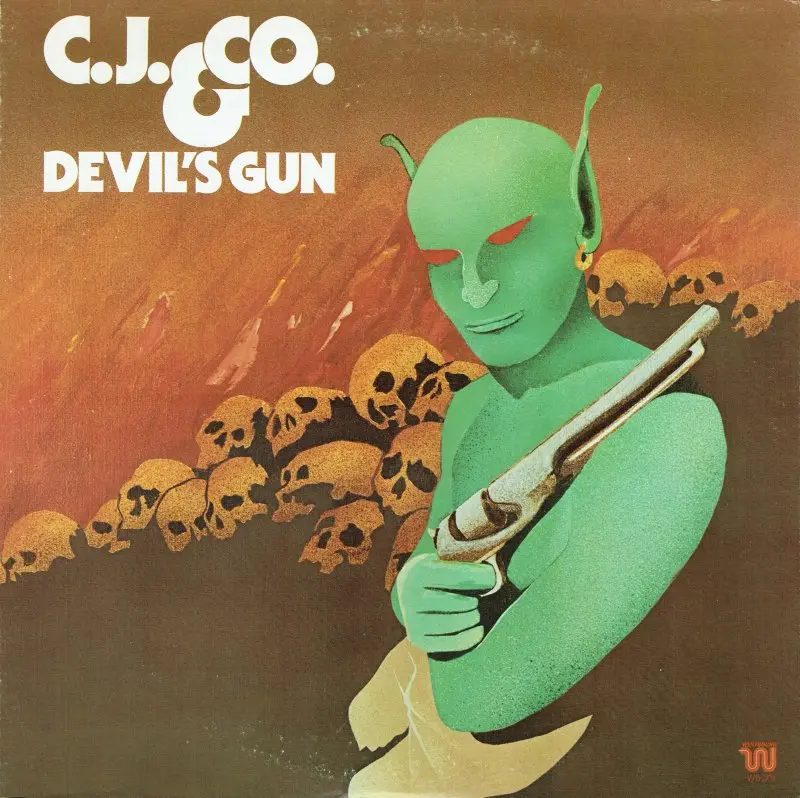 C.J. & Co. released their first album, Devil’s Gun, in May 1977 on Westbound.
The album centers on extended, rhythm-heavy disco-funk with orchestrated strings and horns. Across five long tracks, the band emphasizes communal vocals and instrumental interplay over ballads or slow passages, locking into fast-paced structures that push dancefloor momentum.
Coffey and Theodore produced and arranged the record, writing four tracks with Brown, the Durden siblings, Tolbert, and Clark. Barry Blue (as B. Green), Gerry Shury, and Ron Roker wrote the title track.
“Devil’s Gun” rides a pounding beat and communal chants, peaking with layered strings and guitar licks. “We Got Our Own Thing,” “Free to Be Me,” and “Get a Groove in Order to Move” extend on vocal exchanges and sharp horn punctuation, while “Sure Can’t Go to the Moon” stretches into its longest arc with instrumental solos.
A1. “Devil’s Gun” (7:14)
A2. “We Got Our Own Thing” (9:30)
B1. “Free to Be Me” (5:03)
B2. “Get a Groove In Order to Move” (5:11)
B3. “Sure Can’t Go to the Moon” (7:30)
Sessions occurred at PAC 3 Recording Co. in Dearborn, Michigan, where the rhythm section tracked under Coffey’s direction. Theodore arranged the horns and strings, recorded at Hollywood Sound. Tom Moulton mixed the album in Philadelphia with Arthur Stoppe and Jay Mark engineering.
Devil’s Gun features artwork by John Gabbara, depicting a green-skinned, bare-chested figure with horns against a dark backdrop. In Germany, Atlantic issued the album with an image still of Jane Fonda from the 1968 sci-fi Barbarella.
Westbound issued two singles: “Devil’s Gun” backed with “Free to Be Me,” and “We Got Our Own Thing” split into vocal and instrumental parts. The title track reached No. 2 on the R&B chart, No. 36 on the Hot 100, and topped the Billboard disco chart along with “We Got Our Own Thing” and “Sure Can’t Go to the Moon.” It became the first song played at the opening of Studio 54 on April 26, 1977. The album peaked at No. 12 on the R&B albums chart and No. 60 on the Billboard 200.
Deadeye Dick
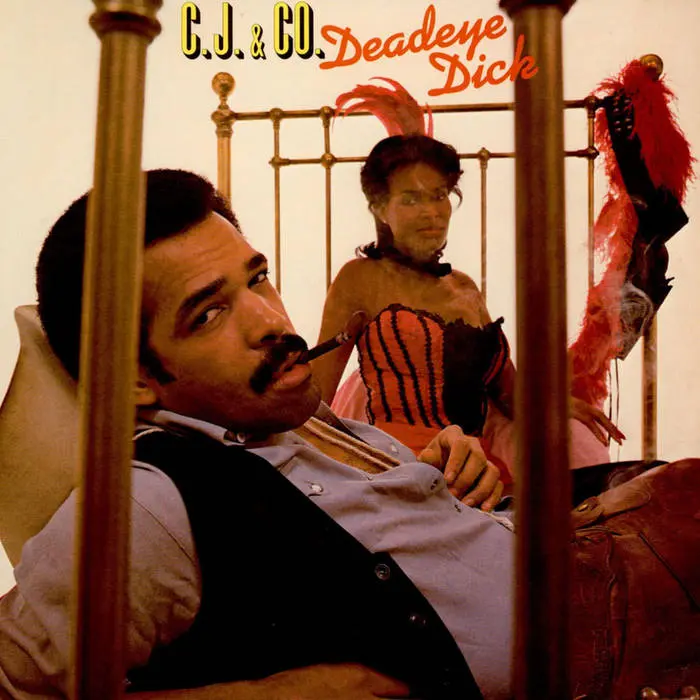 C.J. & Co. released their second album, Deadeye Dick, in July 1978 on Westbound.
The record builds on the disco-soul foundation of Devil’s Gun, fusing string-laden arrangements and percussive drive with a strong Detroit soul undercurrent. Its six songs favor extended dance passages with orchestral lift, rhythmic layering, and group vocals, while slipping in theatrical flourishes like the title track’s Wild West motif.
Mike Theodore wrote four tracks, including “Burning Drums of Fire,” “Deadeye Dick,” “Beware the Stranger,” and “Big City Sidewalk.” Dennis Coffey co-wrote “Hear Say” with Cleveland Horne and James Epps, and paired with Horne on “You’re Still the Sweetest Thing in My Life.”
“Burning Drums of Fire” opens with galloping percussion and swelling strings before locking into a hard-pressed disco pace. “Deadeye Dick” follows with camp theatrics, recounting an outlaw tale against sweeping orchestrations. “Beware the Stranger” and “Big City Sidewalk” sustain momentum with stacked vocals and tight brass phrasing, while “Hear Say” and “You’re Still the Sweetest Thing in My Life” close the album on more contoured, soul-centered turns.
A1. “Burning Drums of Fire” (5:18)
A2. “Deadeye Dick” (7:00)
A3. “Beware the Stranger” (6:15)
B1. “Big City Sidewalk” (6:20)
B2. “Hear Say” (7:18)
B3. “You’re Still the Sweetest Thing In My Life” (5:52)
Sessions occurred at PAC 3 Recording Company in Dearborn, Michigan, with Coffey and Theodore producing and arranging. Tom Moulton mixed the album at Sigma Sound Studios in Philadelphia with Arthur Stoppe engineering, assisted by Darrell Rogers. Richard Becker recorded the sessions, while José Rodriguez mastered the lacquer.
Deadeye Dick features photography by Joel Brodsky.
Westbound issued two singles: “Big City Sidewalk” backed with “Call Me If You Need Me,” and “Deadeye Dick” also paired with “Call Me If You Need Me.”
Postlude
C.J. & Co. recorded material for a projected third album with a proposed 1979 release date, but the record was shelved after Westbound’s distribution deal with Atlantic ended. Tracks intended for that album later surfaced across two compilations: USA Disco (1998) and Ain’t It Amazing (The Unreleased Westbound Masters) (2018).
The unreleased album combined writing from the group’s five vocalists with contributions from producers Dennis Coffey and Mike Theodore, who also arranged and conducted the sessions. Collective efforts by Charles Clark, Cornelius Brown Jr., Constance Durden, Curtis Durden, Joni Talbert, Coffey, and Theodore produced “Ain’t It Amazing,” “Rainbow Music,” and “Let Them Talk.” Coffey and Theodore wrote “The Golden Touch,” while Coffey authored “Call Me If You Need Me.” Other tracks came from outside writers, including “Get Lucky” by Eric Morgeson; “Is Your Love Life Better” by Ben Raleigh and Sam Fox; and three Cole Simon/Lulu Laurent/Sam Kennedy pieces: “Brassband,” “Can’t Believe You’d Break Your Promise,” and “Boogie Love.” Timothy Moore supplied “Rainmaker.”
1. “Ain’t It Amazing” (5:59)
2. “Rainbow Music” (9:48)
3. “Devil’s Gun (Original Mix)” (4:55)
4. “Get Lucky” (6:47)
5. “Is Your Love Life Better” (2:53)
6. “Brassband” (4:21)
7. “Let Them Talk” (3:58)
8. “Can’t Believe You’d Break Your Promise” (3:25)
9. “Boogie Love” (2:47)
10. “The Golden Touch” (7:42)
11. “Rainmaker” (4:15)
12. “Call Me If You Need Me” (5:02)
The collection was mastered at Sound Mastering Ltd. by Nick Robbins and released on Ace Records with packaging design by The Unknown and liner notes by Dean Rudland. Its 2018 booklet described the set as an “alternative history” of C.J. & Co., assembling material recorded as Coffey and Theodore tested new directions for the group alongside unreleased outtakes and the abandoned third album.
Discography:
- Devil’s Gun (1977)
- Deadeye Dick (1978)
Sources:
Artist/Album Pages:
Artcane was a French symphonic-rock band that released the album Odyssée on Philips in 1977. Mem...
Solstice was an American Midwest jazz-funk band that released a 1977 self-titled album through Enc...
Uni Sono was a Finnish jazz-rock supergroup comprised of distinguished players on the Helsinki mus...
Mombasa was an Afro-jazz/funk band formed by German-based American trombonist Lou Blackburn. They ...
Willie Hutch (Dec. 6, 1944 — Sept. 19, 2005) — was an American soul-funk musician, composer, and p...
Pepe & Paradise were a Finnish jazz-pop combo behind ten singles and three albums between 1970...
Tempest was an English hard-rock supergroup on Bronze that released a self-titled album in 1973 wi...
The Funky Kings were an American rustic-folk/pop band from California that released a 1976 album o...
Donald Byrd (1932–2013) was an American post-bop trumpeter who apprenticed with the Jazz Messenger...
Frijid Pink was an American hard-rock band from Detroit that released the 1970 albums Frijid Pink an...
Rainbow Generator was the Australian experimental electronic duo of synthesist Robert “Ras” Greave...
Orange Power was an Austrian band from Wien, active from 1973 for two decades. They included singe...