

Aquarelle was a Québécois chamber-jazz/rock octet that released the 1978 album Sous un Arbre on Atlantic, followed by a live album of unique material from the Montreux Jazz Festival.
Members: Pierre Lescaut (keyboards), Stéphane Morency (guitar), Pierre Bournaki (violin), Jean-Philippe Gélinas (saxophone, flute), Michel De Lisle (bass), André Leclerc (drums), Anne-Marie Courtemanche (vocals), Sharon Ryan (vocals)
Inception
Aquarelle (Watercolor) combined three rock instrumentalists — guitarist Stéphane Morency, bassist Michel De Lisle, and drummer André Leclerc — with keyboardist Pierre Lescaut, violinist Pierre Bournaki, reedist Jean-Philippe Gélinas, and vocalist Anne-Marie Courtemanche.
Leclerc played percussion on one track (“Voix et Violon”) on L’Île Où Vivent Les Loups, the classic 1977 album by Quebecois chamber-folksters L’Engoulevent. His earlier credits include titles by Claude Lafrance, Louise Forestier, and Ovila Blais.
Aquarelle
 Aquarelle released their sole studio album, Sous un Arbre, in February 1978 on Atlantic.
The album presents a chamber-inflected form of Quebecois jazz-rock that merges symphonic textures with the rhythmic drive of late-1970s fusion. The seven-member ensemble centered around keyboardist and composer Pierre Lescaut, whose piano and synthesizer work shapes the music’s refined harmonic framework. Vocalist Anne-Marie Courtemanche contributes ethereal wordless passages that weave through the ensemble’s interplay of violin, flute, and electric instruments.
Lescaut composed all seven pieces, arranging them collectively with the group. His compositions balance impressionistic, acoustic passages with moments of brisk jazz-rock movement.
“La Magie des Sons” opens with violin-led chamber fusion that builds into an expansive rhythmic pulse with layered piano and saxophone. “Francoise” pairs light flute motifs with buoyant syncopation and a closing section in bright, festival-like rhythm. “Bridge” applies a brisk funk undercurrent with ensemble brass textures. “Sous un Arbre” unfolds with gradual thematic development and interplay between acoustic piano and strings. The three-part suite “Aquarelle (Partie 1–3)” moves from pastoral motifs to intricate, classically structured segments that highlight the ensemble’s cohesion. “Volupté” emphasizes reflective piano and violin phrasing, while “Espéranto” closes the set with an extended dialogue between Lescaut and violinist Pierre Bournaki.
A1. “La Magie des Sons” [The Magic of Sounds] (6:40)
A2. “Francoise” (4:48)
A3. “Bridge” (5:48)
A4. “Sous un Arbre” [Under a Tree] (4:30)
B1.1 “Aquarelle (Partie 1)” (2:30)
B1.2 “Aquarelle (Partie 2)” (1:15)
B1.3 “Aquarelle (Partie 3)” (4:35)
B2. “Volupté” [Voluptuousness] (4:32)
B3. “Espéranto” (5:48)
Sessions occurred at Studio Six in Montreal between October and November 1977 with producer Chuck Gray and engineer Gabriel Boucher. The group co-produced the album.
The cover features artwork by Louis Legrand with design concept by Ariel Borremans and photography by Pierre Desjardins.
Atlantic issued “Bridge” (b/w “Aquarelle [Partie 2]”) as a single. “Francoise” appeared on The Vinyl Solution, a 1978 Jem Records sampler with cuts by fellow Canadian acts (Dale Jacobs, Hellfield, Streetheart) and artists from the US (Alphonse Mouzon, Good Rats, The Shoes), UK (Buzzcocks, The Flys, Siouxsie & The Banshees, Ultravox), Australia (The Angels), and Austria (Richard Schönherz).
Live à Montreux
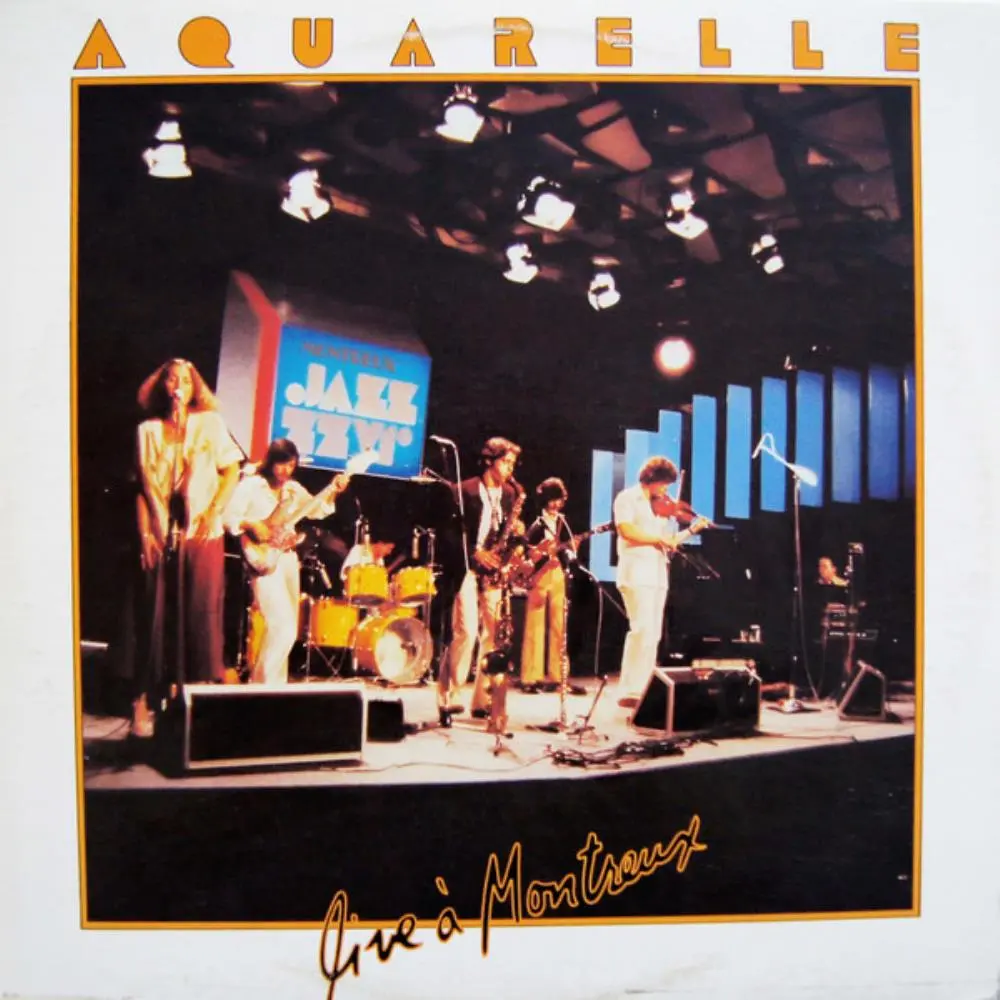 In April 1979, Aquarelle released Live à Montreux, a document of their July 7, 1978, set at the annual Swiss jazz festival.
The album captures Aquarelle’s refined Quebecois jazz fusion in a more expansive, live context, highlighting the ensemble’s interplay and heightened rhythmic freedom. Compared to their studio debut, Live à Montreux leans further into electric jazz textures and extended improvisation, with added funk inflection and less reliance on wordless vocals. Sharon Ryan replaced departing singer Anne-Marie Courtemanche, bringing a more forceful, expressive vocal presence.
Keyboardist Pierre Lescaut composed and arranged all eight pieces, which the group performed without overdubs. His writing retains the impressionistic, classically tinged architecture of Aquarelle while allowing greater space for individual expression, particularly from violinist Pierre Bournaki and saxophonist Jean-Philippe Gélinas.
Side one features four self-contained numbers. “Machine à Boules” opens the set with brisk electric piano runs and rhythmic exchanges between violin and saxophone. “Second Réveil” contrasts electric and acoustic tones across shifting meters, while “Récital des Grenouilles” explores a lively, folkloric theme with percussive accents. “La Nouvelle” concludes the first half with alternating passages of intensity and repose, highlighting Ryan’s expressive phrasing. The second side begins with “L’Étranger,” an instrumental interpretation inspired by the Albert Camus novel, followed by the two-part “Estérel,” which moves from chamber restraint to raucous ensemble sections. The closing “Magie des Sons,” extended from its studio version, features a virtuosic piano interlude and dynamic exchanges between Bournaki’s violin and André Leclerc’s drums.
A1. “Machine à Boules” [Ball Machine] (5:46)
A2. “Second Réveil” (3:54)
A3. “Récital des Grenouilles” [Recital of the Frogs] (4:06)
A4. “La Nouvelle” [The New One] (5:04)
B1. “L’Étranger” [The Stranger] (5:25)
B2.1. “Estérel, Partie 1” (3:41)
B2.2. “Estérel, Partie 2” (2:39)
B3. “Magie des Sons” [Magic of Sounds] (9:37)
The concert was recorded by Mountain Recording Studio engineers David Richards and Gabriel Boucher. Jacques Chénier served as executive producer. The live mix preserves the natural acoustic balance of the performance, emphasizing Lescaut’s piano and Bournaki’s violin.
Live à Montreux features front-cover photography by Denis Lapalme and back-cover photography by Alain Paré.
Recorded before an international audience, the album demonstrates Aquarelle’s ability to merge precision and spontaneity within a live jazz-rock idiom. It marked their final release before disbanding later that year.
Postlude
Pierre Lescaut plays on the 1982 album Le Voyage Intérieur by electronic musician Jean-Louis Victor.
Discography:
- Sous un Arbre (1978)
- Live à Montreux (1979)
Sources:
Artist/Album Pages:
Supply Demand & Curve were an Irish progressive/jazz-rock group active in Dublin from 1970 thr...
Electromagnets were an American jazz-rock band from Austin that issued an eponymous album on self-...
Sonny Sharrock (Aug. 27, 1940 — May 25, 1994) was an American avant-jazz guitarist, active for twe...
Aquila was a Chilean jazz-rock quintet behind a 1974 self-titled album on Alba. Keyboardist Guille...
Shirley Brown (born Jan. 6, 1947) is an American soul singer based in Memphis who made five album...
Maggie Bell is a Scottish singer who fronted soul-rockers Stone the Crows on four albums between 197...
Momoe Yamaguchi (山口百恵) is a Japanese former singer who released twenty-two albums between 1973 and...
Agapanthos (Αγάπανθος) was a Greek folk-rock/art-rock band that released a single and self-titled ...
Bernie Worrell (April 19, 1944 — June 24, 2016) was an American funk keyboardist, composer, and ar...
Sundance was a Swedish jazz-rock band that released a 1976 self-titled album on EMI Harvest. Mem...
Rose Banks is an American soul singer who harmonized with her brother Sly Stone as a member of his...
Ian Thomas is a Canadian songwriter, guitarist, and singer who released six albums on GRT between ...
Hi I am the composer and keyboardist of the group Aquarelle. Here is the link to the Aquarelle Officiel Facebook page. You will find several photos and newspaper articles. The page is still under construction. Soon a complete bio on the group…
Thank you for your work and publications on prog music.
Pierre Lescaut
Aquarelle live at Montreux Jazz Festival in 1978 ”Machine à Boule”
https://www.youtube.com/watch?v=wjueIwQfHo0
Aquarelle live at Montreux International Jazz Festival ”L’Étranger”
https://www.youtube.com/watch?v=yQNupoCNKHo