
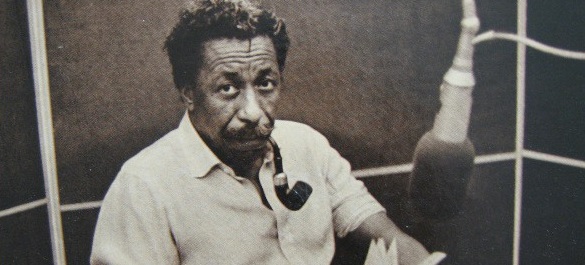
Gordon Parks (Nov. 30, 1912 — March 7, 2006) was an American photographer, filmmaker, writer, composer, and pianist. His music work included the score for The Learning Tree and orchestral collaborations with Henry Brant and Tom McIntosh. Parks directed the 1971 blaxploitation film Shaft with a score by Isaac Hayes, then directed and scored its 1972 followup Shaft’s Big Score!
Background
Gordon Roger Alexander Buchanan Parks was born Nov. 30, 1912, in Fort Scott, Kan., the youngest of 15 children of farmer Andrew Jackson Parks and Sarah Ross Parks. Sarah Parks made installment payments on a household piano from 1919 through 1925; Gordon learned the instrument by ear. Parks finished ninth grade at segregated Plaza School, then entered the integrated high school in Fort Scott. He lost his mother in May 1928 and moved to St. Paul that autumn to live with sister Maggie Lee. Parks enrolled at Mechanic Arts High School in St. Paul.
Parks left his sister’s household near Christmas and supported himself with restaurant work around St. Paul and Minneapolis. An acquaintance at a St. Paul pool hall found him work as pianist at a Minneapolis brothel. He wrote “No Love” at the piano in the early thirties, and Larry Funk’s orchestra broadcast the song on radio. Parks joined Funk’s traveling orchestra and reached New York in March 1933 for a Park Central Hotel engagement. The orchestra dissolved on arrival, and Parks spent the next several months in Harlem. He entered the Civilian Conservation Corps at Fort Dix, N.J., in April and returned to Minneapolis after his discharge the following summer.
Parks joined the Northern Pacific Railroad in 1935 as a porter and waiter. He used a December 1937 Chicago layover to visit a theater showing newsreel footage of the USS Panay, then bought a Voigtländer Brilliant camera at a Seattle pawnshop. The Minneapolis shopkeeper who processed his first roll encouraged his photography and later displayed the pictures. Parks worked for the St. Paul Recorder in 1939 and also photographed for the St. Paul YWCA and International Institute.
Marva Louis, wife of heavyweight boxer Joe Louis, saw Parks’ work in 1940 and encouraged a move to Chicago. Parks established a portrait business there and joined the South Side Community Art Center. He photographed poverty and daily life across the South Side and won a Julius Rosenwald Fellowship with those photographs in 1942. Parks chose Roy Stryker’s Farm Security Administration photography unit in Washington for the fellowship. He followed Stryker into the Office of War Information and subsequently into Standard Oil documentary work. Parks published the instructional book Flash Photography in 1947 and followed it with Camera Portraits the next year. Life hired him as a staff photographer after a Harlem gang photo essay. Editors at Life assigned Parks to Paris in 1950 for two years at the magazine bureau.
Parks resumed composition in Paris and developed a four-movement work from flamenco music he heard on assignment in Spain. Composer-orchestrator Henry Brant transferred Parks’s piano materials into orchestral form. Conductor Dean Dixon premiered Symphonic Set for Piano and Orchestra in July 1952 with the 88-piece La Fenice Theater Orchestra at the Doge’s Palace in Venice. Parks continued to compose around photography assignments and completed Tree Symphony in 1967, then reused themes from the work for The Learning Tree.
Parks published The Learning Tree in 1963 as a semi-autobiographical novel based on his Kansas childhood. He built directing experience with the documentary Flávio and two 1968 television films, Diary of a Harlem Family and The World of Piri Thomas. Independent producers acquired film rights to The Learning Tree but failed to finance a production. Parks rejected a separate offer that required white characters in place of the Black family from his novel. Filmmaker John Cassavetes introduced Parks’s work to Warner Bros.-Seven Arts executive Ken Hyman, who offered Parks a multi-picture agreement. Warner hired Parks to direct his own screenplay of The Learning Tree. Parks returned to Fort Scott for the film shoot in autumn.
Parks composed the score and reused material from Tree Symphony. Jazz trombonist-arranger Tom McIntosh orchestrated and conducted Parks’s music under Warner music supervisor Sonny Burke. Producer Jimmy Bowen produced the soundtrack album for Warner Bros. Records with engineers Lee Herschberg and Rudy Hill.
Discography:
- The Learning Tree (OST, 1969)
- Shaft’s Big Score (OST, 1972)
Artist/Album Pages:
Dreams were an American brass-rock band from New York that released the 1970–71 Columbia albums Dr...
The Raspberries were an American midwest pop-rock band behind the 1972 Capitol albums Raspberries...
Home was an English rustic art-rock band from London, best remembered for the 1972 epic "Lady of t...
Wigwam was a Finnish psychedelic jazz-rock/art-rock band that cut seven studio albums between 1969...
Too Much was a Japanese hard-rock/psych band behind a 1971 self-titled album on Atlantic. Member...
Sogmusobil was a Swedish blues-psych trio behind the 1971 album Telefon on Gump. Members: Einar H...
Berlin was an American new wave band from Los Angeles, best known for the synthpop hits "Masquerad...
Osibisa are an Afro-funk/jazz-rock band formed in London by four Ghanaian and three Caribbean musi...
Twenty Sixty Six and Then were a German symphonic/hard-rock band that released the 1972 album Refl...
Mirthrandir was an American symphonic-rock band behind the 1976 album For You the Old Women, self-...
Milton Hamilton Crystalized was the New York studio project of pianist, arranger, and producer Mil...
Paul Korda (1948 – March 11, 2020) was an English singer, songwriter, and producer who issued a stri...