

Hodges, James & Smith were an American vocal trio that released four albums between 1973 and 1978 on 20th Century Records. Early fourth member Carolyn Crawford also recorded as a solo artist.
Members: Pat Hodges, Denita James, Jessica Smith, Carolyn Crawford (1971—72)
Background
Hodges, James & Smith were assembled in Los Angeles in 1970 by producer William “Mickey” Stevenson (b. January 4, 1937; Detroit), Motown’s original head of A&R who co-wrote the Martha & The Vandellas evergreen “Dancing in the Street” and the Marvin Gaye/Kim Weston duet “It Takes Two.” Stevenson headed west after leaving Motown in 1967 and launched the People label, where he developed a new girl-group intended as a Supremes-style act.
Singer Jessica Smith worked as Stevenson’s secretary in Los Angeles when the idea for the group emerged. She contacted her friend, singer Denita James, who in turn recruited singer Pat Hodges (b. Detroit). All three were Detroit natives with contrasting musical backgrounds: Hodges played clarinet in a local band and later earned a music degree; James studied ballet and tap dance before switching to vocal performance; and Smith came up through gospel singing.
Stevenson debuted the trio on People with the single “Somewhere a Valley” (b/w “Ain’t That Right”), produced by Clarence Paul. In April 1971, they issued “Right On, Brothers, Right On” (b/w “Let It Out, Let It In”) under the pseudonym Love’n Stuff. Their early live sets showcased the group in coordinated harmony with a strong stage presentation designed to compete with Motown’s classic female acts.
To strengthen their commercial profile, Stevenson added singer Carolyn Crawford (b. 1949; Detroit), who recorded three singles for Motown in 1963–64, including “My Smile Is Just a Frown (Turned Upside Down).” With her, the group recorded as Hodges, James, Smith & Crawford, releasing two 1971–72 singles on Mpingo: “Nobody” (b/w “I’m In Love”) and “Let’s Pick Up the Pieces” (b/w “Write Me a Letter”). Crawford soon returned to a solo path that later included work with Hamilton Bohannon, three singles on Philadelphia International, and two Mercury albums (1978–79).
Meanwhile, the remaining trio of Hodges, James & Smith stayed intact. In 1972, they provided backing vocals on the self-titled debut album by singer Ronnie McNeir. Their live act gained exposure through showcases arranged by Stevenson, setting the stage for a recording contract with 20th Century Records.
Incredible
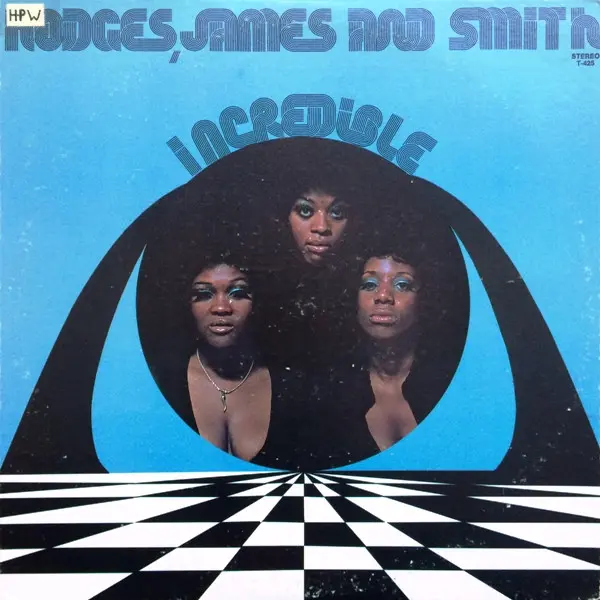 Hodges, James & Smith released their debut album, Incredible, in 1973 on 20th Century Records.
The album showcases their vocal blend across orchestrated soul numbers and mid-tempo R&B, framed by arrangements that mix electric piano, organ, and rhythm guitar. Producer William Stevenson assembled a team of Los Angeles players that gave the trio a firm backdrop with jazz-inflected keys and layered guitars.
Stevenson wrote or co-wrote six of the album’s ten songs. Keyboardist Richard Henn contributed “Signal Your Intention” and co-arranged the record, while songwriter Jackye Gerard co-wrote two tracks with Stevenson. The trio also cover B.B. King’s “Rock Me Baby” and James Taylor’s “Steamroller” as part of a medley.
The record opens with “Turn the People On,” a Stevenson–Hodges composition driven by sharp rhythm accents. “Little by Little (Bit by Bit)” and “If You Wanna Love Me” combine Stevenson’s writing with Curtis Colbert and Harriet Hurst, while Leonard Perry supplied “You Take My Love for Granted.” The closing track, “Love Was Just a Word,” is a Stevenson solo piece.
A1. “Turn the People On” (4:07)
A2. “I Should Stay” (2:51)
A3. “Signal Your Intention” (3:00)
A4a. “Rock Me Baby” — originated as a 1964 B.B. King single, co-written with Joe Josea and later covered by Otis Redding, Ike & Tina Turner, and Johnny Nash. The lyrics address physical passion through direct invitation.
A4b. “Steamroller” — written by James Taylor for his 1970 album Sweet Baby James, a parody of blues clichés couched in exaggerated imagery.
A5. “Oh” (3:01)
B1. “Little by Little (Bit by Bit)” (4:02)
B2. “If You Wanna Love Me” (3:42)
B3. “Can’t Be Alone” (3:33)
B4. “You Take My Love for Granted” (2:45)
B5. “Love Was Just a Word” (3:02)
Sessions took place in Los Angeles with Stevenson producing and Larry Hirsch engineering. Richard Henn and Stevenson arranged the material. The band included bassist Wayne Douglas and Wilton Felton, drummer Paul Humphrey, guitarist Charles Mallory, rhythm guitarist Roland Bautista, guitarist Mike Warren, keyboardist Don Preston (organ), keyboardist Joe Sample (piano), and keyboardist Richard Henn (piano).
20th Century promoted the album with “I Should Stay” (b/w “Only Up”) and “Signal Your Intention” (stereo b/w mono).
Between May and November 1974, Hodges, James & Smith released two interim singles: “Lovin’ Man,” a Rita Jean Bodine cover (b/w “Lucky Man”) followed by the Stevenson/Henn original “Never Gonna Break It Up” (mono b/w stereo).
“Lovin’ Man” first appeared on the 1974 20th Century release Bodine, Rita Jean, produced by Carol Carmichael, who co-wrote the song with Dean Parks.
Power In Your Love
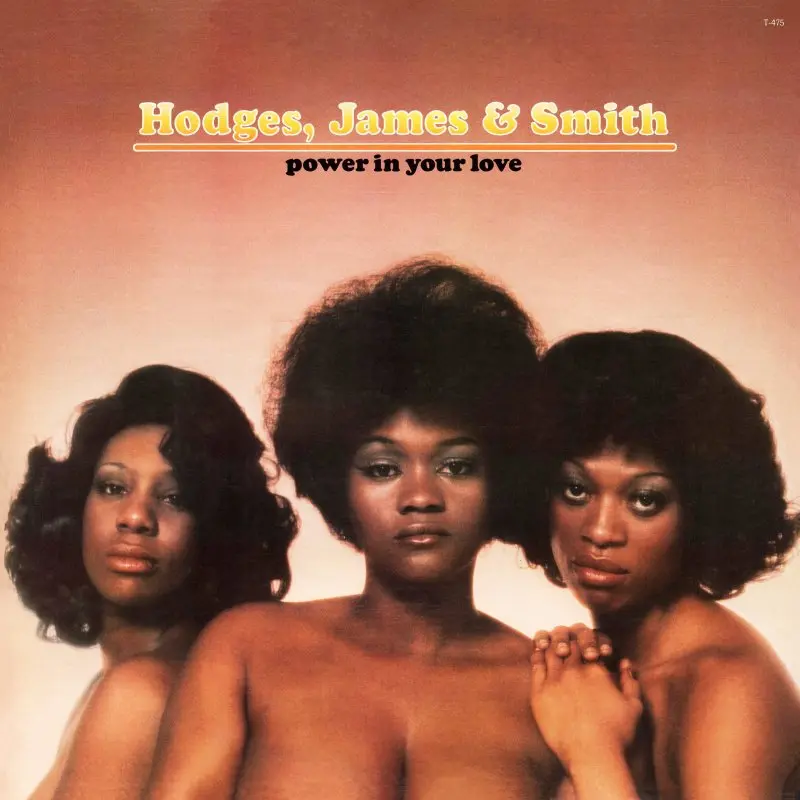 Hodges, James & Smith released their second album, Power In Your Love, in 1975 on 20th Century Records.
The album expands their sound into brass-lifted soul and tighter funk structures, framed by rhythm guitar and a full horn section. Stevenson paired the trio’s harmonies with Los Angeles players whose layered arrangements contrast driving rhythm pieces with dramatic ballads.
Producer William Stevenson oversaw the project and co-wrote three numbers, including the title track with Ruth Robinson, “Monkeyshine” with guitarist Mike Halby, and “Sexy Ways” with songwriter Don Juan Mancha. Guitarist Roland Bautista contributed “Momma.” Ivy Jo Hunter supplied “West Virginia Symphony,” while Bob Merrill wrote “Rusty Old Halo.” The set also includes covers of Ben E. King’s 1963 ballad “I (Who Have Nothing),” written by Jerry Leiber, Mike Stoller, Carlo Donida, and Mogol, and the earlier Hodges, James, Smith & Crawford single “Nobody,” written by Dick Cooper and Ernie Shelby.
“Power in Your Love” features a trumpet solo by Bobby Bryant. “He Did Me Wrong, But He Did It Right,” written by Al Staehely and Patti Dahlstrom, recounts bittersweet affection for a duplicitous lover. The nine-minute sequence alternates between assertive funk pieces (“Monkeyshine,” “Sexy Ways”) and orchestral ballads (“I, Who Have Nothing,” “West Virginia Symphony”).
A1. “Nobody” (3:18) — originally issued in 1971 by Hodges, James, Smith & Crawford as their second single on Mpingo, written by Dick Cooper and Ernie Shelby. This new version adopts a polished disco production in contrast to the rawer original.
A2. “Power in Your Love” (3:12) — features a trumpet solo by Bobby Bryant.
A3. “Momma” (3:05)
A4. “Monkeyshine” (3:18)
A5. “He Did Me Wrong, But He Did It Right” (3:04)
B1. “I, Who Have Nothing” (5:35) — originated as a 1961 Italian ballad (“Uno Dei Tanti”) by Joe Sentieri, adapted by Jerry Leiber and Mike Stoller for Ben E. King’s 1963 single, later covered by Shirley Bassey and Tom Jones. The lyrics plead from the viewpoint of a destitute man unable to offer material wealth.
B2. “Sexy Ways” (4:20)
B3. “Rusty Old Halo” (4:27) — written by Bob Merrill, best known for his Broadway work, with lyrics satirizing sanctimony.
B4. “West Virginia Symphony” (3:31) — written by Motown alumnus Ivy Jo Hunter.
Sessions occurred in Los Angeles at Sound Factory West, Sound City Studios, and Paramount Recording Studios with Stevenson producing and Larry Hirsch engineering. The band included bassist Bill McCubbin, Clint Mosley, and Greg Middleton (credited courtesy of The Infernal Blues Machine); drummer Steve Gutierrez; guitarist Roland Bautista; keyboardist Mike Cavanaugh; conguero Larry “Nastyee” Latimer; saxophonist Herman Riley; trombonist Ray Jackson; and trumpeters Oscar Brashear and Eugene Young, with horn arrangements by Ernie Fields Jr.
20th Century promoted the album with “I, Who Have Nothing” (b/w “Monkeyshine”) in July 1975.
What’s on Your Mind
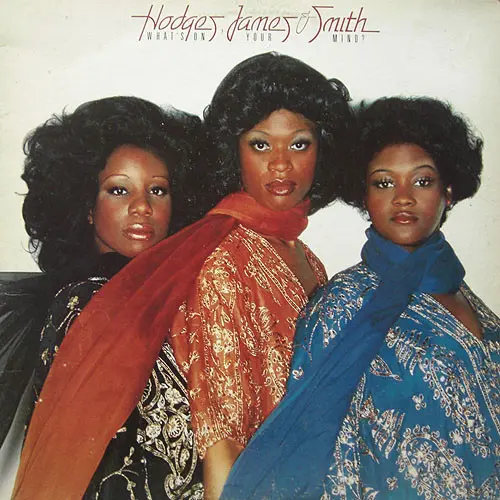 Hodges, James & Smith released their third album, What’s on Your Mind, in 1977 on 20th Century Records.
The album blends string-laden ballads with upbeat R&B numbers, arranged with horns and layered vocal harmonies. It includes their Motown-inspired material alongside orchestrated soul pieces.
Producer William “Mickey” Stevenson wrote or co-wrote four tracks, including “One More Love Song,” “Love Baby,” “People Needing People,” and “Off.” Pianist Richard Henn arranged most of the album and co-wrote “Off” with Stevenson. Group member Jessica Smith co-wrote two selections with Stevenson. They also cover Morris Albert’s ubiquitous “Feelings” and the Forties R&B standard “Since I Fell for You.”
“Don’t Take Away Your Love” opens with a brass-accented rhythm that mirrors their Detroit roots. “Since I Fell for You” stretches past six minutes with saxophone and string passages. The title track uses syncopated rhythm guitar and falsetto choruses, while “People Needing People” moves at a brisk pace with sharp vocal interplay.
A1. “Don’t Take Away Your Love” (3:45) — written by H.B. Barnum and Joyce Ann Clay
A2. “Situation” (3:12) — written by Adeniyi Paris, Ekundayo Paris, and Judy Lamppu
A3. “One More Love Song” (4:16) — written by William “Mickey” Stevenson
A4. “Love Baby” (3:28) — written by Jessica Smith and Stevenson
A5. “People Needing People” (3:09) — written by Smith and Stevenson
B1. “Feelings” (3:54) — written by Morris Albert; first recorded in 1974 by Albert, later covered by Shirley Bassey, Glen Campbell, and Andy Williams
B2. “What’s on Your Mind” (3:38) — written by Charles Khaliq and John Lehman
B3. “Since I Fell for You” (6:18) — written by Buddy Johnson; originated as a 1945 single by Johnson’s Orchestra, popularized by Lenny Welch’s 1963 version and later recorded by Barbra Streisand and Donny Hathaway
B4. “Off” (3:44) — written by Richard Henn and Stevenson
Sessions occurred at Sound City Studios in Van Nuys with producer Stevenson and engineer Bill Drescher. Richard Henn arranged most of the album, with Luchi De Jesus arranging “Feelings.” Greg Calbi mastered the album at Sterling Sound, New York City.
London Records issued What’s on Your Mind with two singles. “Since I Fell for You” appeared in June 1977 in a medley with “I’m Falling in Love” (b/w “Off”) and reached No. 24 on the Billboard R&B chart. In December, London released “Don’t Take Away Your Love” (b/w “Love Baby”).
That year, the trio also sang backing vocals on albums by Bill Withers (Menagerie) and Marilyn McCoo & Billy Davis Jr. (The Two of Us).
What Have You Done for Love
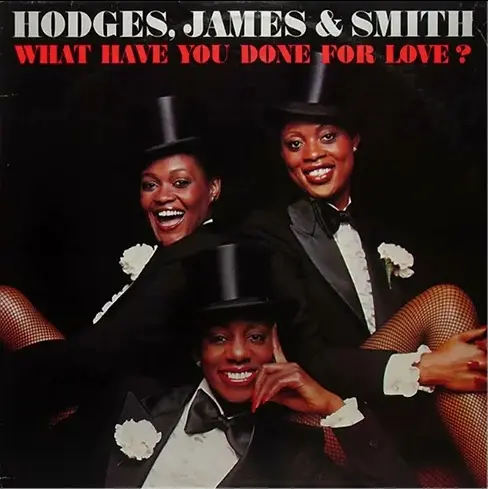 Hodges, James & Smith released their fourth album, What Have You Done for Love, in 1978 on 20th Century Records.
The album combines lavishly arranged stage-style numbers with slow ballads and funk-infused R&B. Broadway-flavored tracks sit alongside soul and jazz covers, showcasing the trio’s vocal range in both orchestrated and intimate settings.
Producer William “Mickey” Stevenson co-wrote the title track with singers Pat Hodges, Denita James, and Jessica Smith. Pianist Richard Henn contributed “Falling in Love” and arranged additional selections. They also cover songs by Earth, Wind & Fire (“You Can’t Hide Love”), Stevie Wonder (“Seems So Long”), Bernard Ighner (“You Know Who You Are”), Bill Champlin (“Here Is Where Your Love Belongs”), Bill Withers (“Hide-A-Way”), and Gilbert Bécaud’s French ballad “Le Mur.”
The title track opens with a show tune quality that contrasts with the smoother ballads. “You Know Who You Are” stretches past six minutes with layered harmonies against slow-tempo instrumentation. “Darling, I Promise” closes the album with gospel-tinged phrasing. Their version of “You Can’t Hide Love” highlights vocal trade-offs, while “Seems So Long” places emphasis on intimate phrasing and steady rhythm guitar.
A1. “What Have You Done for Love?” (3:38) — written by Hodges, James, Smith, and William “Mickey” Stevenson
A2. “The San Francisco Rag (Everytime)” (4:10) — written by Art Posey, Adeniyi Paris, and Ekundayo Paris
A3. “You Can’t Hide Love” (3:52) — written by Skip Scarborough; first recorded in 1973 by Creative Source and popularized by Earth, Wind & Fire on their 1975 album Gratitude
A4. “Falling in Love” (3:55) — written by Richard Henn
A5. “Hide-A-Way” (4:00) — written by Bill Withers and Ray Jackson Coulter; first recorded by Withers on his 1974 album ’+Justments
B1. “You Know Who You Are” (6:05) — written by Bernard Ighner; first recorded on his 1974 album Skipping Stones and later covered by Ahmad Jamal and Carmen McRae
B2. “That’s the Way (English Version of Le Mur)” (4:54) — written by Gilbert Bécaud and Maurice Vidalin, with English lyrics by Norman Stellman; first recorded in French by Bécaud in 1969
B3. “Here Is Where Your Love Belongs” (4:26) — written by Bill Champlin; first recorded on his 1978 solo album Single
B4. “Seems So Long” (4:59) — written by Stevie Wonder; first recorded on his 1972 album Music of My Mind
B5. “Darling, I Promise” (3:22) — written by Art Posey and Josef Powell
Sessions occurred in Los Angeles with producer Stevenson, who oversaw arrangements by Henn and additional orchestrations.
20th Century promoted What Have You Done for Love with two singles: “You Know Who You Are” (b/w “Falling in Love”) and “What Have You Done for Love?” (b/w “Hide-A-Way”).
That year, the trio also sang backing vocals on Roads of Life by Bobby Womack, Mighty Real by Sylvester, and Midnight Rhythm by Midnight Rhythm.
In 1979, Hodges, James & Smith bowed out with a standalone cover of the Martha & the Vandellas hit “Dancing in the Street,” co-written fifteen years earlier by Stevenson with Marvin Gaye and Ivy Jo Hunter; backed with Stevenson’s “Music Turns Me On.”
Discography:
- “Somewhere a Valley” / “Ain’t That Right” (1969)
- “Nobody” / “I’m in Love” (1971)
- “Write Me a Letter” / “Let’s Pick Up the Pieces” (1972)
- Incredible (1973)
- Power In Your Love (1975)
- What’s on Your Mind (1977)
- What Have You Done for Love (1977)
- “Dancing in the Street” / “Music Turns Me On” (1979)
Sources:
- Discogs: Hodges, James & Smith
- RYM: Hodges, James & Smith
- 45cat: Hodges, James & Smith
- MusicBrainz: Hodges, James & Smith
Artist/Album Pages:
Oko was a Yugoslav hard-rock band from Ljubljana, Slovenia, that issued a single on ZKP RTVLJ in 1...
Mother Superior was an English all-female rock band that recorded the album Lady Madonna, released...
Flamengo was a Czech psychedelic jazz-rock band that was active for six years, starting in 1966. I...
Snakegrinder was an American jam-rock/boogie band from Newark, Delaware, that issued the private-...
Flea was an Italian symphonic/hard-rock band that appeared with a 1971 album as Flea on the Honey....
The Climax Blues Band was an English rock band that emerged in 1969 with two blues-rock albums on P...
Horse was an English hard-rock band that released a self-titled album on RCA Victor in 1970. The a...
Jean-Pierre Ferland (June 24, 1934 – April 27, 2024) was a Québécois chanson singer-songwriter, larg...
Milton Hamilton Crystalized was the New York studio project of pianist, arranger, and producer Mil...
Gloria Mundi was an English art-rock/punk band from London that released two albums on RCA Victor ...
Fred Frith is an English avant-garde multi-instrumentalist, composer, and improviser who gained in...
Velvet Glove was an English pop duo behind the 1974 album Sweet Was My Rose on Fresh Air. The title ...