

Stevie Wonder is an American R&B musician, vocalist, songwriter, and producer who began recording for Tamla/Motown in 1962 at age 12.
He catapulted to fame with “Fingerprints Pt 2,” an exuberant chant followed by an upbeat run of mid-Sixties hits: “Uptight (Everything’s Alright),” “I Was Made to Love Her,” “For Once In My Life,” and the ballad “My Cherie Amore.”
After his 1970 hit “Signed, Sealed, Delivered I’m Yours,” Wonder gained full artistic control of his career and adopted a more album-oriented approach, starting with the 1972 releases Music of My Mind and Talking Book. Over the subsequent 15-year period, he recorded seven studio albums, reaching peak popularity with the ambitious 1976 double-plus release Songs in the Key of Life.
Background
Wonder was born Stevland Hardaway Judkins in Saginaw, Michigan, on May 13, 1950, the second of two children born to Calvin Judkins and songwriter Lula Mae Hardaway. He was born six weeks premature and placed in an oxygen-rich hospital incubator, which caused retinopathy of prematurity that left him blind.
When Stevland was four, Hardway divorced Judkins and changed the boy’s surname to Morris. She moved her children to Detroit, where young Stevland sang in the Whitestone Baptist Church choir. From an early age, he played piano, harmonica, and drums. He formed his first musical partnership with a childhood friend named John. They played at parties, dances, and street corners.
At age 11, Stevland played his composition “Lonely Boy” to Miracles co-founder Ronnie White, who took the boy for an audition with Motown founder Berry Gordy, who signed the youngster to the label’s Tamla division. According to contract stipulations, Stevland’s earnings would be held in a trust until he turned 21. Before recording, producer Clarence Paul renamed the boy Little Stevie Wonder.
1962–1965
In May 1962, Tamla issued Little Stevie Wonder’s debut single: “I Call It Pretty Music, But The Old People Call It The Blues, Pt 1” (b/w “Pt. II”), a Gordy/Paul composition.
The Jazz Soul of Little Stevie
 In September 1962, Tamla issued The Jazz Soul of Little Stevie, the debut album by twelve-year old Stevie Wonder.
Motown staff writer Clarence Paul (ex-5 Royals singer) co-wrote one song each with Marvin Gaye (“Soul Bongo”) and one Nettie Glynn (“The Square”). He co-wrote four songs with fellow staffer Henry Cosby, including the opener “Fingertips,” an early Wonder signature tune. Wonder (credited as Stevie Judkins) co-wrote two Side B tracks, “Wondering” and “Session Number 112.” Berry Gordy wrote the closing track, “Bam.”
Wonder plays harmonica and bongos on multiple tracks. He drums on “Manhattan at Six” and displays his early keyboard skills (piano, organ) on “Paulsby” and his two co-written numbers. Paul produced the album, which features liner notes by Billie Jean Brown and a cover designed by Barni Wright.
Tribute to Uncle Ray
 In October 1962, Tamla issued Tribute to Uncle Ray, the second album by Little Stevie Wonder, recorded as a tribute to Ray Charles.
The album features five Charles compositions: “Hallelujah I Love Her So,” “Ain’t That Love,” “Don’t You Know,” “Come Back Baby,” and “Mary Ann.”
Clarence Paul and Stevie Wonder co-wrote one track, “Sunset.” The album also features covers of songs by Henry Glover (“Drown In My Own Tears,” a 1956 Charles hit), Berry Gordy, Jr. (“My Baby’s Gone”), and the team of Rubel and Migidson (“The Masquerade”).
Paul produced the album and arranged the traditional song “Frankie & Johnny.”
Clarence co-headed Wonder’s October 1962 standalone single: “Little Water Boy” backed with “La La La La La.” In December, Motown bigwigs Lamont Dozier and Brian Holland produced Little Stevie’s third non-album a-side: “Contract On Love,” recorded with vocal backing by The Temptations, a little-known recent signing to Motown’s Gordy imprint.
Recorded Live: The 12 Year Old Genius
 On May 21, 1963, Tamla issued Recorded Live: The 12 Year Old Genius, the first Stevie Wonder live album, recorded in June 1962 at the Regal Theater in Chicago.
The short album (23:36 duration) includes four numbers from the recent Charles tribute (Side B) and two from his debut, including Wonder’s exuberant rendition of “Fingertips,” his inaugural hit. He drums on “La La La La La,” the recent b-side.
Tamla split the live “Fingertips” (6:40) onto a two-sided single. The b-side, “Fingertips – Part 2” (3:09), is the vocal half marked by Wonder’s vocal refrain (“Everybody say ‘yeah!”’) and harmonica break (to the tune of “Mary Had a Little Lamb”). Marvin Gaye drums on the track, which features Funk Brothers bassist James Jamerson and horns arranged by Motown/Stax conductor Johnny Allen.
On the week of August 10, 1963, “Fingertips – Part 2” reached No. 1 on the Billboard Hot 100, where it ousted “So Much in Love” by The Tymes and held the summit for three weeks, then bowed to “My Boyfriend’s Back” by The Angels. The song became Motown’s second chart-topper after “Please Mr. Postman” by The Marvelettes. Recorded Live: The 12 Year Old Genius reached No. 1 on the Billboard 200.
On September 13, Tamla issued the non-album single “Workout Stevie, Workout,” a Paul/Cosby number backed with another Paul exclusive, “Monkey Talk.”
With a Song in My Heart
 On December 28, 1963, Tamla issued With a Song in My Heart, the third studio album by the now thirteen-year-old Stevie Wonder and the first without “Little” affixed to his name.
The album features Wonder interpretations of film and musical numbers, including songs from Pinocchio (“When You Wish Upon a Star”), Do Re Mi (“Make Someone Happy”), Bye Bye Birdie (“Put on a Happy Face”), Great Day (“Without a Song”), and Summer Stock (“Get Happy”).
Notable tracks include the 1944 Johnny Mercer song “Dream” and numbers from the 1946 Charlie Chaplin film Modern Times (“Smile”) and the 1929 Rodgers & Hart musical Spring Is Here (“With a Song in My Heart”). Wonder plays harmonica on “On the Sunny Side of the Street,” lifted from Lew Leslie’s International Revue.
Stevie at the Beach
 On June 23, 1964, Tamla issued Stevie at the Beach, the fourth studio album by Stevie Wonder. The album features a beach theme with a mixture of vocals and instrumentals.
Wonder sings the pop standard “Beyond the Sea,” a 1959 hit for Bobby Darin. He plays harmonica, bongos, and keyboards the mostly instrumental first side, which includes the Kitty of Coleraine tune “Red Sails in the Sunset” (a 1960 Platters hit) and the big-band standard “Ebb Tide” (a subsequent Righteous Brothers hit). Side A features two versions of “Castles in the Sand,” written by staff producers Hal Davis and Frank Wilson.
Wonder scored his second hit with “Hey Harmonica Man,” written by Marty Cooper and Lou Josie. Released as a May 1964 single, it reached No. 5 on the Billboard R&B chart and No. 29 on the Hot 100.
In November, Tamla issued “Pretty Little Angel,” a standalone Wonder track (for the time being) backed with Paul’s “Tears In Vain,” covered in 1965/66 by The Supremes and Bettye La Vette.
1965–1967
By 1965, Wonder (now fifteen) lost his childlike tenor. He found work in Motown’s songwriting department and co-wrote single sides for The Marvelettes (“Anything You Wanna Do”), The Supremes (“Baby Doll”), Martha & The Vandellas (“Nobody’ll Care”), Four Tops (“Loving You Is Sweeter Than Ever”), and The Miracles (“Can You Love a Poor Boy”). In 1966, Wonder and Clarence Paul (with Morris Broadnax) co-wrote “Just a Little Misunderstanding,” an R&B hit for The Contours.
He formed a writing partnership with Sylvia Moy, a Motown staffer who recently co-wrote “It Takes Two,” a hit duet for Marvin Gaye and Kim Weston. Between 1965 and 1970, Moy co-wrote eighteen Wonder album tracks, some with Cosby’s involvement.
In 1967, Wonder and Smokey Robinson co-wrote “Tears of a Clown,” an initial Miracles album track that became a 1970 No. 1 hit.
Up-Tight
 Stevie Wonder released his fifth studio album, Up-Tight, on May 4, 1966, on Tamla.
Wonder co-wrote five song with select involvement from Sylvia Moy, Clarence Paul, and Henry Cosby. Musically, the album presents Wonder’s newfound vocal maturity against taut horns and booming rhythm tracks. The titular “Uptight (Everything’s Alright)” became his second major pop-crossover hit.
Most tracks originate here apart from the Bob Dylan cover and “Teach Me Tonight,” a Fifties jazz-pop standard. Several songs (“Love a Go Go,” “Music Talk,” “With a Child’s Heart”) fueled covers on the international soul-pop scene. Side B accomadates the 1964 single “Pretty Little Angel” and the 1962 rarity “Contract on Love,” Wonder’s pre-fame standalone.
Up-Tight features Wonder on harmonica, keyboards, and percussion. He harmonizes on select tracks with Paul (“Blowin’ in the Wind”) and Four Tops frontman Levi Stubbs (“Teach Me Tonight”). Motown in-house band the Funk Brothers play instrumental backup. Six tracks features The Andantes, a Motown backing vocal trio. The Originals back Wonder on “Nothing’s Too Good For My Baby.” Two tracks (“Pretty Little Angel,” “With a Child’s Heart”) feature the Detroit Symphony Orchestra.
A1. “Love a Go Go” (2:42) is the first-recorded version of this Beth Beatty/Ernie Shelby composition, covered in 1967 by Swedish beatsters Slam Creepers and Akron garage rockers The Lime.
A2. “Hold Me” (2:35) a Wonder/Paul co-write with Morris Broadnax.
A3. “Blowin’ in the Wind” (3:45) is a much-covered 1963 signature song by Bob Dylan.
A4. “Nothing’s Too Good for My Baby” (2:38) a Cosby/Moy co-write with William Stevenson, covered in 1967 by the Liverpool soul-rockers Remo Four.
A5. “Teach Me Tonight” (2:38) was a 1954 hit for The De Castro Sisters, composed by Gene De Paul with lyrics by Sammy Cahn, covered since by Blossom Dearie, Brenda Lee, Nancy Wilson, and Gloria Lynne.
A6. “Uptight (Everything’s Alright)” (2:53) an upbeat, brassy number built around Wonder’s chorus, set to a Cosby tune with Moy’s lyrics.
B1. “Ain’t That Asking for Trouble” (2:47) a Moy/Paul/Wonder tune later performed by the Ernie Watts Encounter.
B2. “I Want My Baby Back” (2:46) a giveaway from the Temptations camp (Cornelius Grant, Eddie Kendricks, Norman Whitfield) also recorded by Edwin Starr, whose 1967 version accompanied a more popular b-side, “Gonna Keep On Tryin’ Till I Win Your Love.”
B3. “Pretty Little Angel” (2:11) a Wonder/Paul co-write with Mike Valvano, covered in 1969 by Edwin Starr.
B4. “Music Talk” (2:52) a Wonder co-write with Paul and Ted Haul, spread on the London R&B scene by Georgie Fame & The Blue Flames and Shotgun Express singer Beryl Marsden.
B5. “Contract on Love” (2:02) a 1962 “Little” Stevie Wonder recording, written by Janie Bradford, Lamont Dozier, and Brian Holland.
B6.”With a Child’s Heart” (3:03) a Moy/Cosby co-write with Vicki Basemore, covered by The Bar-Kays (1967), The Supremes (1968), and Michael Jackson (1973).
Up-Tight sessions (barring the two earlier inclusions) occurred in late 1965 and early 1966 at Studio Histville.
“Uptight (Everything’s Alright)” appeared on November 22, 1965, as an advance single with “Purple Rain Drops,” an exclusive by Ted Hall (Wonder’s 5th grade tutor) covered in 1967 by The Flames, a South African band with future Beach Boy auxiliaries Blondie Chaplin and Ricky Fataar.
In February 1966, “Uptight (Everything’s Alright)” peaked at No. 3 on the Cashbox Singles chart and the Billboard Hot 100. The single spent five weeks at No. 1 on the Billboard R&B chart. In the UK, “Uptight” reached No. 14 and influenced “Church of the Poison Mind,” a 1983 Culture Club hit.
Up-Tight reached No. 2 on the Billboard R&B Albums chart and spawned three further singles. “Nothing’s Too Good For My Baby” reached No. 4 on the R&B chart and No. 20 on the Hot 100 while its b-side, “With a Child’s Heart,” reached No. 8 on the R&B chart. “Blowin’ in the Wind” peaked at No. 9 on the Hot 100 and became Wonder’s third No. 1 R&B hit.
Down to Earth
 Stevie Wonder released his sixth studio album, Down to Earth, on November 16, 1966, on Tamla.
Wonder co-wrote the second three tracks on Side A and the closing “Hey Love.” His writing partners, Henry Cosby and Sylvia Moy, submitted “Angel Baby (Don’t You Ever Leave Me).” He scored his third major pop hit with “A Place in the Sun,” written by Motown staffers Ron Miller and Bryan Wells.
Down to Earth also contains covers of The Supremes (“My World Is Empty Without You”), The Byrds (“Mr. Tambourine Man”), Cher (“Bang Bang”), and the folk standards “Sixteen Tons” and “The Lonesome Road.” The title track was a recent Motown side for jazz singer Billy Eckstine.
A1. “A Place in the Sun” (2:52) is the first version of this Miller/Wells song, recorded in 1967/68 by the Four Tops, David Isaacs, Sandy Posey, Staple Singers, Glenn Campbell, and New Christy Minstrels. The Supremes and The Temptations included the song on their 1968 collaborative album. Wonders version includes the spoken line “You know when things are bad, and you’re feeling sad, I want you to always remember.”
A2. “Bang Bang” (2:42) was Cher’s second solo single, written by her then-partner, Sonny Bono.
A3. “Down to Earth” (2:50) co-written by Miller and Avery Vanderberg (aka Motown staffer William “Mickey” Stevenson).
A4. “Thank You Love” (2:55)
A5. “Be Cool, Be Calm (And Keep Yourself Together)” (2:43)
A6. “Sylvia” (2:34)
B1. “My World Is Empty Without You” (2:53) is a January 1966 Top 5 hit by the Supremes, written by Holland–Dozier–Holland and covered in the ensuing months by Jean King, Mary Wells, Vicki Carr, and Barbara McNair. Wonder recorded the first male version (later done by The Miracles and The Originals).
B2. “The Lonesome Road” (3:06) is a folk, blues, and gospel standard, composed in 1927 by Nathaniel Shilkret with lyrics by Gene Austin.
B3. “Angel Baby (Don’t You Ever Leave Me)” (2:45) is the first-recorded version of this Cosby/Moy song, covered in 1967 by Stax soul singer Darrell Banks.
B4. “Mr. Tambourine Man” (2:30) was The Byrds’ 1965 breakout hit, written by Bob Dylan.
B5. “Sixteen Tons” (2:42) is a 1946 cola miner anthem by country singer/actor Merle Travis.
B6. “Hey Love” (2:41) is Morris Broadnax’s third co-write with the Paul/Wonder partnership.
Sessions occurred in late 1965 and 1966 at Studio Hitsville, where Cosby co-produced the album with Clarence Paul. Wonder plays harmonica, keuboards, percussion, and occasion drums on Down to Earth, which features vocal backing by The Andantes, The Originals, and instrumentaton by the Funk Brothers, including the rhythm section of James Jamerson and drummer Benny Benjamin.
“A Place in the Sun” preceded the album as an October 1966 single (b/w “Sylvia”). It reached No. 3 on the R&B chart and No. 9 on the Hot 100. Abroad, the single hit No. 5 in Canada and No. 20 in the UK.
In February 1967, Wonder release the standalone single “Travlin’ Man,” another song by the Miller/Wells writing team. It peaked just outside the Pop and R&B Top 30’s. The album track “Hey Love” appeared on the b-side and reached No. 9 R&B in its own right.
In February 1967, Wonder release the standalone single “Travlin’ Man,” another song by the Miller/Wells writing team. It peaked just outside the Pop and R&B Top 30’s.
I Was Made to Love Her
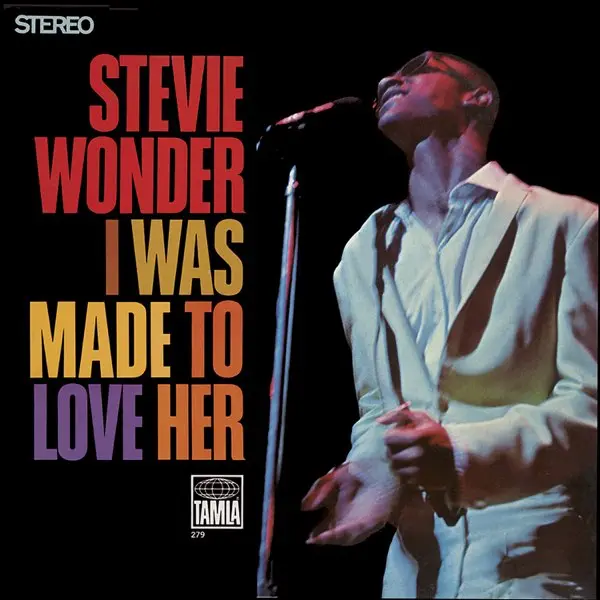 Stevie Wonder released his seventh studio album, I Was Made to Love Her, on August 27, 1967, on Tamla.
The album includes covers of hits by Little Richard (“Send Me Some Lovin”’), Bobby Bland (“I Pity the Fool”), The Temptations (“My Girl”), James Brown (“Please, Please, Please”), Marvin Gaye (“Can I Get a Witness,” “Baby Don’t You Do It”), Ray Charles (“A Fool for You”), and the Otis Redding number “Respect,” a recent breakthrough hit for Aretha Franklin.
Wonder co-wrote “I’d Cry,” “Everybody Needs Somebody (I Need You),” “Every Time I See You I Go Wild,” and the title track, his fourth major pop hit.
A1. “I Was Made to Love Her” (2:36) Henry Cosby and Sylvia Moy co-wrote this song with Wonder and his mother, Lula Mae Hardaway.
A2. “Send Me Some Lovin'” (2:29) was the 1957 b-side to “Lucille,” Little Richard’s signature song.
A3. “I’d Cry” (2:33) is a Wonder/Moy co-write.
A4. “Everybody Needs Somebody (I Need You)” (2:36) is a Wonder/Paul co-write.
A5. “Respect” (2:21) originated as a 1965 Redding single (No. 9 R&B) that became a 1967 crossover No. 1 for Aretha Franklin.
A6. “My Girl” (2:55) is the 1965 signature ballad by The Temptations, written by Smokey Robinson and fellow Miracle Ronnie White.
B1. “Baby Don’t You Do It” (2:11) is a 1964 No. 27 hit by Marvin Gaye, written by Holland–Dozier–Holland.
B2. “A Fool for You” (3:16) is a 1955 R&B No. 1 by Ray Charles, covered since by Redding and Ike & Tina Turner.
B3. “Can I Get a Witness” (2:42) is a 1963 Holland–Dozier–Holland song that made Gaye an international star before his home-country breakthrough.
B4. “I Pity the Fool” (3:04) originated as a 1961 Duke Records a-side by Memphis blues singer Bobby Bland.
B5. “Please, Please, Please” (2:40) originated as a February 1956 Federal Records a-side by James Brown & the Famous Flames, covered by The Who on their first album.
B6. “Every Time I See You I Go Wild” (2:52) is a Wonder/Moy/Cosby number.
Sessions occurred in 1967 at Studio Hitsville USA.
“I Was Made to Love Her” first appeared as a May 1967 single backed with the Up-Tight track “Hold Me.” The single reached No. 1 on the R&B chart and No. 2 on the Billboard Hot 100. Abroad, it reached No. 5 in Canada and the UK and No. 16 in New Zealand.
Someday at Christmas
On November 27, 1967, Tamla issued Someday at Christmas, a collection of yuletide standards by Stevie Wonder.
1968–1969
Eivets Rednow
 On November 20, 1968, Gordy issued Eivets Rednow, a collection of instrumentals recorded by Stevie Wonder with backing by the Funk Brothers. The title is an anadrome (reverse spelling) of his name.
Eivets Rednow contains his first three solo compositions: “How Can You Believe,” “Which Way the Wind,” and “Bye Bye World.” Henry Cosby co-composed “More than a Dream.” Wonder also interprets Hugh Masekela (“Grazin’ in the Grass”) and the Ruby Gentry theme. Side A includes an Association/Four Tops medley.
The project stemmed from Wonder’s version of “Alfie,” the much-covered Burt Bacharach theme to the 1966 Michael Caine comedy. Wonder also cuts Bacharach’s “A House Is Not a Home,” a minor 1964 hit for his main client, Dionne Warwick.
A1. “Alfie” (3:14)
A2. “More than a Dream” (3:48)
A3. “A House Is Not a Home” (3:32)
A4. “How Can You Believe” (3:04)
A5. Medley: “Never My Love/Ask the Lonely” (2:30) merges the 1967 Association ballad with the 1965 Four Tops side.
B1. “Ruby” (6:48) is a composition by score writer Heinz Roemheld for the 1952 film Ruby Gentry, a catalyst for singer Bobbie Gentry.
B2. “Which Way the Wind” (2:47)
B3. “Bye Bye World” (3:21)
B4. “Grazin’ in the Grass” (2:57) is a 1968 Billboard No. 1 by South African trumpeter Hugh Masekela, written under his pseudonym Philemon Hou.
Eivets Rednow features Wonder on his standard arsenal (harmonica, keyboards, drums, percussion) backed by the Funk Brothers.
For Once in My Life
 Stevie Wonder released his tenth studio album, For Once in My Life, on December 8, 1968, on Tamla.
The album includes two pre-released singles (“Shoo-Be-Doo-Be-Doo-Da-Day” and “You Met Your Match”) and six further originals that Wonder co-wrote in assorting team-ups with Henry Cosby, Sylvia Moy, and co-producer Don Hunter. His mother, Lula Mae Hardaway, co-wrote half of Side A and “Ain’t No Lovin’.” The title track became his fourth Top 3 pop hit.
For Once in My Life includes four covers, including a Billie Holiday standard (“God Bless the Child”) and the recent Bobby Herb hit “Sunny.”
A1. “For Once In My Life” (2:48) popularized the 1965 Ron Miller/Orlando Murden composition, also recorded during 1966–68 by Arthur Prysock, Barbara McNair, Jackie Wilson, Martha & The Vandellas, Irene Reid, Della Reese, Tony Bennett, and Roy Ayers.
A2. “Shoo-Be-Doo-Be-Doo-Da-Day” (2:45) is a Wonder/Cosby/Moy song noted as one of the earliest hits with a clavinet.
A3. “You Met Your Match” (2:37) is a Wonder/Hardaway/Hunter song, also with clavinet.
A4. “I Wanna Make Her Love Me” (2:52) is a Wonder/Cosby/Hardaway/Moy song.
A5. “I’m More Than Happy (I’m Satisfied)” (2:56) is a Wonder/Cosby/Moy song with a fourth writer, Cameron Grant.
A6. “I Don’t Know Why” (2:46) is a Wonder/Hardaway/Hunter song with a fourth writer, Paul Riser.
B1. “Sunny” (4:00) much-covered 1966 hit by R&B singer/guitarist Bobby Herb.
B2. “I’d Be a Fool Right Now” (2:54) is the second Wonder/Cosby/Moy song.
B3. “Ain’t No Lovin'” (2:36) is the second Wonder/Hardaway/Hunter/Riser song.
B4. “God Bless the Child” (3:27) originated as a 1942 Billie Holiday single, covered since by J. J. Johnson, Eddie Harris, Sonny Rollins, and (most recently) Blood Sweat & Tears.
B5. “Do I Love Her” (2:58) is a Wonder/Moy song.
B6. “The House on the Hill” (2:36) is an otherwise unrecorded song that Berry Gordy co-wrote with Motown staffers Allen Story and Lawrence Brown.
Sessions occurred at Hitsville U.S.A., where Wonder co-produced the album with Cosby and Hunter in three installments: mid 1967, winter 1967/68, and April–August 1968. Wonder played his standard arsenal (harmonica, piano, percussion) with added organ and clavinet. He used the Adantes/Originals vocal backing with instrumentation from the Funk Brothers, whose pianist, Earl Van Dyke, plays on “For Once in My Life.”
“Shoo-Be-Doo-Be-Doo-Da-Day” preceded the album by seven months as an April 1968 single with “Why You Don’t You Lead Me to Love,” an otherwise unavailable Wonder/Cosby/Hardaway/Moy song. The single reached No. 9 in Canada and the Billboard Hot 100 and became his fifth No. 1 on the R&B chart.
In June 1968, “You Met Your Match” became the second advance single, backed with the earlier Temptations cover “My Girl.” It reached No. 2 on the R&B chart.
“For Once in My Life” appeared in mid-October as the third advance single from the namesake album. An upbeat take on the ubiquitous lounge number, it reached No. 2 on the Billboard R&B and Hot 100 charts and No. 3 in the UK.
In late January 1969, “I Don’t Know Why” became the album’s fourth single, but DJ’s showed more interest in its then-exclusive b-side, the ballad “My Cherie Amour.”
The Rolling Stones covered “I Don’t Know Why” during sessions for their 1969 album Let It Bleed, but their version remained unreleased until their 1975 compilation Metamorphosis.
My Cherie Amour
 Stevie Wonder released his eleventh studio album, My Cherie Amour, on August 29, 1969, on Tamla.
Wonder co-wrote five songs, including the title ballad and the last three tracks. He collaborated on four songs each (three overlapping) with Sylvia Moy and producer Henry Cosby. Stevie’s mother contributed to “Somebody Knows, Somebody Cares.”
Side A includes three cinematic tunes and a Doors cover. Wonder also performs three songs by Motown staff writers, including the Ron Miller/Bryan Wells team, who supplied the album’s second single, “Yester-Me, Yester-You, Yesterday.”
A1. “My Cherie Amour” (2:49) is a Wonder/Cosby/Moy originated as “Oh, My Marsha,” written by Wonder about an early love interest at the Michigan School for the Blind. Moy re-worked the lyrics with mixed foreign words.
A2. “Hello, Young Lovers” (3:09) originates from the 1951 Rodgers & Hammerstein musical The King and I.
A3. “At Last” (2:44) is a Harry Warren composition for the 1941 musical film Sun Valley Serenade, popularized by Glenn Miller and covered in 1960 by Etta James.
A4. “Light My Fire” (3:34) is the 1967 breakthrough Doors hit, taken Top 3 again in 1968 by Puerto Rican singer José Feliciano, a fellow blind.
A5. “The Shadow of Your Smile” (2:38) is the love theme from The Sandpiper, the 1965 drama starring Elizabeth Taylor and Richard Burton, written by Johnny Mandel and Paul Francis Webster.
A6. “You and Me” (2:41) is a song by Motown staff writers Beatrice Verdi and Deke Richards, a member of The Corporation, the team behind recent signees the Jackson 5.
B1. “Pearl” (2:42) is a song by Motown staff writer Richard Morris.
B2. “Somebody Knows, Somebody Cares” (2:30) is a Wonder/Cosby/Moy song with Lula Mae Hardaway’s input.
B3. “Yester-Me, Yester-You, Yesterday” (3:01) is a Miller/Wells composition first recorded in 1966 by Chris Clark, a female blue-eyed Motown singer whose version went unreleased for 39 years.
B4. “Angie Girl” (2:57) is the third Wonder/Cosby/Moy song.
B5. “Give Your Love” (3:42) is a Wonder/Cosby song third-credited to co-producer Don Hunter.
B6. “I’ve Got You” (2:33) is a Wonder/Moy song.
Sessions occurred at Studio Hitsville U.S.A. in late 1968 and early 1969 apart from “My Cherie Amour,” recorded in late 1967 but withheld for a year until its initial release as a b-side. Wonder plays harmonica and keyboards, backed by the Funk Brothers.
Due to the title song’s popularity with DJ’s and radio listeners, Tamla lifted “My Cherie Amour” as a May 1969 single, backed with its formaer a-side, “I Don’t Know Why.” It reached No. 4 on the R&B Singles chart, the Billboard Hot 100, and the UK Singles chart.
In late September, “Yester-Me, Yester-You, Yesterday” became the album’s second single, backed with the earlier “I’d Be a Fool Right Now.” It reached No. 5 on the R&B chart and No. 7 on the Hot 100. Abroad, “Yester-Me” reached No. 2 in the UK, No. 3 in Ireland, and No. 10 in Australia, New Zealand, and Sweden.
1970–1971
Live Albums
On March 6, 1970, Tamla issued Stevie Wonder Live, the singer’s first live album as an adult.
In the UK, Tamla issued Live at the Talk of the Town, recorded at the Talk of the Town nightclub in London.
Signed, Sealed & Delivered
 Stevie Wonder released his twelfth studio album, Signed, Sealed & Delivered, on August 7, 1970, on Motown.
Wonder co-wrote seven tracks with assorted collaborators, including Englishwoman Pam Sawyer (ex-Whyte Boots) and singers Lee Garrett and Syreeta Wright. The album also includes a Beatles cover and three songs by Motown staff writers, including Ron Miller’s gospel-tinged “Heaven Help Us All.”
Two singles preceded the album: “Never Had a Dream Come True” and the title track, a pop-crossover hit with a distinct sitar melody by Eddie Willis of the Funk Brothers. Wonder employs vocal backing by The Andantes, The Originals, and newcomers The Third Generation, comprised of Syreeta, Lynda Laurence, and Venetta Fields.
A1. “Never Had a Dream Come True” (3:13) is Wonder’s final three-way credit with Henry Cosby and Sylvia Moy.
A2. “We Can Work It Out” (3:19) is a 1965 standalone Beatles single, written by Lennon–McCarntey.
A3. “Signed, Sealed, Delivered I’m Yours” (2:41) is an upbeat continuation of Wonder’s Sixties sound, co-written with Garrett, Syreeta, and Lula Mae Hardaway.
A4. “Heaven Help Us All” (3:13) is the first version of this Ron Miller ballad, also recorded in 1970/71 by Brook Benton, Melba Moore, Joan Baez, and Ken Lazarus.
A5. “You Can’t Judge a Book by Its Cover” (2:32) is a Wonder/Cosby/Sawyer song.
A6. “Sugar” (2:52) is one of four co-writes with Don Hunter.
B1. “Don’t Wonder Why” (4:54) is the first version of this Leonard Caston song, covered soon after by The Main Ingredient.
B2. “Anything You Want Me to Do” (2:19) is a Wonder/Hunter/Hardaway collaboration with fourth writer Paul Riser.
B3. “I Can’t Let My Heaven Walk Away” (2:53) is a Sawyer co-write with singer and Motown staffer Joe Hinton, also recorded by Chuck Jackson.
B4. “Joy (Takes Over Me)” (2:12) is the only version of this song by Detroit soul artist Duke Browner.
B5. “I Gotta Have a Song” (2:32) is the second Wonder/Hunter/Hardaway/Riser song.
B6. “Something to Say” (3:26) is the second Wonder/Hunter song.
Sessions occurred in late 1969 and 1970 at Hitsville U.S.A., where Wonder and Hunter juggled co-production duties with Cosby and Miller, who each produced their songwriting contributions. Wonder’s instrumentation includes harmonica, drums, percussion, piano, organ, and clavinet; backed throughout by guitarist Dennis Coffey and the current Funk Brothers lineup with drummer Richard “Pistol” Allen and alternating bassists Bob Babbitt and James Jamerson.
“Never Had a Dream Come True” first appeared in February 1970 as a standalone single backed with the prior album’s “Somebody Knows, Somebody Cares.” It stalled at No. 26 on the Hot 100 but reached No. 11 on the Billboard R&B chart, No. 14 in Ireland, and No. 6 in the UK.
In June 1970, “Signed, Sealed, Delivered I’m Yours” appeared two months before its parent album, backed with the 1968 album track “I’m More Than Happy (I’m Satisfied).” The single reached No. 4 on the Hot 100 and spend six weeks at No. 1 on the Billboard R&B chart. Musically, the single concluded his run of teenage hits.
The contrasting “Heaven Help Us All,” with its mature sound anticipating subsequent work, followed the album’s September release as a third single (b/w “I Gotta Have a Song”) and reached No. 2 on the R&B chart and No. 9 on the Hot 100. Between the album and single release dates, Wonder wed Syreeta.
Where I’m Coming From
 Stevie Wonder released his thirteenth studio album, Where I’m Coming From, on April 9, 1971, on Tamla.
The album marked his transition into full artistic independence at Motown. Wonder co-wrote all songs with his then-wife Syreeta Wright and arranged the material with David Van DePitte, Jerry Long, and Paul Riser. Musically, the record departs from Motown’s established formula with extended forms, stark clavinet textures, orchestral passages, and direct social themes.
Wonder and Wright wrote the entire set, including the Top 10 hit “If You Really Love Me,” which contrasts subdued vocal verses with a melodramatic Philly chorus where his pleas beget her “playing around” refrain.
The opening “Look Around” sets a foreboding tone with its baroque-inflected clavinet and surreal lyrics about societal decline. “Do Yourself a Favor” extends into six minutes of hard funk, driven by Hammond organ, wah-clavinet, and an escalating vocal buildup. “Think of Me as Your Soldier,” “Something Out of the Blue,” and “Never Dreamed You’d Leave in Summer” form the album’s intimate ballad core, moving from lush orchestration to piano-backed lament. “I Wanna Talk to You” stages a tense role-play on racial conflict, while “Take Up a Course in Happiness” parodies vaudevillian uplift with eccentric brass and string interplay. The closing “Sunshine in Their Eyes” unfolds in shifting movements, alternating between hopeful refrains, commentary on global unrest, and a climactic, chant-driven finale.
A1. “Look Around” (2:45)
A2. “Do Yourself a Favor” (6:10)
A3. “Think of Me as Your Soldier” (3:37)
A4. “Something Out of the Blue” (2:59)
A5. “If You Really Love Me” (3:00)
B1. “I Wanna Talk to You” (5:18)
B2. “Take Up a Course in Happiness” (3:11)
B3. “Never Dreamed You’d Leave in Summer” (2:53)
B4. “Sunshine in Their Eyes” (6:58)
Sessions took place between July 1970 and February 1971 at Hitsville U.S.A. in Detroit with Wonder producing and playing most instruments, including synthesizer bass.
“If You Really Love Me” appeared as the second single in July 1971 and reached No. 8 on the Billboard Hot 100 and No. 4 on the R&B chart. Earlier, “Never Dreamed You’d Leave in Summer” surfaced as the B-side of “We Can Work It Out” and later became one of Wonder’s most performed ballads.
1972–1977
Music of My Mind
 Stevie Wonder released his fourteenth studio album, Music of My Mind, on March 3, 1972, on Tamla.
The album marked the beginning of his classic period, his first fully self-produced work after renegotiating creative control from Motown. Wonder recorded most of the instrumentation himself, integrating Moog and Arp synthesizers with drums, keyboards, harmonica, and organ. The record introduced the collaborative presence of Malcolm Cecil and Robert Margouleff of Tonto’s Expanding Head Band, who programmed the synthesizers and handled engineering alongside Wonder.
Wonder composed, arranged, and performed nearly the entire album. He co-wrote “Love Having You Around” with Syreeta Wright, who also co-wrote “Girl Blue” and “Evil.” Guitarist Howard “Buzz” Feiten contributed a solo on “Superwoman,” while trombonist Art Baron played on “Love Having You Around.”
The opening “Love Having You Around” sets a percussive, synthesizer-driven pace with layered vocals and a trombone break. “Superwoman (Where Were You When I Needed You)” unfolds as an extended two-part narrative, its second half incorporating themes from “Never Dreamed You’d Leave in Summer.” Shorter, warmer pieces like “I Love Every Little Thing About You” and “Girl Blue” counterbalance longer tracks such as “Keep On Running,” a frenetic clavinet-and-Moog workout. Ballads range from the tropical-tinged “Happier Than the Morning Sun” to the somber “Seems So Long” and “Evil,” the latter a piano-led reflection on social unrest.
A1. “Love Having You Around” (7:21)
A2. “Superwoman (Where Were You When I Needed You)” (8:04)
A3. “I Love Every Little Thing About You” (3:46)
A4. “Sweet Little Girl” (4:54)
B1. “Happier Than the Morning Sun” (5:18)
B2. “Girl Blue” (3:35)
B3. “Seems So Long” (4:27)
B4. “Keep On Running” (6:35)
B5. “Evil” (3:35)
Sessions occurred at Media Sound and Electric Lady in New York and Crystal Industries in Los Angeles with Wonder producing. Cecil and Margouleff served as associate producers, engineers, and synthesizer programmers, assisted by recordists Joan DeCola and Rick Rowe.
Music of My Mind features cover art and montage by Daniel Blumenau with photography by Gaetano and graphics by Graphic Projects, Inc.
“Superwoman (Where Were You When I Needed You)” appeared as the lead single on April 25, 1972, and reached No. 33 on the Billboard Hot 100. It showcased Wonder as a one-man band, playing Rhodes piano, drums, and Moog synthesizer. “Keep On Running” followed as the second single in August. The album peaked at No. 21 on the Billboard 200 and No. 6 on the R&B Albums chart.
Talking Book
 Stevie Wonder released his fifteenth studio album, Talking Book, on October 27, 1972, on Tamla.
Talking Book is a pivotal album that expands Stevie Wonder’s palette into sharper personal and political themes while retaining his instinct for romantic balladry. He frames these ideas in layered electronic textures, exploratory funk, and intimate soul, creating a work that marked his emergence as a self-directed auteur at Motown.
Wonder wrote and arranged every track except three with outside lyricists: Syreeta Wright penned words for “Blame It on the Sun” and co-wrote “Lookin for Another Pure Love,” while Yvonne Wright contributed to “You’ve Got It Bad Girl” and “I Believe (When I Fall in Love It Will Be Forever).” Guitarist Ray Parker Jr. plays on “Maybe Your Baby,” while Jeff Beck and Buzzy Feton appear on “Lookin for Another Pure Love.”
The album opens with the breezy “You Are the Sunshine of My Life,” led by electric piano, congas, and vocal cameos from Jim Gilstrap and Lani Groves before Wonder takes the mic. Its optimism gives way to the snarling funk of “Maybe Your Baby,” a seven-minute jam with jagged rhythm guitar and distorted vocals. Ballads like “You and I” and “Blame It on the Sun” explore love and loss in stripped, keyboard-driven settings, while “Tuesday Heartbreak” brings tight clavinet runs and a sax solo from David Sanborn.
“Superstition,” propelled by a spiky clavinet riff and punctuated brass, delivers one of Wonder’s fiercest rhythm tracks and a pointed warning against irrational belief. “Big Brother” levels direct political critique against pandering leaders, while “Lookin for Another Pure Love” drifts into dreamlike resignation with Beck’s aching guitar. The album closes with “I Believe (When I Fall in Love It Will Be Forever),” a piano hymn that shifts between somber introspection and affirming release.
A1. “You Are the Sunshine of My Life” (2:45)
A2. “Maybe Your Baby” (6:45)
A3. “You and I (We Can Conquer the World)” (4:39)
A4. “Tuesday Heartbreak” (3:09)
A5. “You’ve Got It Bad Girl” (4:55)
B1. “Superstition” (4:40)
B2. “Big Brother” (3:35)
B3. “Blame It on the Sun” (3:28)
B4. “Lookin for Another Pure Love” (4:45)
B5. “I Believe (When I Fall in Love It Will Be Forever)” (4:48)
Sessions occurred at Air Studios in London, Electric Lady in New York, and Crystal and Record Plant in Los Angeles with Wonder producing. Malcolm Cecil and Robert Margouleff engineered and programmed Moog synthesizers, with Austin Godsey and Joan DeCola assisting as recordists.
“Superstition” appeared first, backed with “You’ve Got It Bad Girl,” and topped the Billboard Hot 100 and R&B charts. “You Are the Sunshine of My Life,” issued with “Tuesday Heartbreak” on the flip, also reached No. 1 in the US and placed internationally.
Innervisions
 Stevie Wonder released his sixteenth studio album, Innervisions, on August 3, 1973, on Tamla.
The album combines funk, jazz fusion, Latin elements, and stark balladry with sharp lyrical focus on spirituality, political corruption, drugs, and inner-city struggle. Wonder plays nearly all the instruments, giving the record a unified sound that balances intensity with introspection.
He wrote, produced, and arranged all nine songs. Associate producers Malcolm Cecil and Robert Margouleff also programmed and engineered the ARP and Moog synthesizers.
The opening track, “Too High,” warns against drug abuse with descending vocal phrasings, a tense Moog bass, and swirling scat passages. “Visions” pares back to acoustic guitar and sparse rhythm, resembling an audible meditation on utopia and impermanence. “Living for the City” stretches to seven minutes as Wonder dramatizes a young Black man’s path from Mississippi to New York, using gritty sound effects and distorted vocal turns to illustrate systemic injustice.
The ballad “Golden Lady” offers a rare moment of warmth with organ and acoustic guitar, while “Higher Ground” delivers rhythmic fire and lyrical rebirth through reincarnation. “Jesus Children of America” confronts organized religion with seductive tones and coded warnings, followed by the stark piano-led lament “All in Love Is Fair.” The Latin-inflected “Don’t You Worry ’Bout a Thing” lightens the mood with humor and percussion, and the album closes on “He’s Misstra Know-It-All,” a pointed satire of arrogance and corruption.
A1. “Too High” (4:37)
A2. “Visions” (5:17)
A3. “Living for the City” (7:26)
A4. “Golden Lady” (5:00)
B1. “Higher Ground” (3:54)
B2. “Jesus Children of America” (4:04)
B3. “All in Love Is Fair” (3:45)
B4. “Don’t You Worry ‘Bout a Thing” (4:55)
B5. “He’s Misstra Know-It-All” (6:06)
Sessions took place at Record Plant in Los Angeles and Mediasound in New York. Wonder produced the album with associate producers Malcolm Cecil and Robert Margouleff, who also engineered the electronic sound programming. Engineers Austin Godsey and Dan Barbiero handled recording, with George Marino mastering.
Innervisions features cover art by Efram Wolff, who illustrated Wonder as a blind visionary figure in a surreal desert landscape.
Fulfillingness’ First Finale
 Stevie Wonder released his seventeenth studio album, Fulfillingness’ First Finale, on July 22, 1974, on Tamla.
The album scales back the sweeping intensity of Innervisions in favor of subdued, intimate settings. Wonder frames personal reflections on love and spirituality alongside biting political critique, alternating between ballads, samba-inspired passages, and funk-driven attacks.
Wonder wrote, produced, and arranged eight of the nine tracks. Yvonne Wright contributed “They Won’t Go When I Go.” Syreeta Wright, Minnie Riperton, Deniece Williams, Shirley Brewer, Paul Anka, Jim Gilstrap, Lani Groves, Larry “Nastyee” Latimer, the Jackson 5, and The Persuasions appear as background vocalists. James Jamerson plays acoustic bass on “Too Shy to Say,” with Sneaky Pete Kleinow on pedal steel guitar. Michael Sembello contributes guitar on two tracks, Reggie McBride handles bass on “Smile Please” and “You Haven’t Done Nothin’,” Bobbye Hall plays congas and cuíca, and Rocky adds congas to “Boogie On Reggae Woman.”
The record opens with the gentle “Smile Please,” a Fender Rhodes setting colored by hand percussion. “Heaven Is 10 Zillion Light Years Away” stretches outward with gospel-tinged backing voices and cosmic imagery. “Too Shy to Say” pairs Jamerson’s acoustic bass with Kleinow’s pedal steel in a restrained ballad, while “Boogie On Reggae Woman” offsets Moog bass with organ swells and earthy percussion. “Creepin’” builds atmosphere from Rhodes, synthesizer, and Riperton’s wordless vocal. The Jackson 5 punctuate “You Haven’t Done Nothin’,” Wonder’s blunt dismissal of President Nixon. “It Ain’t No Use” and “Please Don’t Go” map the fading stages of romance, the latter punctuated by Wonder’s harmonica. Wright’s “They Won’t Go When I Go” drops into solemn piano and synth with Wonder shifting from quiet sadness to searing anger, while “Bird of Beauty” counters with brisk samba rhythm and female chorus.
A1. “Smile Please” (3:27)
A2. “Heaven Is 10 Zillion Light Years Away” (5:01)
A3. “Too Shy to Say” (3:28)
A4. “Boogie On Reggae Woman” (4:55)
A5. “Creepin’” (4:19)
B1. “You Haven’t Done Nothin’” (3:20)
B2. “It Ain’t No Use” (3:57)
B3. “They Won’t Go When I Go” (5:54)
B4. “Bird of Beauty” (3:45)
B5. “Please Don’t Go” (4:04)
Sessions occurred at Record Plant and Westlake Audio in Los Angeles, and at Media Sound and Electric Lady in New York with Wonder producing. Malcolm Cecil and Robert Margouleff served as associate producers, engineers, and synthesizer programmers. Gary Olazabal and Joan DeCola handled recording, assisted by Peter Chaikin, with mastering by RJM at Kendun Recorders in Burbank.
Fulfillingness’ First Finale features cover art and illustration by Bob Gleason, depicting Wonder in a surreal wheel-of-life tableau.
“You Haven’t Done Nothin’,” backed with “Big Brother,” appeared as the lead single in August 1974 and topped charts in the US and Canada. “Boogie On Reggae Woman,” backed with “Seems So Long,” followed in November and also reached No. 1 on the R&B chart and No. 3 on the Hot 100.
Songs in the Key of Life
 Stevie Wonder released his eighteenth studio album, Songs in the Key of Life, on September 28, 1976, on Tamla.
The double album with an accompanying four-song EP runs across themes of childhood, romance, spirituality, social struggle, and celebration. Wonder frames the material in shifting settings of funk, jazz fusion, Latin rhythm, samba, gospel, and baroque textures, presenting his longest and most ambitious collection of songs.
He wrote, produced, and arranged nearly the entire set. Calvin Hardaway co-wrote “Have a Talk with God.” Shatema Byrd co-wrote “Village Ghetto Land.” Michael Sembello wrote “Saturn.” Dorothy Ashby contributes harp on “If It’s Magic.” George Benson sings and plays guitar on “Another Star,” which also features Bobbi Humphrey on flute. Herbie Hancock plays keyboards on “As.” The Wonderlove chorus appears on “Contusion.” Brass players include Hank Redd, Trevor Lawrence, Ray Maldonado, and Steve Madaio. Backing singers across the album include Minnie Riperton, Deniece Williams, Syreeta Wright, Lani Groves, Susaye Greene, and Shirley Brewer.
The opening “Love’s in Need of Love Today” sets a gospel-leaning tone with layered vocals. Wonder pivots to spiritual directness on “Have a Talk with God,” followed by the stark irony of “Village Ghetto Land,” where classical-styled synth strings underscore bleak urban imagery. “Contusion” marks his first instrumental fusion workout, built on rapid turns between guitar, synth, and rhythm section. “Sir Duke” celebrates Duke Ellington with brassy fanfare, while “I Wish” recalls childhood through a propulsive bass line and horn exchanges.
The ballads “Knocks Me Off My Feet” and “Summer Soft” shift between tenderness and dramatic lift, while “Pastime Paradise” uses choir and percussion to contrast resignation with communal strength. The dual-part “Ordinary Pain” moves from mournful piano to sharp funk interplay.
The second LP balances intimate love songs like “Joy Inside My Tears” with pointed commentary such as the Bicentennial-era lesson “Black Man.” Wonder sings in Zulu, Spanish, and English on “Ngiculela – Es Una Historia – I Am Singing.” “If It’s Magic” strips down to voice, harp, and harmonica, while “As” expands outward with extended rhythm cycles. The set closes with “Another Star,” an eight-minute samba with flute and layered vocals.
The companion EP adds “Saturn,” where Sembello’s lyric imagines cosmic escape, along with the soul shuffle “Ebony Eyes,” the biting funk of “All Day Sucker,” and the laid-back harmonica feature “Easy Goin’ Evening (My Mama’s Call).”
A1. “Love’s in Need of Love Today” (7:05)
A2. “Have a Talk with God” (2:42)
A3. “Village Ghetto Land” (3:25)
A4. “Contusion” (3:45)
A5. “Sir Duke” (3:35)
B1. “I Wish” (4:12)
B2. “Knocks Me Off My Feet” (3:35)
B3. “Pastime Paradise” (3:20)
B4. “Summer Soft” (4:16)
B5. “Ordinary Pain” (6:22)
C1. “Isn’t She Lovely” (6:33)
C2. “Joy Inside My Tears” (6:29)
C3. “Black Man” (8:29)
D1. “Ngiculela – Es Una Historia – I Am Singing” (3:48)
D2. “If It’s Magic” (3:11)
D3. “As” (7:07)
D4. “Another Star” (8:19)
E1. “Saturn” (4:54)
E2. “Ebony Eyes” (4:10)
F1. “All Day Sucker” (5:06)
F2. “Easy Goin’ Evening (My Mama’s Call)” (3:58)
Bassist Nathan Watts, guitarist Michael Sembello, rhythm guitarist Ben Bridges, keyboardist Greg Phillinganes, and drummer Raymond Pounds all play on “Contusion.” Four (Watts, Sembello, Bridges, Phillinganes) also appear on “Saturn,” while Watts, Sembello, and Bridges also play on “Sir Duke.”
Pounds reappears with Watts on “I Wish,” and Sembello with Bridges on “All Day Sucker.” Phillinganes also plays on “Isn’t She Lovely” and “Joy Inside My Tears,” while Sembello contributes to “Ordinary Pain” and Bridges to “Summer Soft.” Watts further appears on “As,” “Another Star,” “Ebony Eyes,” and “Easy Goin’ Evening.”
Select tracks feature input by Herbie Hancock (“As”), George Benson (“Another Star”), Bobbi Humphrey (“Another Star”), and Dorothy Ashby (“If It’s Magic”).
Sessions occurred at Crystal Sound, Record Plant, and Westlake Audio in Los Angeles with Wonder producing. John Fischbach engineered with associate producer-engineers Malcolm Cecil and Robert Margouleff handling synthesizer programming.
Tamla lifted four singles from Songs in the Key of Life across 1976–77. “I Wish” backed with “You and I” appeared in November 1976, reaching No. 1 on the US Billboard Hot 100, No. 1 on the US Hot R&B/Hip-Hop Songs chart, No. 1 on the US Cash Box Top 100, and No. 1 in Canada (RPM). It also charted at No. 4 in the Netherlands, No. 5 in Ireland, No. 5 in the UK, No. 10 in Belgium, and No. 19 in New Zealand.
“Isn’t She Lovely” appeared as a non-US single in February 1977.
“Sir Duke” followed in March 1977, topping the US Billboard Hot 100, US Hot R&B/Hip-Hop Songs, and Canada (RPM). It reached No. 2 in the UK, No. 3 on the US Billboard Adult Contemporary chart, No. 4 in Switzerland, No. 8 in Norway, and No. 10 in Austria and Germany.
“Another Star” appeared in August 1977, followed by “As” in October 1977.
Stevie Wonder’s Journey Through “The Secret Life of Plants”
 Stevie Wonder released his first soundtrack album, Journey Through “The Secret Life of Plants”, on October 30, 1979, on Tamla.
Journey Through the Secret Life of Plants serves as the soundtrack to a nature documentary, spanning 88 minutes across a double album. The record emphasizes instrumental and experimental music, blending digital synthesizers with world music textures and classical influences. Vocal tracks appear sporadically, and the album often departs from conventional song structures.
Stevie Wonder wrote all music and lyrics except “Power Flower” (lyrics by Michael Sembello), “Black Orchid” (lyrics by Yvonne Wright), “Come Back as a Flower” (lyrics by Syreeta Wright), and the Tree Medley lyrics by Stephanie Andrews. Guitarists Ben Bridges and Michael Sembello co-wrote select arrangements with Wonder. Nathan Watts appears on bass throughout most tracks, and Dennis Davis contributes electronic drums on “A Seed’s a Star and Tree Medley.”
Instrumentals dominate, including “Earth’s Creation,” a 5/8 piece with inventive synthesizer textures, and “Voyage to India,” which features sitar by Ben Bridges. Full songs range from piano-led ballads like “Same Old Story” to playful tracks such as “Venus’ Flytrap and the Bug.” Vocal highlights include “Send One Your Love,” presented in both vocal and instrumental versions, and “Outside My Window,” a gently swinging, piano-driven piece. African percussion and chanting appear on “Kesse Ye Lolo De Ye,” while the extended medley “A Seed’s a Star/Tree Medley” mixes crowd noise, robotic vocals, and Tata Vega’s shrieks over a funkier rhythm. The album closes with “Finale,” a seven-minute instrumental weaving together its main themes.
A1. “Earth’s Creation” (4:05)
A2. “The First Garden” (2:33)
A3. “Voyage to India” (6:23)
A4. “Same Old Story” (3:45)
A5. “Venus’ Flytrap and the Bug” (2:24)
A6. “Ai No Sono” (2:05)
B1. “Seasons” (2:53)
B2. “Power Flower” (5:31)
B3. “Send One Your Love (Music)” (3:05)
B4. “Race Babbling” (8:51)
C1. “Send One Your Love” (4:02)
C2. “Outside My Window” (5:29)
C3. “Black Orchid” (3:48)
C4. “Ecclesiastes” (3:44)
C5. “Kesse Ye Lolo De Ye” (3:00)
C6. “Come Back as a Flower” (3:23)
D1. “A Seed’s a Star and Tree Medley” (5:41)
D2. “The Secret Life of Plants” (4:28)
D3. “Tree” (5:55)
D4. “Finale” (6:47)
Sessions occurred at International Automated Media, Crystal Sound, Lyon Studios, Sigma Sound Studios, Motown/Hitsville U.S.A. Recording Studios, and Studio in the Country. Stevie Wonder produced and arranged all tracks, with Gary Olazabal co-producing and mixing. Engineers included John Fischbach and Jay Mark, assisted by Ann Bolling, Bob Harlan, Charlie Brewer, Jim Dougherty, Laura Livingston, and Lindy Griffin. Sequencers and synthesizers were programmed by Bill Wolf, Gordon Bahary, Clark Spangler, Gary Olazabal, John Fischbach, and Wonder himself.
The album features artwork by John Cabalka with illustrations by Vigon Nahas Vigon and Margo Nahas, coordinated by Keith Harris and Stephanie Andrews, with layout by Ginny Livingston.
“Send One Your Love” reached the R&B Top Ten, while “Outside My Window” charted in the US Top 60.
Hotter than July
 Stevie Wonder released his twentieth studio album, Hotter than July, on September 29, 1980, on Tamla.
The album marked a return to a more pop-oriented approach, integrating funk, soul, and reggae with meticulous arrangements and layered instrumentation. Wonder balanced danceable rhythms with intimate ballads, blending African, Latin American, and Caribbean influences throughout the record.
Wonder wrote, arranged, and performed the bulk of the material, with outside contributions limited to “All I Do,” co-written with Clarence Paul and Morris Broadnax. Guitarist Benjamin Bridges and bassist Nathan Watts co-wrote parts alongside Wonder on several tracks, while Syreeta Wright provided backing vocals on “As If You Read My Mind.”
The opener “Did I Hear You Say You Love Me” features driving horns and layered background vocals. “All I Do” presents a smooth, flowing ballad with Fender Rhodes and flute synthesizer. Heartbreak and longing appear on “Rocket Love,” supported by Paul Riser’s string arrangements. “I Ain’t Gonna Stand for It” merges R&B and country textures, while “As If You Read My Mind” delivers a Latin-styled, piano-driven tempo with harmonica flourishes. Reggae inflections dominate “Master Blaster (Jammin’),” whereas “Do Like You” celebrates Wonder’s son through a spirited rhythm. The album closes with the confessional piano ballad “Lately” and the buoyant, socially aware “Happy Birthday,” honoring Martin Luther King Jr.
A1. “Did I Hear You Say You Love Me” (4:07)
A2. “All I Do” (5:06)
A3. “Rocket Love” (4:40)
A4. “I Ain’t Gonna Stand for It” (4:39)
A5. “As If You Read My Mind” (3:37)
B1. “Master Blaster (Jammin’)” (5:07)
B2. “Do Like You” (4:26)
B3. “Cash In Your Face” (4:01)
B4. “Lately” (4:04)
B5. “Happy Birthday” (5:57)
Sessions occurred at Wonderland Studios in Los Angeles with Stevie Wonder producing. Additional recording took place at I.A.M. Studios in Irvine and Crystal Sound Studios in Hollywood. Gary Olazabal engineered and mixed, assisted by Bob Harlan, Jimmy Sandweiss, Lon Newmann, and Peter Vargo. Mastering was completed by Arnie Acosta, Jeff Sanders, Larry Emerine, and Stephen Marcussen, with synthesizer programming by Bill Wolfer.
Hotter than July features an album cover concept and illustration by Al Harper, coordinated by Stephanie Andrews, with innersleeve design by John Cabalka. The cover presents an African-inspired portrait of Wonder, reflecting the album’s warm, multicultural influences.
The lead single “Master Blaster (Jammin’)” topped the R&B charts, while “I Ain’t Gonna Stand for It” and “Lately” were released subsequently. The album included a Martin Luther King Jr. inner sleeve to commemorate his legacy.
Stevie Wonder’s Original Musiquarium I
On May 4, 1982, Tamla issued the double-album Stevie Wonder’s Original Musiquarium I, a compilation of 1972–80 material with four new songs.
The compilation spans Wonder’s “classic period,” featuring funk, R&B, ballads, and socially conscious material. The new songs showcase modernized sounds that integrate Wonder’s signature keyboard, harmonica, and percussion textures.
All songs were written and produced by Stevie Wonder, with “Front Line” co-written with Gary Byrd. New tracks include “Front Line,” “Ribbon in the Sky,” “That Girl,” and “Do I Do,” the last featuring a Dizzy Gillespie trumpet solo. Guitar contributions on new material come from Rick Zunigar and Benjamin Bridges, with Nathan Watts on bass and Dennis Davis on drums. Backing vocals appear from Windy Barnes, Melody McCullough, Shirley Brewer, and others.
Musically, Side One collects protest-oriented funk and socially conscious tracks, including “Superstition,” “You Haven’t Done Nothin’,” and the new “Front Line.” Side Two emphasizes ballads and lightly swinging rhythm pieces, highlighted by “Superwoman (Where Were You When I Needed You),” “Send One Your Love,” and “Ribbon in the Sky.” Side Three blends tribute songs and up-tempo funk numbers, adding “That Girl” to the set. Side Four moves toward dance-inflected tracks with jazz-like chord structures, culminating in the extended jam “Do I Do,” featuring Wonder rapping and Gillespie’s trumpet.
A1. “Superstition” (4:25)
A2. “You Haven’t Done Nothin'” (3:29)
A3. “Living for the City” (7:26)
A4. “Front Line” (5:55)
A5. “Superwoman (Where Were You When I Needed You)” (7:57)
A6. “Send One Your Love” (4:02)
A7. “You Are the Sunshine of My Life” (2:51)
A8. “Ribbon in the Sky” (5:35)
B1. “Higher Ground” (3:46)
B2. “Sir Duke” (3:52)
B3. “Master Blaster (Jammin’)” (5:08)
B4. “Boogie On Reggae Woman” (4:55)
B5. “That Girl” (5:15)
B6. “I Wish” (4:12)
B7. “Isn’t She Lovely” (6:32)
B8. “Do I Do” (10:27)
Sessions occurred at various Motown studios from 1972 to 1982, with Wonder producing, arranging, and performing the majority of instruments. Dizzy Gillespie contributed a trumpet solo on “Do I Do,” while Paul Riser arranged strings for selected tracks.
Singles from the compilation include “That Girl,” “Do I Do,” “Ribbon in the Sky,” and “Front Line.” “That Girl” spent nine weeks at No. 1 on the US R&B chart and reached No. 4 on the Billboard Hot 100, while “Do I Do” topped the dance chart and reached the top 20 on the pop chart.
The Woman in Red
Stevie Wonder released his second soundtrack album, The Woman in Red, on August 28, 1984, on Motown.
The album functioned as both a film score and a pop vocal collection, blending synth-driven ballads, funk-inflected tracks, and duets with Dionne Warwick. Wonder incorporated piano, harmonica, vocoder, and multiple synthesizers, producing and performing nearly all instrumentation himself.
Wonder wrote, arranged, and performed all songs except “It’s More Than You,” which was composed by guitarist Ben Bridges. Warwick contributed lead vocals on “It’s You,” “Moments Aren’t Moments,” and “Weakness,” while Bridges, Nathan Watts, Isaiah Sanders, and James Allen played instruments on select tracks. Percussionist Lenny Castro, trumpeter Larry Gittens, and saxophonist Bob Malach appeared on specific tracks.
Opening with the tender synth ballad “The Woman in Red,” the album moves through romantic duets and funk-oriented material. “I Just Called to Say I Love You” delivers a plaintive, layered piano-and-vocal performance, while “Love Light in Flight” drives with funk-influenced pace and percussive accents. Warwick’s solo “Moments Aren’t Moments” and duet “Weakness” provide contrasting textures, with backing instrumentation emphasizing subtle rhythm and harmonic support. The mid-tempo “It’s More Than You” adds guitar-led dynamics to the mix.
A1. “The Woman in Red” (4:38)
A2. “It’s You” (featuring Dionne Warwick) (4:56)
A3. “It’s More Than You” (3:15)
A4. “I Just Called to Say I Love You” (6:17)
B1. “Love Light in Flight” (6:54)
B2. “Moments Aren’t Moments” (solo by Dionne Warwick) (4:33)
B3. “Weakness” (with Dionne Warwick) (4:13)
B4. “Don’t Drive Drunk” (6:33)
Sessions occurred at Wonder’s home studio with Stevie Wonder producing and performing the majority of instrumentation. Engineers handled recording, with mixing overseen by Wonder and his technical team.
“I Just Called to Say I Love You” was released as a single on August 1, 1984, reaching number one internationally. “Love Light in Flight” followed in November 1984, performing strongly on the R&B and Adult Contemporary charts.
In Square Circle
 Stevie Wonder released his twenty-first studio album, In Square Circle, on September 13, 1985, on Tamla.
The album blends synth-driven R&B, mid-tempo funk, and tender ballads, featuring layered electronic instrumentation alongside occasional acoustic elements. Wonder performed the majority of drums, synthesizers, piano, and vocals, creating a blend of modern sonics.
All songs were written, arranged, and produced by Stevie Wonder, who also sequenced the synthesizers. Guitarists Ben Bridges and Rick Zunigar contributed to “Land of La La,” while Earl Klugh played guitar on “Overjoyed.” Backing vocalists include Luther Vandross, Syreeta Wright, Deniece Williams, and Philip Bailey, supporting tracks such as “Part-Time Lover” and “Whereabouts.”
Opening with the dance-oriented “Part-Time Lover,” the album moves through rhythmic mid-tempo tracks like “I Love You Too Much” and “Whereabouts,” introspective ballads such as “Overjoyed,” and politically conscious material in “It’s Wrong (Apartheid).” Funk-leaning keyboard riffs drive “Go Home” and “Land of La La,” while environmental percussion and string arrangements enrich the sonic palette of “Overjoyed.” “Stranger on the Shore of Love” and “Never in Your Sun” offer more angular, contemplative textures.
A1. “Part-Time Lover” (4:09)
A2. “I Love You Too Much” (5:30)
A3. “Whereabouts” (4:17)
A4. “Stranger on the Shore of Love” (5:01)
A5. “Never in Your Sun” (4:07)
B1. “Spiritual Walkers” (5:12)
B2. “Land of La La” (5:14)
B3. “Go Home” (5:18)
B4. “Overjoyed” (3:42)
B5. “It’s Wrong (Apartheid)” (3:29)
Sessions occurred at Wonderland Studios in Los Angeles, with Stevie Wonder producing and programming synthesizers, and Gary Olazabal engineering, mixing, and co-programming electronic instruments. Environmental percussion was recorded on site using the Holophonics system.
In Square Circle features cover photography and design concept by Bobby Holland and Renee Hardaway, with art direction by Johnny Lee and Renee Hardaway.
Singles include “Part-Time Lover” (August 24, 1985), “Go Home” (October 1985), “Overjoyed” (late 1985), “Land of La La” (April 1986), and “Stranger on the Shore of Love” (July 1986).
Characters
 Stevie Wonder released his twenty-second studio album, Characters, on November 6, 1987, on Motown.
The album combines synth-heavy R&B, electronic percussion, and mid-tempo ballads, with Wonder performing most keyboards, drums, and vocals. It incorporates pop and dance influences while retaining moments of intricate harmonic and textural layering.
All songs were written, arranged, and produced by Stevie Wonder, who also programmed the Synclavier, Fairlight, and other synthesizers. Guitarist Ben Bridges contributed to “One of a Kind,” “Get It,” and “Free,” while Brad Buxer and Isaiah Sanders provided additional synthesizer work. Michael Jackson co-leads vocals on “Get It,” produced under Quincy Jones. Backing vocals include Syreeta, Marva Hicks, Alexis England, and others across multiple tracks.
Musically, the album opens with the contemplative ballad “You Will Know” and moves through mid-tempo R&B tracks like “Dark ’N’ Lovely” and “In Your Corner.” Dance-oriented material includes the socially pointed “Skeletons” and the Michael Jackson duet “Get It.” Ballads such as “With Each Beat of My Heart” and “Cryin’ Through the Night” feature layered harmonies, while “Galaxy Paradise” experiments with darker, off-kilter arrangements. The closing track, “Free,” employs gospel choir elements, African drums, and environmental percussion to create a spacious, reflective finale.
A1. “You Will Know” (5:00)
A2. “Dark ‘N’ Lovely” (4:39)
A3. “In Your Corner” (4:30)
A4. “With Each Beat of My Heart” (5:28)
A5. “One of a Kind” (5:10)
B1. “Skeletons” (5:24)
B2. “Get It” (4:31)
B3. “Galaxy Paradise” (3:52)
B4. “Cryin’ Through the Night” (5:48)
B5. “Free” (4:12)
Sessions occurred at Wonderland Studios in Los Angeles, with Stevie Wonder producing, arranging, and programming keyboards and percussion. Gary Olazabal co-produced, engineered, mixed, and programmed additional keyboards, while Robert Arbittier tracked supplementary synthesizer overdubs.
Characters features cover artwork by Willa Shalit with album concept and art direction by Stevie Wonder, Johnny Lee, and Renee Hardaway. Photography was by Matthew Rolston.
Singles from the album include “Skeletons,” “You Will Know,” and “Get It,” which charted prominently on R&B charts, with “Skeletons” reaching number one.
Discography:
- Up-Tight (1966)
- Down to Earth (1966)
- I Was Made to Love Her (1967)
- Someday at Christmas (1967)
- Eivets Rednow (1968)
- For Once in My Life (1968)
- My Cherie Amour (1969)
- Signed, Sealed & Delivered (1970)
- Where I’m Coming From (1971)
- Music of My Mind (1972)
- Talking Book (1972)
- Innervisions (1973)
- Fulfillingness’ First Finale (1974)
- Songs in the Key of Life (1976)
- Stevie Wonder’s Journey Through “The Secret Life of Plants” (1979)
- Hotter than July (1980)
- The Woman in Red (1984)
- In Square Circle (1985)
- Characters (1987)
- Jungle Fever (1991)
Sources:
Artist/Album Pages:
Banzai was a Belgian jazz-rock that released three singles and the 1974 album Hora Nata. Members:...
Rick Mason and Rare Feelings were an American soul-funk band that released the 1976 album The Inne...
Moonlyte was an American Latin-rock/psych band behind the 1974 album Better Late Than Never on Ast...
Déjà Vu was a German jazz-rock band that self-released the album Cosmic Zack in 1977. Members: A...
Fermáta are a Slovak jazz-rock band that released seven albums between 1975 and 1984 on Opus Recor...
Spheroe was a French jazz-rock band that released a self-titled album in 1977, followed by Primado...
Tete Mbambisa (born 1942) is a South African pianist and composer from Eastern Cape who recorded t...
Black White and Co were a French soul-funk band that released three albums on assorted labels betw...
Bighorn was a symphonic/hard-rock band from Seattle that self-released a 1974 standalone single an...
Blonde on Blonde was a Welsh folk-rock/psych band that released the album Contrasts on Pye in 1969, ...
The Blues Magoos were an American garage-rock/psych band from the Bronx that released three albums...
Nuevo México was a Mexican symphonic/hard-rock band behind the 1975 Orfeon album Hecho en Casa, fo...