

Van Dyke Parks is an American composer, arranger, and producer from Hattiesburg, Miss., who initially emerged as a collaborator with Beach Boys mastermind Brian Wilson. The pair worked on material for the band’s ill-fated Smile project. As a recording artist in his own right, Parks released the album Song Cycle on Warner Bros. in 1967, followed by six further Warner albums at sporadic intervals over the ensuing three decades.
Song Cycle
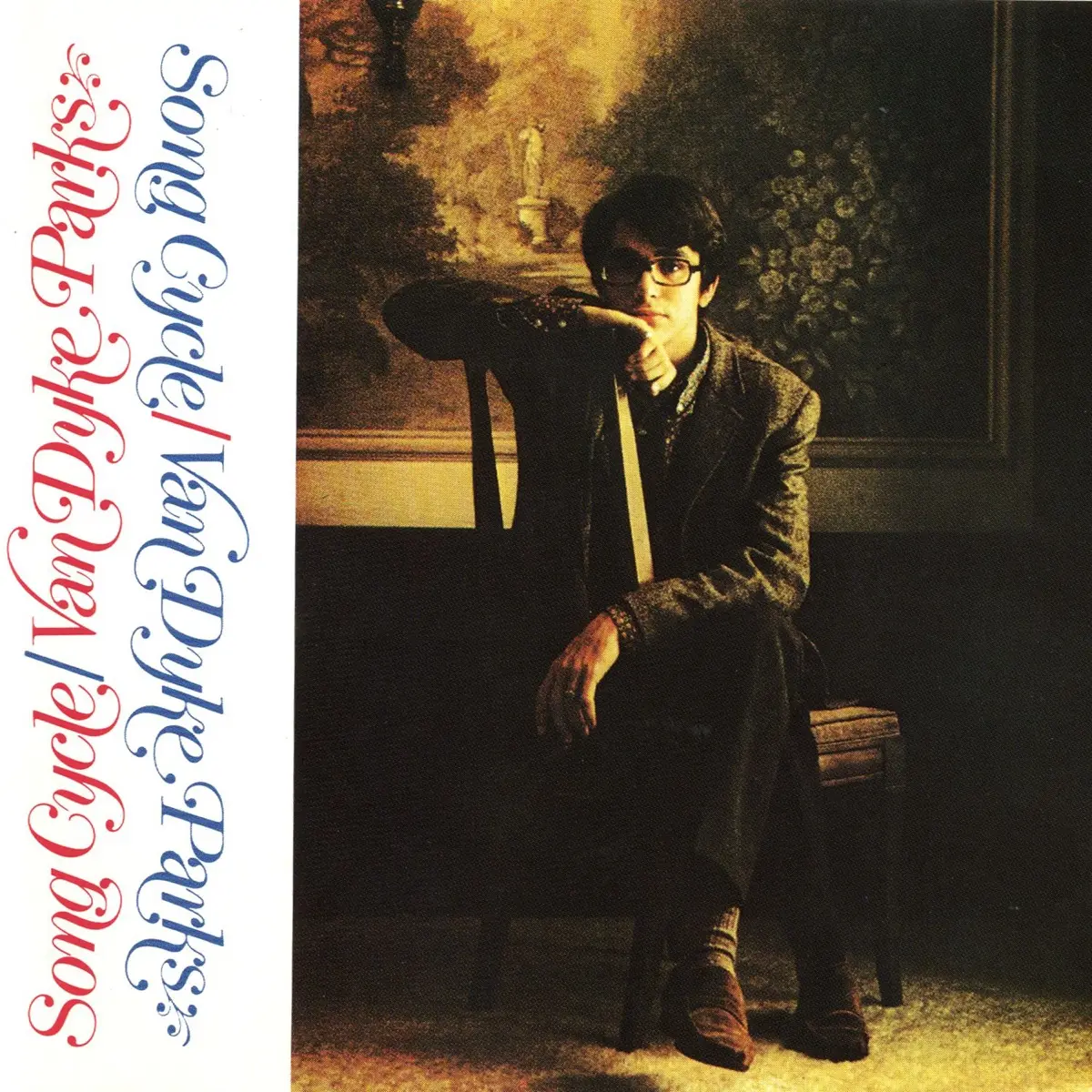 Van Dyke Parks released his debut album, Song Cycle, in November 1967 on Warner Bros.
The album blends orchestral pop with historical American idioms, merging elements of ragtime, string band music, and pre-rock Tin Pan Alley songwriting. Parks plays multiple keyboards—acoustic and electric piano, harpsichord, organ, Rocksichord, and tack piano—alongside marimbas and studio-processed effects.
Parks employed two bassists (Lyle Ritz, Chuck Berghofer), three drummers (Hal Blaine, Jim Gordon, Earl Palmer), and four guitarists, including Beau Brummel Ron Elliott and primitivist pioneer Dick Rosmini. Wrecking Crew guitarist Tommy Tedesco plays the balalaika, a triangular Russian three-stringed instrument. “Palm Desert” features steel guitarist Red Rhodes. Randy Newman plays piano on his songwriting contribution, “Vine Street.” Song Cycle also features nine choral singers and fifty orchestral players.
Song Cycle moves through sharply contrasting sections with abrupt changes in pace, texture, and harmonic direction, often discarding conventional song form in favor of montage and mood. Tracks like “The All Golden” and “By the People” pivot across multiple tonal and rhythmic zones—one moment centered around sparse plucked harp or accordion, the next overtaken by blaring brass or reverberant strings. “Palm Desert” blends chromatic woodwinds, lapsteel, and percussion into a slow-rolling cadence marked by pitch slides and cross-channel motion, while “Widow’s Walk” balances counterposed rhythms with harpsichord and low brass accents.
“Public Domain” opens with layered harp patterns that tumble into clipped, syncopated orchestration. “The Attic” and both versions of “Laurel Canyon Blvd” offer more stable harmonic ground, their gentler contours anchored by clear motifs and staggered pacing. Parks threads instrumental transitions with thematic reprises and ambient elements—train horns, ship whistles, reversed tape edits—evoking imagined geographies rather than narrating fixed ideas. Vocal lines veer toward theatrical phrasing, often shadowed or fractured by processing, and rarely aligned to steady rhythm. Throughout, Parks positions each piece as its own environment, stitched together not by refrain but by gesture, timbre, and juxtaposition.
A1. “Vine Street” (3:40)
A2. “Palm Desert” (3:07)
A3. “Widow’s Walk” (3:13)
A4. “Laurel Canyon Blvd” (0:28)
A5. “The All Golden” (3:46)
A6. “Van Dyke Parks” (0:57)
B1. “Public Domain” (2:34)
B2. “Donovan’s Colours” (3:38) – originated as “Colours” on the 1965 Pye release Fairytale, the second album by Scottish folkster Donovan.
B3. “The Attic” (2:56)
B4. “Laurel Canyon Blvd” (1:19)
B5. “By the People” (5:53)
B6. “Pot Pourri” (1:08)
Parks recorded the album across several Hollywood studios from early to mid-1967, including Sunset Sound and Sound Recorders. Lenny Waronker produced the sessions, with Lee Herschberg as supervising engineer and Bruce Botnick handling mixing. Sessions included large ensemble recordings, piecemeal overdubs, and stereo effects inspired by Juan García Esquivel’s space-age pop innovations. Parks employed techniques such as varispeed, reversed tape, and custom echo effects (“Farkle”) developed by Botnick. Recording costs exceeded $75,000, making it one of the most expensive pop LPs to date.
The instrumental cover of Donovan’s “Colours,” issued under the pseudonym George Washington Brown, served as the album’s first single. Warner Bros. released Song Cycle to favorable press in November 1967, but retail and radio response was minimal. Sales hovered around 10,000 within the first year. Warner launched an unusual print campaign admitting the LP’s financial losses, an approach that Parks opposed. Song Cycle eventually recouped production costs and influenced a later wave of artist-driven studio albums in the 1970s.
1968–72
After Song Cycle, Van Dyke Parks pivoted to production, arrangement, and executive roles at Warner Bros., becoming a key figure in its late-1960s artist network. He moved to Laurel Canyon and co-produced Randy Newman’s 1968 debut, applying a hands-on studio style focused on orchestration and pacing. Parks and Waronker followed with Arlo Guthrie’s Running Down the Road (1969) and Ry Cooder’s 1970 debut, where Parks expanded vernacular material with layered arrangements—most notably on “One Meat Ball.”
At Warner-Reprise, Parks championed artists internally, securing the Beach Boys’ move from Capitol in 1969. He appeared on their 1971 Surf’s Up LP, which revived the Smile-era title track he co-wrote. Parks also forged ties with Lowell George, advising Little Feat, co-writing early versions of “Sailin’ Shoes,” and strengthening the band’s label standing.
By 1970, Parks launched Warner’s Audio-Visual Services division under Mo Ostin, producing short films for Frank Zappa, Joni Mitchell, Earth, Wind & Fire, and Captain Beefheart. These visual pieces treated songs as cinematic objects, anticipating the music video format. Though the unit folded in 1971, Parks remained a trusted A&R presence, securing Beaver & Krause and supporting Peter Ivers’ early development.
Prompted by the 1969 Santa Barbara oil spill, Parks turned toward Caribbean music and environmental themes. He produced the Esso Trinidad Steel Band (1971) and Mighty Sparrow’s Hot & Sweet (1974), presenting calypso as political expression. These efforts culminated in his second album, released after Little Feat’s “Sailin’ Shoes” to avoid overlap.
Discover America
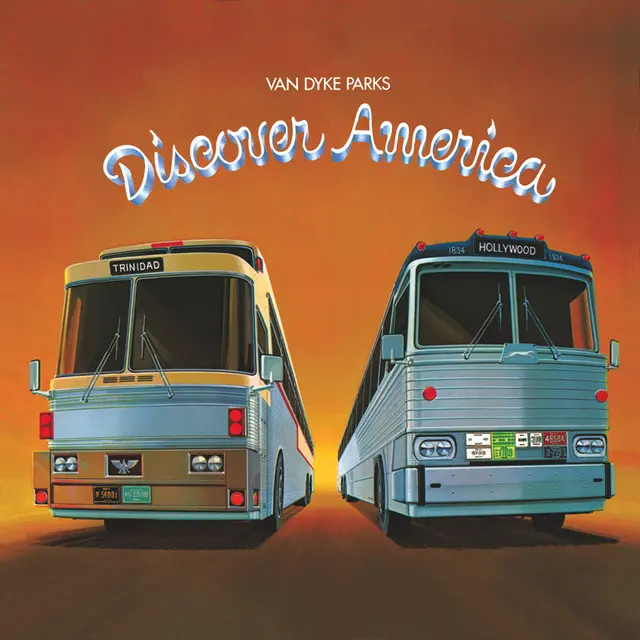 Van Dyke Parks released his second album, Discover America, in May 1972 on Warner Bros.
The album incorporates 1920s–40s calypso tunes by Roaring Lion, Lord Kitchener, Sir Lancelot, and other prewar Trinidadian composers, alongside reworked selections by Allen Toussaint, Lowell George, and John Philip Sousa. Parks presents the material in rapid succession with layered segues, narration, interstitial samples, and hybrid arrangements that combine traditional steel band rhythms with chamber strings, brass figures, and modern studio collage.
Parks himself plays piano and organ throughout. He intersperses vocals with documentary-style audio and orchestral interludes, emphasizing the album’s archival and thematic qualities over traditional song form. Select tracks feature jazz guitarist Mike Deasy, Motown bassist James Jamerson, and the Esso Trinidad Tripoli Steel Band.
Musically, Discover America folds calypso source material, vaudevillian staging, and intercut voice samples into a fragmented but cohesive suite of miniature portraits. Side A clusters Trinidadian tributes like “Bing Crosby,” arranged as a slow tango with concertina, and “The Four Mills Brothers,” trimmed to a ragtime pulse with a string quartet quoting “I Ain’t Got Nobody.” “Be Careful” contrasts its paternal lyric with overlapping tenor pans and chamber strings, while “Steelband Music” foregrounds the Esso Trinidad Tripoli Steel Band’s vocals and percussion. “FDR in Trinidad” shifts to a plucked acoustic backdrop with light percussion and guitar interjections from members of Little Feat, and “John Jones” adapts a 1968 Trojan reggae single into a snappier, keyboard-driven cut.
Side B adopts looser pacing and broader stylistic drift. “Occapella” rides a midtempo reggae frame with a submerged dub coda, while “Riverboat” veers toward swampy funk with loosely stacked rhythm guitar and horns. “G-Man Hoover” warps its string quartet setting with bent intonation and disorienting tonal shifts, approaching cabaret dissonance before resolving into the steel-band rendition of “Stars and Stripes Forever.” The album blends reverence with montage, filtering archival calypso through stylized sequencing, contrast-heavy arrangements, and layered cultural references that blur time, place, and authorship.
A1. “Jack Palance” (0:59) – Excerpt of Mighty Sparrow’s original recording, included as a direct sample rather than a reinterpretation; Parks later produced Sparrow’s Hot and Sweet album in 1974.
A2. “Introduction” (0:27) – Features a lo-fi monologue—possibly by Samuel Alter or Parks—speaking on themes of mythology and geography, setting a surreal tone for the album’s cultural cross-pollination.
A3. “Bing Crosby” (2:21) – Cover of Roaring Lion’s satirical ode to the American crooner, reflecting Parks’ interest in mid-century Caribbean commentary on U.S. pop culture.
A4. “Steelband Music” (2:11) – Built around vocals and steelpan by the Esso Trinidad Tripoli Steel Band; likely adapted from a traditional Trinidadian source.
A5. “The Four Mills Brothers” (1:28) – Roaring Lion’s tribute to the famous vocal group, incorporating the chorus of “I Ain’t Got Nobody,” which the Mills Brothers had themselves popularized.
A6. “Be Careful” (2:48) – Combines steel band rhythm with chamber string arrangement in a father-to-son cautionary tone; song origin remains unknown despite misattribution to Leo Robin.
A7. “John Jones” (3:08) – Originally performed by Rudy Mills for Trojan Records in the late 1960s, here recontextualized within Parks’ Caribbean–American framework.
A8. “FDR in Trinidad” (2:27) – Written by Fritz McLean and popularized by Attila the Hun to commemorate Roosevelt’s 1936 visit; Parks’ version includes contributions from members of Little Feat.
A9. “Sweet Trinidad” (0:56)
B1. “Occapella” (2:41) – Allen Toussaint
B2. “Sailin’ Shoes” (2:09) – Lowell George
B3. “Riverboat” (3:02) – Toussaint
B4. “Ode to Tobago” (5:13) – Lord Kitchener
B5. “Your Own Comes First” (3:24) – Lord Kitchener
B6. “G‑Man Hoover” (2:55) – Sir Lancelot
B7. “Stars and Stripes Forever” (1:00) – Parks adapts Sousa’s 1896 patriotic march, which Congress later designated as the official U.S. National March in 1987.
Sessions took place in early 1972 in Los Angeles, where Parks coordinated arrangements that merged field recordings, early calypso texts, and jazz-pop studio methods. He co-produced the album with his then-wife Linda Perry and his sister Durrie Parks.
Many tracks were arranged from songs in the public domain, or credited generically as traditional, though most had clear roots in Trinidadian sources. Legal ambiguities around copyright resulted in minimal crediting of originators, a point later addressed by Parks in interviews and liner notes for reissues.
1973–75
While working on Discover America, Parks and Lowell George crossed paths with the Japanese rock group Happy End, resulting in the co-written single “Goodbye America, Goodbye Japan” and Parks’ production of their self-titled final album in 1973. This period also marked the beginning of his ongoing friendship and collaborative history with Haruomi Hosono.
Parks co-wrote and arranged the 1973 Beach Boys single “Sail On, Sailor,” co-written by Ray Kennedy. In 1974, Parks arranged horns on “Spanish Moon,” a key cut on the fourth Little Feat album Feats Don’t Fail Me Now. Parks and Little Feat members backed Kathy Dalton on her 1973 release, Amazing, and supplemented Howdy Moon, a country-folk trio with Valerie Carter.
He also became a key creative partner to Harry Nilsson, providing Caribbean-inspired arrangements and studio coordination on albums such as Duit on Mon Dei (1975) and Sandman (1976), while also introducing Nilsson to steel pan player Robert Greenidge. Parks also worked informally on Allen Toussaint’s Southern Nights (1975), but his production role went uncredited due to management conflicts. In 1975, he and Brian Wilson attempted a version of “Come to the Sunshine” for the Beach Boys, though the recording was ultimately lost.
Clang of the Yankee Reaper
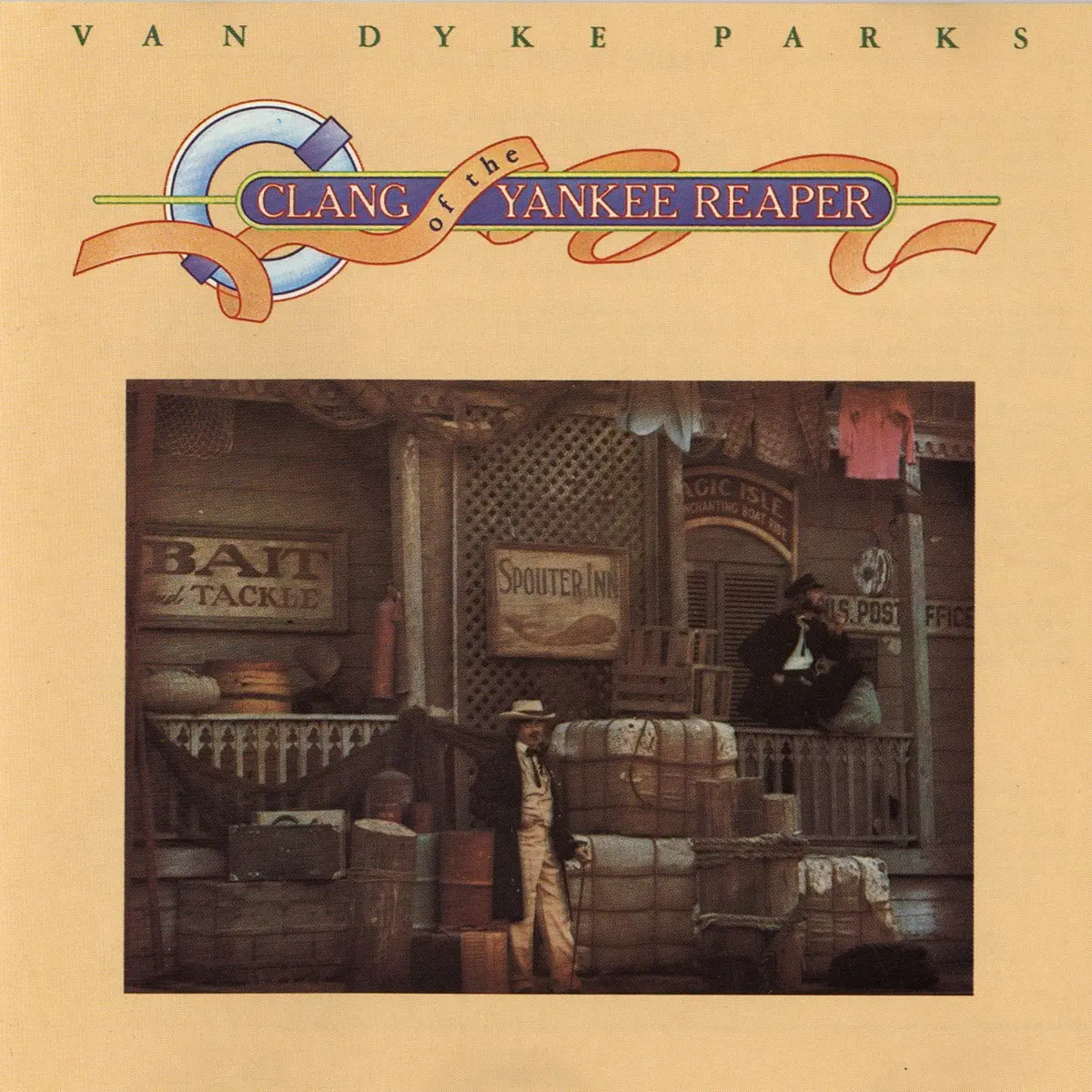 Van Dyke Parks released his third album, Clang of the Yankee Reaper, in 1975 on Warner Bros.
Clang extends his exploration of Trinidadian calypso through a mix of American standards and source material by Mighty Sparrow, Lord Kitchener, and lesser-known Caribbean writers, plus one classical interpolation. He sequences the album in brief, through-composed vignettes that pivot quickly in tone while anchored in West Indian rhythmic structure.
Parks’ arrangements contrast skeletal percussion with bursts of brass, string overlays, and occasional synthesizer. Clang features guitarist Jesse Ed Davis, bassist Klaus Voormann, TONTO synthesist Malcolm Cecil, percussionists Jim Keltner and Chili Charles, and the Esso Trinidad Tripoli Steel Band. Bob Thompson scored the closing “Canon in D” as a cross between chamber arrangement and hymn.
A1. “Clang of the Yankee Reaper” (3:41) – Parks, Martin Kibbee, Trevor Lawrence
A2. “City on the Hill” (3:00) – Winston Monseque
A3. “Pass That Stage” (3:00) – Mighty Sparrow
A4. “Another Dream” (2:54) – The Sandpebbles of Barbados
A5. “You’re a Real Sweetheart” (1:12) – Irving Caesar, Cliff Friend
B1. “Love Is the Answer” (3:28) – F. Williams
B2. “Iron Man” (3:05) – Stanley “Squibby” Cummings
B3. “Tribute to Spree” (3:37) – Lord Kitchener
B4. “Soul Train” (3:12) – Lord Kitchener
B5. “Canon in D” (2:42) – Johann Pachelbel
Sessions took place in Los Angeles under the production of Andrew Wickham and Trevor Lawrence, who helped shape the album’s layered calypso orchestrations and brass-textured transitions around Parks’ conceptual framework. Lawrence, also credited as co-writer and arranger, supervised multiple charts, while Wickham managed the project’s studio coordination during Parks’ final stretch at Warner Bros.
Jump!
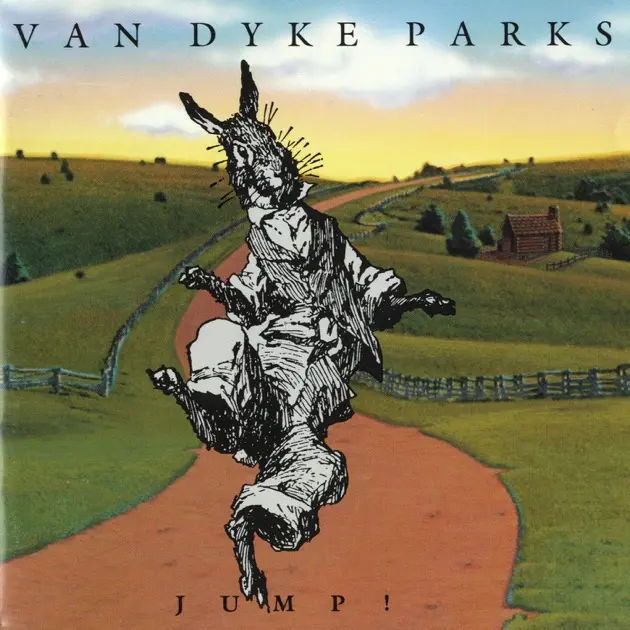 Van Dyke Parks released his fourth album, Jump!, in February 1984 on Warner Bros.
The album sets selections from the Uncle Remus folktales to an original song cycle co-written with lyricist Martin Kibbee. Parks frames the narratives in a theatrical style that draws from ragtime, bluegrass, parlor ballads, vaudeville, and Depression-era orchestration, structured with overtures, reprises, and character-based vocals.
Van Dyke Parks plays piano across Jump!, joined by bassist Jim Hughart, percussionist by Emil Richards, harpist Gayle Levant, and multi-string instrumentalist Fred Tackett (guitar, banjo, mandolin). Jim Keltner and Robert Greenidge split drum duties.
Jump! filters the Br’er Rabbit tales through tightly orchestrated vignettes that shift from carnival bustle to reflective interludes. Parks opens with “Jump!,” a brisk instrumental fanfare that sets a stage-show tone with overlapping winds and syncopated brass. “Opportunity for Two” and “Come Along” follow with dense layering—fast-paced string runs, vaudeville pianos, and vocal group interjections that blur meter and mood. “I Ain’t Goin’ Home” swells into something more grandiose, its spiraling transitions balancing light theatrical cadence with orchestral agitation.
“An Invitation to Sin” leans into strained chromatic tension, with operatic phrasing and sudden brass punches that cast shadows across the record’s otherwise buoyant pace. “Home” returns to lusher textures with harp and softened cadence, while “Look Away” alternates between declamatory refrains and waltz-like pageantry. “Hominy Grove” folds in a quoted Liszt flourish amid banjo-led turns and staged ensemble chatter, underscoring Parks’ interplay between folk instrumentation and dramatic arrangement. Across its compact runtime, the album balances hyper-arranged cheer with tonal rifts, treating its folkloric source not as nostalgia but as a springboard for theatrical dislocation.
A1. “Jump!” (2:02) – Parks
A2. “Opportunity for Two” (3:16) – Kibbee, Parks
A3. “Come Along” (3:26) – Kibbee, Parks
A4. “I Ain’t Goin’ Home” (3:45) – Kibbee, Parks
A5. “Many a Mile to Go” (3:42) – Kibbee, Parks
A6. “Taps” (2:16) – Parks
B1. “An Invitation to Sin” (3:20) – Kibbee, Parks
B2. “Home” (2:55) – Terry Gilkyson, Parks
B3. “After the Ball” (3:52) – Kibbee, Parks
B4. “Look Away” (4:03) – Parks
B5. “Hominy Grove” (3:26) – Kibbee, Parks
Parks recorded the album at Cherokee Studios in Hollywood between December 1982 and February 1983, with Steve Goldman producing. He enlisted a cast of vocalists—including Jennifer Warnes, Danny Hutton, and Kathy Dalton—to voice multiple characters and ensemble roles.
Lennie Niehaus arranged and conducted the orchestral passages, while Ian Freebairn-Smith handled choral direction. Niehaus drew heavily from mid-century musical theater scores with fluid transitions and recurring instrumental motifs across the album’s 36-minute runtime.
Discography:
- Song Cycle (1967)
- Discover America (1972)
- Clang of the Yankee Reaper (1975)
- Jump! (1984)
- Tokyo Rose (1989)
- Orange Crate Art (1995 • Brian Wilson and Van Dyke Parks)
- Broken Trail (TV, 2008 • David Mansfield & Van Dyke Parks)
- Super Chief (2013)
- Songs Cycled (2013)
- ¡Spangled! (2019 • Gaby Moreno & Van Dyke Parks)
Sources:
Artist/Album Pages:
Murray Head (born March 5, 1946) is an English singer–songwriter and actor who portrayed Judas Isc...
Betty Wright (Dec. 21, 1953 – May 10, 2020) was an American soul singer from Miami. She cut her d...
Shampoo was a Belgian jazz-rock band that made the 1971 album Volume One on Disques Motors. They m...
Titus Groan was an English jam-rock band that released a self-titled album and a standalone single...
Donald Byrd (1932–2013) was an American post-bop trumpeter who apprenticed with the Jazz Messenger...
Lobby Loyde — aka John Baslington Lyde (May 18, 1941 — April 21, 2007) — was an Australian blues-r...
Frame was a German Krautrock band that released the 1972 album Frame of Mind on Bacillus. Member...
Demian was an American hard-rock/psych band from San Antonio that released a self-titled album on...
Hugh Hopper (April 29, 1945 — June 7, 2009) was an English bassist from Whitstable, Kent, that gai...
Quicksand was a Welsh symphonic/hard-rock band behind a 1970 standalone single and the 1973 Dawn r...
The Last Nikle was an American brass-rock band from New Orleans that released a self-titled album on...
Flaming Youth was an English psych-rock band that released the album Ark 2 on Fontana in 1969. Drumm...