
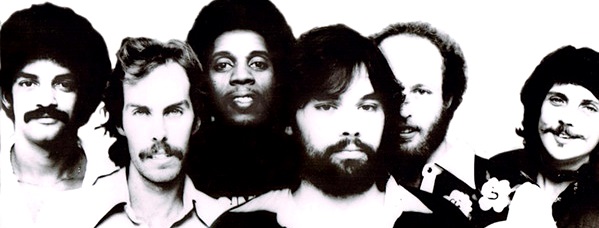
Little Feat are an American rustic funk-rock band from Los Angeles that released seven studio albums and a live double-LP on Warner Bros. between 1971 and 1979. Guitarist–bandleader Lowell George hailed from the Mothers of Invention. After his death in 1979, a revised lineup of Little Feat issued sporadic albums and toured constantly during the next three decades.
Their early albums are noted for the cover art of illustrator Neon Park, whose surreal collages of anthropomorphic food items and Americana sundries became tied to the band’s image and music.
Members: Bill Payne (keyboards, vocals), Lowell George (guitar, slide guitar, vocals, 1969-79), Roy Estrada (bass guitar, 1969-71), Richie Hayward (drums, vocals, 1969-79, 1988-2009), Kenny Gradney (bass, 1972-79, 1988-present), Paul Barrere (guitar, vocals, 1972-79, 1988-present), Sam Clayton (percussion, vocals, 1972-79, 1988-present)
Background
Little Feat stemmed from LA psych-rockers The Factory, which issued two singles on UNI in 1967. The band featured drummer Richie Hayward (1946–2010) and guitarist/singer Lowell George (1945–1979). They recorded roughly an album’s worth of material (most of it released on the Bizarre Records comp Lightning-Rod Man), including two songs produced by Frank Zappa, who roped George into the Mothers of Invention in late 1968.
George played on the Mother’s 1970 albums Weasels Ripped My Flesh and Burnt Weeny Sandwich. Prior to the release of those albums, his stint ended in mid-1969 under debated circumstances. Meanwhile, Hayward and Factory bassist Martin Kibbee formed The Fraternity of Man, which cut a self-titled album for ABC in 1968. One of their cuts, “Don’t Bogart That Joint,” was included on the Easy Rider soundtrack.
During his brief Mothers tenure, George met keyboardist Bill Payne when the latter auditioned for MoI. The two formed Little Feat in late 1969 with Hayward and bassist Roy Estrada.
Little Feat
 Little Feat released their self-titled debut album in January 1971 on Warner Bros. The album presents swampy rock anchored by blues structures and country touches.
Leader Lowell George (rhythm, slide, harmonica) wrote three songs and co-wrote an additional three with keyboardist Bill Payne, who delivered “Snakes on Everything” and “Takin’ My Time.” Bassist Roy Estrada co-wrote “Hamburger Midnight.” Drummer Richard Hayward shares lead vocals on the closing track, “Crazy Captain Gunboat Willie.” Musical guests include bottleneck guitarist Ry Cooder.
Little Feat unfolds with a restless energy that alternates between playful and brooding textures. “Snakes on Everything” opens with jagged piano motifs and shifting rhythmic pulses, setting a vivid, kinetic tone. Tracks like “Strawberry Flats,” “Hamburger Midnight,” and “Crack in Your Door” extend the album’s whimsical, surrealistic imagery through wiry guitar figures and angular piano runs, with sporadic surges in tempo that lend urgency to the narrative lines. Ballads such as “Truck Stop Girl,” “Brides of Jesus,” and “I’ve Been the One” move at more measured paces, weaving contoured vocal lines with subtly evolving instrumental patterns, while “Willin’” delivers a sparse, blues-infused trucker tale accented by bottleneck slide, its rhythm elastic and slightly liminal.
“Forty-Four Blues / How Many More Years” expands into an extended blues workout, layering harmonica and slide interplay over a languid, flexible pulse, and the closing “Crazy Captain Gunboat Willie” fuses playful dissonances with sudden dynamic shifts, marrying surrealist lyricism with brisk, serrated instrumental passages. Across Little Feat, piano, slide guitar, and syncopated percussion constantly redirect the momentum, creating a fluid, unpredictable listening experience.
A1. “Snakes on Everything” (3:04) — Payne
A2. “Strawberry Flats” (2:20) — Payne, George
A3. “Truck Stop Girl” (2:32) — Payne, George
A4. “Brides of Jesus” (3:20) — Payne, George
A5. “Willin'” (2:24) — George; bottleneck guitar by Ry Cooder
A6. “Hamburger Midnight” (2:30) — George, Estrada
B1. “Forty-Four Blues / How Many More Years” (6:25) — originated as 1936 sides by Roosevelt Sykes and Chester Burnett; bottleneck by Cooder.
B2. “Crack in Your Door” (2:16)— George
B3. “I’ve Been the One” (2:20) — George; piano by Russ Titelman, pedal steel by Sneaky Pete Kleinow
B4. “Takin’ My Time” (3:45) — Payne
B5. “Crazy Captain Gunboat Willie” (1:55) — Payne, George; additional lead vocals by Richard Hayward
Sessions occurred in August–September 1970 at United Western Recorders and the Record Plant in Los Angeles with producer Russ Titelman.
The cover features artwork by the L.A. Fine Arts Squad, depicting the mural Venice in the Snow in Venice, Los Angeles.
Sailin’ Shoes
 Little Feat released their second album, Sailin’ Shoes, in February 1972 on Warner Bros. The album shifts toward tighter rock structures with funk undercurrents.
Lowell George (guitar, harmonica, baritone saxophone, drum machine) wrote six songs and co-wrote “Easy to Slip” with Fred Martin, singing lead on all tracks except “Cat Fever.” Keyboardist Bill Payne (Hammond organ, piano, Wurlitzer electric piano, accordion) wrote “Got No Shadow” and co-wrote “Tripe Face Boogie” with drummer Richie Hayward, who also provides backing vocals.
This was their final album with original bassist Roy Estrada. Musical guests include pedal steel guitarist Sneaky Pete Kleinow, percussionist Milt Holland, rhythm guitarist Ron Elliott, and backing vocalist Debbie Lindsey.
Sailin’ Shoes unfolds with a sharp, playful energy, opening with “Easy to Slip,” which rides buoyant, staccato rhythms and spacious vocal harmonies, its contoured lines leaping over crisp percussion and crisp piano accents. “Cold, Cold, Cold” shifts into a more abrasive, hard-edged blues, propelled by kinetic drum strikes, angular slide riffs, and jagged vocal phrasing, creating a surreal tension beneath the driving beat. The album eases into mid-tempo, country-inflected textures with “Trouble” and the title track, where finger-picked acoustic guitar, accordion, and soft snare brushwork frame lightly distorted piano and understated slide, offering moments of ironic, playful lyricism.
Rock-driven numbers like “Tripe Face Boogie” and “Teenage Nervous Breakdown” push with unrelenting bass-and-drum propulsion, dual guitars weaving sharp bends and interlocking fills, while “Willin’” reinterprets its earlier, more stark debut version with spacious piano lines, gentle pedal steel, and measured slide excursions. Bill Payne’s compositions, “Got No Shadow” and “Cat Fever,” expand the palette further: the former unfolds in layered, restrained electric and acoustic pianos with subtle jazzy inflections, the latter pairing sinuous slide and piano interplay over mid-tempo, syncopated patterns. The closer, “Texas Rose Cafe,” fuses languid blues with unexpected midsection shifts into angular, multi-part textures, returning to a serene, wryly theatrical ending.
A1. “Easy to Slip” (3:22) — George, Martin; percussion by Milt Holland
A2. “Cold, Cold, Cold” (4:01) — backing vocals by Debbie Lindsey
A3. “Trouble” (2:19) — percussion by Milt Holland
A4. “Tripe Face Boogie” (3:16) — Hayward, Payne
A5. “Willin'” (2:57) — pedal steel by Sneaky Pete Kleinow
A6. “A Apolitical Blues” (3:28) — rhythm guitar by Ron Elliott
B1. “Sailin’ Shoes” (2:53) — backing vocals by Debbie Lindsey
B2. “Teenage Nervous Breakdown” (2:13)
B3. “Got No Shadow” (5:08) — Payne
B4. “Cat Fever” (4:37) — Payne
B5. “Texas Rose Café” (3:42) — pedal steel by Sneaky Pete Kleinow
Across the album, drums, bass, and keyboards interlock tightly with George’s vocals and slide, creating a continuously shifting landscape of rhythm, tension, and playful coloration.
Sessions occurred late 1971 at Amigo Sounds, Sunset Sound, and TTG Studios in Los Angeles with producer Ted Templeman.
The cover features artwork by Neon Park (aka Martin Muller), the illustrator of Frank Zappa’s 1970 album Weasels Ripped My Flesh.
Warner lifted “Easy to Slip” as a single (b/w “Cat Fever”).
Dixie Chicken
 Little Feat released their third album, Dixie Chicken, on January 25, 1973, on Warner Bros.
The album leans into New Orleans funk rhythms with R&B horn textures, played by an expanded lineup with guitarist Paul Barrere, percussionist Sam Clayton, and new bassist Kenny Gradney.
Lowell George (guitar, cowbell, flute) wrote five songs and co-wrote the title track with Fred Martin Kibbee. Barrere co-wrote “Walkin’ All Night” with Bill Payne. Guest musician Fred Tackett (guitar, mandolin, trumpet) offered “Fool Yourself.” They also cover the recent Allen Toussaint number “On Your Way Down.”
Dixie Chicken opens with the title track, which moves on relaxed, syncopated rhythms with angular vocal turns over subtly shifting guitar lines. “Two Trains” follows with a bright, upbeat pace, propelled by crisp, interlocking percussion and piano fills accenting George’s sly phrasing. “Fool Yourself” and Allen Toussaint’s “On Your Way Down” anchor the album in slow, contoured blues passages, with occasional bursts of horn and guitar interplay.
“Fat Man in a Bathtub” simmers with playful tension, trading between piano riffs and wry vocals, while “Juliette” explores folk-inflected textures, flute lines winding through gently undulating rhythms. The closing “Lafayette Railroad” drifts in a spacious instrumental, guitar and keys tracing fluid arcs over a calm pace. Mid-album tracks such as “Roll ’Um Easy” and “Kiss It Off” shift between sparse, world-weary country folk and tighter, insistent rhythmic drive, showing the six-piece lineup handling complex, layered arrangements with warmth and precision.
A1. “Dixie Chicken” (3:55) — George, Kibbee
A2. “Two Trains” (3:06) — George
A3. “Roll Um Easy” (2:30) — George
A4. “On Your Way Down” (5:31) — originated on Toussaint’s 1972 release Life, Love, and Faith.
A5. “Kiss It Off” (2:56) — George
B1. “Fool Yourself” (3:10) — Tackett
B2. “Walkin’ All Night” (3:35) — Barrere, Payne
B3. “Fat Man in the Bathtub” (4:29) — George
B4. “Juliette” (3:20) — George
B5. “Lafayette Railroad” (3:40) — George, Payne; instrumental
Throughout, keyboards, percussion, and understated horns enrich the sound, moving from contemplative slow-tempo sections to lively, subtly syncopated patterns.
George produced the album in late 1972 at three Los Angeles studios: Clover Recorders, Sunset Sound, and Warner Bros. Recording Studios. Backing vocalists included Bonnie Bramlett, Bonnie Raitt, and Gloria Jones. Synthesist Malcolm Cecil supplemented the sound.
The cover features artwork by Neon Park, referencing a line from “Roll Um Easy.” Warner lifted “Dixie Chicken” as a single (b/w “Lafayette Railroad”).
Feats Don’t Fail Me Now
 Little Feat released their fourth album, Feats Don’t Fail Me Now, on August 9, 1974, on Warner Bros. The album showcased intensified funk rhythms and rock drive in the sextet lineup.
Lowell George (guitar, vocals) sings lead on everything apart from one song each by Billy Payne (“Oh Atlanta”) and Paul Barrere (“Skin it Back”). Musical guests include clavinetist Gordon DeWitty, drummer Fred White, backing vocalists Emmylou Harris, Bonnie Raitt, Fran Tate, and the Tower of Power horn section.
Feats Don’t Fail Me Now opens with Lowell George’s “Rock & Roll Doctor,” which moves on a swampy, low-key riff with sly, angular vocal turns. Billy Payne’s “Oh Atlanta” rides rolling piano lines and layered harmonies over a bright, buoyant pace, while Paul Barrère’s “Skin It Back” pulses with staccato funk rhythms and subtle clavinet accents. “Spanish Moon” builds from an infectious, percussive intro into a warm, soulful interplay of horns, keys, and guitar, and the title track combines extended, syncopated rhythms with interwoven guitar and keyboard textures.
“Cold Cold Cold” and “Tripe Face Boogie” close the album in a ten-minute medley, transitioning from tense, angular R&B riffs through exploratory keyboard motifs to soaring doubled guitars and a thundering, climactic finish. Mid-album tracks such as “Down the Road” and “The Fan” alternate between raspy slide counterpoints, precise keyboard-piano interplay, and expansive rhythmic layering, demonstrating the sextet’s tight, intuitive interaction.
A1. “Rock & Roll Doctor” (2:57) — George, Kibbee
A2. “Oh Atlanta” (3:26) — Payne
A3. “Skin it Back” (4:11) — Barrère
A4. “Down the Road” (3:46) — George
A5. “Spanish Moon” (3:01) — George; clavinet by Gordon DeWitty, drums by Fred White
B1. “Feats Don’t Fail Me Now” (2:27) — George, Barrère, Kibbee
B2. “The Fan” (4:30) — George, Payne
B3. “Medley: Cold Cold Cold / Tripe Face Boogie” (10:00) — George, Hayward, Payne
 Throughout the album, percussion, clavinet, horns, and subtle synthesizer lines add depth, producing a dynamic flow that shifts effortlessly between playful funk, restrained R&B, and expansive instrumental passages.
Sessions ran January through June 1974 at Blue Seas Recording Studio in Hunt Valley, Maryland; The Sound Factory, Los Angeles; Warner Bros. Recording Studios, North Hollywood; and Sunset Sound, Los Angeles, with Lowell George producing most tracks and Van Dyke Parks producing “Spanish Moon.”
The cover features artwork by Neon Park. Warner Bros. promoted Feats Don’t Fail Me Now with “Oh Atlanta” (b/w “Down the Road”).
The Last Record Album
 Little Feat released their fifth album, The Last Record Album, on October 17, 1975, on Warner Bros. The album upheld their funk-rock arrangements with synthesizer accents in a sextet setting.
Lowell George (guitar, vocals) sings lead on all tracks except “Romance Dance” and “Day or Night,” where Bill Payne and Paul Barrère share vocals, and “Somebody’s Leavin’,” sung by Payne. Keyboardist Bill Payne (keyboards, synthesizer, vocals) co-wrote several tracks with Barrère, Gradney, and Fran Tate. Bassist Kenny Gradney and drummer Richie Hayward also contributed songwriting.
Orleans guitarist John Hall (Orleans) guests on “All That You Dream,” which features backing vocals by Linda Ronstadt. Valerie Carter and Fran Tate sing backing vocals on “Long Distance Love” and “One Love Stand.”
The Last Record Album opens with George’s “All That You Dream,” which pairs contoured vocals with fluid, syncopated piano and guitar lines, creating a warm, expansive rhythm. “Long Distance Love” slows to a poignant pace, layering delicate slide guitar over restrained percussion, while “Romance Dance” and “Somebody’s Leavin’” ride lightly undulating rhythms with subtle harmonic interplay between guitars and keys.
“Day or Night” builds through intricate synth textures, drum-conga interplay, and bass-driven motifs, reaching a soft-to-thunderous crescendo. Barrère’s “One Love Stand” and “Mercenary Territory” explore tense, angular motifs, shifting from staccato funk pulses to sweeping, layered instrumental passages. Mid-album tracks like “Down Below the Borderline” combine earthy, rolling rhythms with interlaced guitar and keyboard lines, and sparse horn touches accentuate climactic moments.
A1. “Romance Dance” (3:49) — Barrère, Gradney, Payne; lead vocals: Payne, Barrère
A2. “All That You Dream” (3:52) — Barrère, Payne; lead vocal: George
A3. “Long Distance Love” (2:43) — George; lead vocal: George
A4. “Day or Night” (6:24) — Payne, Tate; lead vocals: Payne, Barrère
B1. “One Love Stand” (4:26) — Barrère, Gradney, Payne; lead vocal: George
B2. “Down Below the Borderline” (3:41) — George; lead vocal: George
B3. “Somebody’s Leavin’” (5:07) — Payne; lead vocal: Payne
B4. “Mercenary Territory” (4:27) — George, Hayward, Elizabeth George; lead vocal: George
Across the album, keyboards, percussion, and guitars trade vocal-like lines and instrumental riffs, producing a dynamic flow that moves from introspective ballads to lively, rhythmically complex passages, reflecting the band’s precise, intuitive interplay at its peak.
Sessions spanned March through September 1975 at The Sound Factory, Los Angeles, with Lowell George producing and George Massenburg engineering.
The cover features artwork by Neon Park, depicting Hollywood Boulevard as desert leading to a Jell-O mold of the Hollywood Sign.
Time Loves a Hero
 Little Feat released their sixth album, Time Loves a Hero, on April 15, 1977, on Warner Bros.
Lowell George wrote one song (“Rocket in My Pocket”) and co-wrote another (“Keepin’ Up with the Jonese”) but ceded most writing duties to Bill Payne and Paul Barrère. The full band (barring George) composed “Day at the Dog Races,” a lengthy jazz-rock instrumental. They perform one outside contribution: “New Delhi Freight Train” by songwriter Terry Allen.
Time Loves a Hero features the Tower of Power horn section and Dixie Chicken sessionist Fred Tackett (mandocello, guitar), plus three Doobies: singer Michael McDonald (“Red Streamliner”) and guitarists Jeff “Skunk” Baxter (dobro, “Missin’ You”) and Patrick Simmons (“New Delhi Freight Train”).
Time Loves a Hero opens with the punchy “Hi Roller,” propelled by layered Latin-tinged percussion, churning guitar riffs, and swaying bass, shifting halfway through to a higher-speed section with urgent drums and bright keyboard accents. The title track drifts at a laid-back, undulating pace, its vocal lines curving over subtle synth textures, while George’s “Rocket in My Pocket” rides an angular, slide guitar motif against tight, mid-tempo drums and bass, punctuated by delicate synth washes.
“Day at the Dog Races” builds from a sharp, synthesized intro into a sprawling instrumental, blending syncopated keyboards, intricate guitar lines, and interlocking percussion in a complex, jazzy tapestry.
Side two opens with the playful, rolling “Old Folks Boogie,” where vocals float atop piano-driven rhythm and restrained horn accents, and continues with “Keepin’ Up with the Joneses,” which layers sensuous mid-tempo grooves with brass stabs and sparse electric piano. “Red Streamliner” maintains a driving, ironclad pace with tight guitar and horn motifs, while “New Delhi Freight Train” slows into a pastoral, contemplative flow accented by slide guitar. The album closes with “Missin’ You,” a quiet, tender arrangement where acoustic guitar, gentle keyboards, and soft percussion provide a spacious frame for expressive vocals.
A1. “Hi Roller” (3:35) — Barrère; lead vocal: George
A2. “Time Loves a Hero” (3:47) — Barrère, Gradney, Payne; lead vocals: Payne, Barrère
A3. “Rocket in My Pocket” (3:25) — George; lead vocal: George
A4. “Day at the Dog Races” (6:27) — Barrère, Clayton, Gradney, Hayward, Payne; instrumental
B1. “Old Folks Boogie” (3:31) — Barrère, Gabriel Barrère; lead vocal: Barrère
B2. “Red Streamliner” (4:44) — Payne, Tate; lead vocal: Payne
B3. “New Delhi Freight Train” (3:42) — Terry Allen; lead vocal: George
B4. “Keepin’ Up with the Joneses” (3:51) — Barrère, George; lead vocal: Barrère
B5. “Missin’ You” (2:21) — Barrère; lead vocal: Barrère
Across the record, synths, horns, and rhythm sections interweave with guitar and piano, producing dynamic shifts from languid to urgent passages while highlighting the band’s ensemble interplay.
Sessions occurred 1976–1977 at studios in Hollywood (Sunset Sound Studios, Warner Bros. Studios, Western Recorders) and Sausalito (Record Plant) with producer Ted Templeman. The cover features artwork by Neon Park.
Waiting for Columbus
 On February 10, 1978, Little Feat released the live double-album Waiting for Columbus.
The recordings showcase extended funk-rock arrangements with layered horns and dynamic interplay among the sextet lineup. Guitarist Lowell George leads vocals across most tracks, supported by Paul Barrère (guitar, vocals), Sam Clayton (congas, vocals), Bill Payne (keyboards, synthesizer, vocals), Kenny Gradney (bass), and Richie Hayward (drums, vocals).
Guest musicians include Tower of Power horn section—Emilio Castillo (tenor saxophone), Greg Adams (trumpet), Lenny Pickett (alto and tenor saxophone, clarinet), Stephen “Doc” Kupka (baritone saxophone), and Mic Gillette (trombone, trumpet)—Mick Taylor (slide guitar on “A Apolitical Blues”), and backing vocalists Michael McDonald and Patrick Simmons on “Red Streamliner.”
The album captures the band reworking material from their studio albums: Dixie Chicken (“On Your Way Down” cover, “Dixie Chicken”), Feats Don’t Fail Me Now (“Rocket in My Pocket,” “Mercenary Territory,” “Feats Don’t Fail Me Now”), The Last Record Album (“All That You Dream,” “Fat Man in the Bathtub”), Time Loves a Hero (“Time Loves a Hero,” “Day or Night”), and Sailin’ Shoes (“Sailin’ Shoes,” “Willin’”). Piano solos extend in “Dixie Chicken” before Dixieland horns and dual guitar interplay; Tower of Power horns rework “Rocket in My Pocket” and “Mercenary Territory.”
A1. “Join the Band” (1:50) — traditional; audience chant introduces the performance
A2. “Fat Man in the Bathtub” (4:50) — George; from Dixie Chicken
A3. “All That You Dream” (4:25) — Barrère, Payne; from The Last Record Album
A4. “Oh Atlanta” (4:09) — Payne; from Feats Don’t Fail Me Now
A5. “Old Folks’ Boogie” (4:22) — Barrère, Gabriel Barrère
B1. “Time Loves a Hero” (4:20) — Barrère, Gradney, Payne; from Time Loves a Hero
B2. “Day or Night” (5:23) — Payne, Fran Tate; from The Last Record Album
B3. “Mercenary Territory” (4:27) — George, Hayward; from The Last Record Album
B4. “Spanish Moon” (4:49) — George; from Feats Don’t Fail Me Now
C1. “Dixie Chicken” (9:00) — George, Martin Kibbee; from Dixie Chicken
C2. “Tripe Face Boogie” (7:02) — Hayward, Payne; from Sailin’ Shoes
C3. “Rocket in My Pocket” (3:42) — George; from Time Loves a Hero
D1. “Willin’” (4:42) — George; from Sailin’ Shoes
D2. “Don’t Bogart That Joint” (0:57) — E. Ingber, L. Wagner; cover of Fraternity of Man
D3. “A Apolitical Blues” (3:41) — George; from Sailin’ Shoes; guest Mick Taylor on slide guitar
D4. “Sailin’ Shoes” (6:18) — George; from Sailin’ Shoes
D5. “Feats Don’t Fail Me Now” (5:17) — Barrère, George, Kibbee; from Feats Don’t Fail Me Now
Sessions occurred at Rainbow Theatre, London, on August 1–4, 1977, and Lisner Auditorium, George Washington University, Washington, D.C., on August 8–10, 1977, with Lowell George producing and Bill Halverson engineering.
Waiting for Columbus features artwork by Neon Park, depicting an anthropomorphic tomato on a hammock amid American native foliage and cactus.
The album reached No. 18 on the US Billboard 200, No. 27 in Australia, No. 18 in Norway, No. 29 in the Netherlands, and No. 11 in New Zealand. The 2002 deluxe edition includes a twelve-minute version of “Day at the Dog Races.”
Down on the Farm
 Little Feat released their seventh studio album, Down on the Farm, on November 14, 1979, on Warner Bros. It marked the band’s last original work for nine years, completed as the group announced its break-up in June 1979.
The album sustains funk-rock patterns with synthesizer and horn accents across the sextet lineup. Guitarist Paul Barrère sings lead on the title track, while Lowell George leads most remaining songs. Keyboardist Bill Payne, bassist Kenny Gradney, and drummer Sam Clayton also contribute vocals and backing arrangements.
Guest players include slide guitarist Fred Tackett, pedal steel guitarist Sneaky Pete Kleinow, saxophonist Jerry Jumonville, guitarist Robben Ford, and backing vocalists Rosemary Butler, Fran Payne, Bonnie Raitt, and the Waters family.
Guitarist Paul Barrère wrote the title track. Lowell George wrote four songs, including co-writes with Keith Godchaux and Fred Tackett. Bill Payne co-wrote two songs with Fran Payne.
Down on the Farm opens with the title track, a swampy, mid-tempo rocker driven by Paul Barrère’s rounded vocals and Lowell George’s sharp slide guitar, layered over steady drums and syncopated bass. “Six Feet of Snow” moves with a loping, country-tinged pace, accented by pedal steel and George’s airy vocals, while “Perfect Imperfection” offers a restrained, blues-leaning ballad with economical slide work and plaintive delivery. “Kokomo” mirrors the title track’s rhythmic elasticity, pairing George’s slide guitar with subtle counterpoint from Fred Tackett. The ballad “Be One Now” flows at a gentle, contemplative pace, its vocal phrasing arching over soft harmonic backing.
Side two opens with the buoyant “Straight from the Heart,” where bouncy bass and crisp guitar punctuate George’s vibrant, expressive singing. “Front Page News” balances syncopated, jazzy keyboards with smooth backing vocals, creating a layered, flowing texture, while Bill Payne’s “Wake Up Dreaming” rides a bright, lightly undulating rhythm with playful piano and airy lead lines. The album closes with “Feel the Groove,” a percussion-led, New Orleans-inflected track with clipped vocal delivery and a minimal synth motif.
A1. “Down on the Farm” (4:16) — Barrère; lead vocal: Barrère
A2. “Six Feet of Snow” (2:30) — George, Keith Godchaux; lead vocal: George
A3. “Perfect Imperfection” (3:46) — Barrère, Tom Snow; lead vocal: George
A4. “Kokomo” (2:58) — George; lead vocal: George; guitar solo by Fred Tackett
A5. “Be One Now” (4:05) — George, Fred Tackett; lead vocal: George
B1. “Straight from the Heart” (4:59) — George, Payne; lead vocal: George
B2. “Front Page News” (5:57) — George, Payne; lead vocal: George
B3. “Wake Up Dreaming” (4:09) — Payne, Fran Payne; lead vocal: Payne
B4. “Feel the Groove” (4:49) — Clayton, Gordon DeWitty; lead vocal: Clayton
Across the record, guitar, keyboard, and rhythm arrangements shift between energetic and introspective, producing a mixture of lively, textured pieces and tender, measured moments that highlight the ensemble’s interplay.
Sessions occurred at Wally Heider’s Studio 3 in Hollywood, Lowell George’s house in Topanga Canyon, and Paramount Ranch in Agoura Hills. Little Feat self-produced in the company of engineer Rob Fraboni.
Down on the Farm features artwork by Neon Park, depicting one of his duck-girls in reference to Gil Elvgren’s painting The Finishing Touch.
Down on the Farm reached No. 29 on the Billboard 200.
Discography:
- Little Feat (1970)
- Sailin’ Shoes (1972)
- Dixie Chicken (1973)
- Feats Don’t Fail Me Now (1974)
- The Last Record Album (1975)
- Time Loves a Hero (1977)
- Waiting for Columbus (live 2LP, 1978)
- Down on the Farm (1979)
- Hoy-Hoy! (1981)
- Let It Roll (1988)
- Representing the Mambo (1990)
Sources:
Artist/Album Pages:
Aretha Franklin (March 25, 1942 — August 16, 2018) was an American soul singer from Memphis. She...
Pastoral was an Argentine folk duo of guitarist-singers Alejandro De Michele and Miguel Angel Erau...
Norman Feels is an American soul singer who first recorded in the early 1960s as Norman Solomon w...
Dave Valentin (April 29, 1952 — March 8, 2017) was an American jazz-funk and Latin-jazz flutist fr...
Ash Ra Tempel was a German space-rock band that released four albums between 1971 and 1973 on Ohr....
F.G. Experimental Laboratory was the electronic-music project of Swiss multi-instrumentalist Frédy...
Andromeda was a German organ-rock/psych band that released a self-titled album on Vogue in 1970. ...
Cherry Five was an Italian symphonic-rock band that released a 1975 self-titled album on Cinevox. ...
Daughters of Albion were an American vocal-pop/psych duo from Los Angeles that released a 1968 al...
Esther Williams is an American soul singer who released three albums between 1976 and 1981, setti...
Schtüng was a New Zealander symphonic-rock band that released a self-titled album in 1977 on Polyd...
The Climax Blues Band was an English rock band that emerged in 1969 with two blues-rock albums on P...