

Sagittarius was the pop-psych studio project of American producers Curt Boettcher and Gary Usher. Their project yielded two albums: Present Tense (Columbia, 1968) and The Blue Marble (Together Records, 1969).
Members: Gary Usher (vocals), Curt Boettcher (vocals)
Background
Sagittarius was a Los Angeles studio pop-psych project masterminded by producers Gary Usher and Curt Boettcher. The name first appeared on the 1967 single “My World Fell Down,” which Usher assembled after Chad & Jeremy declined to record the Ivy League tune. He recruited Beach Boys affiliates Glen Campbell (lead vocals) and Bruce Johnston, as well as Terry Melcher, to complete the track. The single reached No. 70 on the Billboard Hot 100, but when Columbia requested a tour, it became clear that Sagittarius was not a performing act. Usher instead launched work on a full album with Boettcher, whom he had recently met through Ballroom sessions next door to Brian Wilson’s studio activities.
Boettcher had started as frontman of The GoldeBriars before producing The Association‘s debut LP and forming the short-lived Ballroom, a group whose unreleased Warner Bros. album supplied two tracks for the first Sagittarius album. Usher, meanwhile, had co-written with Brian Wilson, produced The Byrds and Chad & Jeremy, and built a reputation for forward-thinking pop production. Between 1967 and 1968, he and Boettcher completed Present Tense with assistance from a rotating cast of L.A. session musicians, including Campbell, Johnston, Joey Stec, and Mike Fennelly.
Present Tense
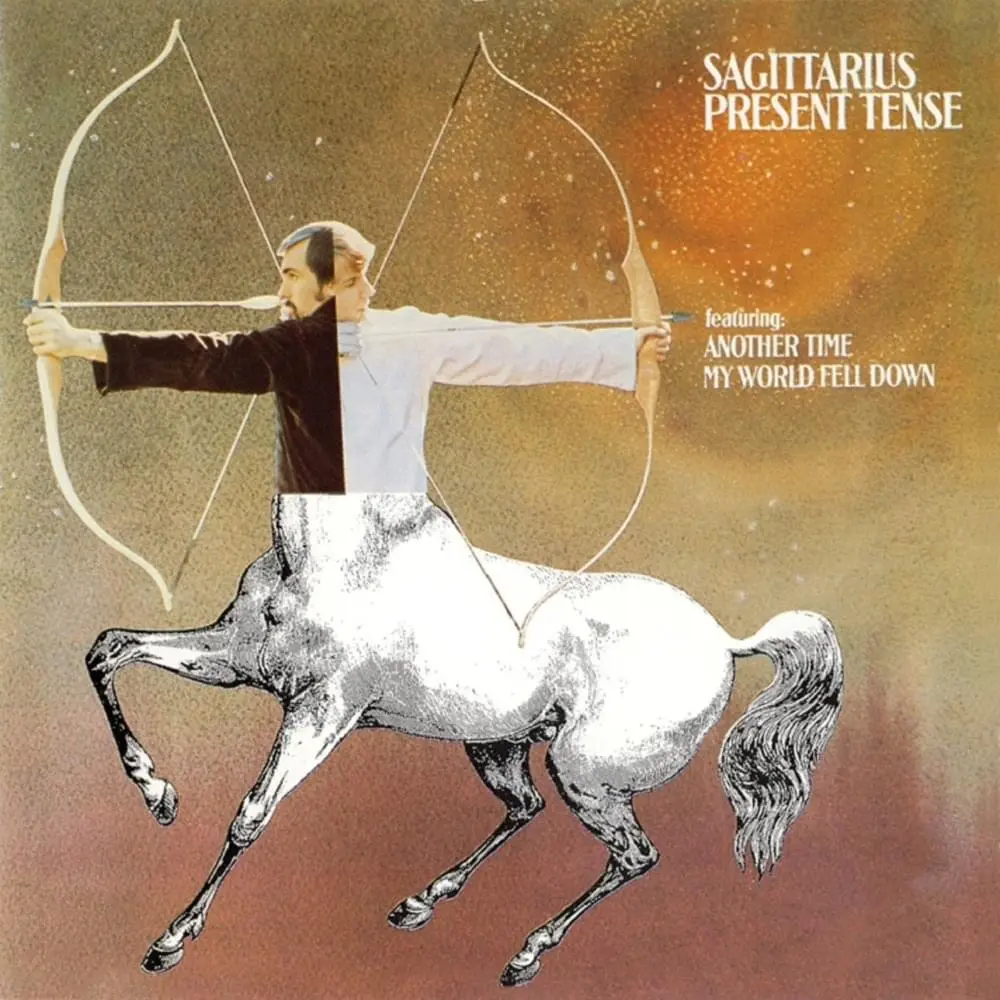 Sagittarius released their debut album, Present Tense, on July 3, 1968 on Columbia.
Present Tense compiles sessions produced between late 1966 and mid-1968 by Gary Usher with substantial input from Curt Boettcher. Two tracks, “I’m Not Living Here” and “Musty Dusty,” originate from Boettcher’s prior project The Ballroom. Due to Columbia executive Clive Davis’ aversion to the musique concrète elements in the group’s singles, both “My World Fell Down” and “Hotel Indiscreet” appear in edited form on the LP. Much of the album is built around multi-part vocal arrangements and chamber pop instrumentation, filtered through a soft psychedelic lens.
Boettcher wrote and sang lead on a majority of the album’s original tracks, including “Another Time,” “Would You Like to Go,” and “The Keeper of the Games.” “Glass,” a raga-tinged cut with abstract lyrics, stands out for its modal construction and layered rhythmic pulse. Usher contributes vocals on the closing track “Truth Is Not Real,” shaped by studio-treated effects. Supporting musicians include Glen Campbell, Bruce Johnston, Joey Stec, and Mike Fennelly.
A1. “Another Time” (2:40) – Vocal layering and keyboard accents frame a slow, chamber-inflected ballad with a restrained, wistful cadence
A2. “Song to the Magic Frog (Will You Ever Know)” (2:49) – Harpsichord and vocal counterpoint animate this stylized minor-key lament with theatrical pacing
A3. “You Know I’ve Found a Way” (1:53) – Mid-tempo with crisp rhythm guitar and wordless vocal overlays, developed from Boettcher’s earlier work with The Ballroom
A4. “The Keeper of the Games” (1:53) – Staccato percussion and abrupt tempo shifts mark this arrangement of start-stop instrumental clusters and layered harmonies
A5. “Glass” (2:27) – Tightly structured track with trebly guitar patterns and dry percussion, maintaining a brittle tonal quality throughout
A6. “Would You Like to Go” (2:37) – Flute accents and buoyant rhythmic phrasing underlie Boettcher’s compact vocal lines, carried over from The Ballroom
B1. “My World Fell Down” (2:54) – Reconstructed single version with phased strings and downward vocal glides; omits the musique concrète bridge found on the original 45
B2. “Hotel Indiscreet” (2:12) – Orchestrated passages bookend a clipped rhythm section and conversational vocal delivery
B3. “I’m Not Living Here” (2:28) – Angular melodic motion and rigid meter undercut the song’s lyric ambivalence
B4. “Musty Dusty” (2:13) – Looped harpsichord and lullaby phrasing characterize this nostalgic childhood vignette
B5. “The Truth Is Not Real” (2:48) – Repetitive vocal phrases and echo effects drive a slow, circular outro with minimal development
Recorded between October 1966 and May 1968. Produced by Gary Usher. Vocal and instrumental contributions by Curt Boettcher, Glen Campbell, Bruce Johnston, Joey Stec, and others.
Three singles were issued from the album: “Another Time” (b/w “Pisces”), “Truth Is Not Real” (b/w “You Know I Found a Way”), and “Keeper of the Games” (b/w “I’m Not Living Here”). The album did not chart.
After leaving Columbia in 1969, Usher co-founded Together Records with Boettcher and engineer Keith Olsen.
The Blue Marble
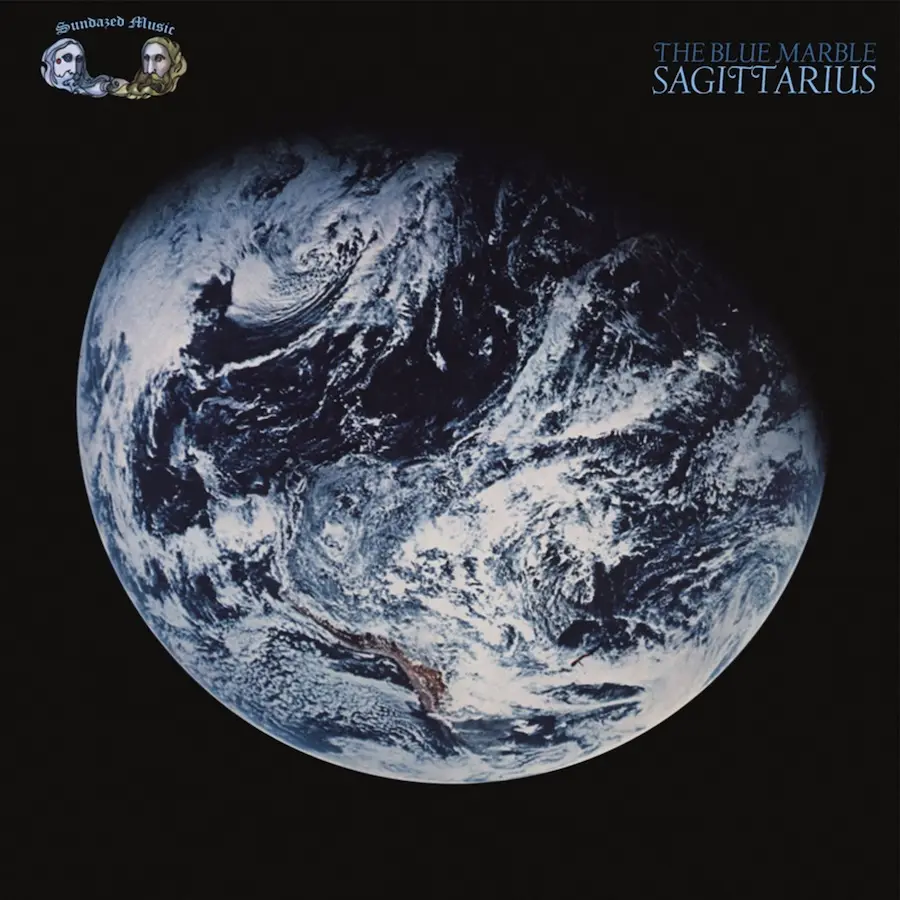 Sagittarius released their second album, The Blue Marble, on October 20, 1969, on Together Records.
Gary Usher oversaw the album with minimal involvement from Curt Boettcher, who contributed vocals to “In My Room” and “Will You Ever See Me,” and wrote the track “From You Unto Us.” The album blends sunshine pop textures with early Moog synthesizer treatments. Usher handled most of the lead vocals and played many of the instruments, favoring slow and mid-tempo arrangements with occasional orchestral overlays.
The album opens with a cover of the Beach Boys’ “In My Room” (co-written by Usher and Brian Wilson), which Together issued as a single. Other notable entries include the title track, built around harpsichord and guitar effects, and “Will You Ever See Me,” a reworking of a track previously recorded by Boettcher’s group The Millennium. “Gladys” and “Lend Me a Smile” reflect Usher’s interest in romantic pop balladry, while “Cloud Talk” and “I Sing My Song” are marked by dated Moog passages.
A1. “In My Room” (2:09) – Brian Wilson cover rendered with multitracked vocals, phased keyboards, and softened percussive motion
A2. “From You Unto Us” (1:47) – Brief, echo-laden vignette with gliding vocal lines and restrained instrumental backing
A3. “Will You Ever See Me” (2:14) – Layers of voice and electric keys cycle across fixed rhythmic figures, yielding a short-form art-pop study
A4. “Gladys” (2:46) – Curt Boettcher–sung cut marked by high-placed piano clusters and short guitar interjections amid a fluid backing arrangement
A5. “I Sing My Song” (2:45) – Light percussive touches and string embellishments accompany Boettcher’s upward vocal inflections
B1. “The Blue Marble” (2:59) – Title track built on slow, cyclic pacing with extended vocal phrases and a suspended harmonic center
B2. “Lend Me a Smile” (3:11) – Alternates between clipped rhythmic passages and elongated vocal sustain, with bright instrumental shading
B3. “I Still Can See Your Face” (2:42) – Features Boettcher’s voice set against open intervals and subdued electronic textures
B4. “I See in You” (3:14) – Gentle track with understated shifts in pace and timbre; vocals framed by low-mixed instrumentation
B5. “Cloud Talk” (2:24) – Instrumental coda with layered keyboards and phased stereo effects arranged around a mid-speed pattern
Released by Together Records. Produced by Gary Usher. Vocals by Usher, Curt Boettcher, and Chuck Girard. Instrumentation includes Moog synthesizer, harpsichord, and orchestral embellishments.
“In My Room” charted modestly at No. 86 on the Billboard Hot 100. The album did not chart. Later CD reissues include single mixes and alternate versions of key tracks.
Aftermath
Sagittarius ended after a final non-album single, a cover of Nilsson’s “I Guess the Lord Must Be in New York City,” backed with “I Still Can See Your Face.” Together Records folded shortly thereafter. Curt Boettcher died of a lung infection in 1987 at age 43. Gary Usher died of lung cancer in 1990 at age 51. Both Sagittarius albums have been reissued on multiple labels with bonus tracks, and remain enduring examples of baroque-psych studio craftsmanship from the late 1960s.
Discography:
- Present Tense (1968)
- The Blue Marble (1969)
Sources:
Artist/Album Pages:
Pookah was an American psychedelic rock trio that released a self-titled album in 1970 on United Art...
The Other Half was an American garage-rock band responsible for the 1966 blues-rock classic "Mr. Pha...
Masters of Deceit was an American psychedelic rock band that released the 1969 Vangaurd album Hensle...
Inner Dialogue was an American soft-pop/vocal group that released two albums in 1969/70 on Ranwoo...
Boffalongo was an American psych-rock band from NYC that released the 1969/70 albums Boffalongo a...
Pidgeon was an American folk-psych band that released a self-titled album and a standalone single...
Strawberry Alarm Clock was an American West Coast rock band, best known for their 1968 psychedeli...
Ultimate Spinach was an American psychedelic rock band that released three 1968–69 albums on MGM. F...
Randy California (Feb. 20, 1951 — Jan. 2, 1997) was an American psych-rock guitarist and composer ...
Ford Theatre was an American psychedelic rock band behind the 1968/69 albums Trilogy for the Masse...
Iron Butterfly was an American psych-rock band, best known for the haunted-organ evergreen "In-A-...
The Red Crayola was an American psychedelic rock band from Houston that released the experimental...