
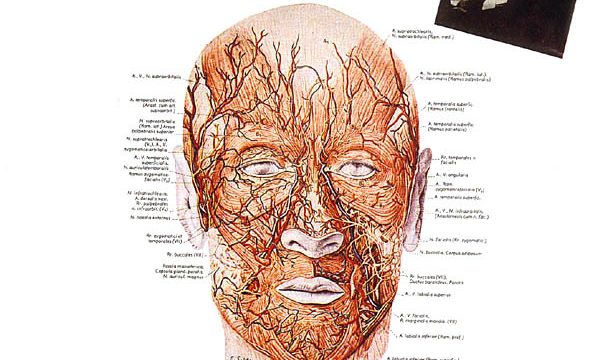
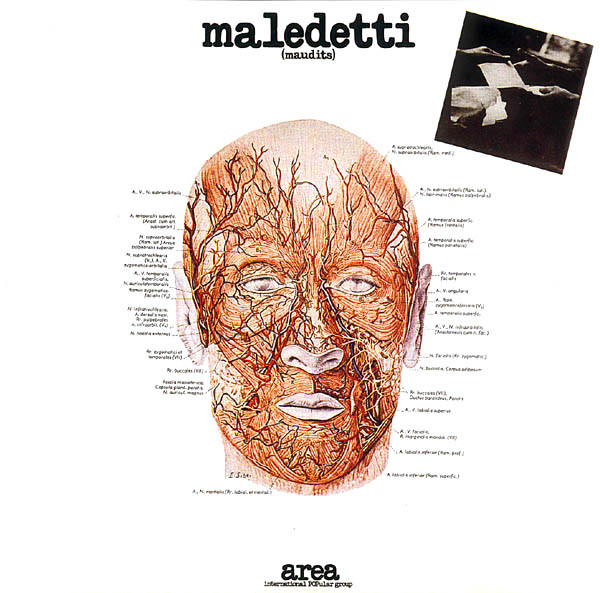
Maledetti (Maudits) is the fourth studio album by Italian avant-garde/jazz-rock band Area, released in 1976 on Cramps.
A1. “Evaporazione” (1:45)
Stratos opens with clipped whispers and semi-intelligible phonemes that scatter across a backdrop of quiet electronics. Tofani activates synthetic resonances and filtered oscillations that mimic a low-pulsing didgeridoo or electric razor, while brief percussive accents flicker into view. Stratos layers vocal stammers, cryptic speech fragments, and breath-punctuated vowel sounds until the monologue culminates in a sudden exclamation: “Ladies and gentlemen… we have lost the memory of the fifteenth century.” The piece functions as both conceptual prologue and sonic invocation.
A2. “Diforisma Urbano” (6:18)
Fariselli initiates with syncopated clusters on electric piano, over a dual-bass foundation formed by Tavolazzi’s arco double bass and Bullen’s amplified lines. Calloni’s drums interlock with brisk snare accents and hi-hat patterns, underpinning a jagged, funk-infected pace.
Steve Lacy joins with darting soprano sax lines that twist between the keyboard motifs and guitar surges. Tofani inserts sharp guitar attacks, phrased like synthesizer squelches, matched by surging bursts from Fariselli’s modular synth. Stratos enters three minutes in, not with lyrics but as an instrumentalist, delivering glottal articulations, scat-fragments, and breathy vowel shapes that expand the harmonic vocabulary.
In the final section, rhythmic density increases beneath sustained synth swells and distorted six-string bends, closing in a tightly wound sequence of group interplay and electro-acoustic texture.
A3. “Gerontocrazia” (7:30)
The txalaparta, performed by Anton and José Arze, strikes out a polyrhythmic lattice with clattering wood-on-wood pulses. Stratos sings a Greek lullaby over the dense rhythmic pattern, establishing a folkloric frame. A quiet cello interlude bridges to a shifting rhythmic ground where Tavolazzi’s bass adopts modal shapes and Lacy threads in slow, sinuous sax figures.
Three minutes in, percussion escalates into a 7/8 figure that suspends atop a rising synth drone. Tofani applies Moog figures in half-tone dissonance while Calloni inserts rapid tom rolls and sudden tempo drops. The track then breaks into a stretched jazz-rock section with syncopated bass and metered counterpoint between piano and drums. Stratos returns near the close, intoning a stark vocal line that reintroduces the initial Greek theme in Italian, now layered over a rhythm echoing the txalaparta’s staggered pulse.
A4. “Scum” (6:30)
Fariselli begins with clipped figures on acoustic piano, laying down angular repetitions that cycle through tonal clusters. Tavolazzi’s fretless bass weaves through the gaps with fast scalar patterns and percussive pops. Calloni alternates between steady backbeat and restless fills, while Tofani introduces pitch-modulated synth shapes and shortwave bursts. After four minutes, dynamics drop. Stratos enters with electronically filtered narration, reading an excerpt from Valerie Solanas’s SCUM Manifesto. His voice shifts between registers and distortions, forming a counterpoint to the sparse piano. The arrangement compresses into single-note motifs punctuated by silences, then dissolves with faint Morse-like tones and processed whispers.
B1. “Il Massacro di Brandeburgo Numero Tre in Sol Maggiore” (2:20)
Four string players reinterpret J.S. Bach’s Brandenburg Concerto No. 3 in G Major with incremental detunings and structural omissions. Armando Burattin’s viola and Umberto Benedetti Michelangeli’s violin state the familiar melodic arc, while Giorgio Garulli’s double bass and Paolo Salvi’s cello move with delayed phrasings and cutaway harmonies. Midway through, the counterpoint is deliberately dismantled; cadences fray into chromatic disruptions, and the original rhythmic symmetry collapses. The arrangement ends on an unresolved interval, symbolically fragmenting the canonized source.
B2. “Giro, Giro, Tondo” (5:55)
Stratos constructs a vocal matrix of sustained vowels, throat overtone figures, and timbral shifts, looping into polyphonic patterns. Tofani adds synth glissandi under Demetrio’s panning voice fragments. One minute in, Calloni and Bullen break into an accelerated 6/8 meter, and Fariselli overlays staccato electric piano phrases that tighten into a forward-leaning drive. Stratos enters with a primary vocal line, rhythmically phrased and pitch-matching the keyboard cycles. Lyrics describe domination framed as child’s play. At 3:30, the tempo shifts; drums lock into a driving straight-time pulse while Fariselli builds repeated dyads into chime-like rhythmic tension. The piece tapers into a cluster of descending scales and filtered harmonic noise.
B3. “Caos (Parte Seconda)” (9:00)
Stratos initiates with erratic phonetic bursts, performed in shifting meters with breath-pulse divisions, alternating between low glottal growls and high nasal glides. Lacy overlays microtonal sax entries that blur into Fariselli’s prepared piano interjections. Each musician operates independently: Tofani scatters bent guitar tones, Lytton introduces irregular percussion accents, and Fariselli pulses subharmonic piano clusters into the midrange.
At four minutes, all elements briefly converge into a narrow textural plateau marked by repeated piano chords and throbbing electronics. A rhythmic bass motif enters and collapses under a wave of percussive interference and unpitched sax noise. Stratos resumes vocalizations with wide intervallic leaps, concluding with a phrasal meltdown of distorted syllables and tongue-clicks. The piece terminates in layered overtones and collapsed resonance.
Tracklist:
A1. “Evaporazione” (1:45)
A2. “Diforisma urbano” (6:18)
A3. “Gerontocrazia” (7:30)
A4. “Scum” (6:30)
B1. “Il massacro di Brandeburgo numero tre in sol maggiore” (2:20)
B2. “Giro, giro, tondo” (5:55)
B3. “Caos (parte seconda)” (9:00)
Credits:
Eugenio Colombo — kazoo
Hugh Bullen — bass
Walter Calloni — drums
Steve Lacy — saxophone
Anton Arze — txalaparta
Josè Arze — txalaparta
Umberto Benedetti Michelangeli — violin
Armando Burattin — viola
Paolo Salvi — cello
Giorgio Garulli — bass
Paul Lytton — percussion
Demetrio Stratos — vocals, Hammond organ, bells, piano
Patrizio Fariselli — synthesiser, electric piano, prepared piano, piano, composer
Paolo Tofani — objects, electric guitar, guitar synthesizer, composer
Ares Tavolazzi — electric bass, double bass
Giulio Capiozzo — drums
Artist/Album Pages:
Szobel is the first and only album to-date by Austrian jazz-rock pianist/composer Hermann Szobel, re...
The Story of i is the debut solo album by Swiss keyboardist Patrick Moraz, released in 1976 on Chari...
Jean Carn is the debut solo album by soul/jazz vocalist Jean Carn, released in 1976 on Philadelphia ...
Automatic Man is the first of two albums by the namesake American space-funk supergroup, released in...
Between the Leaves is an album by Dutch maximalist rockers Déjá-Vu, self-released by the band in 197...
Romantic Warrior is an album by American jazz-rock quartet Return to Forever, released in 1976 on Co...
God's Clown is the debut album by the French progressive hard rock band Ocean, released in October 1...
Somewhere I've Never Travelled is the second album by American symphonic/art-rock band Ambrosia, pro...
Takin' It to the Streets is the sixth album by American soul/pop band the Doobie Brothers, released ...
Caliente! is a 1976 album by Argentine saxophonist Gato Barbieri. Issued by A&M Records, the rec...
Lake is the debut album by the multinational German-based band of the same name, released in 1976 on...
The Front Is Breaking is an album by Finnish jazz saxophonist Eero Koivistoinen, released in 1976 on...