

Taggett was an English rustic-rock supergroup that made a self-titled album in 1973, re-released in 1975.
Members: Peter “Pete” Arnesen (keyboards, vocals), Colin Horton-Jennings (lead vocals), Tony Hicks (guitar), Terry Fogg (drums), Tim Wheatley (bass, vocals)
Background
Singer Colin Horton-Jennings played flute and acoustic guitar on two albums with The Greatest Show on Earth. Keyboardist Pete Arneson (b. 1947; Salzburg, Austria) recorded with If, Daddy Longlegs, and toured with The Hollies, who included the Jennings song “Delaware Taggett and the Outlaw Boys” on their 1972 album, Romany.
Bassist Tim Wheatley cut two prior albums in Gracious. Terry Fogg drummer earlier with Christie and Sounds Incorporated. Ubiquitous sessioner Pete Wingfield (ex-Jellybread) also contributed to Taggett as a guest pianist.
Taggett
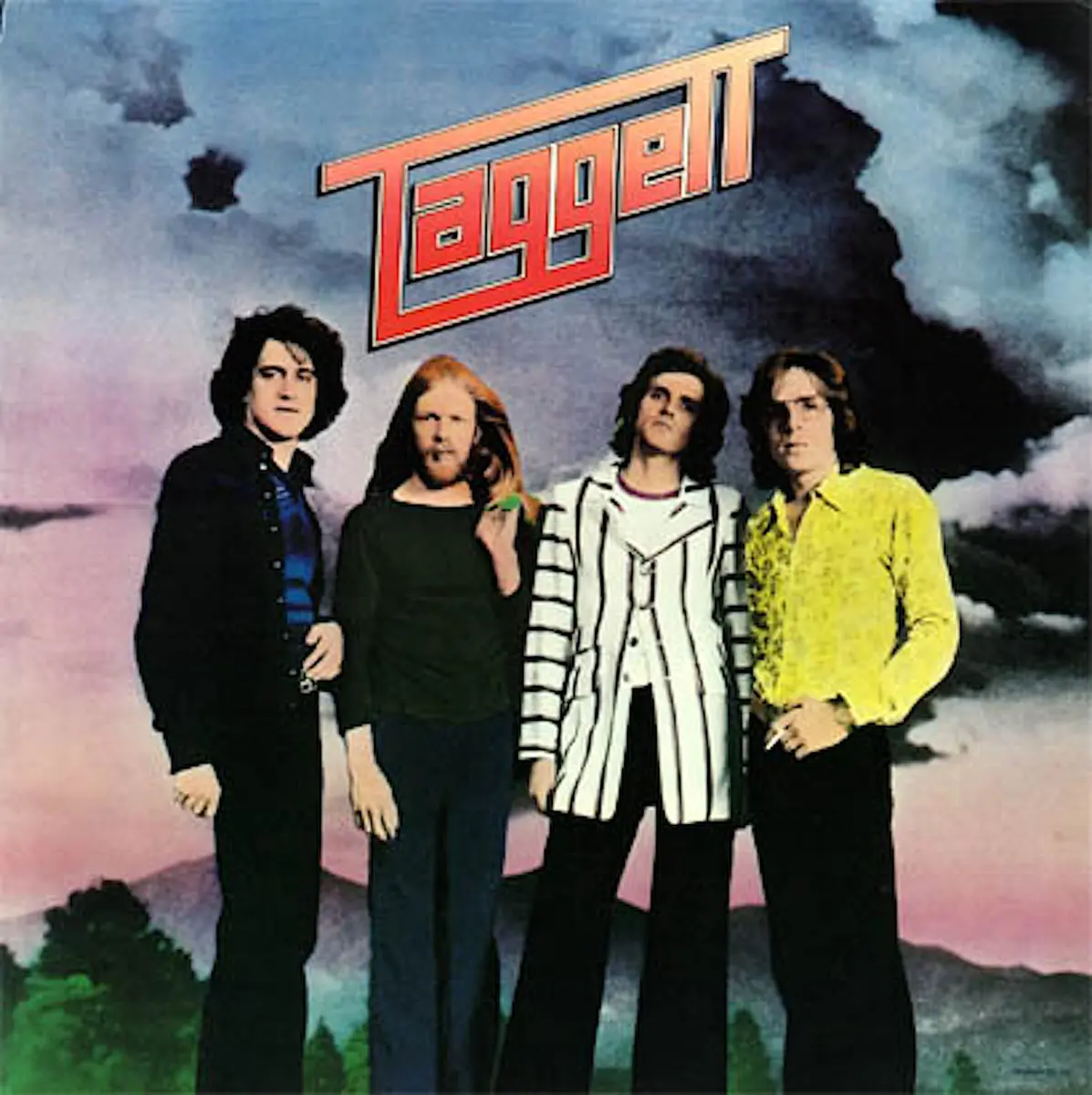 Taggett first released their self-titled album in December 1973 as a white-label test-press on EMI. In January 1975, the album appeared in North America and Germany on United Artists.
The album presents a rustic, harmony-rich blend of vocal-forward ballads, mid-tempo story songs, and countrified rock numbers, framed by Colin Horton-Jennings’ narrative writing and vocal presence. Taggett’s sole release stands apart from other singer-songwriter projects of the era with its pastoral imagery, understated theatricality, and the balance of acoustic textures with electric instrumentation.
Jennings sings lead and plays acoustic guitar, often guiding the verses with soft vocal inflection or dramatic phrasing. Arnesen alternates between Hammond, Wurlitzer, and grand piano, adding tonal motion and orchestral shading. Wheatley plays warm, melodic bass lines and adds vocal support. Hicks handles lead and rhythm guitar. Fogg anchors each track with light kit textures and varied percussion. Select numbers feature guest contributions on horns, woodwinds, and female backing vocals. Pete Wingfield plays guest piano on one track.
Jennings wrote the bulk of the album, including both singles and the namesake track. Arnesen contributed the opener and arranged most backing parts. Wingfield’s guest spot adds tonal flair to “Buster.”
“Delaware Taggett and the Outlaw Boys” opens with a loping rhythm and circular picked guitar figure, underpinning Jennings’ sung-spoken narrative about a rustic fugitive revealed in the toll-bell chorus. “Squares to a Circle” unfolds from a barren arrangement of stark vocals and plucked acoustic guitar. “Lonely Nights Lonely Days” builds from choppy chords and stop/start rhythms to an open-cadence chorus with falsetto harmonies.
“Save a Happy Song” follows a breezy gait with vocal call-and-response. Side B starts with “Time,” a strummed, acoustic mid-tempo track with a harmonized chorus. “Buster” interweaves muted sitar and acoustic guitar across a sparse rhythmic backdrop. “In the Days When I Was Young” builds gradually from an acoustic lament. “An Old Bird Song” closes the set with resigned vocals and quiet unaccompanied piano.
A1. “Delaware Taggett and the Outlaw Boys” (4:32)
A2. “Squares to a Circle” (4:50)
A3. “Lonely Nights Lonely Days” (4:21)
A4. “Save a Happy Song” (3:08)
A5. “(I’ll Be Your) Anchor Man” (3:38)
B1. “Time” (2:38)
B2. “Buster” (5:09)
B3. “New on a Blue Day” (3:50)
B4. “In the Days When I Was Young” (4:38)
B5. “An Old Bird Song” (2:00)
Sessions occurred in 1973 at EMI Studios and Morgan Studios in London with producer Tony Hicks. Alan Parsons, Peter Bown, and Robin Black served as engineers. United Artists pressed the 1975 issue with revised sleeve art.
EMI promoted the album with three singles: “Time” (b/w “Say I Love You”) and “I Don’t Want to Be a Stranger” (b/w “Save a Happy Song”), both issued in 1973. “(I’ll Be Your) Anchor Man” (b/w “New on a Blue Day”) followed in 1975 to support the United Artists edition.
Discography:
- Taggett (1975)
Sources:
Artist/Album Pages:
Slapp Happy was a multi-national art-pop trio, formed in Hamburg, Germany, in 1972 by American singe...
Central Line was an English soul-funk band from London that released eleven singles and the 1981–8...
The Tavares were an American soul group that released ten albums between 1974 and 1981 on Capitol,...
Santana are an American Latin-rock jam band from San Francisco, formed in 1966 by guitarist Carlos...
Dianne Brooks (Jan. 3, 1939 — April 29, 2005) was an American jazz and soul singer who emerged with ...
Syl Johnson (July 1, 1936 – February 6, 2022) was an American soul singer from Holly Springs, Miss...
Maria Creuza (born Feb. 26, 1944) is a Brazilian samba-pop singer who released four albums on Trov...
Bighorn was a symphonic/hard-rock band from Seattle that self-released a 1974 standalone single an...
CANO — aka Coopérative des Artistes du Nouvel-Ontario — was a French-Canadian symphonic-folk colle...
Visitor 2035 was an English symphonic/jazz-rock band that released the 1976 musical double-album ...
Stump was an English–Irish avant-rock band that released the 1985–86 zolo EPs Mud On a Colon and Q...
Kiyoshi Sugimoto — 杉本喜代志 (Feb. 3, 1942) — is a Japanese jazz-rock guitarist who co-headed five alb...