

Høst was a Norwegian symphonic/hard-rock band that recorded two albums between 1974 and 1976 for the On label.
Members: Geir Jahren (lead vocals), Svein Rønning (guitar, Clavinet, organ, Minimoog, grand piano, vocals), Lasse Nilsen (guitar), Fezza Ellingsen (guitar), Halvdan Nedrejord (keyboards), Bernt Bodahl (bass), Knut R. Lie (drums), Willy Bendiksen (drums)
På sterke vinger
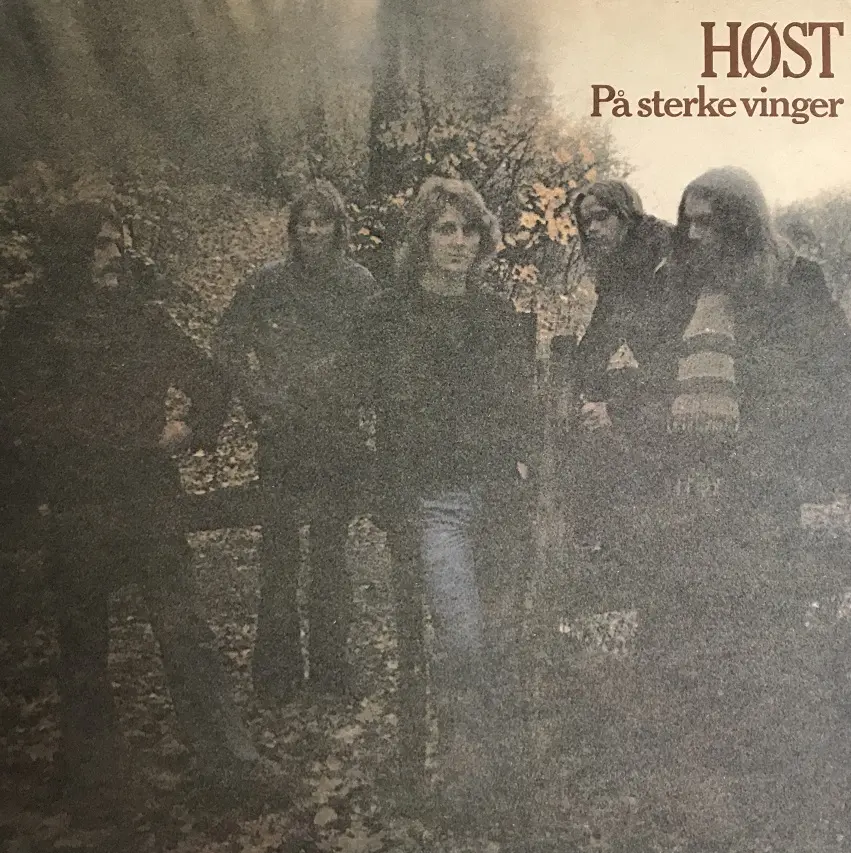 Høst released their debut album, På sterke vinger, in December 1974 on On Records.
The album introduced their blend of twin-lead guitar interplay, rhythmic precision, and Norwegian-language vocals within a progressive heavy-rock framework.
Guitarist Svein Rønning handled keyboards (clavinet, organ, grand piano, Mini Moog, string ensemble) and co-led the group with guitarist Lasse Nilsen, bassist Bernt Bodahl, drummer Knut R. Lie, and vocalist Geir Jahren.
Rønning wrote five of the album’s seven songs, while Jahren contributed the remaining two (“Satans Skorpe” and “Dit Vi Må”).
The tracks shift between tightly driven hard rock and slower, atmospheric sections colored by Rønning’s use of piano and string ensemble. “Fattig Men Fri” opens in double time before easing into a stately verse with surging guitar lines and emphatic drumming. “Satans Skorpe” alternates between heavy midtempo riffing and rapid climaxes with layered harmonies, while “På Sterke Vinger” builds from hymn-like organ and voice passages into an extended instrumental finale anchored by fluid guitar and bass exchanges.
A1. “Fattig Men Fri” [Poor But Free] (4:50) — a declaration of freedom from material wants, set to alternating fast and reflective sections marked by soaring guitars
A2. “For Sent Å Angre” [Too Late to Regret] (2:55) — a brisk rocker driven by percussive rhythm guitar and crisp drumming
A3. “I Ly Av Mørket” [In the Shelter of Darkness] (5:11) — subdued piano passages frame the verses, which rise to plaintive guitar breaks
A4. “Satans Skorpe” [Satan’s Crust] (4:17) — develops from slow tension to explosive twin-guitar exchanges and a high-register vocal climax
B1. “Dit Vi Må” [Where We Must Go] (4:14) — fluid bass and lead interplay highlight the midsection
B2. “Samhold” [Unity] (3:41) — a heavy, riff-based song in 7/8 time, notable for its commanding vocal lines and quick rhythmic shifts
B3. “På Sterke Vinger” [On Strong Wings] (9:57) — the epic title track, alternating lyrical verses with long instrumental sections that expand into a dramatic closing sequence
Sessions occurred at Arctic Studios in Trondheim during October 1974 with producer and assistant engineer Nils B. Kvam and engineer Rune Nordal.
Hardt mot hardt
 Høst released their second album, Hardt mot hardt, in April 1976 on On Records.
The album marked a new phase for Høst with a revised lineup and expanded instrumentation that introduced flute and keyboards to their twin-guitar foundation. The material moved toward complex, symphonic hard rock, blending classical phrasing and folk elements into vigorous, rhythmically diverse arrangements.
Guitarist Fezza Ellingsen wrote seven of the album’s eight songs and played both electric guitar and flute. Vocalist Geir Jahren wrote and performed the acoustic “Åse.” Keyboardist Halvdan Nedrejord contributed organ, piano, and accordion; bassist Bernt Bodahl and drummer Willy Bendiksen anchored the rhythm section.
The album alternates between aggressive numbers and orchestral or folk-inflected interludes. “Profeters Ord” opens with crisp percussion and interlocking guitar motifs, establishing the tone of dynamic interplay that runs through the record. “Gorobin” and “Nattergalen” juxtapose flute and organ with sharp guitar turns, while “Ørnkloa” delivers concentrated force in just over three minutes. Side two stretches into more theatrical terrain: “Sirkus” shifts between heavy riffing and accordion passages; “Lektyre” adds orchestral backing and stately vocals; “Åse” lightens the mood with an acoustic break; and “Æræeo” closes the album on a dark, extended instrumental surge.
A1. “Profeters Ord” [Prophets’ Word] (5:40)
A2. “Gorobin” (5:09)
A3. “Nattergalen” [The Nightingale] (7:10)
A4. “Ørnkloa” [The Eagle’s Claw] (3:17)
B1. “Sirkus” (7:42)
B2. “Lektyre” [Reading Matter] (3:55)
B3. “Åse” (3:19)
B4. “Æræeo” (5:57)
Sessions occurred at Arctic Studios in Trondheim in January 1976 with producer Bjørn Nessjøe and engineer Christian Schreiner. The Trondheim Symphony Orchestra assisted on “Lektyre.”
Hardt mot hardt was packaged with a sleeve designed and printed by Team-Trykk and photography by Sven Solberg.
Discography:
- På sterke vinger (1974)
- Hardt mot hardt (1976)
Sources:
Artist/Album Pages:
Trace was the Dutch symphonic-rock trio behind the 1974/75 Philips albums Trace and Birds and the ...
Flash and the Pan were an Australian studio-based art-pop project from Sydney headed by the songwr...
Procol Harum was an English symphonic-rock band that released nine studio albums between 1967 and 19...
Cockney Rebel was an English rock band fronted by Steve Harley. They released the 1973/74 albums T...
Ryuichi Sakamoto — 坂本龍一 (January 17, 1952 – March 28, 2023) — was a Japanese musician and composer...
Neil Ardley (May 26, 1937 — Feb. 23, 2004) was an English pianist and composer from Carshalton, Su...
Manu Dibango (Dec., 12 1933 — March 24, 2020) was a Cameroonian saxophonist, malletist, and compos...
Elliott Fisher is an American violinist and arranger who worked extensively in Los Angeles film an...
Yabby U — aka Vivian Jackson (Aug. 14, 1946 — Jan. 12, 2010) — was a Jamaican dub/roots-reggae art...
Curt Cress Clan was a German jazz-rock/funk supergroup led by drummer Curt Cress and featuring gui...
Eduardo Bort (January 2, 1948 – February 27, 2020) was a Spanish musician and composer who release...
Ahmad Jamal (born July 2, 1930) is an American post-bop/jazz-funk pianist from Pittsburgh. He est...