

Ophiucus was a French folk/psych band that released two albums and three singles between 1971 and 1973 on Barclay.
Members: Michel Bonnecarrère (guitar, vocals), Alain Labacci (guitar, percussion, vocals), Bernard Labacci (drums, percussion, vocals), Jean-Pierre “Chinois” Pouret (bass, guitar, vocals)
Background
Ophiucus formed in Flagy, Seine-et-Marne, in 1971 when musician-actor Emmanuel Booz brought together guitarist-flautist Michel Bonnecarrère, guitarist Alain Labacci, bassist Jean-Pierre “Chinois” Pouret, and percussionist Bernard Labacci — all singers.
Bonnecarrère made two prior albums with Zoo. Pouret worked as a sideman for Sylvie Vartan. The Labacci brothers constituted Tom et Jerry, a Sixties beat duo on RCA Victor.
The group lived communally in Bonnecarrère’s Flagy house, where they rehearsed and wrote material. Their name derived from Ophiuchus, a constellation on the celestial equator near Scorpius and Sagittarius.
Ophiucus
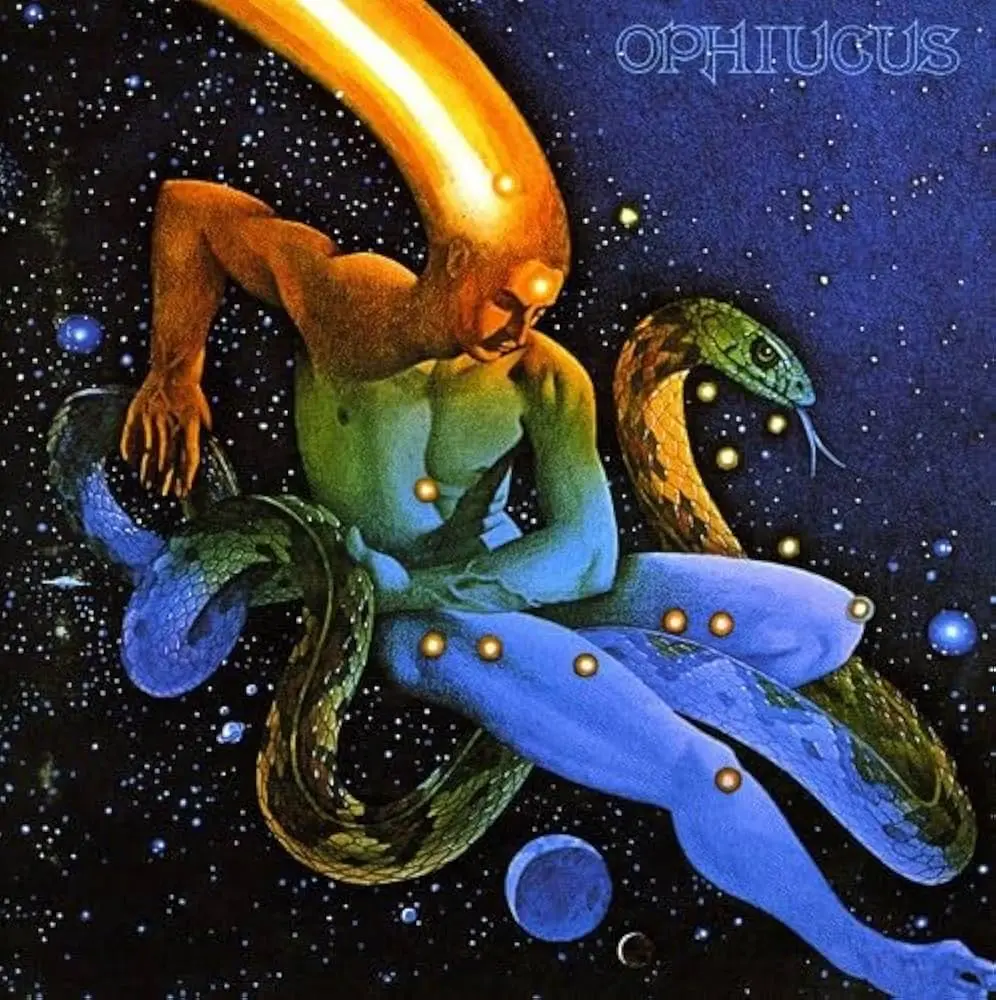 Ophiucus released their self-titled debut album in 1971 on Barclay.
The album breaks compact sung pieces with collage, recitation, abrupt electric passages, and arranged swells. “Prenez, Donnez” stacks crowd murmur, delay, distorted brass, and an old-time acoustic figure into a crowded opening sequence. “Patiemment” slows to two-voice singing, four-hand strum motion, and formal arranged support. “Au Hasard” circles a modal instrumental sketch.
“Ne Cherche Plus” folds group voices and a broad arranged swell around the lead vocal. “L’Éveil de Notre Temps” recites against electric figures and a metronomic tick. “C’Est Pour Toi!” settles into a cradle-song cadence before “Darbouka” breaks into hard electric bursts. “T’Inquiète Pas M’man” follows a plain unplugged blues pattern, while “Djukela” starts with rustic dance motion and roughens into electric release. “Inachevée” places a wordless vocal line beside Sandy Spencer’s cello, and “Univers” closes with a slow, expansive ascent.
Ophiucus features Bonnecarrère, Pouret, and the Labaccis. Cellist Sandy Spencer appears on “Ne cherche plus” and “Inachevée.”
A1. “Prenez, donnez” [Take, Give] (2:50)
A2. “Patiemment” [Patiently] (3:00)
A3. “Au hasard” [At Random] (3:05)
A4. “Ne cherche plus” [Search No More] (2:55)
A5. “L’éveil de notre temps” [The Awakening of Our Time] (3:50)
A6. “C’est pour toi” [It’s for You] (3:00)
B1. “Darbouka” [Darbuka] (2:15)
B2. “T’inquiète pas m’man” [Don’t Worry, Mom] (2:50)
B3. “Djuleka” (3:00)
B4. “Inachevée” [Unfinished] (2:10)
B5. “Mirlipinious” (2:15)
B6. “Univers” [Universe] (3:15)
Barclay lifted “Ne cherche plus” as a 1971 single (b/w “Univers”). In 1972, “T’inquiète pas m’man” reappeared as a single (b/w “Mirlipinious”).
Ophiucus appeared in a sleeve by illustrator Nicole Claveloux (Recreation, Zoo), whose image depicts a surreal humanoid figure that floats against a dense star field, with a long golden head form, green torso, and blue lower body. A coiled serpent wraps around the figure, while small glowing orbs and planets dot the surrounding space.
Salade Chinoise
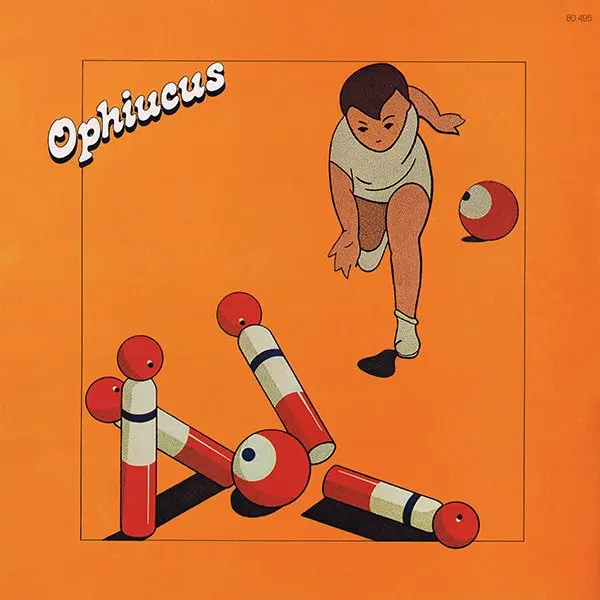 Ophiucus released their second album, Salade Chinoise, in 1973 on Barclay.
The group retains Bonnecarrère, Pouret, and the Labaccis for twelve compact songs with acoustic figures, harmonica lines, close vocal blend, and concise refrain patterns. Salade Chinoise adds keyboardist-arranger Michel Bernholc (piano, strings, brass) and keyboardist Roger Loubet (synthesizer).
Salade Chinoise presents concise, lightly arranged songs with a softer surface than the debut. The album draws on delicate songcraft, psych-folk shading, soft-pop contour, and a broader studio palette with brass, strings, synthesizer, flute, and harmonica.
A1. “Oh ma douée” [Oh My God] (3:34)
A2. “J’oublie” [I Forget] (3:01)
A3. “Canadian Bar” (2:43)
A4. “Cacaoutchouc” [Rubber, punning form] (2:36)
A5. “L’instant d’une nuit” [The Moment of a Night] (3:07)
A6. “Dans toute la France” [Throughout France] (2:37)
B1. “Bonté divine” [Good Heavens] (3:18)
B2. “Je joue toujours de l’harmonica” [I Still Play the Harmonica] (3:14)
B3. “Cette chanson vient d’autrefois” [This Song Comes From Long Ago] (3:38)
B4. “Récréation N°1” [Recess No. 1] (3:35)
B5. “Quand on a besoin de rêver” [When You Need to Dream] (2:57)
B6. “À la claire fontaine” [By the Clear Fountain] (1:23)
Barclay lifted “Canadian Bar” as a 1973 single (b/w “Cette chanson vient d’autrefois”).
Discography:
- Ophiucus (1971)
- Salade Chinoise (1973)
Sources:
Artist/Album Pages:
Rainbow Ffolly was an English psychedelic pop band that demoed an embryonic concept album, Sallies F...
Jasper Wrath was an American hard-rock/psych band that made a 1971 self-titled album on Sunflower....
Soft Machine was an English jazz-rock band that was active between the late 1960s and early 1980s. T...
Gérard Entremont was a French chanson-pop singer who released numerous shortplayers, starting in t...
Ripaille was a French symphonic-folk band that recorded the album La Vieille que l'on Brûla in 197...
Leaf Hound was an English hard-rock band from London that released the album Growers of Mushroom o...
Peter Ivers (September 20, 1946 — March 3, 1983) was an American musician and songwriter from Bos...
Robert Wood is an English vibraphonist and singer who also worked as a guitarist and producer. He ...
4th Cekcion was an American brass-rock band from Bellaire, Texas, that released a self-titled alb...
Hamilton Streetcar was an American psych-rock band from Los Angeles that released two 1967/68 sing...
The True Reflection was an American soul group from Washington, DC, that released the 1973 Atco al...
Strinx was a German jazz-rock quartet that made the 1973 Spiegelei album Talk to the Wind. Memb...