

Exmagma was a German avant-jazz/rock trio that made two 1973/74 albums, Exmagma and Goldball. Their intended 1975 third album appeared as a 21st-century archival disc.
Members: Andy Goldner (guitar, bass, saxophone, tapes, vocals), Thomas Balluff (keyboards, flute, effects, vocals), Fred Braceful (drums, percussion)
Background
Exmagma formed when American jazz drummer Fred Braceful (b. 1938) teamed with two young German rock musicians: guitarist Andy Goldner and bassist Thomas Balluff.
Goldner began in Five Fold Shade, a mod-rock band that cut an undated single: “Cadillac,” a Vince Taylor cover backed with “Can’t Explain,” the early Who chestnut. Balluff hailed from Muli & The Misfits, a Hammond-driven mod-soul group.
Braceful came to Germany in the late Fifties as a US Army serviceman. For ten years, he freelanced on the local jazz circuit. In 1970, he teamed with Wolfgang Dauner in the original lineup of Et Cetera, a jazz-rock collective with input from assorted international names (Eberhard Weber, Larry Coryell). After two studio albums and a live set, Braceful left Dauner and partnered with Goldner and Balluff in Magma. When they learned of the French band, they modified their name to Exmagma.
Exmagma
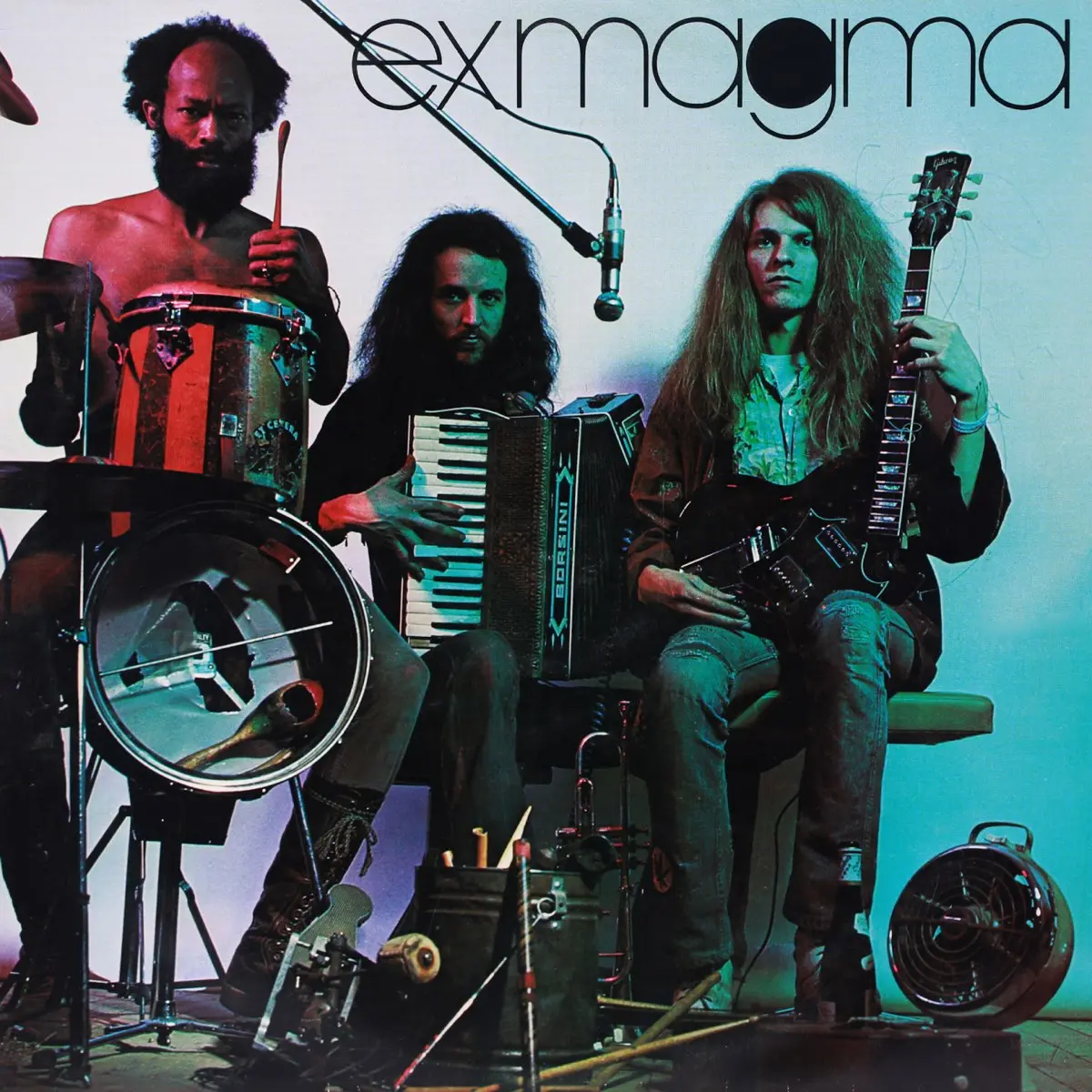 Exmagma released their self-titled debut album in 1973 on Neusi.
The album unfolds in elastic, freeform structures built on organ weight, sliding bass, and volatile percussion. Interplay centers on Thomas Balluff’s shifting keyboard tones—clavinett stabs, electric piano swells—and Andy Goldner’s switches between guitar, fretless bass, and alto sax, triggering abrupt turns and register shifts.
“The First Tune” develops in linked sections: an opening stretch rides a slow, spacious cadence before tightening into denser passages where fuzzed bass and distorted keys push against shifting drum accents, then loosens again without settling into resolution. “Tönjès Dream Interruption” pivots quickly, opening with bass-and-drum pressure before thinning into an atmospheric middle section defined by hovering keyboard tones and restrained cymbal work.
“Interessante Olè” compresses the format into a short burst, its contoured organ lines and walking bass phrasing steering the piece through brisk, swinging motion before cutting off abruptly. “Two Times” operates as a split idea, beginning with a grounded, bass-led pattern and snapping into a faster, more extroverted exchange between keys and drums.
The side-long “Trippin with Birds: Kudu / Horny” expands the group’s language into a long arc: abstract sound layers and bird-like effects give way to dissonant sax interjections, then coalesce into a driving central section where drums lock into a firm stride under surging organ runs, before dissolving again into fractured guitar and fading textures. Across the album, Exmagma favor abrupt shifts, elastic tempo control, and raw timbral contrast over fixed structures, letting each piece evolve through accumulation and release rather than repetition.
A1. “The First Tune” (7:37)
A2. “Tönjès Dream Interruption” (4:17)
A3. “Interessante Olè” (2:50)
A4. “Two Times” (2:25)
B. “Trippin with Birds: Kudu / Horny” (18:48)
Exmagma recorded “Trippin” live and the rest on their home recording system with production by band manager Neusi Neuhäußer.
The cover shows the trio posed in a dim studio setting with deliberately mismatched instruments—accordion, floor tom, electric guitar—flanked by cables, a foot pedal, and a floor fan, projecting a raw, homespun aesthetic.
Goldball
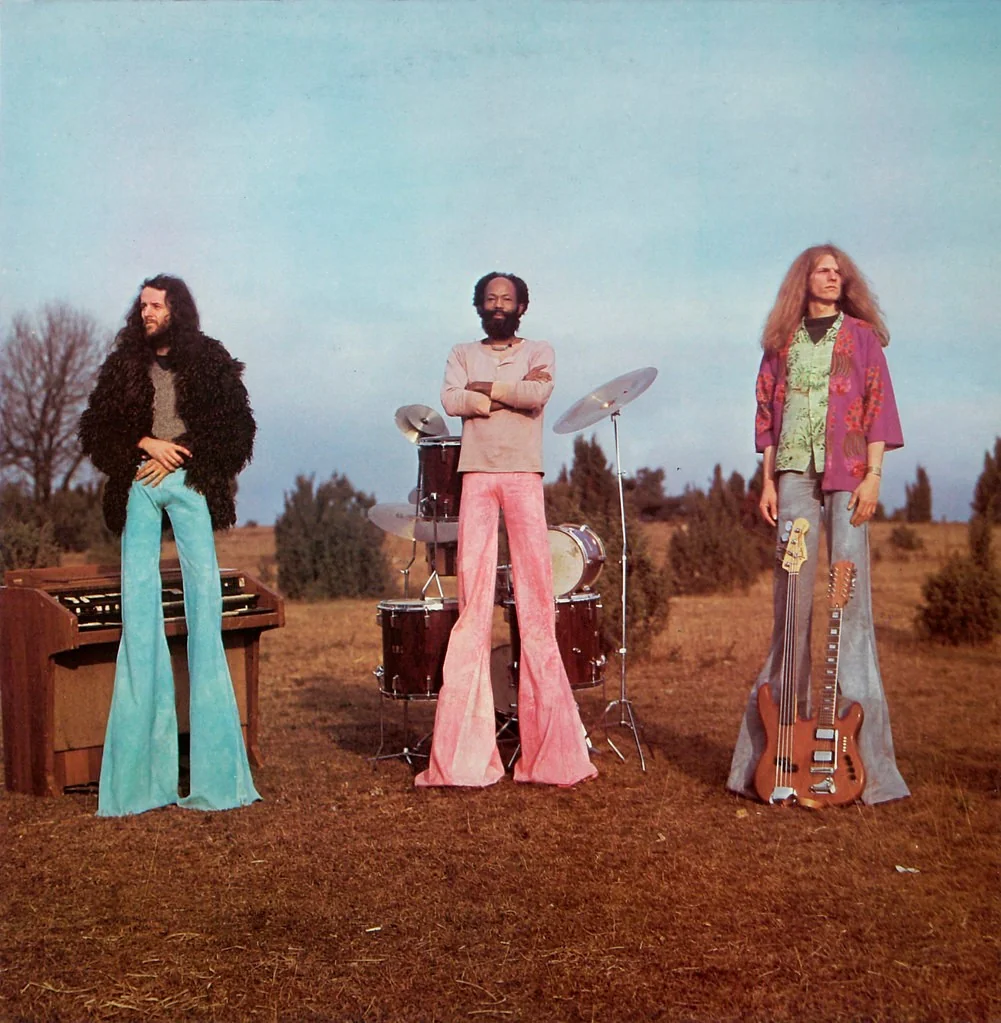 Exmagma released their second album, Goldball, in 1974 on Urus. The album filters their improvisational energy through tighter forms, shorter durations, and more engineered control, while preserving their tactile, hands-on approach to sound.
“Marilyn F. Kennedy” locks into a clipped, high-tension cycle between pulsing bass, overdriven organ, and sharp drum breaks, establishing a crisp dynamic floor. “Dada” unfolds in sections: quiet, layered keyboard pulses and open percussion give way to a swelling, effects-laden climax driven by modulated guitar. “Adventures with Long S. Tea” pushes into heavier territory with staggered low-end patterns and distended organ tones across irregular accents.
“25 Two Seconds Before Sunrise” builds atmosphere through spaced guitar reflections and background noise, with minimal drumming and a smeared keyboard bed sustaining the drift. “Groove Tango Wolperaiso” threads intermittent guitar against abstract electronic fragments and closes in overlapping instrumental gestures. “Jam Factory for People Insane” pairs spoken vocals with abrupt rhythmic jolts, then collapses into freewheeling instrumental interplay with elastic percussion and isolated tone bursts. “Habits” sustains a relaxed pulse under swelling electric piano and scratchy guitar textures, expanding slowly before receding.
“Greetings to the Maroccan Farmers” stretches across six and a half minutes of environmental collage and manipulated sound objects, occasionally punctured by piano, flute, or breathy brass. Two short studies—“Dance of the Crabs” and “Last But One Train to Amsterdam”—bookend the set’s final quarter with jagged stabs of polyrhythmic tension and chamber-sized compression. Throughout, the trio shape their materials through contrast: sudden cuts, modulated decay, and spatial reverb give each track a discrete presence while maintaining a tactile link across the album.
A1. “Marilyn F. Kennedy” (2:25)
A2. “Dada” (3:35)
A3. “Adventures With Long S. Tea 25 Seconds Before Sunrise” (2:25)
A4. “Groove” (4:50)
A5. “Tango Wolperaiso” (2:30)
B1. “Jam Factory (For People Insane)” (4:00)
B2. “Habits” (5:55)
B3. “Dance of the Crass” (0:50)
B4. “Greetings to the Moroccan Farmers” (6:45)
B5. “Last But One Train to Amsterdam” (0:55)
On the cover, the trio stands in an open field, each wearing stilts under exaggerated bell-bottoms in vibrant pastel hues, staged beside their instruments (organ, drum kit, bass, and guitar) with arms crossed and faces stoic, blending rural stillness with psychedelic absurdity.
Exmagma 3
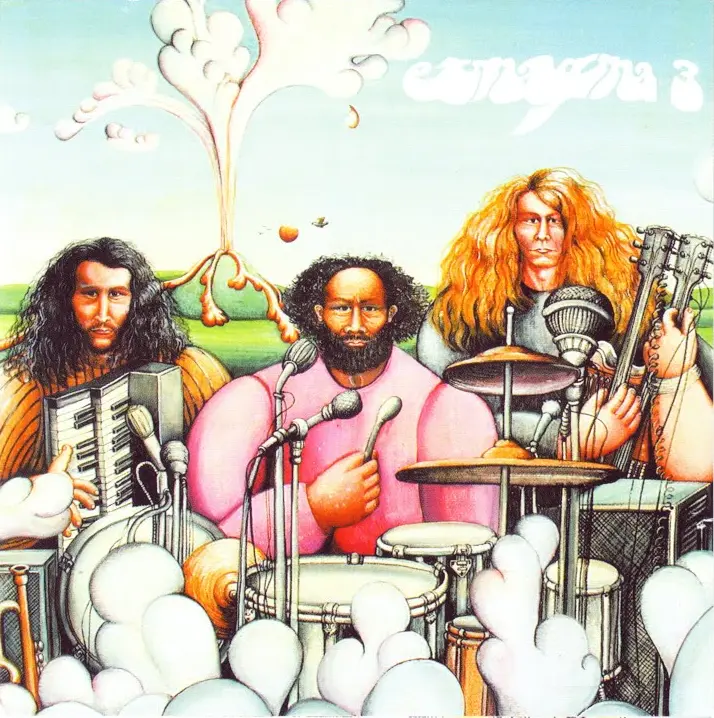 In 1975, Exmagma recorded a third album that finally appeared in 2006 as an archival disc on Daily Records.
Exmagma 3 presents a fragmented, deliberately unruly set of pieces assembled from extended sessions rather than a single, unified arc. Several tracks rely on abrupt contrasts between clipped keyboard figures, stop‑start drum patterns, and bursts of treated noise that arrive without preparation and vanish just as quickly.
“Stoned Chicken” stands out through its looping keyboard motif, which circles in tight, playful motion while the drums chatter restlessly beneath it, constantly shifting emphasis and density. Elsewhere, vocals move to the foreground not as sustained lines but as shouted phrases, spoken interruptions, and exaggerated syllables that cut across the instrumental flow rather than sit inside it. Many passages favor collage over continuity, stacking short ideas—percussive flurries, distorted organ tones, tape fragments—into sequences that resist resolution. Across the album’s length, Exmagma prioritize provocation and disruption, letting humor, overload, and abrupt silence shape the listening experience more than balance or development.
1. “Box 25” (3:36)
2. “My Baby’s Gone I’m out of Tune Blues” (2:08)
3. “Torpedo Tits” (3:59)
4. “Fred Braceful is Talkin’ to Bread Faithful” (1:14)
5. “It’s so nice” (6:06)
6. “Rock & Roll” (7:46)
7. “Weltstar” (0:17)
8. “The Pope” (5:49)
9. “?berm Beutental” (3:19)
10. “Dr.Phil.S.H.” (7:34)
11. “Qu’est-ce que c’est?” (1:19)
12. “Da Da Too” (2:28)
13. “Stoned Chicken” (5:25)
14. “In Arkansas steht ‘n Atomkraftwerk” (1:11)
15. “Full Moon Again” (12:06)
16. “Walkin’ on Ice” (4:27)
17. “If I Could” (0:18)
Postlude
Andy Goldner went solo with the 1978 Well Known Records album titled ∞, followed by the 1981 release Belleville on Peak Records.
Discography:
- Exmagma (1973)
- Goldball (1974)
- Exmagma 3 (2006, recorded 1975)
Sources:
Artist/Album Pages:
Ibliss was a German Krautrock band that released the 1972 album Supernova on Spiegelei. Members:...
Peter Herbolzheimer Rhythm Combination & Brass were a German jazz-funk big band led by trombon...
Robert Schröder (born May 20, 1955) is a German electronic musician who released 10 albums on Inno...
Gift was a German hard-rock band behind the 1972 Telefunken album Gift and the 1974 NOVA title Blu...
The Twins was a German synthpop duo that released four albums on Hansa International between 1981 ...
Scaramouche was a German art-rock band that released a self-titled album in 1981 on Ohrwurm Record...
Train was a German jazz-rock band that released the 1977 album Coo-Coo Out! on JA Tonaufnahmestudi...
Puppenhaus was a German jazz-rock band that recorded a 52-minute SWF session in 1973. The session ...
Lucifer's Friend was a German hard-rock band that evolved from Asterix with a 1970 Philips debut. ...
Frumpy was a German post-psychedelic soul-rock band responsible for the 1970/71 Philips titles All...
Lake was a German rock band that released eight studio albums between 1976 and 1986 on CBS and Pol...
Missus Beastly was a German jazz-rock band that released a self-titled album on CPM in 1970. After...