

Valhalla was an American psych-rock band from New York that released a 1969 album on United Artists Records.
Members: Mark Mangold (organ, percussion, vocals), Rick Ambrose (bass, vocals), Bob Hulling (vocals), Don Krantz (guitar, bass), Eddie Livingston (drums)
Background
Valhalla emerged from the Long Island garage scene in the wake of Yesterday’s Children*, a short-lived outfit that issued one 1966 (“Wanna Be With You” / “Feelings”) single on Pickwick’s Showcase imprint. Guitarist Don Krantz and vocalist Bob Hulling led that group, which featured a rotating cast and a teenage Krantz handling most of the songwriting.
After cutting ties with Pickwick, the pair teamed with organist Mark Mangold to form Euphoria, a heavier, more progressive unit. The lineup solidified with bassist Rick Ambrose and drummer Eddie Livingston. Rebranded as Valhalla, they secured a deal with United Artists after manager Jim Foley arranged a successful industry showcase in New York City.
The band took its name from Valhalla, the mythic Norse hall of slain warriors ruled by Odin, where fallen heroes dwell until called to fight at Ragnarök.
*No relation to the Connecticut band that made a 1970 hard-psych album on Map City.
Valhalla
 Valhalla released their self-titled album in November 1969 on United Artists. It contains seven originals by organist Mark Mangold plus co-writes with guitarist Don Krantz (“Conceit”), bassist Rick Ambrose (“JBT”), and both on “I’m Not Askin,” an instrument-swap arrangement.
Mangold’s Hammond organ and Krantz’s fuzz-toned guitar form the core texture, alternating between compact, blues-inflected rockers and longer, denser compositions. Valhalla ranges from percussive, high-density psych (“Hard Times”) to ballads with chamber-pop overtones (“Ladies in Waiting,” “Conversations”), occasionally incorporating elements of orchestral rock, modal jazz, or blues. The closing track, “Overseas Symphony,” merges band and orchestral forces in an episodic, six-minute structure.
A1. “Hard Times” (4:24) – Hammered organ and fuzz guitar define this weighty opener, marked by a slow churn and thick instrumental layering.
A2. “Conceit” (4:38) – Starts subdued, builds steadily in volume and density; ends with a distorted guitar figure processed through rapid modulation.
A3. “Ladies In Waiting” (3:57) – Sparse, organ-led ballad with reserved phrasing and lyrical themes centered on maternal absence.
A4. “I’m Not Askin’” (6:10) – Role-switched instrumentation underpins this extended track, which moves from blues-inflected passages into a midsection of staggered instrumental interplay.
A5. “Deacon” (4:16) – Lounge-paced and orchestrated, this track shifts tonal ground entirely with trumpet accents and layered production.
B1. “Heads Are Free” (3:45) – Features bass-forward movement and clipped guitar phrasing; one of the album’s more direct, compact tracks.
B2. “Roof Top Man” (4:04) – Begins with loose jazz voicings before shifting into heavier rhythmic syncopation and sustained guitar bursts.
B3. “JBT” (5:33) – Ambrose shares writing credit on this track, which layers soft-focus organ over a contour-shifting melodic line and culminates in a solitary bass spotlight.
B4. “Conversation” (3:21) – Lyrically introspective; musically restrained, with a light orchestral sheen.
B5. “Overseas Symphony” (6:14) – Alternates full orchestration with episodic shifts in tone and pace, including guitar breaks and flute-led transitions.
Valhalla recorded the album at Record Plant NYC with minimal takes and post-production. Richard Rome arranged horns and strings on “Deacon” and “Overseas Symphony.”
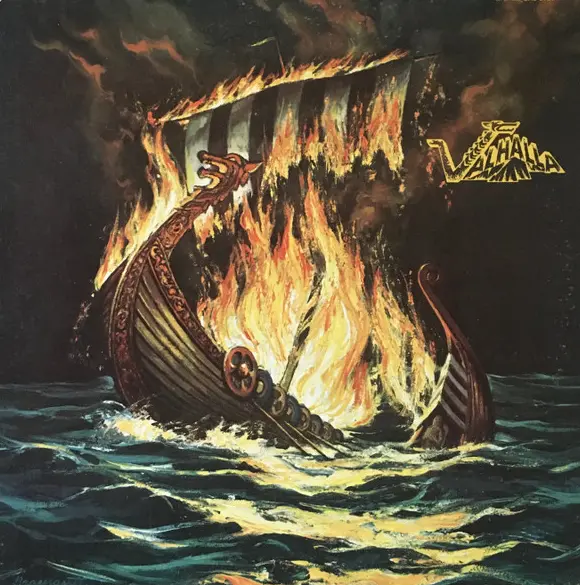
Valhalla appeared in a gatefold cover designed and painted by Remo Bramanti. It shows a Viking vessel aflame (front), a sepia group-shot (back), and a dark-lit of the band pictured head-to-head before a horned medieval helmet.
“I’m Not Askin'” appears on Electric Rock (Idee 2000), a 1970 German Liberty comp with cuts by Amon Düül II, Aynsley Dunbar Retaliation, Can, Floating Bridge, Groundhogs, Jean-Luc Ponty, Klaus Doldinger, and Krokodil.
Post-Valhalla
Mark Mangold surfaced in American Tears, a pomp-rock band that made three 1974–77 albums on Columbia. He then formed Touch, an AOR/hard-rock band that made a 1980 album for Ariola. In 1989, he surfaced in the hard-rock duo Drive, She Said.
Eddie Livingston surfaced in the late-Eighties/early Nineties thrash/speed-metal bands Evildead and Tactics.
Discography:
- Valhalla (1969)
Sources:
- Discogs: Valhalla
- RYM: Valhalla
- ProgArchives: Valhalla
- PsychedelicBabyMag: Valhalla (Mark Mangold interview)
Artist/Album Pages:
Autosalvage was an American blues-rock/psych band behind a 1968 self-titled album on RCA Victor. ...
Bethlehem Asylum was an American sax-rock/psych band from Tampa that released two albums in 1970/...
Cherry People were an American pop-psych/bubblegum band that released a self-titled album on Heritag...
Gass was a Caribbean–English jazz-rock/psych band that released the 1970 album Juju on Polydor, fo...
Marsha Hunt (born April 15, 1946) is an American soul singer from Philadelphia. She moved to Brit...
S.O.U.L. — short for Sounds of Unity and Love — was an American soul-funk band from Cleveland that...
Coven was an American hard-rock band from Chicago that released the 1969 Mercury album Witchcraft...
Jackal was a Canadian post-psychedelic hard-rock band that released the 1973 album Awake on Periwi...
Space Opera was an American rustic-rock band from Fort Worth, Texas, that released a self-titled a...
Mike Oldfield is an English composer, arranger, and multi-instrumentalist with a career in music dat...
Stonehouse was an English hard-rock band that released the album Stonehouse Creek on RCA Victor i...
Van der Graaf Generator are an English rock band, formed at Manchester University in 1967 by singer–...